
Last month, a PGY‑2 internal medicine resident called me from his parked car, hands still shaking. He’d just hit “send” on an email to GME disclosing a newly diagnosed autoimmune condition and requesting accommodations. For the first time in his life, he wasn’t worrying about a test or a pager—he was worrying about retaliation, being labeled “weak,” or quietly pushed out.
He asked me the question almost everyone in your position asks: “Okay… what actually happens now?” Let me walk you through what really goes on behind the office doors you never see.
The First 48 Hours: Triage, Not Sympathy
Here’s the part nobody tells you: once your disability letter hits the GME office inbox, the reaction is not primarily emotional. It’s procedural. There’s a workflow for you now.
Most places follow a variation of the same pattern:
- Initial read and risk check
- Forwarding to the disability/ADA office
- Quiet outreach to your program leadership
- Early containment of anything that could become a legal or safety problem
You’re thinking about your life. They’re thinking about risk, documentation, and compliance.
Who actually opens your letter?
At most academic centers, that email goes to a generic GME inbox or a coordinator first. Within a few hours to a day it’s sitting in front of one of these people:
- Associate Dean for GME or DIO (Designated Institutional Official)
- GME director or assistant director
- Senior GME coordinator who’s essentially the operational brain of the place
They’re scanning for a few things immediately:
- Are you describing an active patient safety risk? (e.g., seizures, uncontrolled narcolepsy, sudden cognitive issues)
- Are there phrases that scream legal exposure? (“hostile environment,” “discrimination,” “retaliation,” “unsafe,” “forced,” “threatened”)
- Do you already mention ADA, disability, lawyer, or EEOC?
If yes to any of those, your email stops being “a resident issue” and becomes “a case.” That means more eyes, quicker escalation, and a lot more documentation.
They are not, at this stage, deciding what they believe about you. They are classifying the situation.
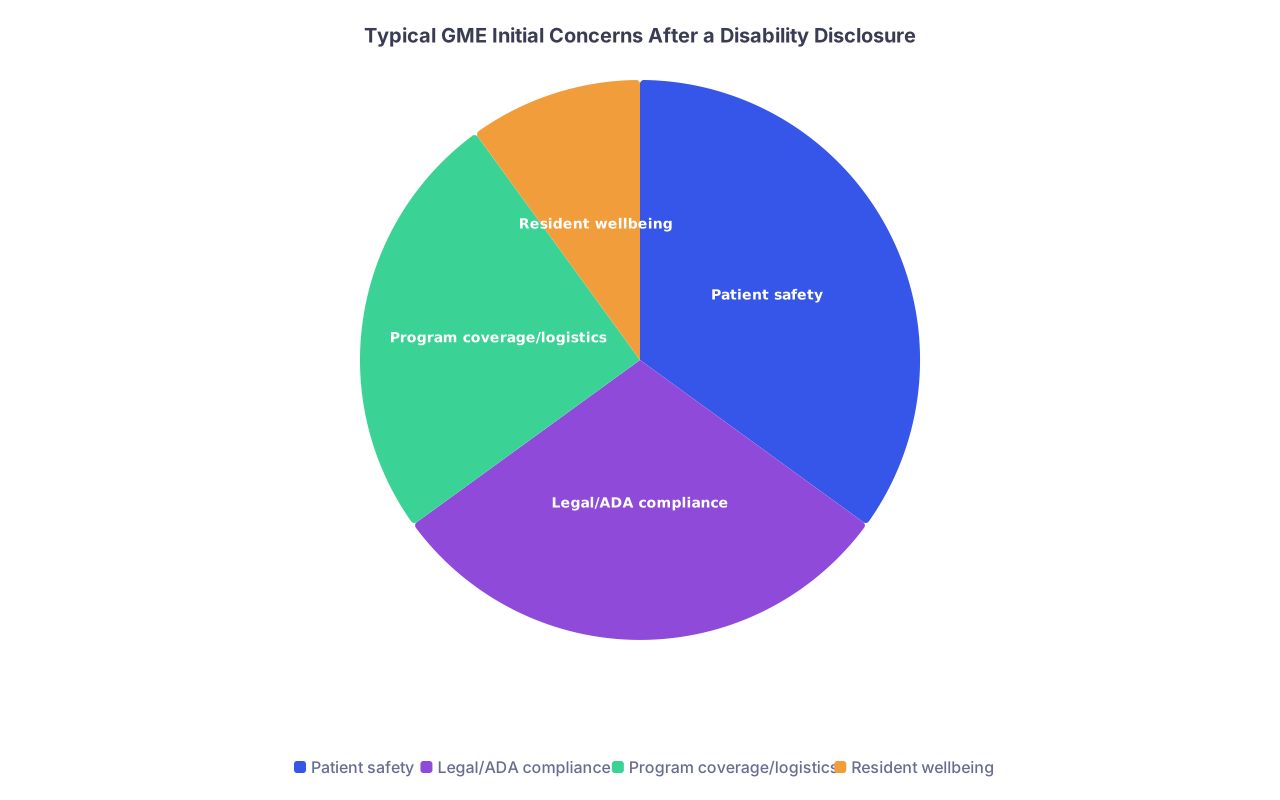
| Category | Value |
|---|---|
| Patient safety | 35 |
| Legal/ADA compliance | 30 |
| Program coverage/logistics | 25 |
| Resident wellbeing | 10 |
You’ll notice “your wellbeing” is the smallest slice in practice. Not because they’re villains. Because institutions are built to protect the institution first.
The Quiet Forward: Why HR and ADA Step In
Here’s the myth: “GME decides your accommodations.”
Here’s the reality: at most large institutions, GME tries very hard not to decide your accommodations. They want the disability office or HR to own that.
After the initial read, your email usually gets funneled to:
- The institutional disability/ADA office (sometimes under HR, sometimes under student affairs)
- Occasionally Occupational Health for work-related or communicable conditions
- Less commonly, directly to legal if what you wrote suggests prior misconduct or retaliation
What happens next is almost always the same:
- They tell you: “You need to register with the disability services/ADA office.”
- They push you into a formal process: forms, documentation, verification.
- Until that process is complete, every concrete decision about schedule, call, or duties is “temporary” and “interim”—if you get anything at all.
That’s why people who send long, vulnerable emails asking for precise schedule changes and call exemptions almost always get a dry, procedural response back. You’re pouring your heart out; they’re funneling you into the pipeline that protects them.
The Documentation Game: What They Really Want from Your Doctor
Here’s where residents get blindsided. Your heartfelt email is not enough. The system wants medical documentation that can be categorized.
The unspoken rule:
They do not actually care what your diagnosis is as much as they care how well your limitations and needs are translated into functional terms.
Vague letters from physicians get you nowhere. I’ve seen this fail repeatedly:
“Dr. X has [condition] and will benefit from reduced stress and a lighter schedule.”
That sounds caring. It’s useless to GME and the disability office.
What actually works is something like:
“Because of [condition], Dr. X has the following functional limitations:
– Cannot safely perform continuous overnight duties longer than 16 hours.
– Requires predictable 1 day per week free from clinical duties for medical treatment.
– Has episodic flares causing severe fatigue 1–2 days per month, requiring work absence on those days.Recommended accommodations:
– No 24+ hour in-house call.
– Protected half-day weekly on [X or flexible] for treatment.
– Flexible sick day use during acute flares.”
That gives the institution something quantifiable to accept, modify, or deny.
| Aspect | Weak Letter | Strong Letter |
|---|---|---|
| Diagnosis focus | Vague condition name | Clear but brief |
| Functional limits | “High stress is difficult” | Specific, measurable |
| Time impact | “Needs lighter schedule” | Hours, shifts, frequency |
| Accommodations | General (“flexibility”) | Concrete requests |
No one explains this to you. Then you wonder why your “approved” accommodations don’t change your day-to-day reality.
Parallel Track: Your PD Gets the “Heads Up” Call
While you’re waiting for a polite “We received your request” email, another conversation is already happening.
GME leadership quietly calls or emails your Program Director:
- “We got a disclosure from [Resident Name].”
- “They’ve reported [broad category of issue: chronic illness, mental health, mobility].”
- “We’re connecting them with the disability office. In the meantime, does the program have any immediate concerns about safety or performance?”
This is where your existing reputation cashes in—or burns you.
If your PD’s first internal reaction is, “They’re fantastic—this explains some recent struggles,” the tone of the entire process is different than if they’re thinking, “We’ve already had multiple professionalism flags.”
Harsh, but true: your paperwork goes to the same offices either way, but the energy around your case—supportive vs. skeptical—comes heavily from that first PD conversation.
And no, this is not supposed to happen in an ideal world. In the real world, of course it happens.
The Informal Back-Channel: Who Talks About You (and How)
Let me be clear: there are lines they’re not supposed to cross. But the gray zone is wide.
This is the part you never see:
- Program leadership debriefing in a small room:
“So, [Name] just disclosed they have [condition]. That tracks with what we’ve been seeing on nights.” - Chief residents pinged:
“We may need some schedule flexibility around X team; can you see what we can juggle?” - Faculty quietly warned (sometimes inappropriately):
“Just a heads up, they’re going through some health stuff; keep an eye on performance.”
The more “old school” the culture, the more this devolves into commentary:
- “Is this really a disability or are they just burnt out?”
- “Everyone’s tired. Where do we draw the line?”
- “We can’t keep pulling people off call—service has to run.”
You will almost never hear this directly. You’ll feel it as a shift in tone, a new layer of hesitancy in how they give you feedback, or, in bad programs, as gossip.
What Actually Gets Decided: The Accommodation Menu
Once you’re properly in the disability/ADA system, the formal script kicks in: an “interactive process.” That’s legal code for: we talk, we see what’s reasonable, we document it.
The dirty secret is that most programs have an unwritten menu of what they’re actually willing to do for residents, regardless of how the policies are worded.
Common “yes, we can probably do that” items:
- Shifting you off night float-heavy rotations if there’s coverage
- Limiting frequency of 24‑hour calls (or converting to night shifts)
- Protected half‑day weekly for appointments
- Strategic rotation selection to avoid heavy procedural or ICU months
- Temporarily lowering FTE (with all the financial and graduation-timeline consequences)
Much harder sells:
- “No nights at all in a specialty that is built on nights” (think surgery, EM, ICU heavy fields)
- “No weekends”
- “No cross-coverage”
- Demanding a specific chief’s or attending’s service be avoided long-term, unless tied to a prior harassment issue that’s already on record
- “I want to keep my pay and status exactly the same but work significantly fewer hours”
For residents and fellows, the institution’s favorite move is to say:
“We can provide accommodation, but we cannot waive the essential functions of the role required for board eligibility.”
Translation: anything they can plausibly argue is “core training” becomes protected from change. That phrase—essential functions—is their shield.
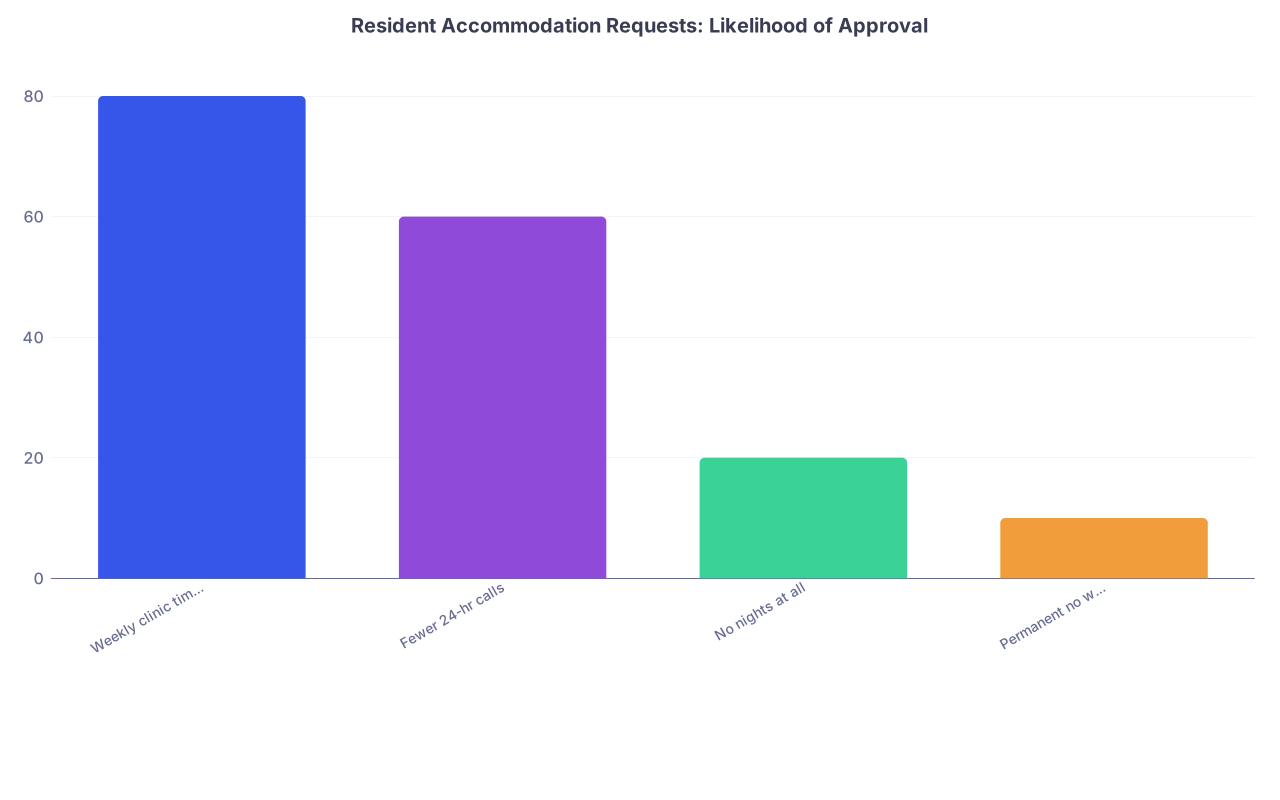
| Category | Value |
|---|---|
| Weekly clinic time shift | 80 |
| Fewer 24-hr calls | 60 |
| No nights at all | 20 |
| Permanent no weekends | 10 |
Numbers aren’t exact, but the pattern is right. The further you move from “schedule tweaking” into “role redesign,” the more resistance you’ll face.
Timelines: Why Everything Takes Longer Than They Admit
From your side, your world changed the day you hit send. From theirs, you’re… one of many processes in motion.
Realistic timeline for most institutions:
- 1–3 business days: GME acknowledges receipt, pushes you to ADA/disability office
- 1–2 weeks: First meeting with disability office / HR / Occupational Health
- 2–4 weeks: Your physician sends in formal documentation; disability office reviews
- 4–8 weeks: Formal accommodations letter drafted and sent to GME/program
- 8+ weeks: Changes actually reflected in your schedule rotation-to-rotation
And that’s if nothing is contested.
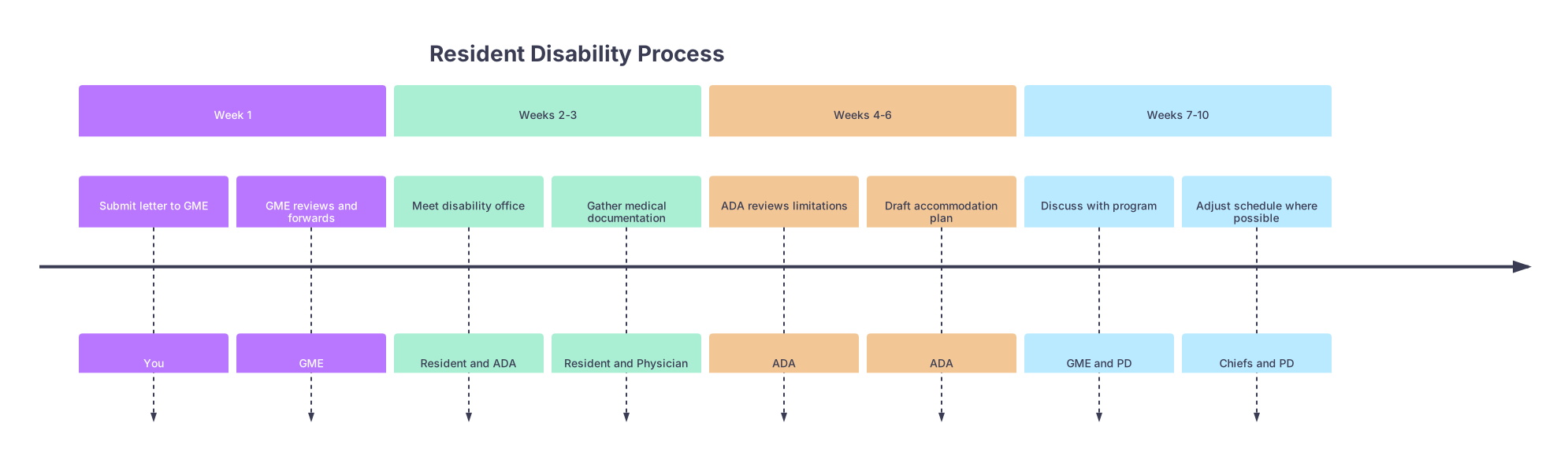
| Period | Event |
|---|---|
| Week 1 - Submit letter to GME | You |
| Week 1 - GME reviews and forwards | GME |
| Weeks 2-3 - Meet disability office | Resident and ADA |
| Weeks 2-3 - Gather medical documentation | Resident and Physician |
| Weeks 4-6 - ADA reviews limitations | ADA |
| Weeks 4-6 - Draft accommodation plan | ADA |
| Weeks 7-10 - Discuss with program | GME and PD |
| Weeks 7-10 - Adjust schedule where possible | Chiefs and PD |
Notice what’s missing? Anything about immediate relief.
That’s why you must be explicit if the situation is urgent:
- “I am currently unsafe to perform 24‑hour call.”
- “My treating physician has advised I stop nights immediately; formal letter to follow.”
That triggers a different calculus: temporary restrictions for safety while paperwork catches up. Not guaranteed, but far more likely if you frame it clearly as a risk.
How Your Performance History Gets Weaponized (or Protects You)
Programs will deny this, but I’ve been in those rooms.
Two residents present similarly: both submit disability letters for the first time, both asking for fewer nights and schedule flexibility.
Resident A:
- Solid evaluations for two years
- Known as reliable, good team member
- One recent dip in performance after health declined
Resident B:
- Scattered professionalism flags
- Multiple “barely passing” rotations
- Chronic lateness and poor follow-through long before disclosure
Who gets more leeway? You already know.
What actually happens is this:
- For Resident A, the story becomes: “They’ve been struggling recently—this explains it, let’s help them succeed.”
- For Resident B, the story becomes: “We’ve had concerns for a long time; is this disclosure an attempt to shield themselves from consequences?”
That doesn’t mean Resident B doesn’t deserve accommodations. Legally, they do if they meet criteria. But the tone of how they’re treated, how strictly policies are interpreted, how generous “reasonable” is—that’s where the bias creeps in.
So if you’re still early in training and healthy now, here’s the unvarnished advice: guard your reputation. It buys you margin if your health changes later.
What They Won’t Tell You Unless You Ask
There are a few realities most residents only hear about by accident:
You can appeal a denial of accommodations.
There’s almost always a formal or informal appeal path—sometimes through the ADA office, sometimes through a school-level dean. They rarely advertise it.You can pull in institutional legal or an ombudsperson early.
Many residents assume that contacting legal or an ombuds “escalates too much.” That’s exactly why some programs get away with half-measures.You can ask for a written list of “essential functions” they’re relying on.
Don’t accept the hand‑wavy version. Ask: “Can you provide the written essential functions for my role that are informing this decision?” Watch how that changes the conversation.You can explore reduced FTE or extended training without tanking your career.
Painful truth: for some people, the best “accommodation” is actually less than 1.0 FTE with extended graduation. GME won’t suggest this first. They know residents usually panic at the idea. But it can be the difference between burning out completely and making it through.

How to Protect Yourself While the Machine Moves
You can’t control the internal GME whispers, but you do have more power than you think.
A few tactical moves that I’ve seen make a real difference:
Insist on written follow-up.
Every meeting about your disability or accommodations should be followed by an email summary—from you if they don’t send one. “Per our meeting today, my understanding is…” That becomes part of the record.Separate performance issues from disability issues explicitly.
If they start blending “You struggled on ICU” with “You’re asking for nights off,” ask:
“Can we clarify which concerns are related to my disability and which are independent performance concerns? I want to make sure both are addressed appropriately.”
Sounds simple. It forces them to think more carefully.Use your own physician strategically.
You don’t need a 6‑page note. You need a sharp, functional one-page letter. You can literally tell your doctor:
“They need my limitations turned into time, tasks, and frequencies. Less emotion, more specifics.”Loop in an ally early.
Could be a trusted faculty member, the APD who “gets it,” or a chief who isn’t a coward. Someone who can be in the room or at least quietly vouch for you.
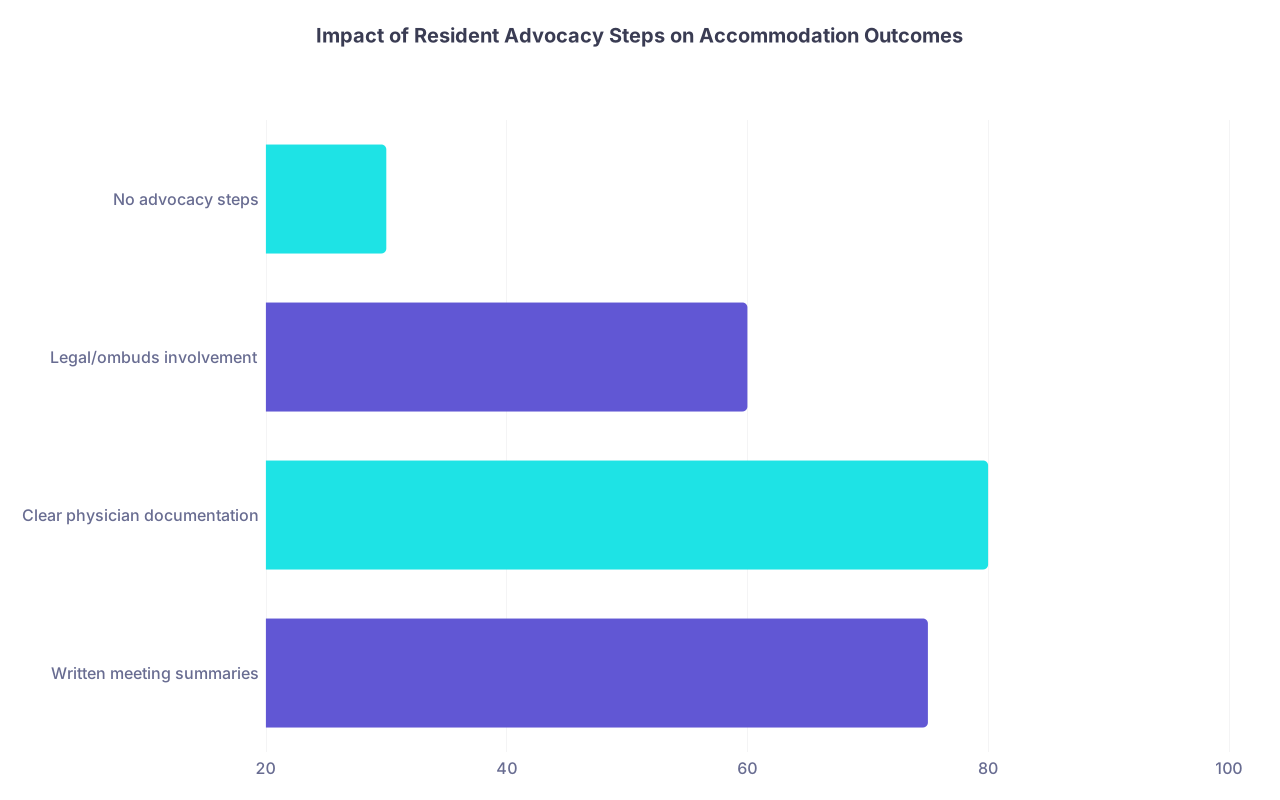
| Category | Value |
|---|---|
| Written meeting summaries | 75 |
| Clear physician documentation | 80 |
| Legal/ombuds involvement | 60 |
| No advocacy steps | 30 |
High numbers here mean “more likely to get meaningful, timely accommodations.” If you do nothing but sign forms and hope for the best, you’re gambling.
Where This Is All Headed: The Future of Disability in GME
The old guard still thinks of disability as a rare, dramatic thing: someone in a wheelchair, or someone who’s had a stroke. The newer reality in GME offices is very different:
- Residents disclosing ADHD after barely crawling through Step and early rotations.
- People with serious autoimmune disease trying to survive ICU months.
- Trainees with depression, PTSD, bipolar disorder finally refusing to white‑knuckle their way through 28‑hour shifts.
Institutions are slowly figuring out they can’t just keep saying “no nights, no weekends = no residency.” They’re being forced to develop structured policies.
You are going to see more:
- Standardized accommodation templates for common situations (no 24s, protected appointments, task modification after injuries).
- Flexible training pathways with built‑in extra time for those with chronic conditions.
- Less stigma—not because everyone got nicer, but because there are simply too many of you for them to pretend you don’t exist.
But you’re living through the transitional chaos. Policies lag behind reality. Culture lags behind policy.

So when you submit that disability letter to GME right now, this is what actually happens:
- You become a test case for how brave or cowardly your institution is willing to be.
- Your PD and chiefs are quietly forced to expose their true values.
- The gap between glossy wellness brochures and real support becomes impossible for them to hide.
And yes—if you’re thoughtful, documented, and persistent—you can come out of this with real, concrete changes that let you keep training and stay alive.
FAQs
1. Should I tell my Program Director first or go straight to GME?
If your PD has a track record of being decent and you trust them even 70%, looping them in early can help. They can pre‑frame your situation before GME calls them. But if your PD has been dismissive, punitive, or already hinted that “everyone has problems, just push through,” go to GME/disability first and then inform your PD once the process is formally underway. You do not owe your PD a raw, detailed medical story—keep it functional and focused on what you can and can’t safely do.
2. Can my program use my disability disclosure against me during remediation or non‑renewal?
They’re not supposed to. In reality, disclosures and performance concerns often get tangled. The key move is to explicitly separate them in writing. If they’re talking remediation, ask for a written remediation plan that focuses on observable behaviors and competencies, not on your condition. If you suspect retaliation or that your disability is being used as a pretext, that’s exactly when you involve an ombudsperson, ADA office leadership, or legal. Document every timeline carefully—when you disclosed, when concerns were raised, what changed.
3. Will future employers or fellowship programs know I requested accommodations?
Not from your disability file. GME and ADA records are generally kept separate from your official training record. What can leak is pattern, not paperwork: schedule gaps, part‑time status, leaves of absence, extended training. Those may require explanation later, but you control that narrative. Most fellowship directors care more about whether your current PD says, “I’d hire them again,” than whether you ever needed a modified call schedule. Your goal now is to survive training and maintain enough trust and performance that your future letters are strong, regardless of the path you took to get there.
Key points: after you submit that disability letter, your case immediately becomes a mix of risk management, policy, and culture—not just compassion. The strength of your documentation and your existing reputation heavily shape what “reasonable” looks like for you. And you have more leverage than anyone will advertise if you’re willing to put things in writing, ask direct questions, and insist the institution live up to its own rules.