
The way residency leadership publicly talks about disability and the way they privately think about it are not the same thing. Not even close.
I’ve sat in those meetings. I’ve heard what’s said after a resident leaves the room. I’ve watched program directors (PDs), associate PDs, and chief residents argue—sometimes bluntly—about residents who disclose disabilities, chronic conditions, or mental health issues.
Let me tell you how it really works behind closed doors.
The First Reaction: “Can They Do the Job Safely?”
This is the unfiltered core question almost every PD jumps to, even the ones who pride themselves on being “progressive” and “supportive.”
They are not thinking first about fairness. They are thinking about risk. To patients, to the program, to accreditation, and to their personal reputation. In that order.
When a resident discloses a disability—physical, psychiatric, neurocognitive—here are the very first things that silently run through a PD’s head:
- Are patients safe?
- Are co-residents going to have to carry extra weight?
- Will this trigger GME or hospital-level scrutiny?
- Is this going to become a legal/HR situation?
Nobody will say that to your face during a “supportive” meeting. But they say it to each other.
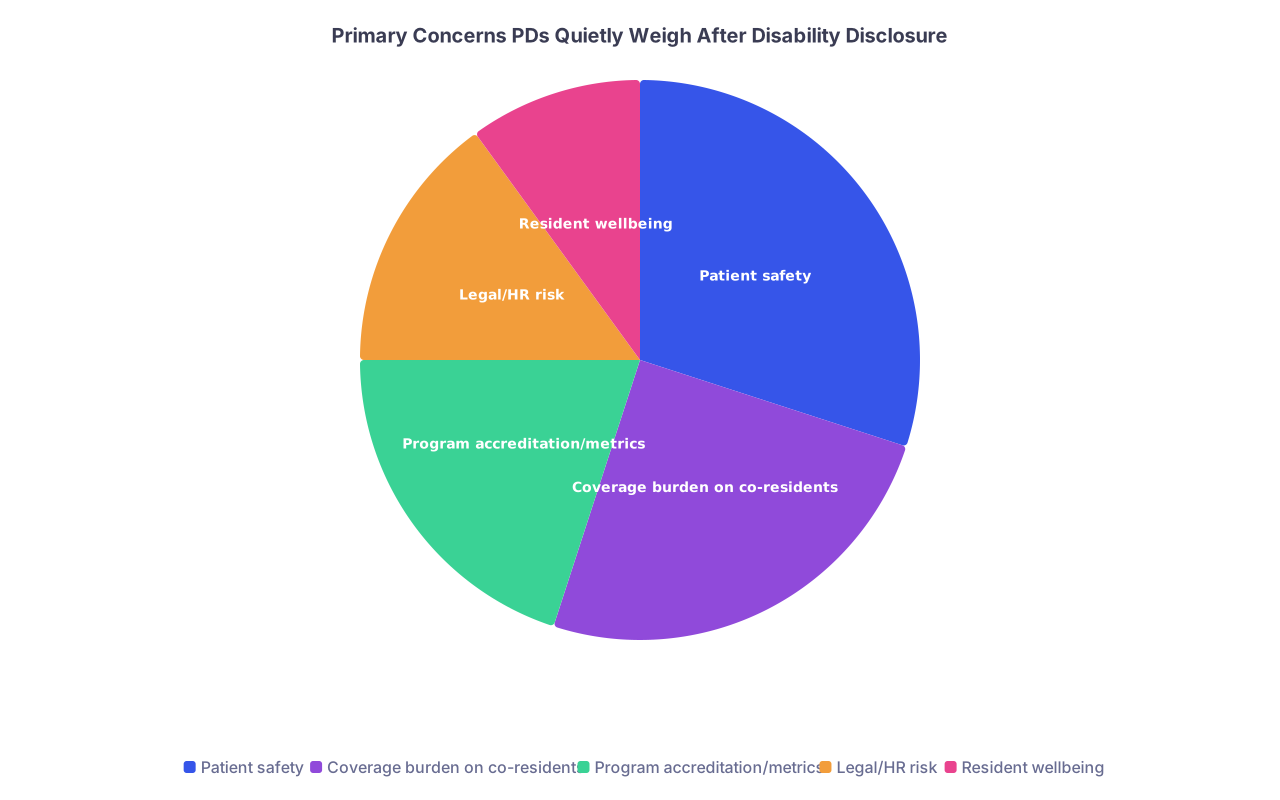
| Category | Value |
|---|---|
| Patient safety | 30 |
| Coverage burden on co-residents | 25 |
| Program accreditation/metrics | 20 |
| Legal/HR risk | 15 |
| Resident wellbeing | 10 |
Notice what’s last on that list: your wellbeing. Not because your PD is evil. Because the system is brutal and they are judged on throughput, board pass rates, ACGME citations, and never-ending clinical demands.
The honest PDs will admit this over a beer. The others will keep repeating, “We just want you to be successful,” while already mentally gaming out how to reshuffle call schedules.
How Different PDs Really Categorize Residents Who Disclose
PDs informally sort residents into mental buckets. Disability disclosure changes which bucket you go into, whether you like it or not.
There are three broad categories I’ve seen used behind closed doors (never written, always implied):
“Solid and safe with a medical issue”
This is the best-case scenario for you. You’re viewed as competent, reliable, and already proven. Now you’ve disclosed something—MS, controlled epilepsy, bipolar on treatment, ADHD, hearing impairment, chronic illness.The conversation sounds like:
“Look, she’s one of our best. We just need to figure out reasonable adjustments.”
“He’s never missed a deadline; we can work with this.”Here, the disability is seen as a logistical variable, not a character flaw. That’s the sweet spot.
“Borderline performance + new disability info”
This is where things get dicey. If you’ve already had flags—late notes, unprofessional emails, test failures—and then disclose, some faculty will frame the disability as an excuse rather than an explanation.Behind your back:
“This explains some things, but we can’t lower the bar.”
“Is this going to be their go-to reason whenever something goes wrong?”Fair? Not really. Real? Absolutely.
“High risk to the program”
This bucket is reserved for residents perceived as potentially unsafe or unstable: repeated absences, erratic behavior, medication nonadherence, or significant functional limitations that aren’t well-controlled.You’ll hear:
“We need to loop in GME and legal early.”
“I’m worried this ends with a major incident or a lawsuit.”Once you’re mentally slotted into this category, everything you do is viewed through a risk lens. Not a competence lens.
| Category | PD's Core Question | Typical Outcome |
|---|---|---|
| Solid and safe with a medical issue | How do we adjust, not break? | Real accommodations possible |
| Borderline + new disability info | Are we being gamed? | Close scrutiny, limited leeway |
| High risk to the program | How do we protect ourselves? | Formal remediation or exit |
You want to do everything in your power—before disclosure—to have a track record that locks you into the first group.
Timing: When Disclosure Helps You and When It Burns You
The timing of disclosure is one of the most misunderstood pieces. People get this wrong constantly because they’re working from fear or idealism instead of strategy.
Disclosing During Residency Interviews
Here’s the unvarnished truth:
Most PDs will not tank an otherwise strong applicant just because they disclosed a stable, well-managed disability. But they will immediately start running a mental cost-benefit analysis.
What they won’t tell you is that many borderline decisions swing away from the applicant who seems “complicated.”
I’ve literally watched this happen:
Candidate A: Strong scores, standard story, no red flags.
Candidate B: Equally strong, discloses needing specific accommodations for chronic condition.
Conversation in the selection meeting:
“Between these two, which one’s going to be easier to schedule on wards and nights?”
“We’re already stretched on coverage.”
“Let’s rank Candidate A slightly higher.”
They do not say, “We’re discriminating on the basis of disability.” They say, “We’re considering program needs and patient care.” Same outcome.
There are exceptions. Certain programs (especially at big academic centers with strong institutional culture around disability inclusion) do lean in and treat it as a diversity advantage. But they’re the minority.
So should you disclose at interview? My opinion:
- If your disability is highly visible or certain to affect scheduling, clinical duties, or exam timing, controlled disclosure with a solution-oriented frame during recruitment can sometimes help. You define the narrative before rumors do.
- If your disability is invisible, well-controlled, and doesn’t require major structural changes, you gain nothing by leading with it during interviews. You’re asking them to see you as a “challenge” before they’ve even seen you as a resident.
Disclosing After You’ve Matched but Before Starting
This is a quieter but important window.
Savvier residents with chronic conditions sometimes email the PD, APD, or program coordinator after matching, but before contract and scheduling are finalized. They frame it as:
“I want to make sure we plan from day one so I can meet all expectations safely.”
Behind the scenes, what happens?
The PD pulls in GME, maybe occupational health, sometimes HR. They look at essential job functions, call schedules, clinic templates. And they decide—privately—whether what you’re asking for feels “reasonable” or “too much.”
The advantage of this timing:
You’re already in. They can’t just make you disappear. And you look proactive and honest, which PDs respect.
The disadvantage:
You might get pre-labeled as “logistically complex” before you’ve had a chance to prove yourself clinically.
Disclosing Mid-Residency
This is where most disclosures actually happen. A resident hits a wall, has a new diagnosis, or finally stops white-knuckling through.
The PD reaction depends heavily on your track record up to that point.
If you’ve been solid:
“Okay, this makes sense. You’ve been a strong resident; let’s figure this out together.”
If you’ve been shaky:
“We need documentation, clear treatment, and a very structured improvement plan.”
And yes, they tell each other:
“If they’d told us earlier, maybe we could’ve avoided this mess.”
They say that even though the culture often punishes early disclosure. Hypocritical, but it’s what happens.

| Step | Description |
|---|---|
| Step 1 | Resident discloses disability |
| Step 2 | Discuss adjustments with goodwill |
| Step 3 | Request documentation and formal plan |
| Step 4 | Implement accommodations quietly |
| Step 5 | Involve GME, legal, consider remediation |
| Step 6 | Track record strong? |
| Step 7 | Impact on patient safety minimal? |
What PDs Really Think About Specific Types of Disabilities
They do not view all disabilities the same way. Not even close.
Let’s talk patterns.
Physical Disabilities and Chronic Medical Illness
Things like mobility impairments, diabetes, MS, inflammatory bowel disease, visual or hearing impairment.
PDs tend to view these as logistical more than characterological. They ask:
- Can we adjust call, procedures, or locations?
- Are there clear, stable treatment plans?
- Is there an obvious way to preserve patient safety?
You’ll hear:
“We can probably work around this.”
“Maybe we avoid certain rotations or modify schedules.”
The underlying bias:
Visible physical limitations are often perceived as more “legitimate” than psychological or cognitive ones. Unfair, but very real.
Psychiatric Conditions (Depression, Anxiety, Bipolar, PTSD, etc.)
This category triggers the most behind-the-scenes anxiety for PDs.
They worry about:
- Suicidality or self-harm on their watch
- Impaired judgment during high-stakes situations
- Unpredictable absences or performance swings
- Their own legal exposure if something goes wrong
I’ve heard PDs say, in closed rooms:
“I’d rather deal with almost anything than a resident with unstable mood symptoms on call.”
“If this goes sideways, everyone asks why we didn’t act sooner.”
The residents who do best with these disclosures:
- Come in with a psychiatrist or therapist already involved
- Have a clear medication/treatment plan
- Frame it as a managed chronic condition, not as a crisis they’re still in the middle of
The ones who trigger maximum alarm?
- Repeated last-minute call-outs
- Emotional volatility witnessed by nurses and faculty
- Crisis-level episodes with no follow-through on treatment
ADHD, Learning Disabilities, Neurodivergence
This is where attitude and framing matter a lot.
If you show up saying:
“I have ADHD, I need people to cut me slack on being late and missing things.”
You’re done. PDs privately interpret that as: “I will be a chronic administrative burden.”
If you instead arrive with:
- Documentation
- History of using specific strategies and accommodations successfully
- A very concrete “this is what works for me” plan
PDs are much more likely to view it as:
“Okay, this is how their brain works. If they’ve gotten this far, they can do the job with structure.”
Fair or not, residents with ADHD who are chronically disorganized, late, and defensive about it do a lot of damage to how seriously PDs take future ADHD disclosures. I’ve seen the bias build over years.
“Invisible” Conditions: Chronic Pain, Fibromyalgia, Fatigue Syndromes
These get the most skepticism.
You will hear:
“Is this real or is this burnout in disguise?”
“They look fine when they’re here but call out a lot.”
Programs are terrible at managing these. They tend to either minimize or over-medicalize them, and the resident ends up feeling gaslit or pushed out.
If you are in this category, you must have:
- Clear, consistent documentation
- A track record of reliability when present
- Realistic, specific accommodation requests (not “I can’t do nights ever,” but “I need predictable post-call protected time due to X limitation, here’s my specialist letter.”)
The Unspoken Factors That Change How You’re Treated
The ugly truth: the same disclosure from two different residents doesn’t get the same response.
There are “protected” residents. And there are expendable ones.
Factors that tilt things in your favor:
- You’re already a top performer. PDs fight to keep strong residents. They will push GME and hospital systems harder on your behalf.
- You have powerful faculty champions. When an influential attending says, “We need to support them, they’re excellent,” it changes the whole tone of the meeting.
- You don’t surprise people. If your disclosure is framed as, “Here’s what’s going on, here’s what I’m already doing, here’s what I need,” you’re seen as responsible. Surprises plus chaos are what scare PDs.
And what hurts you:
- Repeated professionalism issues before disclosure. Late evaluations, snappy emails, attitude problems—these all get reinterpreted post-hoc as “maybe they’re not cut out for this,” with or without disability.
- Inconsistent story. Saying one thing to PD, another to chief, another to HR—PDs hate feeling manipulated. Once they feel that, your goodwill evaporates.
- Family members calling the program. Nothing makes PDs lock down faster than angry parents or spouses calling about schedules, “mistreatment,” or disability rights. Once that happens, everything shifts into defensive posture.
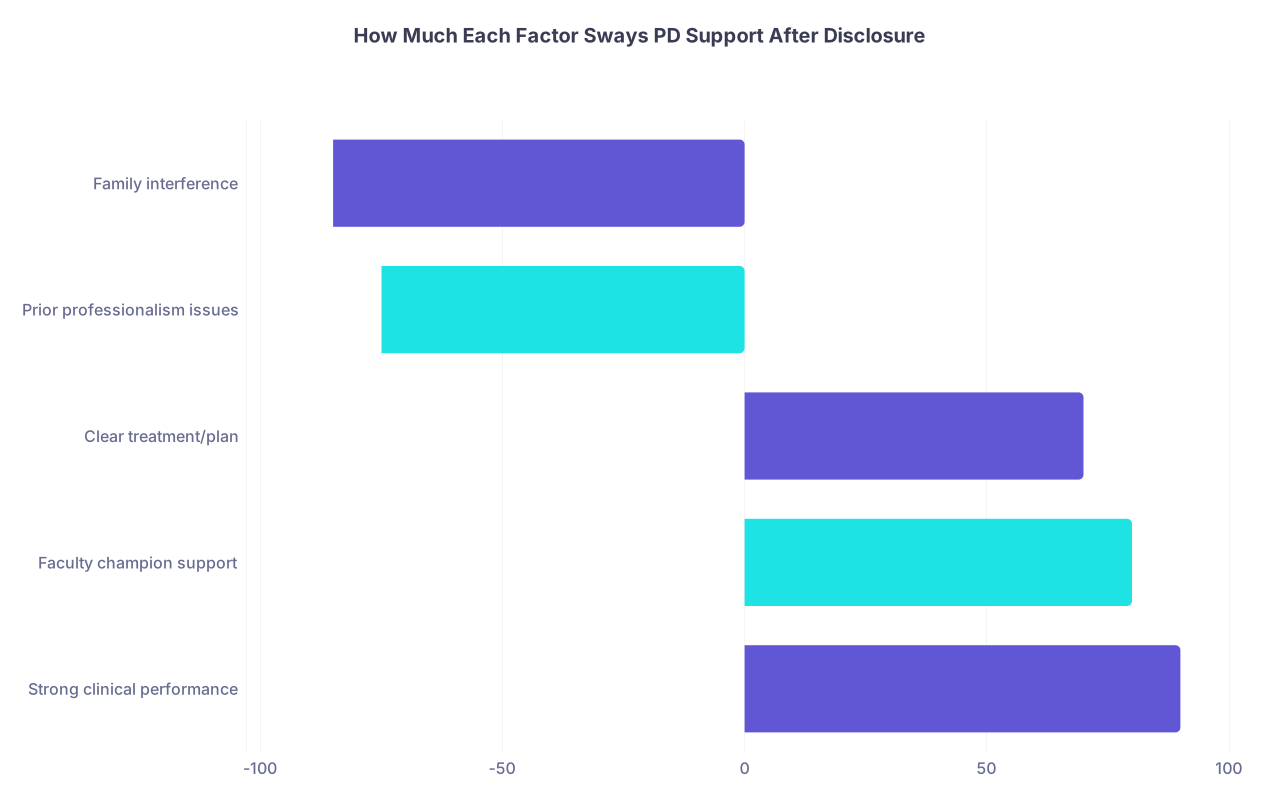
| Category | Value |
|---|---|
| Strong clinical performance | 90 |
| Faculty champion support | 80 |
| Clear treatment/plan | 70 |
| Prior professionalism issues | -75 |
| Family interference | -85 |
Positive vs negative numbers here aren’t “official,” but they reflect how much these factors quietly help or hurt you.
How Accommodations Are Actually Decided (Not the Brochure Version)
Officially, there are policies. Essential job functions. Technical standards. GME guidelines. All the buzzwords.
Practically, what happens is much messier.
Typical sequence I’ve watched play out:
- You disclose to PD or APD. They nod, express support, and ask for documentation.
- They immediately email GME: “Need to discuss potential accommodations for resident X.”
- GME pulls in legal/HR/occupational health depending on the hospital.
- They quietly map your requests to what they’re already doing (or refusing) for others. They’re terrified of setting new precedents.
- The PD argues for what they can realistically implement without blowing up schedules or angering co-residents.
- A compromise emerges. Often narrower than what you asked for.
Nobody tells you this directly, but one of the biggest unspoken constraints is: “What will the other residents tolerate without revolt?”
Programs will accommodate you… up until the point where your peers start saying:
“We’re always covering for them.”
“Why do they get special treatment?”
Once that sentiment becomes loud, PDs start to backpedal, no matter what the paperwork says.
This is why some residents with disabilities are quietly protected and supported (because they’ve built trust and goodwill with peers), and others get open pushback.
How to Disclose in a Way PDs Respect (Even if They Won’t Say It)
Let’s be blunt: you’re not going to disclosure-script your way out of structural ableism. But you can dramatically change how your PD categorizes you.
Here’s the pattern PDs actually respect, even if they’d never phrase it quite this way:
Lead with competence, not crisis.
If you can, build a visible track record of reliability before heavy disclosure. Let them see you can do the job.Come with your own plan.
Do not walk in saying, “What can you do for me?”
Instead: “Here’s what has worked for me in medical school/previous jobs, here’s what I think is reasonable here, and I want your input.”Be specific and proportional.
Requests like “no nights ever,” “no inpatient,” or “I can’t work more than X hours per week” are often interpreted as “this specialty may not be feasible.” Sometimes that’s the truth. Sometimes it’s a negotiating starting point that backfires.Make it clear you understand program constraints.
A line like:“I know you still have to cover call and meet ACGME requirements. I’m trying to find the narrowest adjustments that let me meet the same standards safely.”
goes a long way.Follow-through is everything.
If you say you’re in treatment, and then six months later there’s still no improvement and no visible engagement, PDs start shifting you mentally into the “can’t or won’t change” category. That’s when exit pathways start getting discussed.
The Future: Where Things Are Actually Shifting
You’ll hear a lot of aspirational talk about disability inclusion in medicine. Some of it is real; some of it is branding.
Here’s what is genuinely changing from what I’ve seen:
- Younger PDs and APDs, especially those who’ve struggled with their own chronic conditions or burnout, are much more open to structured accommodations.
- Large academic centers tied to universities with strong disability offices are slowly dragging their GME programs into more consistent processes.
- There’s a quiet but real recognition that medicine is hemorrhaging trainees; pushing out everyone who doesn’t fit a 1970s “indestructible resident” mold is becoming less sustainable.
But don’t kid yourself. Most programs still operate under an unspoken cultural belief:
“If you can’t hack residency as-is, maybe this isn’t for you.”
That belief is cracking, not shattered. You are training in the transition era.
FAQ: Behind Closed Doors – Disability and PD Perceptions
1. Should I disclose a disability on my residency application or ERAS?
Usually no, unless it’s clearly relevant and strategically framed (e.g., explains a time gap, or shows resilience and you’re applying to a program known to be disability-forward). Most PDs prefer to evaluate you on performance first. Early disclosure on ERAS can quietly move you from “clean” to “complicated” in PDs’ minds without giving you the chance to demonstrate your value.
2. Can a PD legally use my disability disclosure against me in ranking or evaluation?
Legally, no. Practically, bias absolutely creeps in. They will phrase it as “program fit,” “ability to meet essential functions,” or “scheduling constraints,” not “we are penalizing disability.” Enforcement is weak. Your best protection is documented strong performance and, when needed, looping institutional disability or GME offices into the conversation—not relying on vibes.
3. Will other residents find out if I ask for accommodations?
Not officially through documentation, but functionally, yes, most of the time. When your call schedule is different, your rotations are adjusted, or your workload looks different, co-residents put two and two together. PDs worry heavily about this peer perception. Residents who maintain strong relationships and are seen as pulling their weight elsewhere get far less pushback.
4. What happens if my PD is openly unsupportive or dismissive after I disclose?
Behind the scenes, you then move into a political game. Your options become: bring in GME, disability services, or ombudspersons; get everything in writing; and find faculty allies who can speak for your value. Some residents do ultimately transfer or change specialties when the PD relationship is poisoned. Others survive by building support outside the PD’s office and forcing the program to follow policy rather than personal preference.
5. Is it ever smarter not to disclose at all and just “power through”?
Sometimes that’s how people survive short-term. But I’ve also watched residents crash so hard they ended up on leave, on probation, or out of the program because they hid too long. If your condition significantly affects patient safety, your ability to work nights/call, or complete essential functions, total nondisclosure is a high-risk strategy. The art is in timing and framing—disclosing early enough to prevent disaster, late enough that you’ve proven you’re an asset, and always with a concrete plan rather than just a problem.
Key points: PDs quietly ask, “Can you do the job safely without breaking the system?” Your track record and timing matter as much as the diagnosis itself. And while the culture is slowly shifting, you still have to play the game strategically if you want both accommodations and respect.