
The moment you ask for reduced clinical hours, people start emailing about you behind closed doors.
Not always hostile. But always strategic. And you need to understand that machinery if you want to protect yourself, your career, and frankly, your sanity.
Let me pull the curtain back on what really happens after you say the words: “I need an accommodation.”
What Actually Happens the Day You Ask
You send the email. Or you talk to your PD. Or you finally tell someone in GME that the current schedule is wrecking your health.
From your side, it’s a single brave act.
From their side, it triggers a very specific backstage sequence.

| Step | Description |
|---|---|
| Step 1 | You request reduced hours |
| Step 2 | Program director alerted |
| Step 3 | Loop in GME and HR |
| Step 4 | Informal adjustments |
| Step 5 | Backchannel emails |
| Step 6 | Leadership meeting |
| Step 7 | Decision drafted |
| Step 8 | You get official response |
| Step 9 | Is this simple? |
Here’s the part you never see: as soon as your request hits an inbox, forward buttons get hit fast.
“Thoughts?” “Can we even do this?” “Flagging for awareness.” Those are the nice versions.
The main players on the email threads usually look like this:
- Your program director (PD)
- Associate program director (APD) or chief resident
- GME office representative
- HR or disability/accommodations officer
- Sometimes: department chair or vice chair of education
- Occasionally: risk management or legal (especially if you hint at discrimination or prior issues)
They’re not all villains. Some are genuinely trying to make it work. Some are quietly annoyed. Some are mostly worried they’ll screw up a technical rule and get audited.
But make no mistake: the conversation shifts from “our trainee” to “our institutional risk and logistical problem” within a day.
The Backchannel: Who Says What Behind Your Back
The backchannel emails are where your fate is largely shaped.
Let me walk you through the recurring archetypes I’ve seen, because once you know the roles, you can predict the script.
1. The “Reasonable vs. Unreasonable” Framing
The first thing they do is decide how to label your request.
- “This seems reasonable”
- “This is going to be tough to operationalize”
- “This would set a precedent” (translation: we don’t want to do this)
They’re not debating your worth as a person. They’re debating your burden as a logistical problem.
This is where language matters. If your request was framed vaguely—“I’m struggling, can I do fewer nights for a bit?”—it gets translated in email into something like:
“Resident requesting significant reduction in call. Concerned re: service coverage and fairness to peers.”
Once someone uses the word “significant,” “fairness,” or “precedent,” the tone of the entire chain tilts against you.
If instead your request is tied directly to specific documentation and clear limitations:
“Resident with documented disability requesting temporary 0.8 FTE schedule, supported by medical documentation.”
Now anyone pushing back has to push against a documented disability and institutional policy. Different game.
2. The PD’s First Move: Triaging You
Your PD’s first email shapes the entire trajectory. Here are the three classic flavors I’ve seen:
The Supportive Advocate:
“We need to support them. Let’s explore all options and ensure compliance with our obligations.”The Defensive Administrator:
“We have limited capacity to accommodate this without compromising service and education. Need guidance on what’s required.”The Quiet Saboteur:
“Trainee has had ongoing professionalism and performance concerns. Need to consider global context before approving.”
You may never see this email. But it’s the one that either builds a presumption of “we should try” or “we should resist.”
And yes—if you already have a reputation issue in the program (fair or unfair), it absolutely shows up in these emails.
How They Actually Weigh Your Request
You think they’re asking: “Is this morally right?”
They’re actually asking five very different questions.
| Factor | How It’s Really Discussed |
|---|---|
| Service Coverage | Call schedules, clinic volumes, RVUs |
| Precedent | “What if others ask the same?” |
| Accreditation | ACGME case logs, duty hour rules |
| Politics | Culture of department, chair preferences |
| Legal Risk | ADA compliance, documentation, email trail |
Now let’s translate that into real conversations I’ve heard and seen in email threads.
Service Coverage
This is always the first panic.
“Who covers nights?”
“We’re already short on wards.”
“We’d have to increase call frequency for the rest of the class.”
They start mapping out call schedules, clinic templates, inpatient caps. Your name becomes a schedule variable.
If the program is already barely covering service, you’re swimming upstream. If they have a buffer (large residency, fellows, hospitalists), your odds improve.
Precedent Anxiety
This is one of the most overblown but heavily used objections.
“If we do this for them, we’ll have to do it for everyone.”
That line shows up constantly. Here’s the truth no one tells you:
They already make exceptions for people. All the time.
The neuro resident doing 80% research.
The ortho resident who never sees a late-night add-on because they’re “fast tracked.”
The chief who mysteriously disappears from weekend call.
Precedent only becomes a concern when the exception is for disability or mental health and not packaged as “elite track” or “research protection.” Ugly, but real.
Accreditation and Training Requirements
Someone eventually asks: “Can they still graduate on time?”
This triggers emails about:
- Case logs and procedural numbers
- Required rotations (ICU, wards, continuity clinic)
- ACGME minimums
- Board eligibility language
Here’s the real calculation:
If they can say “Yes, with some creative scheduling” → your request stays alive.
If they have to say “Not without major restructuring” → resistance hardens.
The Disability Office: Ally, Shield, or Box-Checker
When the disability or accommodations office gets pulled in, the tone of the emails changes. Suddenly you see words like “ADA,” “interactive process,” and “essential job functions.”
Here’s the unvarnished breakdown.
What They Actually Do
They’re not there just to protect you. They’re there to protect the institution.
Their mandate is:
- Make sure there’s a documented process
- Make sure someone, somewhere, can say “we considered options”
- Make sure emails wouldn’t look terrible in front of an OCR investigator or in court
That said, some disability officers are quietly excellent advocates. They’ll write:
“Given the medical documentation, reduced clinical hours and schedule modification are reasonable accommodations. Program should engage in good faith to identify workable options.”
That sentence, in writing, is gold for you. Because now a program that refuses looks objectively unreasonable.
The “Essential Functions” Game
Watch for this phrase if anything gets shared with you: “essential functions of the position.”
Behind the curtain, that looks like:
- “Is 80-hour availability an essential function?”
- “Is overnight call essential, or just traditional?”
- “Is full-time FTE essential, or can training be extended?”
Programs love to declare many things “essential” because once they do that, they can say, “We’re not required to accommodate beyond this.”
The more documentation you have that you can perform the essential clinical functions safely with modified hours, the harder it is for them to slam the door.
The Misconceptions That Hurt Trainees
Let me be blunt: trainees walk into this process with dangerous illusions. Those illusions cost them leverage.
Illusion 1: “If I’m honest and vulnerable, they’ll surely help.”
I’ve watched people bare their souls in emails and meetings, sharing gratuitous amounts of trauma and detail. Then five minutes later, their PD sends a backchannel email:
“They are clearly very distressed and may not be safe to continue work at this time. We may need to consider leave or fitness for duty.”
Your emotional vulnerability gets weaponized into “maybe they can’t function clinically at all.”
You do not need your entire psychological history in writing. You need a clear, medically framed statement of functional limitations, ideally from a clinician who understands occupational language.
Illusion 2: “Verbal support from my PD means I’m safe.”
I have seen PDs say to residents:
- “We’ll find a way to make this work.”
- “We support you 100%.”
Then send an email five minutes later:
“We should consider whether they’re a good fit for this specialty long term. Could remediation or extended training be appropriate?”
If it’s not in writing, it doesn’t count. If what’s in writing doesn’t match what they said to your face, believe the writing.
Illusion 3: “They can’t retaliate if this is a disability request.”
They know they’re not allowed to blatantly retaliate. So retaliation gets camouflaged:
- Suddenly “global concerns about performance” emerge
- You start getting nitpicked evaluations with language like “lack of resilience”
- You’re told, “Given all this, maybe it’s best to take a leave,” when what you asked for was modified hours
Is this always intentional? No. But it’s very common. And once the narrative becomes “marginal trainee who also needs special hours,” your life gets hard.
How Programs Actually Track “People Like You”
Here’s the part that no policy ever describes: the informal mental list.
Every program leadership team has a quiet, unwritten roster:
- Superstars (can do no wrong)
- Steady majority (good enough, not discussed much)
- Question marks (borderline performance, potential problems)
- “Projects” (people requiring extra effort, extra monitoring, or special arrangements)
When you ask for reduced hours due to disability or health, you get mentally shifted—fairly or unfairly—toward that last category.
This doesn’t mean you’re doomed. It means:
- Your charting is watched more closely
- Your absences are noticed faster
- Your mistakes are more likely to be attributed to “limitations” rather than normal training errors
And yes, this gets talked about in email threads:
“Given prior attendance and wellness concerns, we should keep a closer eye on performance under modified schedule.”
You’re not paranoid if you sense the scrutiny ramping up. It usually is.
What You Can Do Before You Ask
You can’t control every backchannel email. But you can shape the playing field.
1. Solidify Your Performance Record First
If you know you’re going to need reduced hours, your best move is to bank as much “clinical capital” as you can before that.
Good evals. Procedures done. Attendings who will say, “They’re excellent clinically; the schedule is the only issue.”
Why? Because when your name hits that backchannel thread, someone might say:
“They’ve been a strong performer; we should try to accommodate.”
Very different from:
“They’ve already been struggling; this may not be the right path for them.”
2. Get Your Documentation Tight
Do not go in empty-handed or with vague letters.
You want documentation that says things like:
- “Limit night shifts to X per month”
- “Maximum clinical hours per week: X”
- “Avoid >24-hour continuous shifts”
- “Recommend X months of reduced schedule, then reassessment”
This gives the disability office something concrete. And it gives less room for emails like, “Hard to know exactly what they’re asking for.”
What Happens After They Decide
The end of the chain looks deceptively clean.
You’ll get one of a few messages:
- “We can accommodate with XYZ changes.”
- “We can partially accommodate with ABC but not DEF.”
- “We are unable to accommodate the requested schedule while maintaining essential functions, but we can support a leave of absence.”
Behind that short email is often a chain of 30–60 messages carefully massaged to sound supportive while limiting liability.
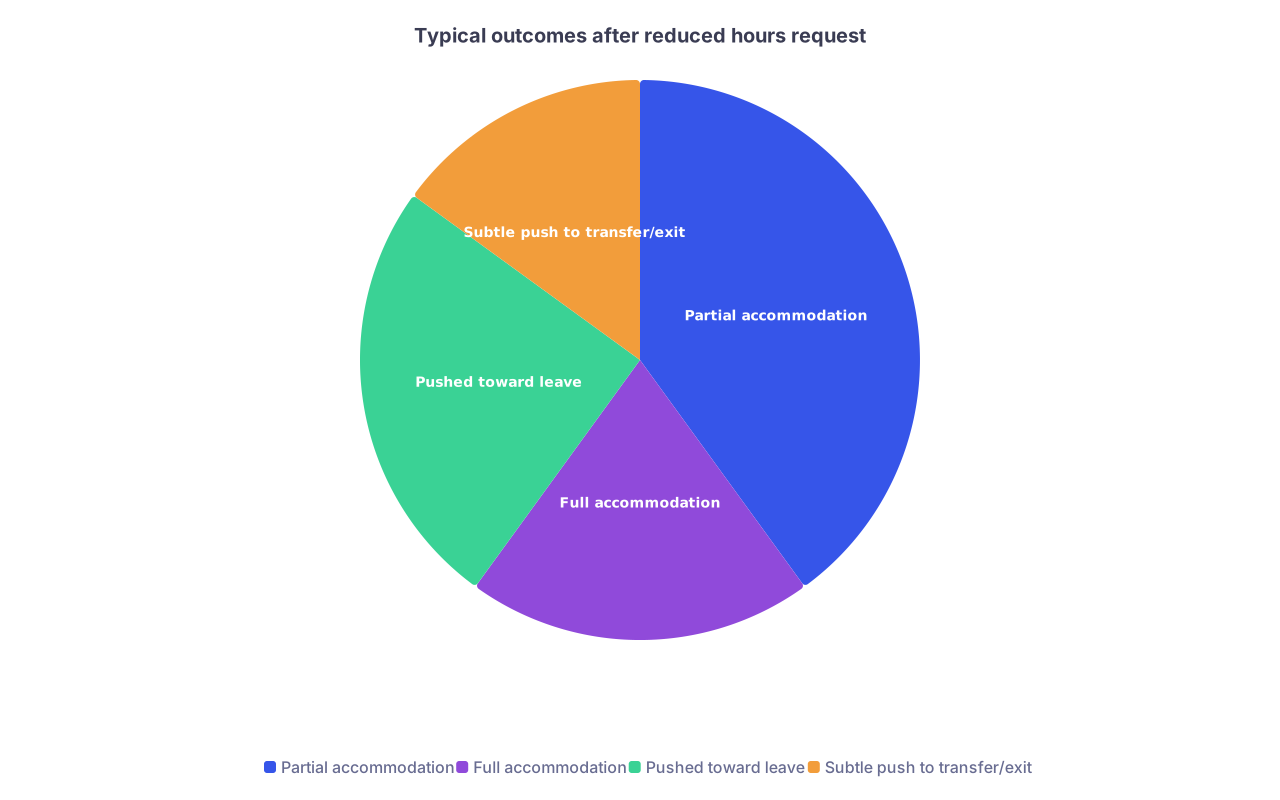
| Category | Value |
|---|---|
| Partial accommodation | 40 |
| Full accommodation | 20 |
| Pushed toward leave | 25 |
| Subtle push to transfer/exit | 15 |
Those numbers aren’t from a published paper. They’re a reflection of what I’ve seen across multiple programs over years. Full accommodations happen, but partial or redirected ones are more common.
And here’s another quiet move: if they agree to something, they often time-limit it.
- “We’ll revisit in 3 months.”
- “Temporary arrangement through end of rotation block.”
Translation: “We’re buying time. And we’ll see if this is sustainable or if we can nudge you toward leave or a different path.”
The Future: This System Will Change. Slowly.
The dirty secret is this: the current system is not built for disabled or chronically ill trainees. It’s barely built for healthy ones.
But the pressure is mounting—legal, cultural, generational.
You’re going to see over the next decade:
- More explicit policy language on reduced FTE tracks
- Longer but more humane training timelines (think 4-year IM for 0.75 FTE)
- Less stigma—driven not by altruism, but by workforce shortages and legal pressure
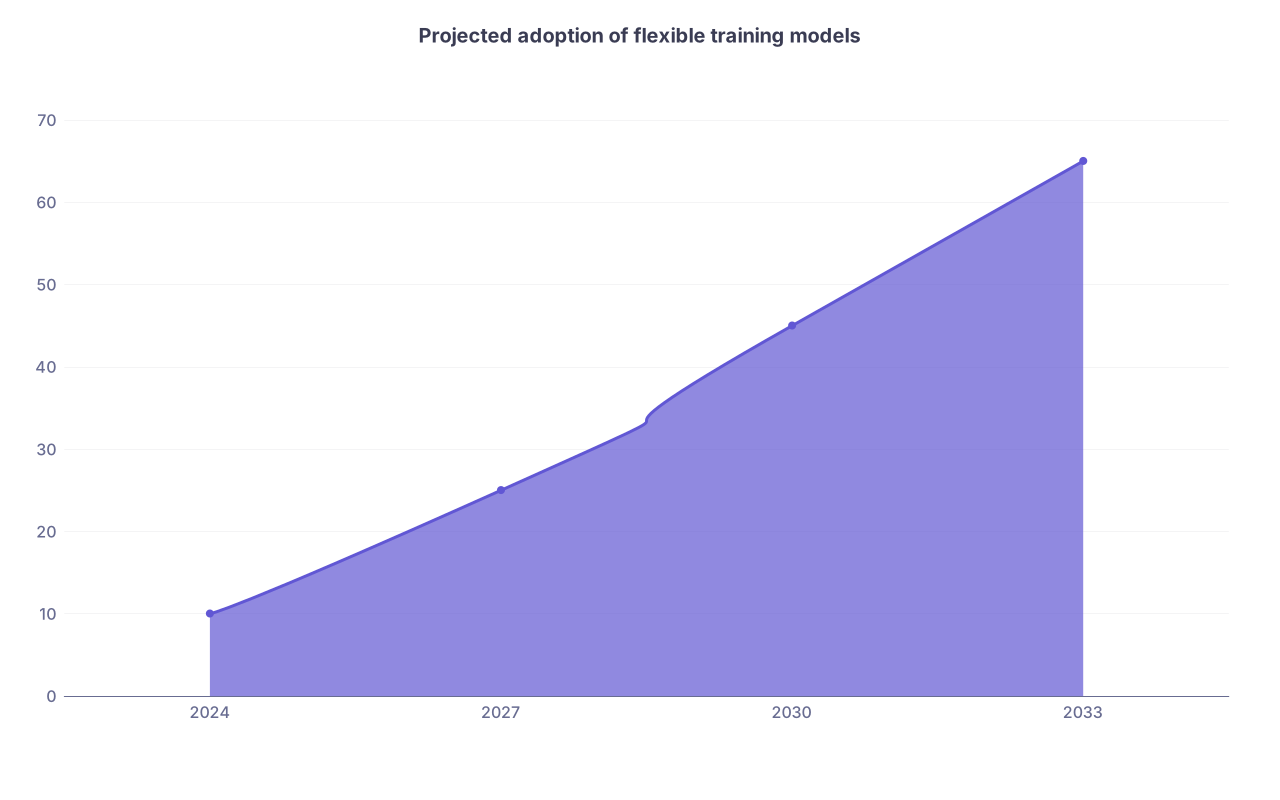
| Category | Value |
|---|---|
| 2024 | 10 |
| 2027 | 25 |
| 2030 | 45 |
| 2033 | 65 |
Right now, though? You’re in the transitional era. Early enough to face resistance. Late enough that they know they have obligations.
That’s actually where you have some leverage—if you understand what’s happening in those emails.
How to Read the Room Without Seeing the Emails
You’ll never get to see those backchannel chains. But you can infer a lot from the behavior that follows.
If, after your request:
- You’re suddenly being invited to “check-in meetings” more often
- Your feedback shifts from “great job” to “areas for growth” with vague language
- You’re gently floated the idea of “taking some time off to focus on your health”
Then I can almost guarantee the emails behind the scenes include phrases like:
- “Concerned about their long-term fit.”
- “May not be able to meet essential demands even with accommodations.”
- “Would a leave or career counseling be appropriate?”
On the other hand, if:
- Adjustments are made quickly
- Faculty speak openly about making it work
- No one starts hinting that maybe this specialty is “too demanding” for you
Then someone in those email threads went to bat for you. Hard.
You may never know who that was. But they exist.
A Quiet, Practical Mindset Shift
I’m not going to sugarcoat it: asking for reduced clinical hours as a trainee with a disability or health condition is risky in the current culture.
But here’s the tradeoff no one admits: the alternative—silently destroying your health to stay “low risk”—is often worse.
Years from now, you won’t remember the exact wording of the backchannel emails that decided your fate. You’ll remember whether you treated your health like something negotiable or non-negotiable.
And that’s one thing no committee gets to vote on.