Two nights before a big in-service exam, a PGY-2 called her PD from the ER. New diagnosis: multiple sclerosis. Vision blurred, legs weak, terrified she’d lose her residency spot if she asked for real time off. After they hung up, the PD sighed, shut the door, and said what most of us only say off-record: “This is exactly the kind of case the GME office will pretend they’re prepared for. They’re not.”
You’ve heard the official lines. “We support wellness.” “We comply with the ADA.” “Your health comes first.” Let me tell you what actually gets said in PD meetings, closed-door Clinical Competency Committees, and those back-channel calls between PDs when a resident disappears for a month with “medical leave.”
The Two Stories: What’s on Paper vs What PDs Really Think
On paper, time-off for health crises is clean and humane. Leave policies, FMLA, GME templates, ACGME minimum time-in-training requirements, disability accommodation language. Everything looks reasonable.
Inside the PD office, the conversation sounds different. It’s not usually malicious. It’s operational. And unfortunately, you’re the variable in their equation.
Here’s the basic mental framework PDs use, whether they admit it or not:
- Is this a real crisis or “soft” wellness?
- How disruptive will this be to the schedule and service?
- Is this resident someone we want to fight for?
- Can I justify this to my Chair, GME, and the other residents?
- What precedent will this set?
Nobody will say that to your face. But I’ve watched that exact checklist get worked through in real time in places like an IM program in the Midwest, a West Coast surgery department, and a competitive East Coast pediatrics program. Different specialties, same calculus.
The harsh truth: your clinical reputation before the crisis heavily affects how flexible a PD will be when you suddenly need time off for a health issue.
If you’ve been solid, reliable, and low-drama? They will move mountains. Quietly. If you’ve been chronically late, combative, or “fragile” in their eyes? Every ask is viewed through suspicion: “Is this real or avoidance?”
You may hate that. I do too. But it’s reality.
How PDs Sort Health Crises in Their Heads
Let’s be blunt: PDs triage you almost the same way you triage patients. They categorize.
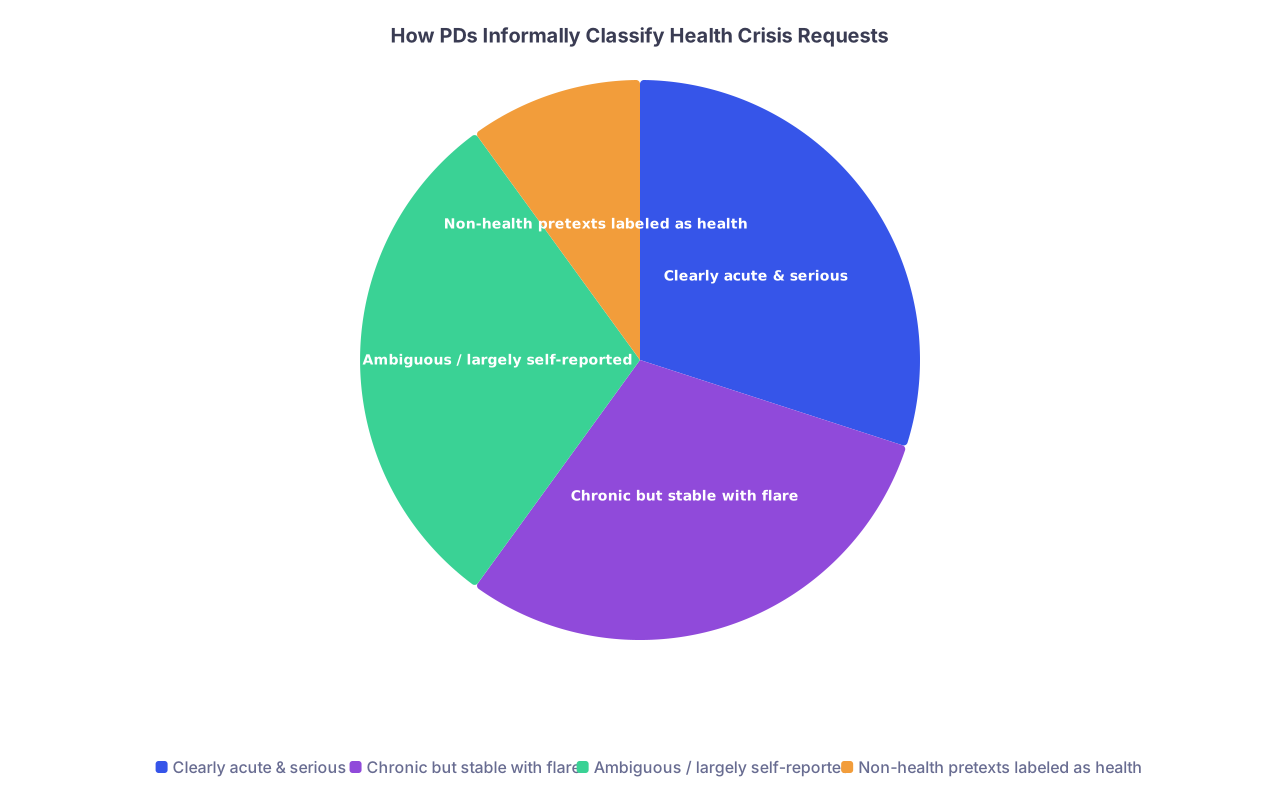
| Category | Value |
|---|---|
| Clearly acute & serious | 30 |
| Chronic but stable with flare | 30 |
| Ambiguous / largely self-reported | 30 |
| Non-health pretexts labeled as health | 10 |
Category 1: “No brainer” crises
These are things that stop arguments cold:
- New cancer diagnosis
- Major trauma (MVC, fracture requiring surgery)
- New neurologic event (stroke, MS flare with clear deficits)
- Psychiatric emergencies: inpatient psych, suicide attempt, acute psychosis
Behind closed doors, PDs say: “We’re not messing around with this. Just cover them.” The focus shifts to:
- How long will they be out?
- How to keep them eligible for boards (time-in-training requirements)
- What to tell co-residents and attendings
Programs hate uncertainty. But if this is clear and severe, the politics are actually easier. Chairs and GME offices rarely push back.
Category 2: “Legit but complicated” chronic issues
Think:
- Crohn’s with severe flare
- Lupus with recurrent hospitalizations
- Severe migraines, POTS, complex pain disorders
- Cancer survivors with late effects
These are the cases PDs worry will keep recurring. In private they ask:
- “Is this the first big decompensation or the fifth?”
- “Can they realistically finish this specialty?”
- “Do we need to start talking about part-time training, extended training, or even a different specialty?”
This is where you want a PD who’s actually seen long-term accommodations work. Many haven’t. So they default to either overprotecting (pushing you out “for your own good”) or under-supporting (hoping it just gets better).
Category 3: “Invisible” illnesses, especially mental health
Anxiety, depression, ADHD, bipolar disorder, PTSD. Also: chronic fatigue, fibromyalgia, “burnout with physical symptoms.”
These get the most off-record debate. PDs will never say this publicly, but you need to know it:
- Many older PDs still see these as character issues, not health issues.
- They’ll say “Of course we support mental health” at town hall.
- Then at the CCC they’ll say, “I’m worried this resident doesn’t have the resilience for this field.”
Do they take real suicidality seriously? Yes. Most do. But for outpatient-managed mental health conditions, the attitude ranges from genuinely supportive to quietly dismissive.
Your best defense here is documentation and a clear, bounded plan. More on that later.
The Three Axes PDs Use to Decide What Happens to You
Time-off is never just about your diagnosis. PDs mentally plot you on three axes.
| Axis | What They Look At |
|---|---|
| Performance History | Evaluations, exam scores, reliability, patient complaints |
| Risk to Program | Service coverage, ACGME violations, board eligibility stats |
| Political Cost | How angry co-residents/attendings will be, precedent set |
1. Performance history: your pre-crisis “credit score”
If you’ve been:
- On time
- Teachable
- Helpful with swaps
- Non-toxic
You’ve built what I’ll call goodwill capital. PDs spend that capital to defend you.
I’ve watched a PD at a big-name IM program tell the Chair: “I don’t care if we have to moonlight a hospitalist for two months; this resident is gold and we’re keeping them.” Why? The resident had been a quiet workhorse for two years before a new bipolar diagnosis flattened them.
Contrast that with the PGY-1 who’d already had professionalism flags and then asked for “a month off for mental health” after three call shifts in a row. PD’s off-record reaction: “We’re going to need real documentation before we blow up the schedule for this.”
Same words in the email. Very different energy behind the scenes.
2. Risk to program: the stuff they’ll never say out loud
Every PD has two numbers in their head:
- ACGME minimum time-in-training for your specialty
- Board eligibility rules (continuous vs total time)
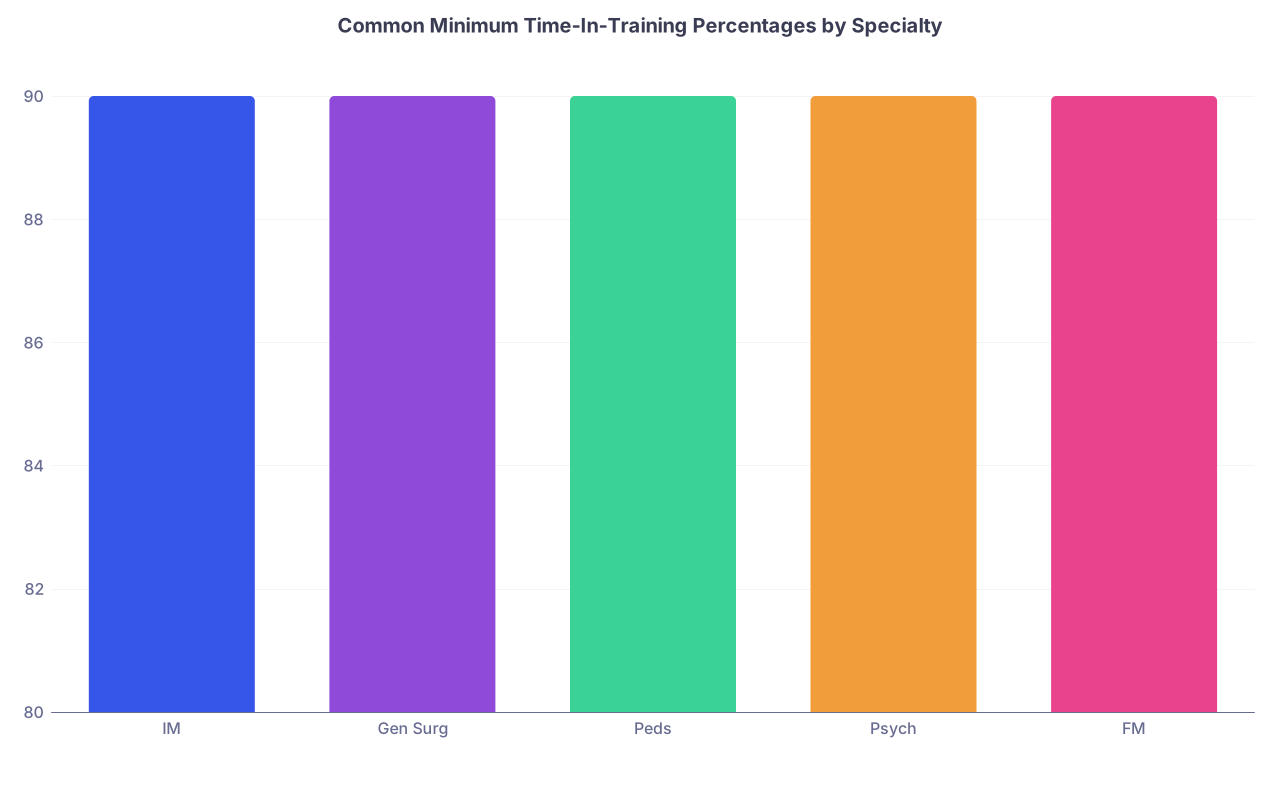
| Category | Value |
|---|---|
| IM | 90 |
| Gen Surg | 90 |
| Peds | 90 |
| Psych | 90 |
| FM | 90 |
Most specialties require you to complete around 90% of each year’s training days, though there’s nuance. PDs live in terror of an ACGME citation or a resident who can’t sit for boards because of fragmented training.
So when you ask for significant time off for a health crisis, PDs are thinking:
- “If I grant this much now, what happens if they need more later?”
- “Will we be forced into a remediation/extension year?”
- “Will GME pay for that extra year or will the department eat it?”
You’re worrying about your health and career. They’re also worrying about budgets, slot caps, and how they’ll explain it when the Dean asks why one of “their” residents isn’t board-eligible.
3. Political cost: co-residents, attendings, and fairness
Here’s what you do not hear when you’re out:
- “The seniors are furious; they’re covering two services now.”
- “The chair of surgery refuses to cover nights with an extra attending again.”
- “The PGY-2 class says we’re playing favorites.”
This matters more than it should.
If you’re well-liked, if you’ve covered for others before, if you’ve never been the person constantly asking for exceptions — co-residents actually defend you. “Let them take the time, they’d do it for us.” That makes a PD’s life easier and they’re more generous.
If you’ve burned bridges? Your absence becomes proof of every complaint they’ve ever had. And PDs are less inclined to spend political capital on you.
How PDs Wish Residents Would Handle Health Crisis Requests
Let me flip this and show you the “best case” scenario from the PD side. When PDs gather at national meetings (APDIM, APGO, etc.), this is the composite story they tell each other as “the resident who handled it well.”

| Step | Description |
|---|---|
| Step 1 | Noticing health problem |
| Step 2 | Talk to treating clinician |
| Step 3 | Get documentation |
| Step 4 | Email PD to request meeting |
| Step 5 | Private PD meeting |
| Step 6 | Involve GME and HR |
| Step 7 | Short leave with schedule tweaks |
| Step 8 | Plan return and modifications |
| Step 9 | Communicate clear timeline |
| Step 10 | Need extended leave? |
What they love to see:
Early heads-up, before it’s a five-alarm fire
“Dr. Smith, I’ve been working with my neurologist on worsening migraines. It’s starting to affect my ability to function on nights. I want to discuss options before something unsafe happens.”Concrete information, not vague drama
They don’t need your whole life story. They do need:- Diagnosis category (at least generally)
- Treating clinician involved
- Expected interventions (meds, surgery, hospitalization)
- Best-guess timeline
Bounded ask, with openness to adjustment
“My psychiatrist recommends 4–6 weeks of dedicated treatment. I’d like to request 4 weeks away from clinical duties, with a plan to reassess at week three.”
Translation: you’re serious, you’re following medical advice, and you’re giving them a starting point they can negotiate around.
Willingness to work with occupational health / disability office
Many residents resist this, thinking it’s adversarial. PDs see it as cover. If Occ Health backs your restrictions, they can tell angry attendings, “This isn’t my call; this is institutional.”Clear return-to-work plan
Not just “I’ll come back when I feel better.” Something like:- Specific date range
- Proposed starting rotation type (clinic vs ICU)
- Any concrete restrictions (“no 28-hour calls for X weeks”)
That level of clarity makes PDs much more likely to advocate hard for you with the department and GME.
Off-Record Comments PDs Make About Specific Situations
Let’s go even more granular. Here’s the stuff PDs really say to each other about common health-crisis scenarios.
New major psychiatric diagnosis during residency
Out loud: “We’re fully supportive. Take care of your health.”
Off record in PD meetings:
- “Can they safely take night float right now?”
- “Are we dealing with intermittent decompensations every winter?”
- “Do we need to think about an LOA and a less intense re-entry plan?”
The smart PDs loop in:
- Program’s mental health liaison (if they have one)
- GME office
- Occasionally risk management, depending on context
They try to quietly rearrange your schedule to give you a softer landing: outpatient blocks, elective, research time front-loaded, fewer ICU months initially.
You rarely see how many strings they’re pulling. Or how many times they’ve had to justify it.
Pregnancy complications and obstetric emergencies
Here’s the dirty secret: PDs are better at handling pregnancy-related leave than almost any other medical issue. Why? Because they’ve been forced to. Every year. In every specialty.
The typical off-record comments:
- “We need to frontload her ICU now before third trimester.”
- “How do we keep the other residents from feeling like they’re stuck with all the nights?”
- “We should just build a ‘pregnancy buffer’ into our staffing; this isn’t a surprise.”
The problem is not usually whether they’ll allow time off. It’s resentment from peers if the coverage feels unfair. Again, your pre-existing reputation matters.
Flare of a chronic condition you downplayed on day one
This one makes PDs nervous.
Scenario: you told everyone you were fine. You kept quiet about your Crohn’s or POTS or severe migraines. Now you’re crashing on ICU call and suddenly need weeks off.
Off-record reaction: “Why didn’t they tell us? We could’ve planned. Now we’re scrambling mid-year.”
PDs don’t like surprises that could have been predicted. Disability law does not require you to disclose at the beginning. But practically, hiding significant known limitations and then springing them on the program during a crisis makes everybody more adversarial.
The Quiet Role of GME, HR, and Legal
You think your PD is the main decision-maker. That’s only half true.
On any health crisis that triggers >2–4 weeks off, formal disability accommodation, or significant modifications to schedule, there are three invisible players:
- GME Office – cares about accrediting bodies, fairness across programs, precedent
- HR / Leave Administration – cares about FMLA, paid vs unpaid leave, benefits
- Legal / Risk Management – cares about ADA compliance and litigation risk
Off record, PDs complain about all three.
What PDs say to each other:
- “GME wants us to treat this exactly like the last case, but it’s not the same.”
- “HR’s FMLA timelines and ACGME’s time-in-training rules do not talk to each other.”
- “Legal is terrified of an ADA complaint, so they keep pushing us to document every email.”
What this means for you: past a certain threshold, your PD is not in full control. They may want to be generous and simply “give you three months off and we’ll sort it out.” GME and HR may block that.
And sometimes? The opposite. GME may push for a formal accommodation and your PD is the one dragging their feet.
How to Strategically Protect Yourself While Being Honest
You cannot game a health crisis. But you can choose how you present it.
Here’s how attendings and PDs quietly advise their own kids in medicine to handle it.
1. Document everything – but be smart about what you share
Have:
- Notes from your treating clinician
- Clear diagnoses or at least working diagnoses
- Treatment recommendations and expected duration
- Any recommendations around work limitations
You do not have to give your PD every graphic detail. What they actually care about:
- Functional limitations: what you can and cannot safely do
- Expected duration of those limitations
- Needed modifications: schedule, shifts, environment
When PDs have something from an independent clinician to wave around, they’re much more confident defending you.
2. Frame your request around patient safety and training quality
Nothing moves a PD more reliably than this sentence:
“I’m worried that if I continue at my current schedule, I’m putting patients and the program at risk, and I’d rather address this proactively.”
Now they’re not just doing you a favor. They’re reducing institutional risk. Align your ask with their job.
3. Know the difference between “LOA” and “light-duty / modifications”
There are usually three levels of adjustment:
| Level | Typical Duration | What It Looks Like |
|---|---|---|
| Minor adjustments | Days–2 weeks | Call swaps, lighter rotations, clinic over ICU |
| Modified duty | Weeks–months | No nights, reduced hours, specific rotation types |
| Formal LOA | 1+ months | Full time off, extension of training, HR involvement |
Off record, PDs prefer you start with the smallest category that will actually keep you safe. It’s less bureaucratic and easier to sell to your peers.
But here’s the nuance: don’t under-ask out of guilt if you know you’re actually going to need a real LOA. Drip-feeding requests (“just this week… actually one more… actually another…”) makes everyone suspicious and frustrated. And it looks like you’re playing games, even when you’re not.
4. Use the disability / accommodation office sooner than you think
Most residents see disability offices as something for people in wheelchairs or with obvious impairments. PDs see them as armor.
When an official accommodation plan is in place:
- It’s no longer “Dr. Jones asked for this”; it’s institutional
- PDs can point to a document instead of defending personal decisions
- Future conflicts (new attending, new chief) are easier to resolve
Yes, the paperwork is annoying. Yes, it can feel exposing. But in any situation that will extend beyond a single block, it’s usually worth it.
The Stuff PDs Are Afraid to Tell You
Let me pull the curtain even further.

Here are the hard truths they almost never say out loud to residents, but talk about with each other constantly.
1. Some specialties are brutally unforgiving
Neurosurgery, ortho, general surgery, EM, OB/GYN. If you require long or repeated leaves, especially early, someone will bring up the question: “Is this the right specialty for them long term?”
That’s not always fair. But it’s common. In cognitive fields (psych, path, radiology, neurology), there’s often more flexibility – not zero, but more.
2. Your co-residents’ behavior heavily shapes what you get
Programs with a strong culture of “we help each other” handle crises gracefully. Programs with a transactional, every-person-for-themselves culture? Residents resent you quickly, which makes PDs cautious.
I’ve sat through CCC meetings where a class collectively said: “We’re happy to pick up the slack; just keep them in the program.” That kind of support saves careers.
I’ve also watched classes say: “We’re burned out and done covering for them,” and the PD quietly shifts from “how do we keep them” to “how do we transition them out with dignity.”
3. PDs remember how you respond when others are in crisis
This one’s almost comically consistent.
- If you roll your eyes when someone else is out with a health issue
- If you complain loudly about coverage
- If you call others “weak” behind their backs
Do not expect a sympathetic hearing when you’re the one in trouble later. PDs pay attention. Even if they don’t confront you, it colors everything.
The Future: Are Things Actually Getting Better?
Short answer: slowly, and unevenly.
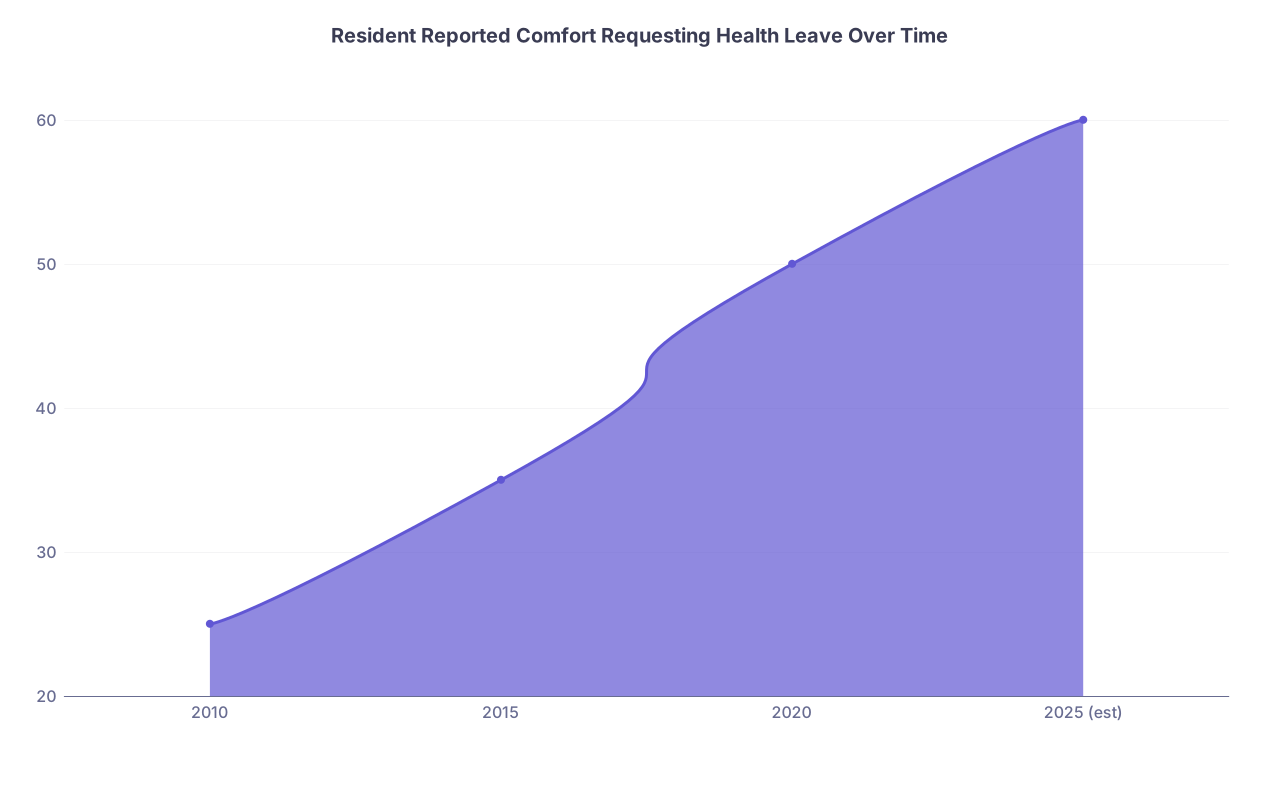
| Category | Value |
|---|---|
| 2010 | 25 |
| 2015 | 35 |
| 2020 | 50 |
| 2025 (est) | 60 |
Newer PDs (especially those who trained after duty hour reforms and wellness initiatives) are noticeably more comfortable:
- Involving mental health professionals
- Normalizing accommodations
- Designing flexible rehabs back into residency tracks
Some institutions are piloting:
- Part-time residency tracks for certain specialties
- Built-in “health and caregiving” buffers in staffing
- Centralized leave pools and funding so one department doesn’t “pay” for your time off alone
But culture change is slower than policy change. The ACGME can send out as many wellness memos as they want; the real question is what a specific PD in a specific department does when you walk in and say, “I can’t do this at full speed right now.”
That’s why you need to understand the off-record thinking. You’re not just dealing with rules. You’re dealing with people juggling loyalty to you, to your class, and to the institution.
FAQs
1. Will disclosing a chronic illness or disability early hurt my chances in residency or fellowship?
Here’s the unsanitized answer: it can in the wrong hands, but hiding it and then having a crisis later can hurt you more. The ideal is targeted disclosure. Tell the PD (and maybe assistant PD) enough to plan safely — especially if your condition could suddenly impair your ability to do nights, ICU, or long cases. You don’t need to broadcast it to every attending on day one, but giving leadership a realistic picture up front builds trust and allows them to protect you when things flare.
2. Can a PD push me out “for my own good” if I’m asking for accommodations instead?
They’ll frame it as concern, but yes, some will lean hard on the “this specialty may not be safe or sustainable for you” line. Legally, they cannot just dump you because you requested an ADA accommodation, but practically they can make your life miserable or lean toward non-renewal if they decide you’re an unsafe or unreliable trainee. That’s why getting your own clinician, the disability office, and GME on record about what’s actually needed is critical, instead of letting the PD unilaterally define what’s “possible.”
3. How much detail about my mental health do I really have to share?
Less than you think. They don’t need your full psych history. They need to know: that you’re under the care of a professional, whether there are acute safety risks (suicidality, psychosis), what the expected treatment plan is, and what concrete work limitations are recommended short-term. You can say, “I’m dealing with a serious mood/anxiety condition, I’m under active treatment, my psychiatrist recommends X weeks off clinical duties followed by Y modifications.” If they push for more details, redirect to Occ Health or disability services; that’s their job.
If you remember nothing else: PDs are human beings trying to keep a shaky system standing. Your best protection during a health crisis is a strong pre-crisis reputation, clear documentation, and framing your needs in terms of safety and training quality — not guilt, not vague distress. The more you understand how they really think, the easier it becomes to get what you actually need and keep your career intact.