It’s late at night. You’re staring at your school’s disability services portal, cursor hovering over the “Submit Documentation” button. Your heart’s pounding, but not because of the diagnosis itself. You’re thinking: “If I upload this letter… will my classmates ever find out? Could someone pull up my records? Will this follow me into residency? Am I basically tattooing ‘disabled’ on my forehead in the world of medicine?”
You’re not scared of needing accommodations. You’re scared of being exposed.
Let me say this straight: your classmates cannot access your disability status or records through any normal, legitimate channel. Full stop. That said, I know that doesn’t quiet the spiral of “Yeah, but what if…” that starts popping up at 2 a.m.
So let’s walk through all the specific nightmare scenarios your brain is probably throwing at you and what’s actually realistic.
How Disability Info Is Supposed To Work In Med School
Here’s the basic structure most med schools (and residencies) use, whether they say it clearly or not:
- There’s a disability office / student access office / learning specialist.
- There’s the dean’s office / student affairs / course directors.
- There are clinical supervisors.
- And then there are classmates.
Only the first two layers should ever see documentation. Classmates should see at most: behavior (e.g., you leaving early for testing, using a note taker, using a laptop when others can’t). They never see diagnosis codes, psych testing printouts, or your psychiatrist’s letter.
Usually, the process goes like this:

| Step | Description |
|---|---|
| Step 1 | Student submits documentation |
| Step 2 | Disability office reviews |
| Step 3 | Accommodation letter created |
| Step 4 | Appeal or more documentation |
| Step 5 | Faculty informed of accommodations only |
| Step 6 | Accommodations implemented |
| Step 7 | Qualifies for accommodations |
Notice what never happens in that flow? “Dean emails your entire class your DSM-5 codes.”
Is that how it always feels? No. Does it stop your brain from imagining all the ways this could leak? Also no. But structurally, the system is built to keep diagnosis and documentation walled off.
Can My Classmates See My Disability Records?
Short answer: no.
Longer, panic-friendly answer:
Your disability information is usually protected under FERPA (education records) and, depending on the setup, sometimes HIPAA-ish constraints if it’s handled within healthcare systems. Schools are paranoid about this stuff because one dumb disclosure can get them sued into oblivion.
Your classmates:
- Don’t have login access to disability services portals.
- Don’t get “special permissions” as student leaders to see this.
- Can’t see who’s approved for accommodations in any official list.
Where do leaks actually happen in real life? It’s not “random M2 hacks the registrar and pulls your ADHD assessment.” It’s:
- A careless comment from a faculty member.
- A roommate reading an open email on your screen.
- You feeling safe and confiding in the wrong person who later gossips.
The system itself isn’t built to let other students “look you up.” The real risk is social, not technical.
What Faculty See vs What Classmates See
This is where people get confused and understandably freaked out.
Faculty usually see: “This student is approved for 1.5x exam time and a reduced-distraction testing environment.”
They usually do not see: “Because of ADHD-combined type, with comorbid generalized anxiety and prior suicide attempt, confirmed by Dr. X on date Y.”
Most accommodation letters are deliberately vague. Something like: “Student X has documentation supporting a disability that impacts [learning/testing/physical access]. Please provide the following accommodations…” No label. No diagnosis. No full report.
Classmates see even less. At most they might notice:
- You’re never in the big exam room.
- You get to type essays when others handwrite.
- You have a special parking spot.
- You use assisted technology or different equipment.
They can guess. They can speculate. They can be wrong. But they don’t get official confirmation.
Here’s the rough breakdown:
| Group | Diagnosis | Documentation | Specific Accommodations | Anything By Default? |
|---|---|---|---|---|
| Disability Office | Yes | Yes | Yes | Yes |
| Dean / Student Affairs | Maybe (limited) | Maybe (summary) | Yes | Sometimes |
| Course Directors | No | No | Yes (what to implement) | Only what’s needed |
| Residents/Preceptors | No | No | Sometimes indirectly | Rarely |
| Classmates | No | No | Only what they observe | Never |
Classmates having a vibe that you have something going on is not the same as them having access to your “records.”
Worst-Case Scenarios Your Brain Is Probably Running
Let’s do the thing you’re already doing in your head, but with reality checks.
“What if my accommodations show up on some list that other students can see?”
That list doesn’t exist in any place students can access.
Test coordinators might have an internal list of students who need separate rooms or extended time. Those lists are usually in some admin office or secure drive. Students never see them, unless a staff member is being wildly negligent.
Does that mean no one can ever screw up? No. I’ve seen attendance sheets for “accommodated testing” accidentally handed to a TA who left it face-up on a table. That’s a privacy breach. It’s also rare, and when it happens, schools scramble because it’s a legal problem for them, not just “oops.”
“What if a resident or attending mentions it in front of others?”
This one’s more real.
I’ve heard things like:
- “Oh yeah, this student has accommodations, give them a few more minutes.”
- “They’re in the disability testing group.”
Is that okay? No. Does it happen? Sometimes. But even then, what leaks is “this person gets accommodations,” not “this person has bipolar disorder and PTSD.”
You’re right to be cautious about who you disclose specifics to on rotations. Not because they’re allowed to share, but because human beings talk, and medicine isn’t as enlightened as it likes to think it is.
“What if someone hacks into the system?”
Honestly? If someone hacks your disability office database, med students finding out about your ADHD is going to be the least of the university’s problems. That becomes FBI-IT-investigation-level. The chance of this targeted at you is basically zero.
Will This Follow Me Into Residency and Beyond?
This is the next layer of panic: “If I disclose to my school, will programs see it? Will it be in my MSPE? Will they label me forever?”
Short version: residency programs do not get a file labeled “DISABILITY STATUS” sent to them.
They get:
- Your MSPE (Dean’s Letter)
- Your transcripts
- Your exams
- Letters of recommendation
The MSPE is not supposed to include health status, disability labels, or your accommodations. If your school is competent (most are at least passable on this), they know better than to write, “Despite having ADHD, anxiety, and dyslexia, the student performed admirably.”
Does it ever happen? I’ve seen rare cases where vague language hinted at something:
- “Overcame personal challenges with the help of student services”
- “Required support to meet testing requirements”
That’s not okay, but it’s not the norm. And if you ever see something like this in a draft or hear rumors your school does this, you’re well within your rights to push back hard.
And no, your USMLE or COMLEX scores don’t show whether you had extended time.
How People Actually “Figure It Out” In Real Life
Let’s be honest. The real anxiety isn’t “database access.” It’s “Are people going to put it together and whisper?”
Here’s how it usually happens when it happens:
- You’re never in the main test room → people start to wonder.
- You get invited to a smaller classroom during OSCEs → someone notices.
- A friend sees an email subject line over your shoulder: “Approved accommodations memo.”
- You casually say, “Yeah, I have to go to the disability office later,” thinking it’s safe, and they share it.
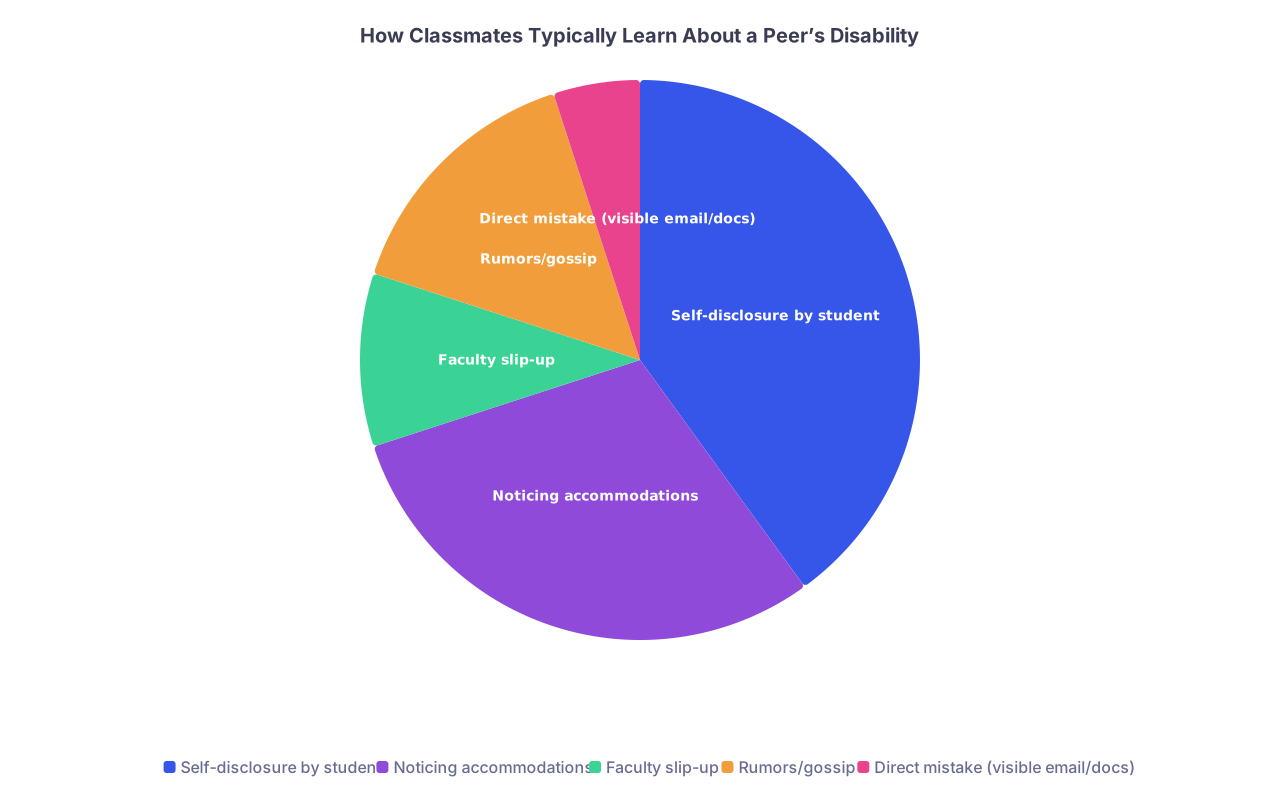
| Category | Value |
|---|---|
| Self-disclosure by student | 40 |
| Noticing accommodations | 30 |
| Faculty slip-up | 10 |
| Rumors/gossip | 15 |
| Direct mistake (visible email/docs) | 5 |
Most “discoveries” aren’t official leaks. They’re human behavior. Either yours or someone else’s.
So no, your records aren’t a public file. But yes, if you have visible accommodations, some classmates will notice. That’s reality. The question is: does that equal “they know my diagnosis”? Not necessarily.
How Much Control Do I Actually Have?
You don’t control everything. But you do control more than you think.
You can choose:
- Whether you mention “disability” at all when explaining why you’re leaving for a different test room.
- How much detail you share with friends vs acquaintances vs nobody.
- Whether you keep sensitive emails and PDFs closed in public places.
- How you respond if someone directly asks: “Do you get extra time?” (And yes, you can simply say, “I’m not comfortable talking about that.” That’s allowed.)
You can also directly ask your disability office:
- “Exactly who will see my documentation vs my accommodation letter?”
- “How are my accommodations communicated to faculty?”
- “Will my dean know my diagnosis or just my accommodations?”
- “Is anything about this ever included in my MSPE or file that goes to residency programs?”
If they get weirdly vague or defensive about those questions, that’s a red flag about the office—not about you.
Common Myths vs Reality About Disability Privacy
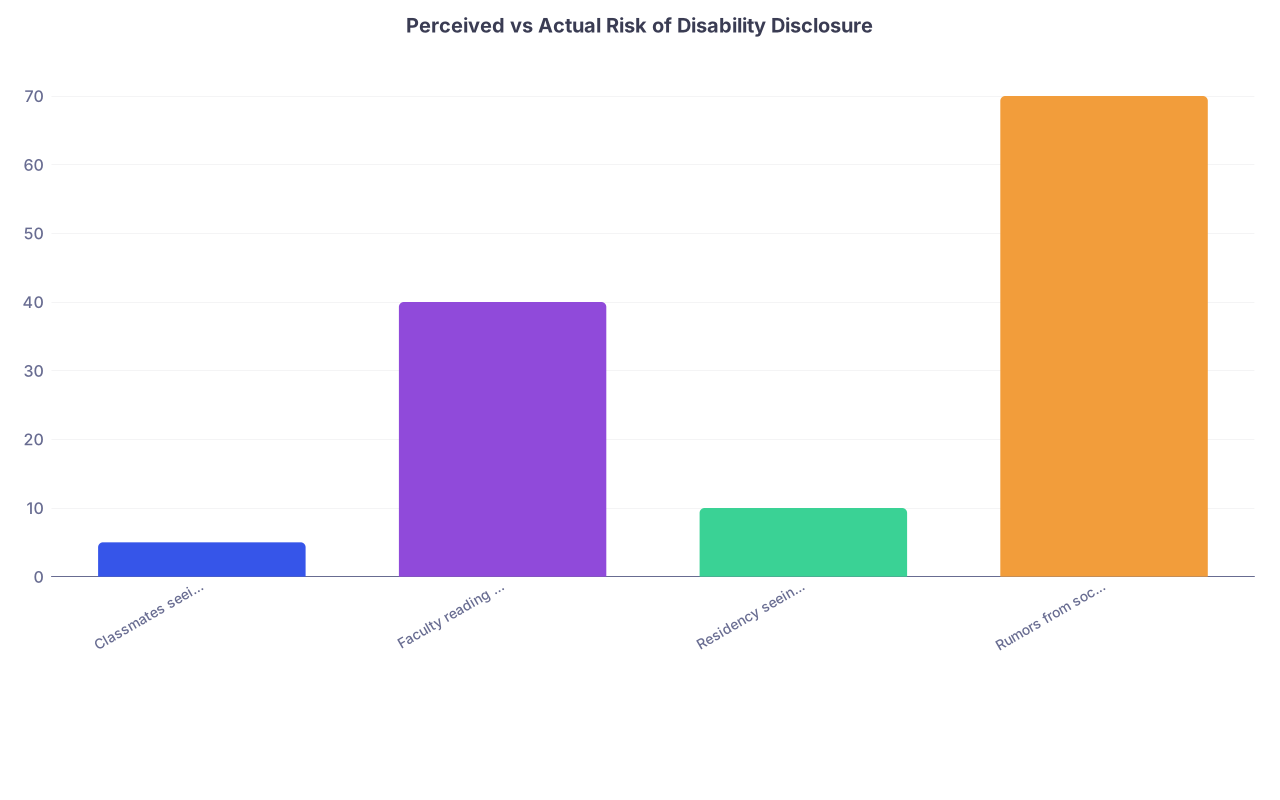
| Category | Value |
|---|---|
| Classmates seeing records | 5 |
| Faculty reading diagnosis | 40 |
| Residency seeing status | 10 |
| Rumors from social interactions | 70 |
My brain (and probably yours) tends to catastrophize in neat, dramatic ways:
- “Everyone will see my file.”
- “My disability will be on my record forever.”
- “Residency programs will blacklist me.”
- “I’ll never be able to switch specialties because of this.”
Reality is way more boring and bureaucratic. Records sit in a protected database nobody looks at unless they have to. Most faculty don’t want your psych notes, they want to know, “Do I need to schedule a separate room?” Residency programs want to know if you’re safe and competent, not your DSM paperwork from M1.
Is there stigma in medicine? 100%. Is there illegal sharing of disability diagnoses all over the place? No. Because schools are scared of lawsuits, not because they’re kind.
What I’d Worry About (And What I Wouldn’t)
If I were in your shoes, here’s what would honestly keep me up at night—and what I’d actively stop spinning about.
I would worry about:
- Loose talk from faculty in front of other students.
- Over-sharing with classmates out of desperation for support, then regretting it.
- A poorly trained admin CC’ing the wrong person in an email.
- How stigma might show up if someone does find out.
I wouldn’t waste much energy on:
- Classmates “accessing” my records through portals they don’t have.
- Programs seeing a list labeled “disability history.”
- My Step/COMLEX results being tagged “accommodation used.”
- Disability status being printed in my MSPE by default.
You’re not paranoid for asking these questions. The system hasn’t exactly earned blind trust. But the worst fears—“my classmates can look me up”—don’t line up with how these systems actually function.
Quick Snapshot: Where Your Disability Info Can and Can’t Go
| Stage | Stored Privately? | Shared with Peers? | Shared with Residency? |
|---|---|---|---|
| Med School | Yes | No | Not directly |
| Step/COMLEX | Yes (internal) | No | Score only |
| MSPE/Dean Letter | No diagnosis | N/A | Yes, but not disability |
| Residency | If you disclose | No | Stays at that program |
If You Need Accommodations But You’re Terrified To Disclose
Here’s the dirty secret: tons of students quietly sabotage themselves by not requesting accommodations because of exactly the fears you’re naming.
I’ve watched people:
- Fail exams they could’ve passed with extra time they clearly qualified for.
- White-knuckle their way through clinicals instead of asking for simple adjustments.
- End up on leaves of absence from burnout and mental health crashes that might’ve been avoided.
I’m not going to pretend there are zero risks. There are always risks in medicine. But usually the bigger, more concrete risk is going without support you legitimately need, not the risk of your class group chat finding out you have dyslexia.
You’re allowed to protect yourself—both academically and privacy-wise. Those two goals aren’t mutually exclusive.

FAQs
1. Can my classmates ever legally access my disability records?
No. They have zero legal right to your disability records, and there’s no legitimate system where they can “look you up.” If a classmate ever somehow saw your actual records, that would almost certainly be due to a serious privacy breach by the school or outright illegal behavior. That kind of thing is extremely rare and exposes the school to major legal consequences.
2. Will my disability or accommodations appear in my MSPE or Dean’s Letter?
They shouldn’t. The MSPE is not supposed to contain health information or disability status. If your school is doing anything shady like hinting at diagnoses or explicitly mentioning accommodations, that’s something you can and should challenge. You can ask your dean point-blank: “Do you ever mention disability or accommodations in the MSPE?” and push for a clear, written answer.
3. Can residency programs find out I used testing accommodations on Step or COMLEX?
No. Your score report does not say “extended time used” or list accommodations. Programs see a number, not the testing conditions behind it. The only way they’d know is if you or your school explicitly told them—which is not standard and would be inappropriate without your consent.
4. What if I already told a classmate and now I regret it?
You’re not stuck. You can still set boundaries going forward. You can say something like, “Hey, I shared some personal medical stuff earlier and I’m realizing I’m not comfortable having that floating around. I’d really appreciate you keeping that strictly between us.” Will that guarantee silence? No. But most people don’t want to be the obvious jerk who spreads someone else’s health info. And you can be more guarded with future disclosures.
5. What’s one concrete thing I can do right now to protect my privacy?
Email or meet with your disability office and ask them, in writing if possible, exactly who sees your diagnosis and who only sees accommodations. Ask how they communicate accommodations to faculty, and whether anything related to disability ever appears in documents that go to residency programs. Having those specifics—not just vague reassurances—will either calm your brain or show you where you need to push for better boundaries.
Open your email right now and draft a three-sentence message to your disability office: ask who sees your diagnosis, who sees only accommodations, and whether anything goes to residency. You’ll feel a lot less at the mercy of rumors and more in control of your own story once you have that answer in writing.