
The biggest mistake residents make after an injury is trying to “tough it out” instead of treating recovery like a rotation with clear milestones and deadlines.
You’re not weak for needing modified duties. You’re unprofessional if you don’t plan it properly.
This is your 90-day, step‑by‑step recovery roadmap—from the moment you get hurt to being back on service with a sustainable schedule and formal accommodations in place.
Day 0–3: The Injury and Immediate Aftermath
At this point you should stop thinking like “I’ll push through” and start thinking like “I’m a patient with a job that affects patient safety.”
Within the first 24 hours
Non‑negotiable steps:
Get medically evaluated.
Not by your co‑resident in the call room. By an actual clinician documenting your injury.- ED or urgent care if acute/serious (fall, needle stick with exposure, back injury from a lift, etc.)
- Employee/occupational health if open and appropriate
- Make sure you get:
- Official note with diagnosis (or working diagnosis)
- Functional limitations documented: lifting, standing, fine motor, hours, night work
Report the injury through official channels.
Do not skip this because you “don’t want to be a problem.”- Notify charge nurse / supervising attending on shift
- Notify chief resident by text and email (paper trail)
- File incident report / employee injury form if your institution has one
- If this happened on‑duty, this is especially critical for workers’ comp
Document everything for yourself.
Make a quick file (physical or digital) with:
- Visit notes and discharge summary
- Imaging reports
- Work excuse / restrictions note
- Photos if visible injury (e.g., hand laceration, swelling)
Email your program leadership.
Very short, factual. For example:“I sustained an on‑duty back injury on 1/8 while transferring a patient. Evaluated in ED. Diagnosis: lumbar strain. ED note attached. I’ve been given temporary restrictions (no lifting >10 lbs, no prolonged standing, and no night shifts for at least 2 weeks). I’ll follow up with occupational health on 1/10. I’d like to discuss temporary modified duties.”
You’re not asking permission to be injured. You’re notifying them you’re injured and already taking appropriate steps.
Days 2–3: Setting up the support structure
At this point you should be shifting from “crisis” to “plan.”
Schedule follow‑up:
- Occupational health or your treating specialist within 3–7 days
- Ask explicitly: “Can you write specific work restrictions?”
Vague notes (“light duty”) are useless for scheduling.
Identify which policies apply to you:
- GME/institutional leave policy
- Disability insurance (short‑term disability) if you cannot work
- Workers’ comp if work‑related
- ACGME and state/federal disability accommodation policies (this frames your rights)
Initial conversation with chiefs/program director (PD):
Goal: immediate short‑term safety, not your entire 90‑day life plan.
Discuss:
- What you can and cannot do in the next 2 weeks
- Night float/call obligations in that period
- Whether you should be off completely for a short time (e.g., 3–5 days)
You’re buying time to get proper evaluations and a realistic plan—not agreeing to “see how it goes” indefinitely.
Week 1: Stabilize, Clarify, and Protect Your Timeline
Week 1 is about two things: clear restrictions and preventing your schedule from becoming chaos.
Medical side (Days 4–7)
At this point you should have:
- A confirmed diagnosis or at least a clear working diagnosis
- A documented treatment plan
- A follow‑up date
Push your clinician to be specific:
- Not helpful: “Avoid heavy lifting”
- Helpful: “No lifting >10 lbs, no more than 2 hours standing at a time, no repetitive hand motions, no driving after taking medication X, no night shifts while on sedating meds”
Ask outright: “What is a realistic timeline for improvement—2 weeks, 6 weeks, 3 months?”
Even if it’s approximate, that estimate shapes your work accommodation plan.
Work side (Days 4–7)
You now need to shift from verbal understandings to structured planning.
Schedule a formal meeting with the PD or associate PD.
Bring:
- Medical documentation (with restrictions highlighted)
- Your current block schedule
- Call schedule
- Any forms your institution uses for accommodations or modified duties
Discuss three time frames:
- Immediate (next 2 weeks)
What needs to change today? - Short term (next 4–6 weeks)
Which rotations are unsafe or unrealistic? - Medium term (up to 90 days)
What if you’re not fully recovered by then?
- Immediate (next 2 weeks)
Start the formal accommodation process.
This usually involves:
- HR / Disability services / GME office
- Occupational health or an external clinician
- Possibly a “reasonable accommodation” committee
You want this process started in Week 1 so that by Week 3–4 you have something official, not just goodwill.
Weeks 2–4: Designing and Implementing Modified Duties
At this point you should not be improvising your workday. You should be on a defined modified duty plan.
Week 2: Draft the actual modification plan
Sit down (ideally with someone from GME/HR) and convert “restrictions” into concrete duty changes.
Common resident‑level modifications:
- Physical limitations
- Outpatient clinic instead of busy inpatient
- No or limited OR time
- No cross‑coverage for multiple floors
- Avoid heavy lifting (ICU turns, frequent transfers)
- Cognitive/neurologic limitations (post‑concussion, migraines, etc.)
- No night shifts
- Shorter shifts (8–10 hours instead of 28‑hour call)
- Reduced panel of patients
- Upper extremity/hand injuries
- No procedures
- Scribe‑heavy or telehealth work
- More supervision for notes and orders
Convert that into a written plan. Think like this:
| Timeframe | Shift Length | Nights/Call | Primary Setting |
|---|---|---|---|
| Weeks 2-3 | 8 hrs/day | None | Outpatient clinic |
| Weeks 4-6 | 10 hrs/day | One night q2w | Step-down/inpatient |
| Weeks 7-12 | 12 hrs/day | Standard for class | Regular rotations |
That table looks simple. Getting there is the hard part.
You need signatures or written approval from:
- PD (and sometimes department chair)
- Occupational health / disability office
- GME
Week 3: Adjust the rotation and call schedule
At this point you should not be “helping out with call when you feel up to it.” That’s how people get re‑injured.
Concrete tasks:
Swap out high‑risk rotations.
Examples:
- Out: Trauma surgery, ICU, busy ED, OB nights
- In: Clinic, consults, academic/research block, elective with flexibility
Re‑map your call schedule.
Do not let it become a random patchwork of favors. You want a clear, official revision.
- Remove nights/weekends you truly cannot do safely
- Convert some call to backup/home call if feasible
- Document: “Resident X is excused from night call until [date] per occupational health restrictions.”
Record changes in writing and in the actual schedule system.
Verbal agreements vanish. Updated schedules in Amion/ QGenda / whatever system your program uses are what count.
30-Day Checkpoint: Re‑Assessment and Reality Check
By Day 30 you should stop asking, “Am I being difficult?” and start asking, “Is this plan working or setting me up for burnout or re‑injury?”
Medical re‑evaluation (around Week 4)
You’re looking for:
- Objective progress (range of motion, pain scale, strength, functional testing)
- Updated work restrictions (sometimes less restrictive, sometimes unchanged)
- Prognosis over next 60 days
Ask your clinician to do this in plain language you can hand to GME:
- “Safe to gradually increase standing time to 4 hours/day over the next month.”
- “Night shifts still contraindicated due to medication and sleep-disruption risk.”
- “No OR cases requiring prolonged standing >2 hours until 8 weeks from now.”
Work re‑evaluation
Schedule a 30‑day check‑in with:
- PD or associate PD
- Possibly chief resident and/or GME rep
Use this structure:
What’s working?
Example: “Clinic with shorter days is sustainable; pain controlled; able to follow through on patient care.”What’s not working?
Example: “Still being assigned one 24‑hour call every week is wiping me out and setting me back.”What needs to change for the next 30 days?
This is where you shift from just “modified duties” to a longer‑term, defensible accommodation plan if recovery is slower than hoped.
Weeks 5–8: Transition to Sustainable, Long‑Term Accommodations
These weeks are where programs often get sloppy. The initial crisis is over, you’re no longer “acutely” out, and people assume you’re fine.
You can’t let the plan silently drift back to “business as usual” if your body is not ready.
Week 5–6: Decide which path you’re on
There are really three paths by this point:
Path A: Rapid recovery
You’re nearly back to baseline. You can ramp back toward full duties with a short, stepped plan.Path B: Moderate but incomplete recovery
You’re better, functional, but not capable of full resident grind without risk.Path C: Persistent or serious limitation
It’s clear you’ll need long‑term or permanent accommodations, or even schedule extension.
You need to be honest about which path you’re on—not which one you wish you were on.
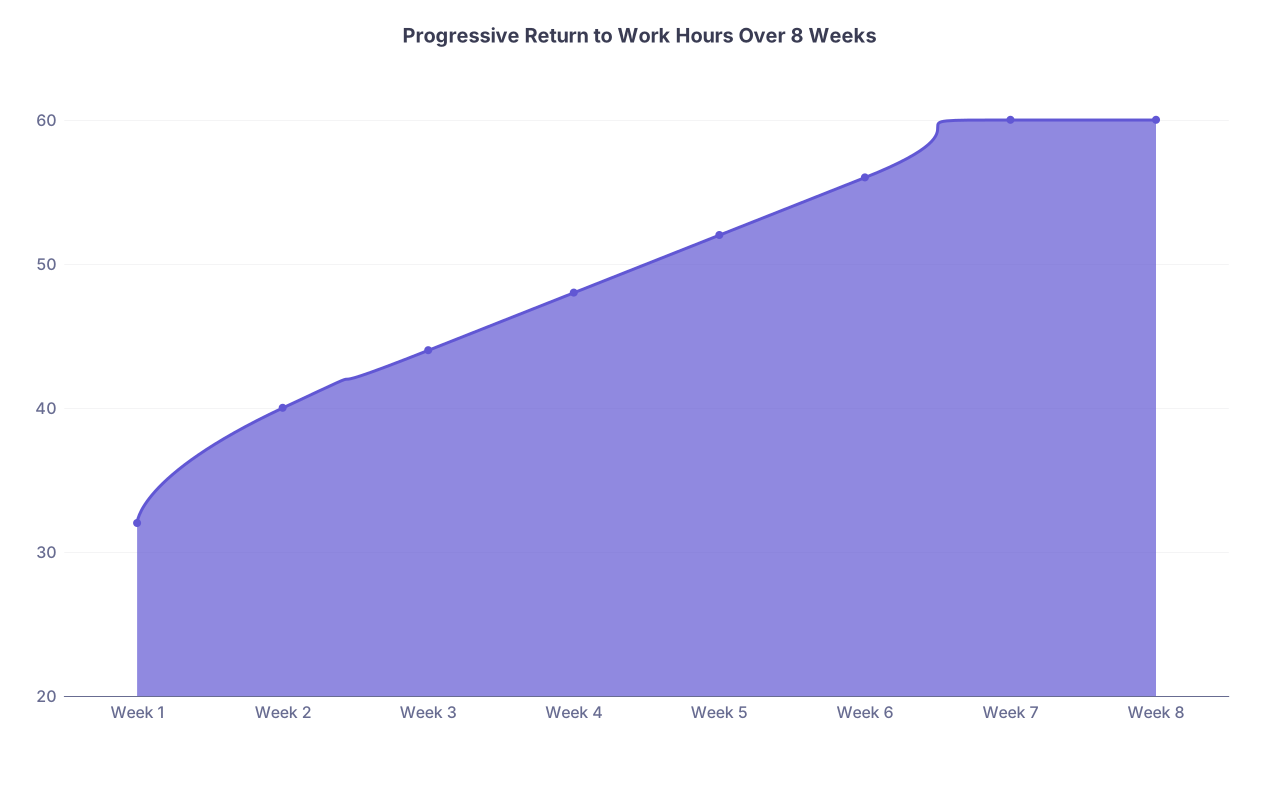
Build the “ramp up” if you’re on Paths A or B
This is where a structured timeline helps you and your PD not overcorrect.
| Category | Value |
|---|---|
| Week 1 | 32 |
| Week 2 | 40 |
| Week 3 | 44 |
| Week 4 | 48 |
| Week 5 | 52 |
| Week 6 | 56 |
| Week 7 | 60 |
| Week 8 | 60 |
For example:
- Week 5:
- 4 clinic days (8–9 hours) + 1 academic/admin day from home
- Week 6–7:
- Mix of clinic and lighter inpatient days, 10–12 hours
- One short home‑call or 12‑hour night
- Week 8:
- Closer to standard rotation intensity, with targeted exceptions (still no heavy lifting, no 28‑hour shifts if contraindicated)
All of this should be pre‑planned, not decided day-to-day.
If you’re on Path C: Long‑term accommodation planning
At this point you should:
Loop in disability services formally (if not already).
You need a documented disability accommodation, not just informal kindness.Clarify essential vs. non‑essential job functions.
This matters legally. Not every single traditional task is “essential” to being a physician.
Examples of potentially modifiable “non‑essential” functions during residency:
- Driving between sites
- Lifting certain weights
- Performing long operative cases
- Frequent 28‑hour calls if alternative coverage models exist
Discuss training timeline and board eligibility.
Sometimes you need:
- A schedule extension (e.g., finish PGY‑2 over 13–14 months)
- A partial LOA
- Alternate rotations that still meet ACGME and board requirements
Do not wait until you’re at the end of the year to have this conversation. Day 45–60 is a good time.
60-Day Checkpoint: Solidifying the New Normal
By Day 60 you should have one of two things:
- A clear path to full duty by ~Day 90
or - A documented, long‑term accommodation plan that governs how you work safely
Review the big three: Function, Flexibility, Fatigue
Ask yourself, your clinician, and your PD:
Function:
- Can you do your core tasks reliably?
- Where do you still fail or struggle?
Flexibility:
- How much schedule variability can you tolerate?
- Are sudden cross‑cover or extra calls wrecking you?
Fatigue:
- After a typical day, are you just tired—or are you wiped out and symptomatic?
This isn’t about being “soft.” It’s about whether the system you’re in will break you again if you let it.
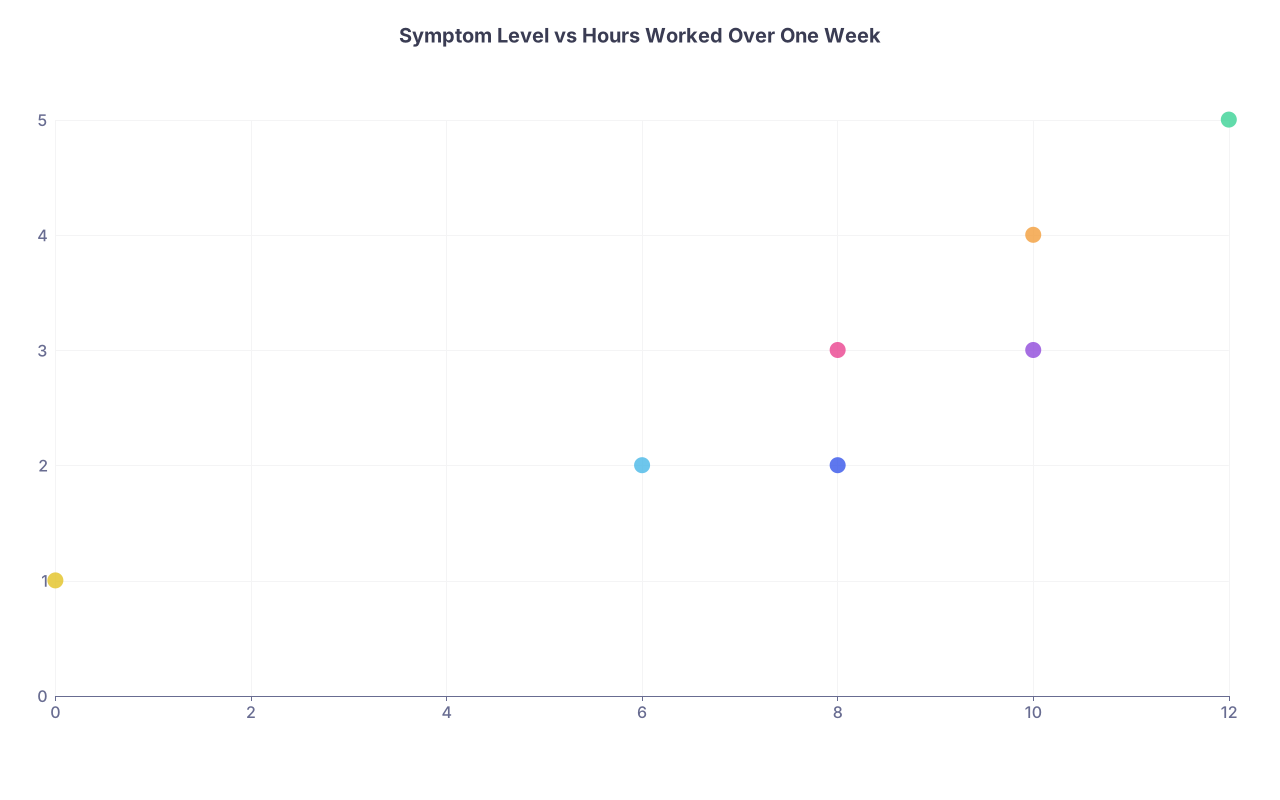
Adjust your duties based on data, not vibes
Track a simple weekly log for at least 2 weeks:
- Hours worked per day
- Type of work (clinic, inpatient, OR, nights)
- Pain/symptom level (0–10)
- Medication needs (especially anything sedating)
- Mistakes/nearly missed items you noticed
| Category | Value |
|---|---|
| Day 1 | 8,2 |
| Day 2 | 10,3 |
| Day 3 | 12,5 |
| Day 4 | 10,4 |
| Day 5 | 8,3 |
| Day 6 | 6,2 |
| Day 7 | 0,1 |
Then sit down with your PD and show them patterns:
- “Once I hit 12 hours, my pain spikes and I make more documentation errors.”
- “Night shifts correlate with 2 days of decreased function after.”
You’re not complaining. You’re presenting data.
Weeks 9–12 (Days 60–90): Transition, Consolidation, or Redirection
At this point you should stop thinking in weeks and start thinking in training blocks and career trajectory.
Scenario 1: You’re almost fully recovered
You can:
- Tolerate heavy days with minimal symptoms
- Do most or all core tasks safely
- Work near your prior schedule
Your focus in this last 30 days:
Gradual reintroduction of previously restricted tasks
- Example: limited OR time progressing to full days
- Example: one 24‑hour call then assess, not “back to q4 immediately”
Education catch‑up
- Identify key rotations you missed or watered down
- Plan where they’ll be made up over the next 6–12 months
Long‑term prevention
- PT/OT continuation
- Equipment changes (e.g., better footwear, ergonomic adjustments)
- Clear boundaries about not going back to dangerous patterns that caused the injury
Scenario 2: You’re stable but with ongoing limitations
So now you’re in the territory of permanent or semi‑permanent accommodations.
Tasks for Weeks 9–12:
Formalize the long‑term accommodation.
This might include:
- Caps on night call frequency
- Rotation restrictions (e.g., no trauma, limited OR heavy rotations)
- Physical limitations (lifting, standing)
- Cognitive restrictions if applicable
Align with ACGME and board requirements:
Use a simple planning grid with your PD:
| Requirement Type | Standard | Your Plan |
|---|---|---|
| Total months | 36 | 37 with 1-month extension |
| ICU months | 4 | 4 spread over 2 years with lighter call |
| Night rotations | 6 | 4 with home-call mix, approved by GME |
| Electives | 6 | 5 + 1 month research from home |
You want explicit confirmation: “Yes, this plan still qualifies you for graduation and board eligibility.”
Consider specialty or role adjustments (if needed).
This is the hard conversation. Sometimes injury + reality means your original niche might not be sustainable:
- Ortho resident with permanent lifting restrictions
- Surgical trainee with hand function limitations
- EM resident who cannot safely do recurrent nights
That doesn’t mean your career is over. It means your path might change:
- Different subspecialty
- Non‑operative track
- More outpatient‑focused career
Those decisions usually start in this 60–90 day window but play out over 6–24 months.
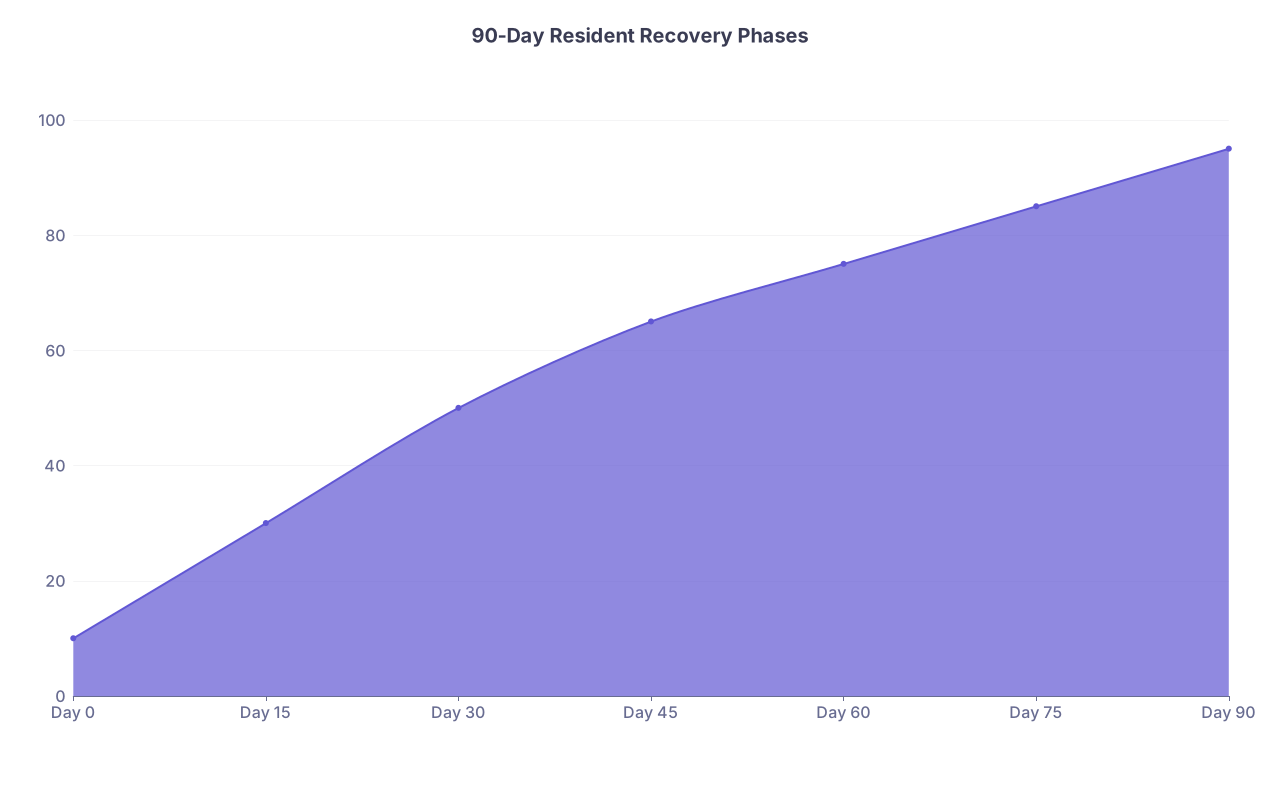
A Visual of the 90-Day Recovery Arc
Here’s how the three phases typically distribute over time:
| Category | Value |
|---|---|
| Day 0 | 10 |
| Day 15 | 30 |
| Day 30 | 50 |
| Day 45 | 65 |
| Day 60 | 75 |
| Day 75 | 85 |
| Day 90 | 95 |
Think of it like this:
- Day 0–30: Stabilize & Protect
- Day 30–60: Test & Adjust
- Day 60–90: Commit & Consolidate
Common Pitfalls and How to Avoid Them
By now you see the pattern: residents get hurt, minimize, push, crash, then finally accept they need help—usually after making things worse.
Three predictable mistakes:
Letting everything be informal.
“My attending knows,” “The chiefs are helping out,” “We’ll just figure it out.”
No. If it’s not written, scheduled, and approved, it can disappear overnight.Ignoring how this impacts training requirements.
Months suddenly “don’t count,” or you end up short ICU or continuity clinic time.
You fix this early or you end up extending your residency when you least expect it.Pretending this is a 2‑week problem when it’s a 3‑month issue.
Especially with back injuries, concussions, or significant surgeries.
They don’t follow your wishful thinking.
You’re not “difficult” for insisting on a structured 90‑day plan. You’re realistic.
The Very First Step You Should Take Today
If you’re injured right now—or even just “managing” something that’s clearly affecting your work—do this before you do anything else:
Open your email and draft a message to your PD and chief stating: your diagnosis (or suspected injury), your current functional limits, and your request for a meeting this week to discuss a 90‑day modified duty plan.
Do not send it later.
Write it now.
Then look at it and ask yourself: “Does this actually reflect how bad things are?” Adjust it until it does, then hit send.