
The biggest mistake residents make with disability accommodations is waiting until orientation week to say something. By then, the system is moving too fast, the schedules are locked, and you are negotiating from a position of panic instead of planning.
Here is the residency onboarding timeline I give interns who need GME accommodations. Week by week. With what actually happens on the hospital side, and when you still have leverage.
6–9 Months Before Residency Start (Before Rank List / Around Match List Season)
At this point you should be planning strategically, not scrambling.
You are:
- Still in medical school.
- Finalizing your rank list or just after submission.
- Not yet matched, but you know your likely competitiveness and geography.
This is the pre‑Match strategy window.
Your goals in this phase
- Clarify what you actually need to function safely.
- Understand which kinds of accommodations are realistic in residency.
- Avoid ranking programs that structurally cannot support you.
Step 1: Lock in your functional needs (not just labels)
At this point you should:
- Meet with your med school disability office and, if relevant, student health or psychiatry.
- Translate “diagnosis” into “functional limitations.”
Examples:
- Not: “I have ADHD.”
- Instead: “I need protected time for documentation; I struggle with rapid task switching without written structure.”
- Not: “I have a mobility impairment.”
- Instead: “I cannot use stairs safely; I need reliable access to elevators and nearby parking; I cannot safely take 28‑hour call without rest opportunities.”
Ask explicitly: “What accommodations have former students used successfully in residency?”
I have heard answers like:
- “They had call schedule modifications in the first year.”
- “They used speech‑to‑text for notes.”
- “They got permission to sit during procedures.”
You want concrete precedent, not abstract reassurance.
Step 2: Reality‑check against residency demands
At this point you should compare your needs with the realities of residency work.
Use a simple grid like this:
| Functional Area | Residency Pressure Point |
|---|---|
| Prolonged standing | OR cases, codes, long rounds |
| Night work | 28-hr calls, night float, ED |
| Visual processing | Reading imaging, EHR, orders |
| Data entry speed | High-throughput documentation |
| Sensory overload | Busy ED, ICUs, beeping monitors |
If your functional limits and the specialty demands are completely opposed, you want to know that now. Sometimes the adjustment is specialty choice; more often it is how you will need the program to structure your work.
Step 3: Use interviews and visits intelligently
If you are still interviewing:
At this point you should be quietly assessing program culture without disclosing your disability unless you want to.
Look for:
- Programs that already have:
- Night float instead of Q4 28‑hour call.
- Reasonable, enforced duty hours.
- Robust wellness / mental health infrastructure.
- Signals the program actually flexes for people (pregnancy, chronic illness, caregiving).
Questions you can ask without outing yourself:
- “How does the program support residents returning from medical leave?”
- “Have residents been able to adjust schedules temporarily after health events?”
- “Who handles ADA accommodations—the GME office or HR?”
You are mapping the accommodation pathway before you ever need it.
Match Week to 2 Months Before Start Date (Offer in Hand, Program Known)
Once you match, the clock starts. This is the highest‑leverage window to set things up.
At this point you should:
- Know where you are going.
- Have a start date (usually July 1).
- Have an institutional GME office and HR to work with.
Week 0–1 After Match: Quiet Reconnaissance
Do not fire off an emotional email to the program director. This is not a conversation to wing.
Instead, at this point you should:
Read your offer and GME materials carefully.
- Look for:
- “Reasonable accommodation” language.
- Whether they mention an ADA office, HR disability coordinator, or Employee Health.
- Save all PDFs. You will reference exact policies later.
- Look for:
Identify the correct accommodation gatekeepers. Do not start with the PD unless the institution specifically says to. Typically it is:
- GME office → points you to
- Institutional ADA/HR accommodations office → coordinates with
- Employee/Occupational Health
Check:
- Program website.
- Institution GME website (“Residents/Fellows” pages).
- Onboarding portal.
Weeks 1–3 After Match: Initial Outreach and Documentation
This is when you lay the groundwork.
At this point you should:
- Gather existing documentation.
- Comprehensive diagnosis letter from:
- Treating specialist (psychiatrist, neurologist, rheumatologist, etc.).
- Or psychologist report (for learning disorders, ADHD).
- Prior accommodation letters (USMLE, med school exams, clinical rotations).
- Surgical or procedure notes if structural.
- Comprehensive diagnosis letter from:
Aim for:
- Clear statement of condition.
- Functional limitations.
- Connection between limitations and work tasks.
- Draft your functional statement.
One page, bullet style. For example:
- Condition: Generalized anxiety disorder with panic episodes.
- Impact:
- Sudden unplanned schedule changes worsen symptoms.
- Sleep fragmentation leads to significant cognitive slowing.
- Residency tasks affected:
- Overnight shifts with minimal rest.
- Rapid serial tasks without breaks.
- Proposed accommodations:
- Predictable schedule posting at least 4 weeks in advance.
- Limit on consecutive night shifts when feasible.
Do not ask for the moon. Ask for what links clearly to safety and essential job performance.
- Contact the institutional accommodations office.
Your email should be short and professional. Something like:
- Identify yourself as an incoming resident.
- State you are requesting an appointment to discuss disability accommodations.
- Attach nothing yet unless instructed; keep it simple.
At this point you should not be asking your PD for approval. The legal process goes through HR/ADA, not program leadership.
3–2 Months Before Start (April–May for a July Start)
This is where the formal process usually begins. Many residents are still half‑checked‑out of med school at this point. You do not have that luxury.
Month −3: Formal Request and Evaluation
At this point you should:
Complete any official accommodation request forms.
- These may ask:
- Diagnosis (sometimes optional).
- Functional limitations.
- Specific accommodations requested.
- Use your prepared one‑pager to avoid rambling.
- These may ask:
Have your clinician complete required provider forms.
- Warn them this is coming.
- Ask them to:
- Be concrete.
- Tie recommendations to specific work tasks.
- Avoid absolute language like “can never work nights” unless truly non‑negotiable.
Programs are more willing to flex when providers show an understanding of residency reality.
- Meet (virtually or in person) with the accommodations office.
At this point you should be ready to:
- Explain a “day in the life” of an intern and where you struggle.
- Prioritize your requests:
- Non‑negotiable (e.g., no 28‑hour shifts for someone with a seizure disorder).
- Strongly preferred.
- Nice‑to‑have.
You are collaborating, not begging.
Month −2: Draft Accommodation Plan and Program Notification
Once the accommodations office reviews everything, they will usually:
- Decide what is approved vs not reasonable.
- Communicate with GME / PD to figure out implementation.
You may or may not be in the room for those conversations. That is normal.
At this point you should:
Review the proposed plan for practicality. Ask yourself:
- Does this actually solve the core functional problems?
- Does it create unintended issues (e.g., always on nights → social isolation, more burnout)?
Clarify confidentiality boundaries. Ask explicitly:
- Who will know about my exact diagnosis?
- Who will only know I have approved accommodations? Typical pattern:
- HR/ADA: full documentation.
- PD/APDs: know there are formal accommodations and what they are, but not all details.
- Chiefs/rotation schedulers: see the constraints needed to build schedules.
Request implementation by a specific date. You need call schedules and rotation modifications in place before they publish schedules publicly.
Ask that final decisions for PGY‑1 July–September be locked at least 4 weeks pre‑start if at all possible.
1 Month Before Start (June for a July 1 Start)
Now you are close. Orientations, EMR trainings, HR paperwork all pile up here.
Weeks −4 to −3: Confirm Schedules and Structural Changes
At this point you should:
Request your preliminary July–September schedule. Check if:
- Your accommodations are reflected.
- You are not randomly placed on the exact rotation pattern that triggers your limitations.
Concrete examples:
- ADHD with documentation issues:
- Are you starting on a high‑throughput ward service with 18 patients on day 1? Maybe not ideal.
- Mobility limitation:
- Are you scheduled in a clinic 3 buildings away with no accessible restroom? Red flag.
- Check physical / tech setups early.
This is where people underestimate the time needed.
Common items:
- Ergonomic workstation (adjustable chair, standing desk, footrest).
- Large monitor or screen magnification tools.
- Dictation software or speech‑to‑text integrated into the EHR.
- Visual / auditory alert adjustments.
Ask IT and facilities:
- When will these be installed?
- Who do you contact if they are not ready on day one?
Weeks −3 to −2: Communication with Program Leadership
By now, your PD almost certainly knows you have accommodations.
At this point you should:
- Request a brief, structured meeting with PD or APD.
You are not re‑litigating the accommodation decision. You are operationalizing it.
Topics:
- “This is what has been approved.”
- “This is how I typically work best.”
- “Here is what you can expect from me in return.”
Phrase it as:
- You are focused on patient safety and consistent performance.
- The point of accommodations is to allow you to meet the same standards, not avoid them.
- Decide what you will voluntarily disclose to peers.
You control this narrative.
Options:
- Tell chiefs only.
- Tell a trusted co‑resident.
- Say nothing and let the schedule speak for itself.
The only universal rule: do not let rumors fill the vacuum. If your schedule is visibly different (e.g., fewer 28‑hour calls), have a simple one‑sentence explanation ready that you are comfortable with.
Orientation Week (Start Date to +1 Week)
Orientation is chaos. Everyone is tired, overloaded, and confused. This is a terrible time to start the process. You are using it to check what was promised.
At this point you should:
Verify every accommodation in real life.
- Workstation:
- Is your desk actually where it was supposed to be?
- Does your dictation software log in correctly?
- Call schedule:
- Does the shared final schedule match the version you saw?
- Physical access:
- Can you get to your main work areas without unnecessary barriers?
- Workstation:
Meet, briefly, with your chief residents or schedule coordinator. Confirm they understand:
- The structural rules (e.g., “cannot be scheduled for X”).
- How to contact HR/ADA if they hit a conflict.
You do not need to pour out your life story. Keep it procedural.
- Create your own quick‑reference plan.
One half‑page document for you:
- Key contacts:
- ADA/HR coordinator.
- GME director.
- PD/APD.
- What you do if:
- Your schedule violates accommodations.
- Your equipment is missing or fails.
- You are pressured to “just do it this once.”
This is for the day you are on hour 17 of a shift and not thinking clearly.
First 4–6 Weeks of Residency (Early PGY‑1)
This is the adjustment and calibration period. No plan survives first contact perfectly. That is normal.
Weeks +1 to +2: Immediate Feedback Loop
At this point you should:
Journal or jot down real‑world friction points. For 2 weeks, capture:
- When your accommodations work.
- When they fail.
- Unexpected issues (e.g., sign‑out locations, pager noise, team habits).
Distinguish between training discomfort and disability barriers.
Example:
- Everyone is tired post‑call → training discomfort.
- You are having panic attacks every time call rolls around despite meds → barrier.
Be honest with yourself. Not everything miserable in residency is about disability. But some things clearly are.
Weeks +3 to +4: Micro‑Adjustments
At this point you should:
- Request a brief check‑in with the accommodations office or GME.
Bring:
- 2–3 specific things that are working well.
- 2–3 targeted fixes you need.
Examples:
- “The call modifications are working, but I am still being scheduled for ad‑hoc overnight codes from home. That contradicts what we agreed to.”
- “The dictation software is installed, but I need noise‑canceling headphones; the ward noise makes it nearly unusable.”
- Avoid vague complaints. Do not say: “This is all too much.”
Say:
- “Here is one concrete change that would allow me to do notes safely and on time.”
Months 2–6 of PGY‑1: Consolidation and Long‑Range Planning
Once you are through the initial whirlwind, you can start thinking beyond survival.
At this point you should:
- Review your evaluation patterns.
- Are there consistent comments like:
- “Documentation slow,”
- “Seems disorganized on rounds,”
- “Strong but struggles overnight”?
- Do those feedback patterns line up with your disability and accommodations?
- Are there consistent comments like:
If there is a mismatch, talk with:
- Your PD/APD.
- The accommodations office.
- Your treating clinician.
Sometimes a small tweak (e.g., pre‑rounding strategy, checklists, using scripts) closes that gap.
- Prepare for later‑year rotations.
- ICU.
- Night float.
- Off‑site rotations.
For each, ask:
- How will my accommodations apply?
- Do we need a rotation‑specific plan?
This is especially critical for:
- Visual or mobility accommodations in new physical spaces.
- Cognitive accommodations in high‑acuity environments like the MICU.
A Quick Visual of the Overall Timeline
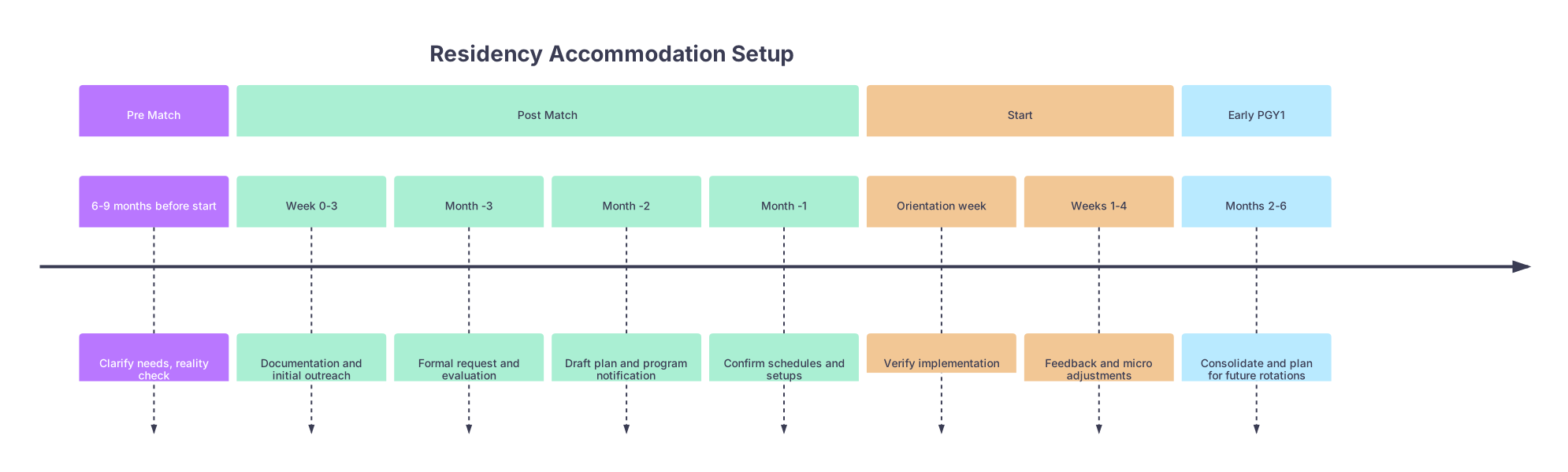
| Period | Event |
|---|---|
| Pre Match - 6-9 months before start | Clarify needs, reality check |
| Post Match - Week 0-3 | Documentation and initial outreach |
| Post Match - Month -3 | Formal request and evaluation |
| Post Match - Month -2 | Draft plan and program notification |
| Post Match - Month -1 | Confirm schedules and setups |
| Start - Orientation week | Verify implementation |
| Start - Weeks 1-4 | Feedback and micro adjustments |
| Early PGY1 - Months 2-6 | Consolidate and plan for future rotations |
Common Pitfalls and How the Timeline Prevents Them
You are not doing this timeline for fun. You are doing it to avoid the disasters I have seen up close.
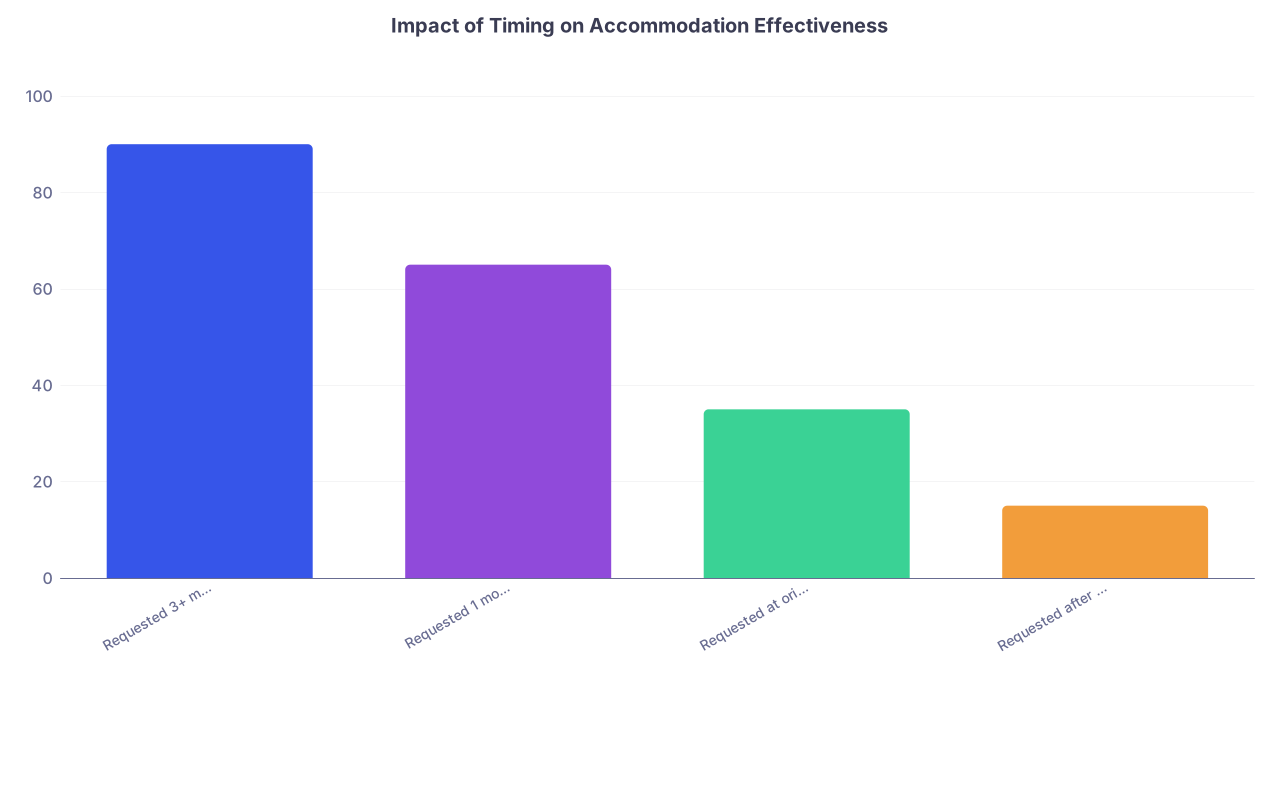
| Category | Value |
|---|---|
| Requested 3+ months early | 90 |
| Requested 1 month early | 65 |
| Requested at orientation | 35 |
| Requested after first crisis | 15 |
Those percentages are not from a randomized trial, obviously. But if you shadow GME offices long enough, those are roughly the odds that:
- Your accommodations are in place.
- People understand them.
- They are integrated without drama.
The later you start, the more it becomes crisis management instead of structured support.
Final Checkpoints by Phase
To make this brutally clear, here is what you should have done by each key point:
| Timepoint | What Should Be Done |
|---|---|
| 3+ months pre‑start | Needs clarified, documentation updated |
| 2–3 months pre‑start | Formal request submitted, eval underway |
| 1 month pre‑start | Plan approved, schedules/equipment queued |
| Orientation week | On‑site verification and quick fixes |
| End of month 1 | First feedback loop with GME/ADA |
| Months 2–6 | Adjustments and future rotation planning |
The Core Takeaways
- Start early, before the machine starts moving. Three to six months before your start date is not overkill. It is realistic.
- Talk in functional terms, not just diagnoses. Programs can work with “cannot safely do 28‑hour call because of X.” They cannot do much with “I have anxiety, be nice to me.”
- Treat this as a professional systems problem, not a personal failing. You are aligning legal obligations, institutional logistics, and your own safety so you can train at full capacity. That is not special treatment. That is good medicine.