What happens when you hand your medical school the exact same accommodation letter that worked perfectly for you in college—and they quietly say “No”?
Let me be blunt: trying to reuse your college disability accommodation letter for medical school is one of the fastest ways to sabotage the support you actually need. I have seen students do this, assume they are “covered,” and then hit a wall during anatomy, OSCEs, call nights, and Step prep. By the time they realize it, they are already on remediation or quietly thinking about withdrawing.
You cannot treat medical school like a fourth year of undergrad. And your documentation cannot treat it that way either.
Below is what goes wrong, why it goes wrong, and how to avoid being the cautionary tale everyone whispers about later.
The Core Mistake: Treating Med School Like College 2.0
The first mistake is conceptual: assuming medical school is just “harder college” and that the same letter, the same extra-time language, the same documentation will simply port over.
Reality check:
- Different laws are emphasized
- Different stakes
- Different environments
- Different exam formats
- Different clinical expectations
Your undergrad letter was written for:
- Semester-long lecture courses
- Multiple-choice midterms and finals
- Flexible deadlines and online tests
- A campus where missing a lecture is low‑stakes
Medical school demands:
- High-stakes exams that determine progression or dismissal
- Skills-based assessments (OSCEs, standardized patients, procedures)
- Clinical evaluations from preceptors with unpredictable schedules
- National board exams (NBME, COMLEX, USMLE) with separate approval processes
When you hand over a college letter that just says “1.5x time on all timed exams” and “note taker as needed,” you are telling the med school:
“I have not thought about how my disability interacts with the actual demands of this program.”
That is the first red flag to them. And it makes them conservative.
Why College Letters Don’t Map Cleanly to Medical Training
The piece most students underestimate: the formal legal framework does not actually guarantee that your old accommodations will travel with you.
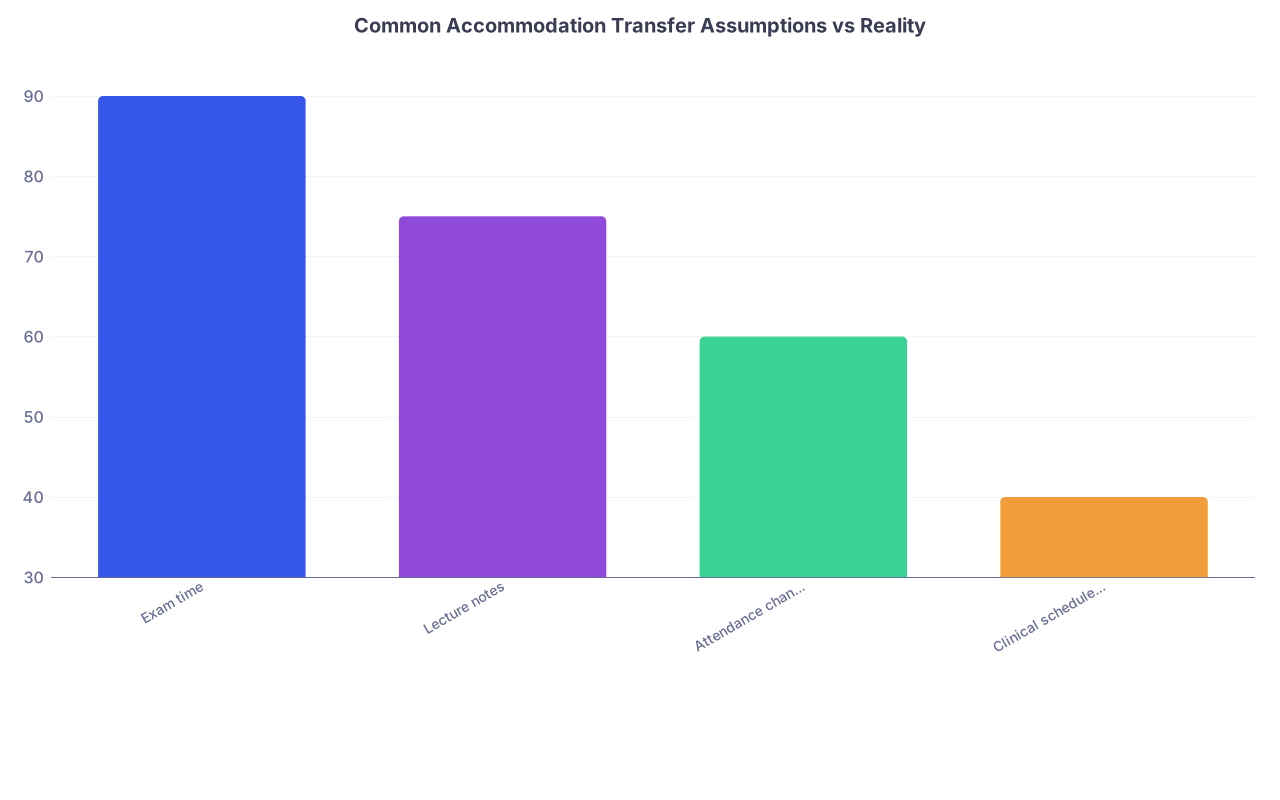
| Category | Value |
|---|---|
| Exam time | 90 |
| Lecture notes | 75 |
| Attendance changes | 60 |
| Clinical schedule changes | 40 |
Roughly how often students assume these will transfer from college, versus how often they realistically do.
1. Different interpretation of “essential functions”
In college, the “essential functions” are usually:
- Attending class (sort of)
- Completing assignments
- Passing exams
Medical schools will define essential functions far more strictly. They will lean on their technical standards:
- Timely response to emergencies
- Physical presence in certain clinical tasks
- Safe performance of procedures
- Rapid clinical decision-making under time pressure
Anything that appears to erode an essential function is much harder for them to grant. Extra time on a midterm is very different from extra time during a code situation or a rapid response exam scenario. If your letter is generic, they will assume it is not tailored to these functions. And they are right.
2. Clinical environment vs classroom
Your college letter was built for a classroom. Medical school is increasingly:
- Simulation labs
- Standardized patient encounters
- Bedside rounding
- ORs, EDs, L&D units
Accommodations that sound fine on paper can be unsafe or unworkable at the bedside. For example:
- “Frequent breaks as needed” on a 10‑hour surgery case
- “No early morning obligations” on an inpatient medicine rotation
- “Extra time for all tasks” during a timed OSCE station with standardized patients rotating through
If you simply present a recycled letter without any clinical-context language, do not be surprised when clinical faculty push back later, or the disability office narrows your accommodations once rotations start.
3. Board exams are their own ecosystem
A brutal mistake I see every year: students assume that because their college and medical school granted 1.5x or 2x time, the NBME or USMLE or COMLEX will too.
They do not.
Each testing agency:
- Requires its own documentation
- Has stricter recency requirements
- Demands a tight link between functional impairment and requested accommodation
- Often wants childhood or earlier records for ADHD or learning disabilities
Your college letter might help—but it does not substitute for:
- A recent neuropsychological evaluation
- Objective test scores
- Clear rationale linking the impairment to the testing setting
If you stroll into M2 thinking, “Well, my college letter got me extra time; I am sure NBME will approve it,” you are setting yourself up for a very ugly shock about 6–9 months before Step.
Copy-Paste Failures I See Over and Over
Let me walk through the classic patterns that blow up.
1. The “Old Letter, New Life” error
Scenario:
You used a college letter from sophomore year. It says:
- 1.5x time on all exams
- Priority seating
- Access to lecture notes
You send this letter to your M1 disability office. You do not update your documentation. You do not have a recent evaluation. You say, “These are the accommodations I have had for years.”
What happens?
- They may grant something minimal for didactic exams
- They may decline anything for labs or OSCEs because the wording is too vague
- When you apply for board exam accommodations, your documentation is considered “stale” and insufficient
Result: you are protected in low‑stakes contexts and naked in high‑stakes ones.
2. The vague-diagnosis problem
College letters often say things like:
- “Student has a learning disability”
- “Student has a mental health condition that affects concentration and stamina”
Medical schools—and definitely board agencies—hate that level of vagueness.
They want:
- Specific diagnosis (with DSM/ICD wording)
- Measurable functional limitations
- Direct connection to the requested accommodation
If your letter is all soft generalities, medical school will see it as a weak foundation. They may still help you, but it will not carry the weight you think it will, especially with NBME/USMLE.
3. The “everything everywhere” request
Another killer: dragging in a college letter that basically says, “Extended time, flexible deadlines, attendance flexibility, and alternative formats on all tasks and quizzes.”
In a pre‑med English seminar, that might be manageable. In medical school:
- Flexible deadlines for anatomy or pharm content? That breaks the course schedule.
- Attendance flexibility during small-group clinical skills? That undermines assessment of core skills.
- Alternative formats for all assignments? That is not sustainable at scale.
So the accommodation office does what they must: they narrow everything aggressively. You feel dismissed. But you set them up by asking them to rubber‑stamp a system that cannot operate in their environment.
How Med Schools Actually Think About Your Documentation
This is what is happening in the room when your med school reviews that familiar college form you just uploaded.
They are silently asking:
- Does this documentation clearly explain the diagnosis and its functional impact?
- Is it recent enough to reflect the student’s current functioning?
- Does it address the tasks and essential functions of this program?
- Can these accommodations be provided without fundamentally altering our curriculum or assessments?
- Will this documentation hold up if the student later seeks NBME or USMLE accommodations?

Your college letter usually does not answer half of these. Because it was never designed to.
Practical Differences You Cannot Ignore
To make this tangible, here is a quick comparison.
| Aspect | College Setting | Medical School Setting |
|---|---|---|
| Primary focus | Course grades, GPA | Progression, professionalism, patient safety |
| Assessments | Essays, midterms, finals | NBME-style exams, OSCEs, clinical evaluations |
| Schedule | Semesters, flexible deadlines | Compressed blocks, clinical shifts, call |
| Attendance | Often negotiable | Often essential, especially in clinical years |
| Decision drivers | Academic equity | Technical standards and licensure requirements |
If your letter only “speaks” in the left-hand column, it will fail in the right-hand column.
How to Avoid the Copy-Paste Trap
You do not need to start from scratch, but you do need to stop treating your college letter as your main tool. Use it as history, not as your current strategy.
1. Get your evaluation updated early
If your last formal evaluation (for ADHD, LD, processing, etc.) is from:
- High school or early college: that is already old
- More than 3–5 years ago: it will be questioned by board agencies
You need:
- A recent, thorough evaluation by a qualified professional
- Objective test data (not just “student reports difficulty”)
- Clear narrative linking your disability to:
- Time demands of exams
- Reading load
- Clinical tasks (attention, motor function, stamina, sensory issues, etc.)
Do this before you start medical school or in early M1. Waiting until you are tanking exams is the classic too-late move.
2. Rewrite your story for medical demands
When you meet your med school’s disability office, do not hand them your undergrad letter and say, “Same thing, please.”
Walk in with:
- A list of past accommodations that actually helped you
- Specific issues you anticipate in med school:
- Long exam blocks?
- Clinical noise and sensory overload?
- Fine motor tasks?
- Night shifts and circadian chaos?
Talk about:
- How you function during long, high-stakes tests
- How fatigue, pain, attention, or anxiety show up in fast-paced clinical situations
- What has worked in similar high-pressure settings (MCAT, EMT work, scribing, etc.)
This tells the office: “I understand your environment and I am trying to work with it, not fight it.”
3. Separate school accommodations from board accommodations
Do not make the mistake of assuming your med school and your board exam agency are interchangeable.
Different documentation paths.
Different timelines.
Different standards.
Plan for:
- Step/Level 1: documentation ready at least 9–12 months in advance
- Step/Level 2: sometimes needing updated or additional data if your condition changes
Ask your med school disability office explicitly:
- “What documentation have you seen succeed for NBME/USMLE/COMLEX accommodations?”
- “What gaps do you see in my current file if I want to apply later?”
Then fix those gaps now. Not during your dedicated board study block.
Special Pitfalls by Disability Type
Different conditions run into different landmines when students rely on copy-paste letters.
ADHD / Learning Disorders
Common mistakes:
- Old psychoeducational testing with no adult update
- Vague language: “attention difficulties” instead of specific deficits
- Only asking for time-and-a-half on exams because “that’s what I always had”
What you actually need:
- Clear objective deficits (processing speed, working memory, reading fluency)
- Explicit connection to:
- Exam length
- Reading speed for long stems
- Sustained focus over multi-hour sessions
- Rationale for which specific boards‑style accommodations you need:
- 25% vs 50% extra time
- Separate room vs reduced distractions
Chronic illness / Pain / Fatigue
Copy-paste letters often say:
- “Flexible attendance and deadlines”
- “Ability to reschedule exams when symptomatic”
In med school, that language sets off alarm bells.
You need instead:
- Documentation explaining pattern and predictability of flares
- What supportive structures work in structured environments
- Concrete ideas for what is realistic in:
- Pre-clinical blocks
- Clinical rotations
- Night float or call
Otherwise you get labeled as “unreliable” instead of “disabled and supported.”
Psychiatric conditions
College letters frequently lean on generalities:
- “Student may need occasional absences”
- “Symptom exacerbations may impact performance”
Boards and med schools want specifics:
- Symptom patterns (panic, dissociation, cognitive slowing, sleep)
- Triggers in medical settings (trauma exposure, ICU noise, night shifts)
- Objective treatment history and current regimen
Without that, requests for major schedule modifications or prolonged absences look like preference, not necessity.
A Better Process: What To Actually Do
Let’s be concrete. Here is a more competent sequence than “upload old letter, hope for the best.”

| Step | Description |
|---|---|
| Step 1 | Accept Med School Offer |
| Step 2 | Review Technical Standards |
| Step 3 | Update Evaluation with Specialist |
| Step 4 | Gather Old Letters as History |
| Step 5 | Meet Med School Disability Office |
| Step 6 | Define Med-Specific Needs |
| Step 7 | Secure Didactic Accommodations |
| Step 8 | Plan Ahead for Boards Documentation |
| Step 9 | Reassess Needs Before Clinical Years |
Notice where the college letter belongs: as history, not as the entire plan.
Common Red Flags Med Schools Notice Immediately
If you are doing any of these, correct course quickly.
- Your only documentation is your college letter.
- Your last full evaluation is >5 years old.
- You cannot clearly explain how your disability affects you during an 8-hour exam day or 12-hour clinical shift.
- Your requests sound like: “No mornings, no nights, no call, and no long days.”
- You treat the disability office like a rubber stamp instead of a partner.
These patterns make schools defensive and conservative. They protect the program, not you.
FAQ (Exactly 4 Questions)
1. My college letter got me MCAT accommodations. Won’t that help for Step or Level?
It helps as part of a pattern, but it is not enough. Board agencies treat each exam separately. They will want up-to-date documentation, current functional assessments, and a clear justification connected to their specific testing conditions. Do not rely on past MCAT approval to predict board decisions.
2. Can I at least use my college letter as a starting point when I talk to my med school?
Yes, but treat it as background, not a template. Bring it to show what has historically helped you, then be ready to discuss how those needs will show up in long exams, labs, and clinical work. If you act like the letter is binding or sufficient, you will limit what your med school can reasonably design for you.
3. What if my diagnosis was never formally tested in college, only “clinically diagnosed”?
That is a problem for both med schools and boards. Many agencies, especially NBME/USMLE, want objective testing—neuropsych, cognitive, or other standardized measures—rather than just a clinician note. If your history is mostly narrative, invest in a thorough evaluation now. It is unpleasant and expensive, but the alternative is repeatedly being denied accommodations when stakes are highest.
4. When is the latest I can safely update my documentation?
If you wait until you are struggling in M2 or approaching Step/Level registration, you have already pushed it. Aim for: updated evaluation before M1 starts or during the first half of M1, initial med school accommodations in place by mid‑M1, and board-ready documentation at least 9–12 months before your planned exam date. Anything later becomes damage control instead of planning.
Key points to remember:
- Copy-pasting your college accommodation letter into medical school is not a plan; it is a liability.
- Medical training, clinical work, and board exams require tailored, updated documentation that speaks to their specific demands.
- Use your old letter as history, then build a new, med‑school‑specific strategy with current evaluations and proactive conversations.