The biggest mistake pre-meds make with MCAT accommodations is assuming “I qualify” is the same as “I can prove it.” It is not.
If you want accommodations approved, you must think like the people paid to say no.
I am going to walk you through the top errors that quietly kill otherwise legitimate MCAT accommodation requests. These are the reasons I have seen smart, deserving students get denied, appeal, get denied again, and lose an entire cycle. You do not have time for that.
1. Treating the MCAT Like a Campus Disability Office
Do not confuse “I get accommodations at my university” with “I will get the same accommodations for the MCAT.” Different rules. Different standards. Different level of skepticism.
Campus disability offices often rely on:
- Student self-report
- Brief letters from counselors
- Old IEP/504 plans
- A culture of “when in doubt, support the student”
The AAMC does not operate like that. They run a high‑stakes, standardized exam with a legal mandate to protect test security and “validity of scores.” Their default posture is conservative.
Common mistakes here:
Sending only your school letter and calling it a day
- “I get 1.5x time on all exams at my university; see attached letter.”
- AAMC will read that, nod, and still ask: On what objective basis?
Assuming identical accommodations will be granted
- Campus: separate quiet room, flexible due dates, recorded lectures.
- AAMC: cares about what affects test-taking on a single standardized, timed exam. Not general academic life.
Ignoring the MCAT’s own documentation standards
The MCAT has detailed documentation guidelines by condition (ADHD, LD, psychiatric, visual, medical, etc.). If your packet does not align with those expectations, you are handing them an easy excuse to deny.
Do not make the mistake of “translating” your college approval into an MCAT approval. Treat them as two completely separate processes and build your MCAT file from the ground up.
2. Submitting Outdated, Weak, or Incomplete Evaluations
Too many pre-meds send in evaluations that would barely satisfy a mediocre high school IEP, then act surprised when the AAMC says no.
The usual errors:
Old neuropsych testing
- ADHD/LD eval from age 13, current age 23.
- No adult update. No current functioning data.
- AAMC: “Symptom presentation in adulthood not adequately documented.”
-
- Only a therapist letter and self-report questionnaires.
- That might work for accommodations in college. Not here.
One-page “diagnosis letters” from primary care
- PCP: “Patient has ADHD and anxiety. I recommend extra time.”
- AAMC: “Where is the evidence?”
Eval that lists diagnoses but no functional impact
- Long list of DSM diagnoses.
- Almost no specifics on how these conditions impair reading speed, attention, stamina, visual processing, etc.
You need to stop assuming the label is enough. The AAMC is obsessed with functional limitations documented through:
- Standardized tests (e.g., WAIS, Woodcock-Johnson, WIAT)
- Timed vs. untimed performance comparisons
- Measurable deficits (percentiles, standard scores)
- Direct links between those deficits and the specific accommodation requested
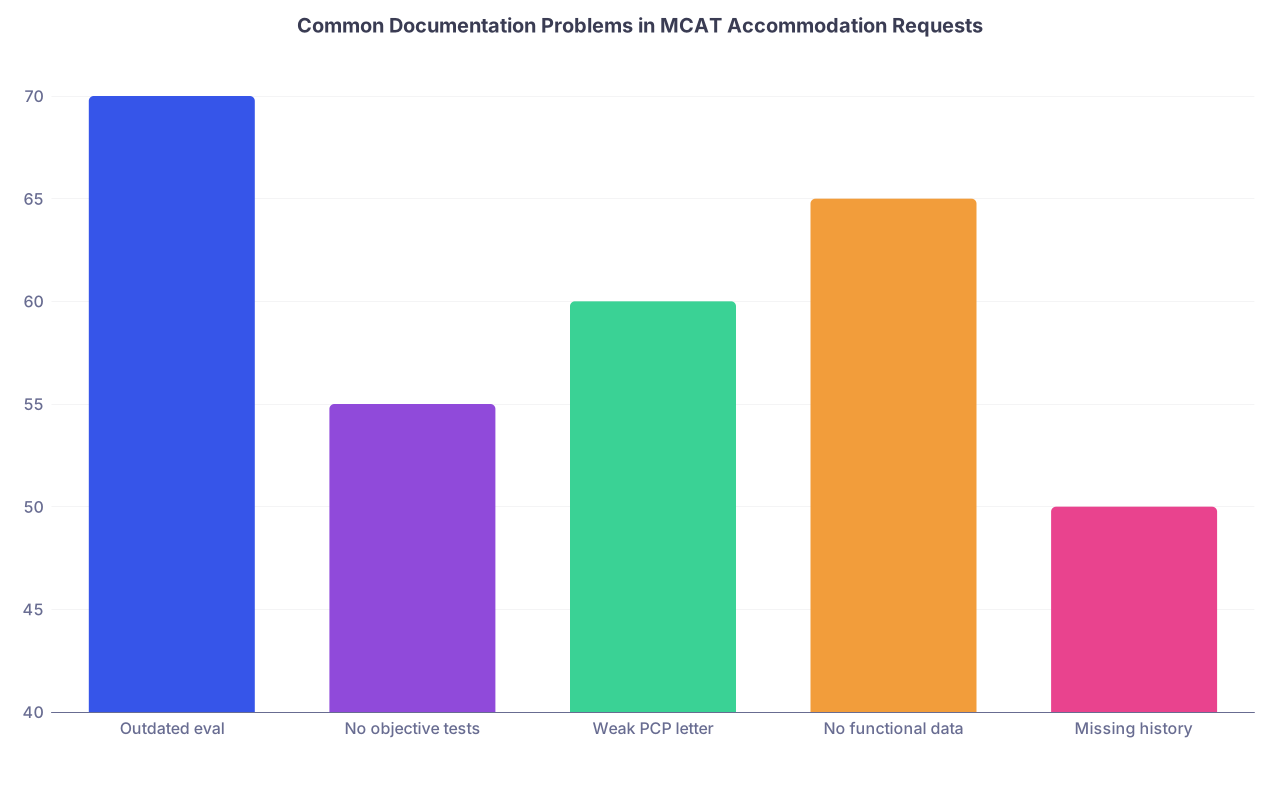
| Category | Value |
|---|---|
| Outdated eval | 70 |
| No objective tests | 55 |
| Weak PCP letter | 60 |
| No functional data | 65 |
| Missing history | 50 |
If your evaluation is:
- More than a few years old, and
- Does not clearly describe your current adult functioning
…you are handing them a reason to deny.
Ask your evaluator, explicitly:
- “Will this report meet AAMC standards for high-stakes testing accommodations?”
If they hesitate, that is your answer. Fix it before you apply.
3. Asking for Accommodations You Do Not Prove You Need
This is the silent killer: over-asking without matching evidence.
You cannot just say “I need double time” because other people with ADHD or dyslexia you know got it. The AAMC looks for proportionality: the severity of the documented impairment must reasonably justify the level of accommodation requested.
Common forms of overreach:
Requesting 2x time with only mild deficits documented
- Test scores mostly average or low-average.
- No clear severe underperformance under timed conditions.
- AAMC: “Your data do not support this level of extra time.”
Asking for a private room with no sensory/behavioral justification
- No history of panic attacks, tics, sensory overload, or disruptive behaviors.
- You just “concentrate better alone.” So does everyone else.
Requesting every possible accommodation “just in case”
- Extra time, extra breaks, private room, paper exam, keyboard changes, etc.
- It reads like a wish list, not a targeted medical need.
Requesting accommodations you have never used before
- No history of extended time in school or on standardized tests.
- Suddenly requesting major accommodations for the MCAT only.
- Major red flag for AAMC.
You must align three things very carefully:
| Element | What AAMC Wants To See |
|---|---|
| Diagnosis | Clear, credible, consistent |
| Functional limitation | Measurable, test-based, not vague |
| Requested accommodation | Directly tied to the specific limitation |
Example of good alignment:
- Documented severe reading fluency deficits (5th percentile) under timed conditions
- History of 1.5x time on exams in college and prior standardized tests
- Requesting 1.5x time on MCAT, not 2x, plus periodic breaks because of fatigue
Example of bad alignment:
- Mild attention problems on self-report, normal test scores
- No prior accommodations history
- Asking for 2x time, single room, and paper exam “because computer screens make it harder”
Ask yourself:
“If a cynical stranger who does not know me at all read my file, would they say the specific accommodation is inevitable from this evidence?”
If the answer is not a clear yes, scale or sharpen your request.
4. Telling a Great Story, but Providing Terrible Structure
The personal narrative part of your application matters. But not the way most students think.
Students often:
- Write a moving personal statement about struggle and resilience
- Describe their anxiety, pain, trauma, or burnout in emotional detail
- Fail to convert that narrative into concrete, test-relevant limitations
Your personal history should do three things:
Show longstanding nature of the condition
- Not “out of nowhere” for the MCAT.
- Early school problems, prior evaluations, earlier interventions.
Connect symptoms to specific academic/testing patterns
- “I run out of time even when I know the material.”
- “My reading speed has always been markedly slower than peers.”
- “I frequently misread answer choices under time pressure.”
Be consistent with the objective data
- If you describe “severe” reading issues but your reading tests are average, you look unreliable.
- If you claim lifelong ADHD but have zero mention of it in any school records, it raises questions.
Do not just “tell your story.” Build a case file. Your narrative, your test scores, your school records, and your provider letters should all be telling the same story, from different angles. If they contradict each other, the AAMC will choose the version that supports denial.
5. Assuming Your Provider Knows How to Write for AAMC
Many clinicians are excellent diagnosticians and terrible documentation writers for high‑stakes exams. This is not an insult; it is just a different skill set.
Common provider mistakes that torpedo your application:
Vague phrases:
- “Student would benefit from additional time.”
- “Accommodations may help reduce anxiety.”
These are useless to AAMC reviewers.
No explanation of why a specific accommodation is medically or functionally necessary
Letters that:
- Repeat your own words instead of adding clinical interpretation
- Use emotional appeals (“She has worked so hard and deserves this chance”)
- Fail to reference the MCAT at all as a unique testing environment
You need to prep your clinician before they write anything. Not script them, but educate them.
Give them:
- The AAMC documentation guidelines for your condition
- A summary of your testing-specific difficulties
- A clear statement of which accommodations you are requesting
They should:
- Reference specific test results and observations
- Use concrete, exam-related language (speed, stamina, accuracy, processing)
- Explicitly connect limitations → requested accommodations
If your clinician’s letter could be copy-pasted into any random accommodation request for any exam, it is probably too generic.
6. Poor Timing: Last-Minute or Poorly Planned Submissions
Rushing this process is how you end up burning an entire cycle.
Here is what I have watched unfold too many times:
- Student decides to ask for accommodations 8–10 weeks before MCAT date
- Realizes they need updated documentation
- Scrambles to book neuropsych testing (often 2–3 month waitlists)
- Submits an incomplete or weak file because “I have to get something in”
- Gets denied
- Does not have time for a meaningful appeal before test date
- Either tests without accommodations or delays a year
Stop doing this to yourself.
A safer timeline (for most students):
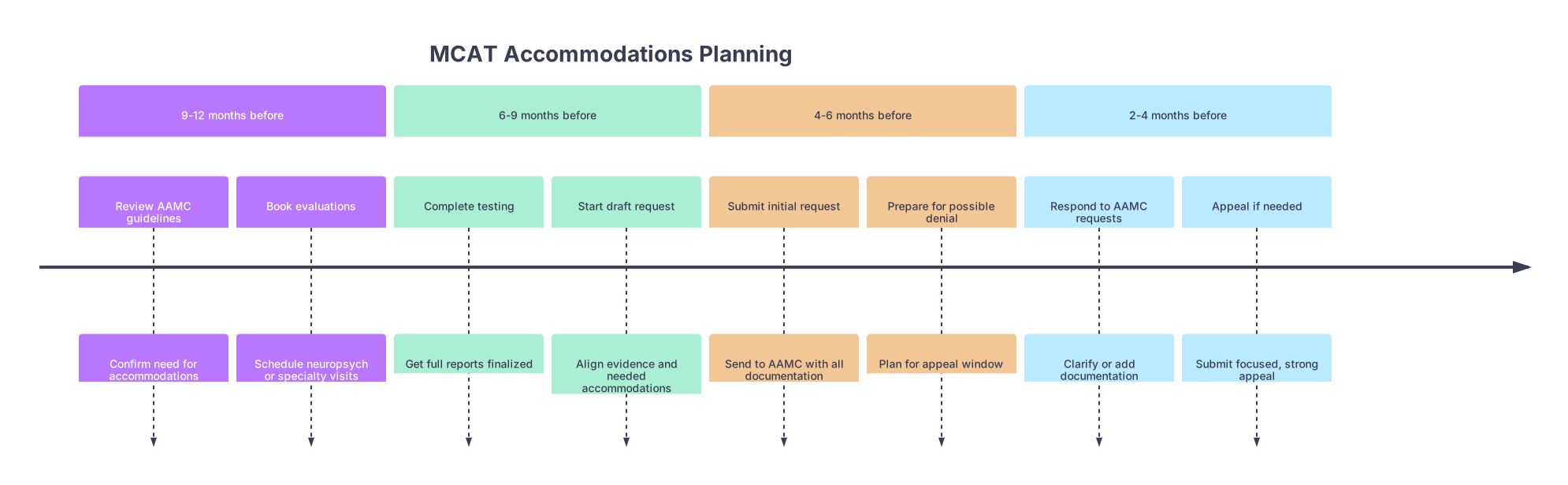
| Period | Event |
|---|---|
| 9-12 months before - Review AAMC guidelines | Confirm need for accommodations |
| 9-12 months before - Book evaluations | Schedule neuropsych or specialty visits |
| 6-9 months before - Complete testing | Get full reports finalized |
| 6-9 months before - Start draft request | Align evidence and needed accommodations |
| 4-6 months before - Submit initial request | Send to AAMC with all documentation |
| 4-6 months before - Prepare for possible denial | Plan for appeal window |
| 2-4 months before - Respond to AAMC requests | Clarify or add documentation |
| 2-4 months before - Appeal if needed | Submit focused, strong appeal |
You want:
- Full, finalized reports in hand before you submit
- Enough time to correct or supplement if AAMC asks for more
- Breathing room for an appeal that is more than a panicked email
If you are already behind this schedule, you need realism. Either:
- Accept you may take the MCAT later than you hoped, or
- Decide strategically if you can or cannot safely test without accommodations
What you cannot do is pretend time pressure will magically lower AAMC’s standards. It will not.
7. Ignoring Inconsistencies That Make You Look Less Credible
This part matters more than most students realize. Inconsistencies kill credibility. The AAMC reviewers pay attention to patterns.
Red flags they notice:
Strong standardized test history with no accommodations
- SAT/ACT/other major exams all average or strong, taken without accommodations
- Now requesting heavy accommodations on the MCAT
You must explain what has changed: progression of illness, new diagnosis, worsening symptoms, etc.
Academic record that does not match described severity
- Near-perfect GPA in heavy reading/writing majors with no supports
- Claiming “severe reading disability” that suddenly appears for the MCAT
Shifting narratives between documents
- You say ADHD was diagnosed in high school.
- Your clinician letter says “diagnosed in college.”
- Your school records say nothing.
They will notice.
Inconsistent accommodation histories
- You state you had 1.5x time in college.
- Official disability office letter only documents note-taking assistance.
None of these automatically mean you are not disabled. Life is messy. But if you do not explicitly reconcile these inconsistencies in your application, you leave AAMC to make the most conservative interpretation.
Spell things out:
- Why you did not receive accommodations earlier
- Why your functional impacts have intensified (e.g., more content, more time pressure, health changes)
- How you compensated before, and why those compensations are no longer enough at this level
Do not let silence do the talking for you. It rarely speaks in your favor.
8. Failing to Think Like a Reviewer
If you want to avoid unnecessary denials, stop thinking like an applicant begging for help and start thinking like a reviewer protecting the exam.
Reviewers are asking:
- Is this diagnosis credible?
- Are the functional limitations clearly established?
- Do the requested accommodations directly address those limitations?
- Do the history and documentation show a consistent pattern over time?
- Are we being asked for accommodations that go beyond what is necessary?
Before you submit, review your entire packet and look for these common “reviewer‑triggering” mistakes:
- Emotionally intense personal statement but weak data
- Strong data but vague or lazy provider letter (one paragraph)
- “Laundry list” of requested accommodations with no precise justification
- Obvious gaps in history (no explanation of earlier testing without accommodations)
- Conflicting dates, diagnoses, or descriptions
Ask a trusted, blunt person—ideally someone with some experience in disability services or academic review—to read your materials and answer one question:
“If you were skeptical and trying to deny this, where would you attack?”
Then fix those weak points before AAMC sees them.
FAQ (Exactly 5 Questions)
1. If I already receive 1.5x time at my university, will the AAMC automatically give me the same for the MCAT?
No. University approval helps, but it is not decisive. The AAMC wants underlying documentation: recent evaluations, objective test data, and explicit functional limitations that justify 1.5x time on a high-stakes, timed exam. Think of your campus letter as supporting evidence, not a golden ticket.
2. How recent does my neuropsych or psychological evaluation need to be for MCAT accommodations?
For ADHD and learning disabilities, you usually want adult‑age or late adolescent data. Evaluations from early childhood are almost never enough alone. As a practical rule: if your testing is older than about 5 years or done pre‑high school, you probably need updated assessment, especially if your current functioning has changed or the old report lacks detailed, timed test data.
3. Can I get accommodations if I have never used them before on standardized tests?
It is harder, but not impossible. You will need to clearly explain why you did not use them before (lack of diagnosis, fear of stigma, inaccessible services, milder symptoms that have worsened) and back that up with strong current evidence. Without that context, requesting major accommodations for the first time on the MCAT looks suspicious to reviewers.
4. What is the biggest documentation mistake that leads to denial?
The single worst mistake is sending in a short, generic provider letter with no objective testing, no specific functional limitations, and a vague recommendation like “extra time would be helpful.” That kind of letter signals to reviewers that there is no rigorous evidence behind the request. They will deny or ask for more, and you will lose time you probably do not have.
5. If my initial request is denied, is an appeal actually worth it?
Yes—if you are willing to do real work on the weaknesses the AAMC pointed out. A good appeal is not “Please reconsider, I really need this.” It is: new or clarified documentation, updated testing if necessary, precise responses to every reason they listed for denial, and tighter alignment between limitations and requested accommodations. If you just resend the same material with more emotion, you are wasting your appeal.
Key points to remember:
- Do not assume campus accommodations or a diagnosis alone are enough; the AAMC wants hard, current, test‑relevant evidence.
- Match each requested accommodation to clearly documented functional limitations and a consistent history.
- Start the process early, read the AAMC guidelines like a contract, and fix inconsistencies before the reviewers see them.