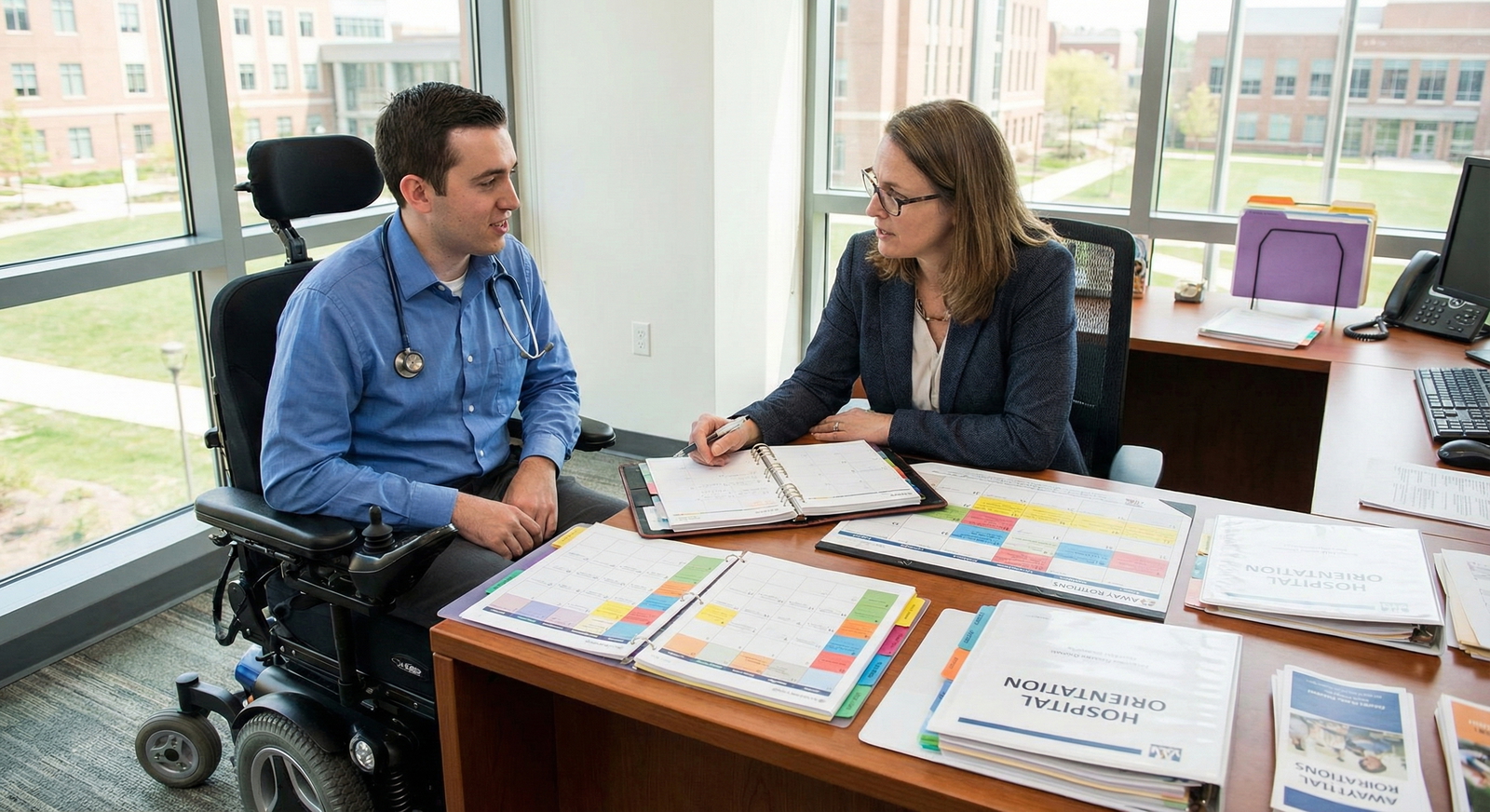
Understanding the Landscape: Chronic Illness, Disability, and Residency
Entering residency as an MD graduate is demanding under the best circumstances. For an MD graduate residency candidate managing a chronic illness—whether visible or invisible—the transition can feel especially complex. You are navigating not only the allopathic medical school match process but also questions about disclosure, performance, safety, stigma, and disability accommodations in residency.
This article is designed for you: a recent or soon-to-be MD graduate with a long-term health condition considering how to approach your residency applications and training environment. We’ll walk through:
- How chronic illness intersects with the definition of disability
- Your legal protections and rights as a trainee-physician
- How and when to disclose a health condition on your application
- What kinds of accommodations are possible in residency
- Strategies for choosing programs, advocating for yourself, and thriving
The goal is not to convince you to disclose or to conceal your condition, but to give you the information, frameworks, and language to make informed, strategic decisions that prioritize both your career and your health.
1. Chronic Illness, Disability, and the MD Graduate: Setting the Stage
1.1 Chronic illness and the “technical standards” debate
Most allopathic medical schools and residency programs publish “technical standards”—the physical, cognitive, and behavioral abilities they consider essential to perform the role of physician, with or without reasonable accommodations.
Common categories include:
- Observation (e.g., visual, auditory, tactile)
- Communication (verbal, written, electronic)
- Motor function (performing physical exams, procedures)
- Intellectual abilities (reasoning, problem-solving, judgment)
- Professionalism (reliability, emotional stability, ethics)
A chronic illness—such as diabetes, inflammatory bowel disease, rheumatoid arthritis, migraine disorder, epilepsy, multiple sclerosis, congenital heart disease, or a psychiatric condition—may impact one or more of these domains some of the time or nearly all the time.
However:
- A limitation does not mean you are “unfit” for residency.
- Many MD graduates successfully complete residency with appropriate disability accommodations.
- Technical standards are required to be achievable with reasonable accommodations, not only in an “ideal healthy body.”
Recognizing that your chronic illness may qualify as a disability is not about labeling yourself. It is about unlocking legal protections and structured forms of support that allow you to perform at your best.
1.2 When a chronic illness qualifies as a disability
In the U.S., under the Americans with Disabilities Act (ADA) and Section 504 of the Rehabilitation Act, a disability is generally defined as:
A physical or mental impairment that substantially limits one or more major life activities.
Major life activities include walking, seeing, hearing, eating, sleeping, concentrating, working, caring for yourself, major bodily functions (immune system, endocrine function, bowel, bladder, neurological, etc.), and others.
Examples of chronic illness that often qualify as disabilities, depending on impact:
- Type 1 or Type 2 diabetes
- Crohn’s disease or ulcerative colitis
- Epilepsy
- Severe asthma or COPD
- Rheumatologic disease (e.g., SLE, RA)
- HIV or other immunocompromising conditions
- Cardiac conditions or POTS
- Migraine with significant functional impairment
- Major depressive disorder, bipolar disorder, anxiety disorders, ADHD, OCD, PTSD
- Some forms of cancer and cancer survivorship conditions
Importantly, you don’t need to be “severely impaired” all the time. Intermittent or episodic conditions can still qualify, especially if they predictably or periodically limit your functioning.
2. Your Rights and Legal Protections as a Resident Physician
Understanding your rights is foundational before you decide how to handle a health condition application strategy for the Match and beyond.
2.1 Key legal frameworks (U.S.-focused)
While details vary by country, for U.S. MD graduates these frameworks are central:
- ADA (Title I & Title II): Prohibits discrimination based on disability in employment and public services. Residency is often considered both employment and education.
- Section 504 of the Rehabilitation Act: Prohibits disability discrimination in programs receiving federal funding (most academic institutions).
- GME policies / institutional policies: Many institutions have internal policies specific to resident accommodations, leave, and fitness for duty.
Under these laws and policies:
- You have the right to request reasonable accommodations.
- The program cannot retaliate against you for requesting or using accommodations.
- The institution must engage in an interactive process with you to determine what accommodations are reasonable.
- Your medical information must be kept confidential and separate from personnel files, with limited access.
Reasonable accommodations do not mean eliminating essential job functions, but they can significantly alter how those functions are performed.
2.2 What “reasonable” means in residency
“Reasonable” accommodations in the residency context are those that:
- Allow you to perform the essential functions of your role
- Do not create undue hardship for the program (e.g., excessive cost or operational disruption)
- Do not significantly compromise patient safety
The bar for “undue hardship” is higher than many programs informally assume. Accommodations like schedule adjustments, assistive devices, or modified call patterns are frequently negotiable.
3. Accommodations in Residency: What’s Possible and How to Request Them

3.1 Examples of disability accommodations in residency
The right accommodations depend on your diagnosis, symptoms, and clinical demands of your specialty. Below are real-world types of disability accommodations residency programs have provided.
Scheduling and duty hours
- Strategic scheduling of days off to align with infusion treatments, dialysis, or weekly flares
- Avoidance or limitation of back-to-back 28-hour calls where not essential
- Predictable clinic days (e.g., no “surprise” late add-on clinics when you need consistent medication timing)
- Increased break time during long OR days for conditions like POTS, diabetes, or musculoskeletal issues
- Ability to step away briefly for blood glucose checks or restroom access for IBD
Physical and environmental accommodations
- Ergonomic workstations or adjustable-height stools for charting and procedures
- Permission to sit during parts of rounds or bedside teaching
- Parking accommodations closer to clinical sites
- Access to refrigeration for medications or sharps disposal for injections
- Alternative call rooms or quiet spaces for migraine-prone residents
- Personal protective equipment tailored to your condition (e.g., N95 availability for immunocompromised residents)
Task-related modifications
- Redistribution of tasks requiring prolonged standing, lifting, or repetitive strain, balanced by increased responsibility in other areas (e.g., care coordination, procedures you can perform safely)
- Use of scribes or dictation software if manual documentation is limited by arthritis or neuropathy
- Assistive devices: magnification tools for visual impairment, adapted instruments, or electronic stethoscopes
Testing and assessment accommodations
- Extended time on standardized exams administered during residency (in-training or board exams), separate testing room, or scheduled breaks
- Flexible scheduling of mandatory OSCEs, simulations, or didactics around treatment
Leave and time off
- Structured medical leave with a plan to meet board eligibility requirements
- Staggered return-to-work or graduated schedules after a flare or hospitalization
- Additional sick days beyond standard policy, negotiated case-by-case
Realistically, not every program can offer every accommodation; small community programs may be less flexible than large academic centers. But many MD graduate residency trainees underestimate how much is negotiable once they are in a program and performing well.
3.2 Timing: When to request accommodations
There are three primary time points:
- Before Match (during application)
- After Match, before starting residency
- After starting residency (new diagnosis or change in status)
Each carries different strategic considerations.
1. Before Match
- Pros: You can identify programs explicitly open to disability accommodations residency discussions; you may avoid matching into programs clearly unable to meet your needs.
- Cons: Disclosure during the allopathic medical school match process always carries some risk of unconscious bias, despite legal protections.
Most MD graduates choose not to make a formal accommodations request before Match unless:
- The condition requires extremely specific scheduling or specialty choice (e.g., dialysis three times a week, need for a specific region for subspecialty care).
- They are applying in a small subspecialty where honest, early discussions are critical.
2. After Match, before starting
This is a common and usually safe time to engage:
- You are already matched; you are not competing for a spot.
- Programs have more concrete information about your schedule and rotations.
- You can begin your intern year with supports in place rather than struggling through preventable crises.
3. After starting residency
If your condition worsens, a new diagnosis arises, or initial accommodations are not sufficient, you can request additional accommodations. The law does not require you to anticipate every need up front.
3.3 How to request accommodations: Step-by-step
Gather medical documentation
- A letter from your treating clinician that:
- Confirms the diagnosis (or at least functional limitations if diagnosis is sensitive)
- Describes how it impacts major life activities and/or specific work tasks
- Recommends general types of accommodations (e.g., predictable days off, no overnight shifts back-to-back, breaks for glucose checks)
- A letter from your treating clinician that:
Identify the right office
- For MD graduate residency trainees, the process may go through:
- The hospital’s GME office
- The university’s disability services office (often for didactics/exams)
- Human Resources for employment-related accommodations
- Ask your program administrator or GME office: “Who handles disability accommodations for residents here?”
- For MD graduate residency trainees, the process may go through:
Submit a formal written request
Include:
- A concise description of your condition’s impact (not necessarily your full medical history)
- The accommodations you are requesting, framed as enabling you to perform essential functions
- Willingness to engage in an interactive process
Example language:
“I am requesting reasonable accommodations under the ADA due to a chronic health condition that affects my ability to perform certain tasks without modified scheduling. Specifically, I request predictable days off for weekly treatments and access to refrigeration for medication storage. I am committed to fulfilling all essential functions of the residency and am available to discuss how these accommodations can be implemented.”
Engage in the interactive process
Expect back-and-forth. They might:
- Ask clarifying questions
- Request additional documentation
- Propose alternatives if your initial requests are challenging to implement
Keep communication professional, solutions-focused, and anchored in patient safety and your ability to meet competencies.
Get the plan in writing
- Ask for a written description of your approved accommodations.
- Clarify who in the program will know about them (e.g., PD, chief residents, rotation directors).
- Confirm how to handle situations where your health changes (e.g., flare, hospitalization).
4. Disclosure Strategy in the Match: If, When, and How

Residency applicants often struggle with how much to share about a chronic illness or disability during the allopathic medical school match. There is no universally correct answer. Use a risk–benefit framework tailored to your goals, specialty, and condition.
4.1 Reasons you might choose to disclose during applications
- Your story is central to your motivation for medicine or your specialty (e.g., an MD graduate with multiple sclerosis drawn to neurology or PM&R).
- You need specific geographic constraints for continuity of complex care.
- You anticipate needing significant accommodations from day one and want to ensure program buy-in.
- You value alignment with supportive program culture, even if that means receiving fewer interview invitations overall.
If you choose to disclose, focus on:
- Resilience and strategies, not just adversity
- Concrete examples of how you’ve successfully performed clinical duties
- Insight you bring to patient care as a chronic illness medical student and now as a physician
- How your experience enhances professionalism, empathy, and systems thinking
4.2 Reasons you might choose not to disclose until after Match
- Your health condition is currently well controlled and does not require major schedule modifications.
- You primarily anticipate minor accommodations (e.g., breaks for glucose checks, ergonomic equipment) that can easily be arranged after start.
- Your main concern is avoiding conscious or unconscious bias, especially in competitive specialties.
You are legally entitled to confidentiality and do not have to discuss health details during interviews. If asked improper questions about your health, you can respond with:
“I’m fully able to meet the essential requirements of the residency position and comply with duty hour expectations.”
You are not required to elaborate further.
4.3 How to frame your story if you do disclose
If you opt to incorporate your health condition into your application:
Personal statement
- Briefly name the condition or describe it functionally (“a chronic autoimmune condition”).
- Emphasize what you learned: navigating the healthcare system, advocating for yourself, understanding chronic pain or fatigue, appreciating multidisciplinary care.
- Connect these insights to your clinical interests and strengths.
ERAS experiences section
Use entries that show:
- Longitudinal commitment despite health challenges (e.g., research, QI projects)
- Systems-level thinking: involvement in accessibility initiatives, wellness committees, advocacy work
- Leadership: mentoring other students with disabilities, developing support groups
Interviews
Prepare concise, confident responses to:
- “Tell me about a challenge you’ve overcome.”
- “How do you handle stress and high workload?”
- “Can you manage our call schedule?”
You might say:
“I manage a chronic health condition that has taught me to be proactive with planning, communicate clearly with my team, and prioritize patient safety. Throughout clinical rotations, I consistently met or exceeded expectations, including on busy inpatient services. I’ve learned to recognize early signs of fatigue, use my off-time well for recovery, and rely on evidence-based self-management. I’m confident in my ability to meet the demands of residency, and I have systems in place that have worked well for me.”
Avoid centering the narrative on limitations; instead, spotlight the competencies you’ve developed because of—not in spite of—your condition.
5. Choosing Programs and Specialties Strategically
For a health condition application strategy, program selection is as important as disclosure decisions. You are not just trying to match—you’re aiming to match somewhere you can sustainably thrive.
5.1 Specialty-specific considerations
Chronic illness does not preclude any particular specialty, but different fields have different typical demands:
- Surgery, OB/GYN, EM: Long OR cases or intense shifts; more prolonged standing and night work; some programs more flexible than others.
- Internal Medicine, Pediatrics, Family Medicine: Inpatient months can still be grueling, but often more schedule variation and outpatient-heavy career options down the line.
- Psychiatry, Pathology, Radiology, Neurology, PM&R: Physically lighter in many settings, though call and cognitive load can still be substantial.
Ask yourself:
- How does fatigue, pain, or flare frequency intersect with typical duty hours?
- Are there aspects of the specialty that actually align with caring for your condition (e.g., scheduling predictability, outpatient options, telehealth possibilities)?
- Does the specialty provide career paths that can adapt if your condition changes over time (e.g., primarily outpatient practice, academic roles, research time)?
5.2 Evaluating program culture and flexibility
Whether or not you disclose, you can gather signals about how supportive a program might be:
- Ask residents (at pre-interview socials or post-interview):
- “How does the program handle serious illness or family emergencies?”
- “Has anyone taken medical leave, and how did the program respond?”
- “How strictly are duty hours enforced?”
- Look for clues in how they discuss:
- Wellness initiatives
- Parental leave and family responsibilities
- Mental health support
- On interview day, note if leadership language is rigid (“We expect our residents to just push through anything”) versus flexible (“We work with residents individually to help them succeed”).
Programs that treat pregnant residents, new parents, or residents with short-term medical issues compassionately are more likely to support chronic illness and disability as well.
5.3 Geographic and institutional considerations
For an MD graduate residency candidate with a chronic condition, geography may be more than lifestyle—it can be health-critical:
- Access to your specialists (e.g., rheumatologist, neurologist, transplant team)
- Proximity to a tertiary or quaternary care center familiar with your diagnosis
- Climate factors that affect your symptoms (e.g., heat, humidity, altitude)
- Insurance networks and coverage for your current medications, infusions, or devices
When building your rank list, balance reputation with realistic support for your health. A slightly less “prestigious” program where you can safely complete training is more valuable than a “top” program that may push you beyond your physical limits.
6. Thriving in Residency with Chronic Illness: Practical Strategies
Once you’ve matched and arranged disability accommodations residency supports, focus on sustainable habits and self-advocacy.
6.1 Building your support network
- Healthcare team: Ensure you can maintain regular follow-up; schedule appointments during elective or lighter rotations when possible.
- Peer allies: Trusted co-residents who understand your condition and can swap call if you have a sudden flare.
- Mentors with lived experience: Seek faculty or senior residents who have navigated a health condition or disability themselves.
- Family/friends: Explicitly discuss your schedule realities and where you may need concrete help (meals, transportation, emotional support).
6.2 Communication with your program and colleagues
You do not owe everyone detailed medical information, but a simple framework helps:
- Program leadership (PD, APD, chiefs): Higher-level understanding of your functional limitations and accommodations.
- Immediate team (attendings, co-residents): Task- and shift-relevant information:
- “If I step out briefly during rounds, it’s for a medical reason— I’ll be back in a few minutes.”
- “I might need to sit occasionally due to a health condition, but I can still fully participate.”
When issues arise (e.g., repeated schedule violations of agreed accommodations), document examples and bring them to GME or disability services promptly.
6.3 Anticipatory planning for flares and crises
Work with your clinicians and your program to create:
- A flare plan:
- When you can safely continue working; when you need to call out
- How to communicate urgent needs without oversharing
- Backup coverage protocols
- A medication and supplies plan:
- Extra medication at work (as appropriate)
- Redundancy for devices (batteries, infusion sets, inhalers)
- A board eligibility and graduation plan:
- If you ever require extended medical leave, clarify how this interacts with ACGME and board requirements for time in training.
6.4 Protecting your own perspective
Residency can make anyone doubt themselves, and MD graduates with chronic illness may be especially vulnerable to internalized stigma:
- You may feel guilty about taking leave or using accommodations, even when they are entirely justified.
- You might compare yourself to co-residents with different health profiles.
Counterbalance this by:
- Reframing accommodations as tools for excellence, not weakness.
- Remembering that medicine benefits from physicians with diverse bodies and lived experiences.
- Celebrating your achievements—milestone by milestone—given the extra complexity you are managing.
FAQs: Chronic Illness, Disability, and Residency Applications
1. Do I have to disclose my chronic illness on ERAS or during interviews?
No. You are under no obligation to disclose a chronic health condition during your residency application or interviews unless it directly prevents you from meeting essential job functions. You can request accommodations after you match and even after you start residency. If asked inappropriate health questions, you can redirect to your ability to perform the role.
2. Will requesting accommodations hurt my career or evaluation in residency?
Legally, you are protected from retaliation for requesting or using disability accommodations. In practice, culture varies by program. This is why documenting agreements, working through formal channels (GME, disability services), and choosing programs with a reputation for supporting residents during crises are key. Using accommodations to safely meet expectations is more protective of your career than silently struggling and risking performance or health crises.
3. What if my health worsens after I start residency and I didn’t disclose it before?
You can still request disability accommodations residency support at any time, even if your condition changes or is newly diagnosed. Contact your PD and the GME or disability services office, provide updated medical documentation, and engage in the interactive process. You may also be eligible for medical leave, with a plan to make up required training time later.
4. Can a program legally unmatch me or withdraw my contract because of my chronic illness?
Once you have matched and signed a contract, a program cannot rescind your position solely due to a disclosed disability if you can perform essential functions with reasonable accommodations. If concerns arise about fitness for duty or patient safety, they must follow structured, non-discriminatory processes. If you ever suspect discrimination, consult your school’s disability office, a physician union (if present), or a lawyer experienced in healthcare/ADA cases.
Managing a chronic illness as an MD graduate residency applicant is undeniably complex—but it is also absolutely compatible with a successful, fulfilling training experience. By understanding your rights, planning an intentional health condition application strategy, requesting thoughtful accommodations, and choosing programs aligned with your needs, you can build a career that honors both your ambition and your well-being.