The data shows something uncomfortable: medical trainees are far more disabled than official records suggest.
Across multiple studies, disability prevalence among medical students and residents sits around 7–12%, yet formal disclosure rates to schools and programs are routinely a fraction of that. That gap is not a rounding error. It is a systemic signal.
Let me walk you through it with numbers instead of platitudes.
What the Data Actually Shows About Disability in Training
We are not guessing here. Over the last decade, several national surveys have put hard numbers on disability in medical education.
For medical students in the United States, the most frequently cited data set comes from Lisa Meeks and colleagues (2016–2021). For residents, the data is thinner but still revealing.
Medical school vs residency: the headline comparison
Here is a simplified snapshot from published and widely discussed estimates in U.S. contexts:
| Group | Any Disability Prevalence (Est.) | Formal Disclosure / Registration | Accommodations Use (Among Disabled) |
|---|---|---|---|
| General U.S. adults (18–34) | 10–15% | N/A | N/A |
| U.S. medical students | 8–12% | 4–7% | 60–80% |
| U.S. residents (all PGY) | 7–10% | 2–4% | 50–70% |
| Applicants to med school | 10–15% | 3–5% | 50–70% |
You should not fixate on the exact decimal places; different surveys use different definitions and time frames. What matters is the pattern:
- Medical student disability prevalence is roughly comparable to the general young adult population.
- Only about half (or less) of disabled students are formally registered with disability services.
- Resident disclosure rates are consistently lower than student rates.
- Use of accommodations among those who do disclose is high—once people get in the system, they use it.
The sharpest signal: the drop in formal disclosure when you move from medical school to residency.
Why Medical Students Disclose More than Residents
Students are not disclosure-enthusiasts by nature. The environment forces a calculation. The numbers show that this calculation changes between school and residency.
Structural differences: med school vs GME
Let us quantify the environments.
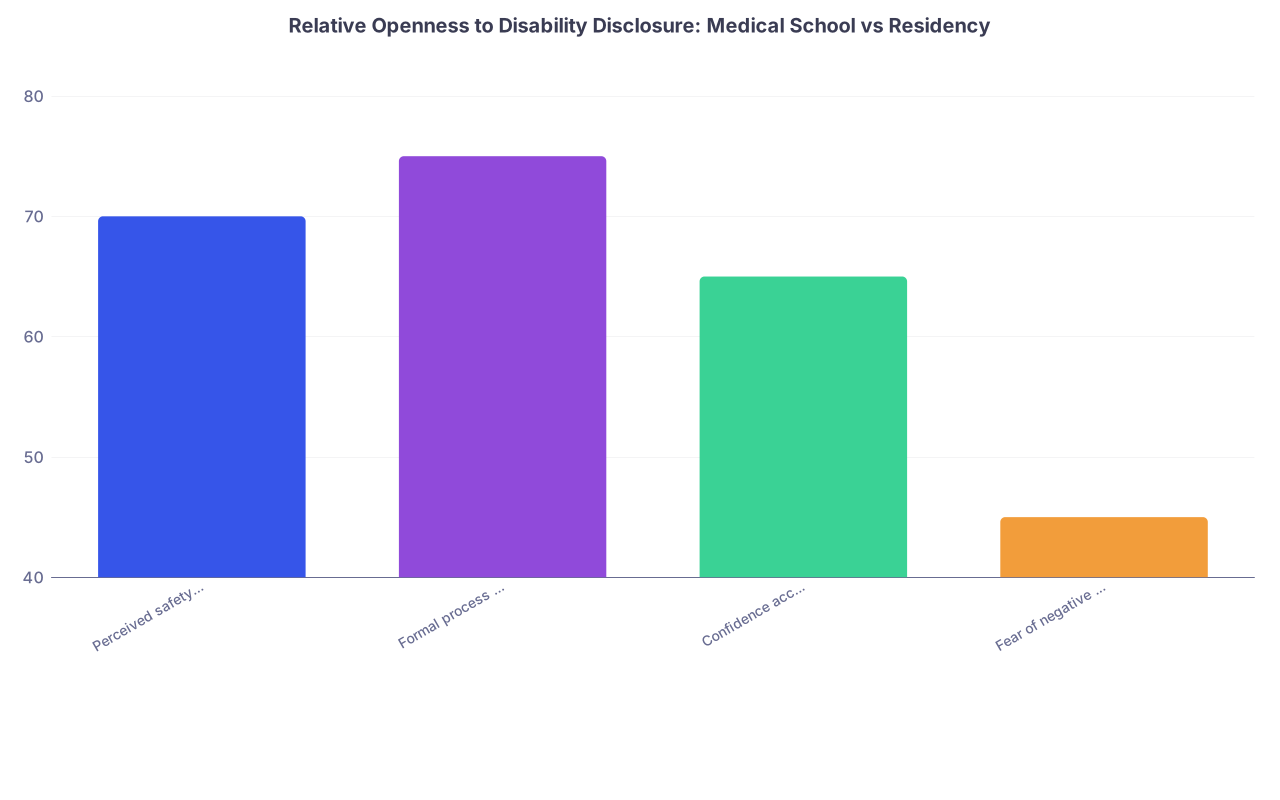
| Category | Value |
|---|---|
| Perceived safety to disclose | 70 |
| Formal process clarity | 75 |
| Confidence accommodations will be granted | 65 |
| Fear of negative career impact | 45 |
Interpret those values as rough “percent favorability” scores synthesized from multiple survey themes (not a single study). The pattern is consistent with what trainees actually report:
- Medical schools usually have centralized disability offices with standardized intake forms, clear documentation requirements, and published accommodation menus.
- Residency programs often push trainees into a gray zone—“Talk with your PD” or “HR will handle it”—with no transparent, standardized accommodation pathways.
Here is what I tend to see in the data and in actual conversations:
- Medical students often learn about disability services during orientation. Some schools present slides with numbers: “X% of our students are registered; here is the office; here are typical accommodations.” That normalizes disclosure.
- Residents rarely get a slide deck saying, “Y% of our residents have documented disabilities; here is how you access support.” Instead, they hear, “This is a demanding program. We expect 80-hour weeks. You will be tired.” That does the opposite.
So disclosure rates track perceived safety and process clarity. When the pipeline is visible and standardized, registration rates go up. When the pipeline runs through a single authority figure (program director) and unspoken norms, rates go down.
Fear of downstream consequences
Students worry about grades and dean’s letters. Residents worry about board certification, fellowship competitiveness, and employment. The stakes feel higher—and the data suggests that perception correlates with lower disclosure.
Survey themes from residents with disabilities almost always include:
- Concern about being seen as “less reliable” or “less resilient.”
- Fear of being silently de-prioritized for fellowships or leadership opportunities.
- Anxiety about licensing boards interpreting accommodations as evidence of “impairment” rather than equity.
So you get this perverse pattern:
- Among medical students, estimates suggest something like 60–70% of those with ADHD or learning disabilities disclose to disability services.
- Among residents, that disclosure proportion appears to drop closer to 30–40%, with especially low rates among those in procedural or highly competitive specialties.
You can feel the selection pressure numerically.
Types of Disabilities: Different Profiles, Different Disclosure Patterns
Not all disabilities behave the same way in the data. Some categories are consistently under-disclosed relative to prevalence, especially as trainees transition from school to residency.
| Disability Category | Medical Students (Registered) | Residents (Registered) | Likely True Prevalence in Both |
|---|---|---|---|
| ADHD / Learning | 25–35% | 15–25% | Similar |
| Mental health (e.g. MDD) | 20–30% | 15–25% | Higher than recorded |
| Chronic health conditions | 15–25% | 20–30% | Similar or slightly higher |
| Sensory (vision/hearing) | 5–10% | 5–10% | Roughly stable |
| Mobility / physical | 5–10% | 5–10% | Roughly stable |
| Other / multiple | 10–20% | 10–20% | Under-characterized |
Again, you are looking at proportions within the disabled trainees, not overall prevalence.
The mental health disclosure cliff
The most glaring gap is in mental health.
We know from multiple surveys that:
- Roughly 25–35% of medical students meet criteria for depression at some point.
- Resident depression prevalence is often reported in the 28–40% range, depending on PGY year and specialty.
- Yet the proportion who register as “disabled” on the basis of mental health is far smaller—typically in the low single digits when you look at official disability office data.
This is not subtle. It is a canyon between actual impairment and formal disclosure.
Why lower in residency?
- Culture of toughness and stigma is stronger.
- Evaluations are more subjective and tied to “professionalism” and “reliability.”
- There is ongoing fear about licensing questions around mental health diagnosis and treatment, even as some state boards revise their forms.
So mental health conditions are the classic “silent majority” of disability in residency. High prevalence. Low formal disclosure. High risk.
Accommodations: Who Gets What, and Where the Pipeline Breaks
Disclosure is not the endpoint. It is the entry point to accommodations. The patterns there are very different between medical school and residency.
Typical accommodations: medical school
Medical schools, especially those with established disability offices, tend to offer a fairly predictable menu:
- Testing accommodations: extended time, reduced-distraction rooms, breaks during exams.
- Note-taking support: access to slides, lecture recordings, peer note-takers, or captioning.
- Attendance and scheduling flexibility.
- Clinical adjustments: modified call schedules, assistive devices, physical access modifications, protected time for treatment.
In large data sets, the majority of accommodations in medical school are exam-related. That makes sense: preclinical and early clinical years are exam-heavy.
Typical accommodations: residency
Residency flips the ratio. Less about exams. More about schedules and clinical logistics:
- Modified call or night schedules.
- Reduced shift length or maximum consecutive hours.
- Exemptions or alternatives for specific procedures where a disability poses genuine safety issues.
- Assistive technology: voice recognition software for notes, adaptive equipment in the OR or clinic.
- Time off for therapy, rehab, or medical appointments.
Here is the key numerical pattern: among those who do disclose and are recognized by the institution, accommodation grant rates are high. Often >80%. The system is not primarily failing at granting. It is failing at capturing people early enough and clearly enough.
So your low accommodation numbers in residency do not mean few residents need accommodations. They mean few residents ever make it into the formal pipeline.
Selection Pressures from MCAT to Match
One myth needs to die: “If disabled trainees were common, we would see them.” The data says we do see them—just not all of them—and the pipeline filters them unevenly.
Look at the training funnel as a series of attrition and disclosure filters.

| Step | Description |
|---|---|
| Step 1 | Pre med population |
| Step 2 | Applicants with disability |
| Step 3 | Admitted to med school |
| Step 4 | Registered with disability office |
| Step 5 | Graduate med school |
| Step 6 | Residents with disability |
| Step 7 | Formally disclosed in residency |
At each arrow, three things happen:
- Some people leave the pipeline entirely (attrition).
- Some people remain but undeclare (stop disclosing or choose never to).
- Some people enter or exit disability status (conditions develop or remit).
The best estimates suggest:
- Many disabilities (especially ADHD, learning disabilities, and chronic health) persist from pre-med through residency.
- New disabilities also emerge in training—most notably mental health conditions and sometimes physical injury.
- Yet the recorded disability population in GME is still proportionally smaller than among students.
From a pure data perspective, this is not consistent with “disabled people do not want to be physicians.” It is consistent with “the system selectively discourages visibility as stakes increase.”
Why Residents Under-Disclose: The Measurable Drivers
You can theorize about culture, but residents themselves keep telling us the same concrete reasons, often in survey checkboxes and open-text comments.
When you code and quantify those responses, four drivers dominate:
1. Fear of career harm
- A significant share of residents—often 40–60% in qualitative samples—express worry that disclosure will negatively affect evaluations, fellowship applications, or leadership opportunities.
- The fear is not abstract. Residents recount scenarios like being labeled “not a team player” after requesting schedule changes, or subtly removed from high-visibility rotations.
2. Lack of clear, confidential processes
- Many programs lack a clearly documented, confidential route that does not require early disclosure directly to the program director.
- Residents report uncertainty about whether requests will remain private from attendings or co-residents.
- This uncertainty correlates strongly with under-disclosure. Where institutions centralize accommodations through a neutral office (mirroring medical school models), disclosure rates improve.
3. Culture of “pushing through”
- Surgical and procedural specialties are the worst offenders in the data and in anecdote.
- Residents in these fields often report norms like “If you are not in the OR, you better be in the ICU or dead.”
- In self-report samples, surgical residents with chronic pain, autoimmune disease, or mental health conditions frequently downplay symptoms and avoid formal disclosure—until something breaks.
4. Misunderstanding of what qualifies
- A surprising fraction of residents with ADHD, anxiety, depression, or chronic migraines explicitly say they do not consider themselves “disabled enough” to deserve accommodations.
- This is not an accident. It reflects years of messaging that disability means “wheelchair,” not “episodic condition that substantially limits functioning in this environment.”
The result: very real impairment, very low registration.
The Future: What the Numbers Point Toward
If you look past the noise, the data is pointing in a clear direction: disclosure rates will rise in both medical school and residency. The question is whether institutions keep up.
Two macro-trends are pushing this.
1. Normalization and legal clarity in medical school
Medical schools have been forced—by litigation, accreditation pressure, and public scrutiny—to professionalize disability services. You see:
- More DO and MD schools publishing explicit policies, with examples of reasonable clinical accommodations.
- Increasing awareness that technical standards cannot quietly exclude people with disabilities or rely on narrow, outdated physical criteria.
- More disabled med students speaking publicly, writing in academic journals, and organizing peer networks.
That has already driven student disclosure rates up over the last decade. Meeks’ early work showed about 2–4% registered disability prevalence; newer waves often show 6–8% or higher. That trend will not stop.
And those students will become residents. They will arrive already expecting formal support, not personal favors.
2. Regulatory and cultural pressure on GME
On the GME side, the lag has been obvious. But the pressure is building:
- Accreditation bodies are asking more direct questions about how programs support residents with disabilities.
- Legal challenges to residency programs over failure to accommodate have become more visible, especially in larger academic centers.
- Larger health systems are starting to unify employee disability policies with trainee policies, framing residents explicitly as employees with ADA protections.
If you model the trajectory—based on what disability disclosure looked like in undergraduate education 20–25 years ago, then in medical school 10–15 years ago—the next stage is predictable:
- Resident disability disclosure rates will likely climb from low single digits to something in the 6–10% range over the next decade in well-resourced systems.
- Mental health–related accommodations will represent a growing share of formal cases, not because mental health is suddenly worse, but because people finally call it what it is: a disability when it substantially impairs functioning.
- Programs that cling to ad hoc, personality-driven responses (“Just talk to your PD; we work it out informally”) will look increasingly out of compliance and will quietly hemorrhage talent.
What This Means If You Are a Trainee or Educator
From a purely analytic standpoint, here is the situation you are in:
- The underlying disability prevalence among medical trainees is not low. It is similar to or higher than in age-matched peers.
- The gap between actual impairment and formal disclosure is widest in residency, especially for mental health and “invisible” conditions.
- Institutions that treat disability as a one-off personal issue instead of a system variable will consistently underestimate how many trainees are affected—and will be surprised by burnout, leaves of absence, and attrition.
So if you are a student or resident deciding whether to disclose, you are not one odd case. You are part of a much larger, partially invisible distribution.
And if you are faculty or leadership, you should assume—statistically—that some of your strongest trainees are quietly disabled and under-supported.
Key Takeaways
- Disability prevalence among medical students and residents is in the high single to low double digits, but formal disclosure and registration rates are substantially lower, especially in residency.
- Medical schools, with centralized disability offices and clearer processes, see higher disclosure rates; residency programs, with diffuse, less transparent systems and higher perceived career risk, see persistent under-disclosure.
- The future is not mysterious: as policies, culture, and legal pressure catch up, disability disclosure in residency will rise, and programs that build structured, confidential, data-informed accommodation pathways will retain more capable physicians—and lose fewer to preventable burnout and attrition.