
The fear that “if you disclose a disability, your career is over” is not supported by data. It is supported by anecdotes, outdated policies, and a lot of rumor.
Licensing boards and hospitals have certainly done damage in the past. Some still do. But if you actually look at the numbers, the gap between fear narratives and documented board actions is large. Quantifiably large.
What follows is not a motivational speech. It is a reality check based on available data, policy trends, and the actual risk surface for disabled and mentally ill physicians.
What the Data Actually Say About Board Actions
Start with the core question: “If I disclose a disability or mental health condition, how likely is it that a licensing board will discipline me because of it?”
The best hard numbers we have come from:
- FSMB (Federation of State Medical Boards) annual reports on board actions
- Published surveys of state medical boards and physicians
- Policy analyses of licensing questions pre‑ and post‑Americans with Disabilities Act (ADA) litigation and DOJ guidance
Board action statistics consistently show:
The overwhelming majority of actions are for:
- Substance use that impairs practice
- Criminal behavior (fraud, abuse, diversion, DUIs with clear risk)
- Gross incompetence or severe boundary violations
Very few actions are triggered solely by the existence of a diagnosis or disability label.
The FSMB’s national data typically show total annual board actions in the low thousands, against a physician workforce of roughly 1,000,000 in the U.S. That is a rate on the order of 2–4 actions per 1,000 physicians per year, depending on the year and what you count as a “major” action.
Within those actions, disability or mental health per se is rarely the primary category.
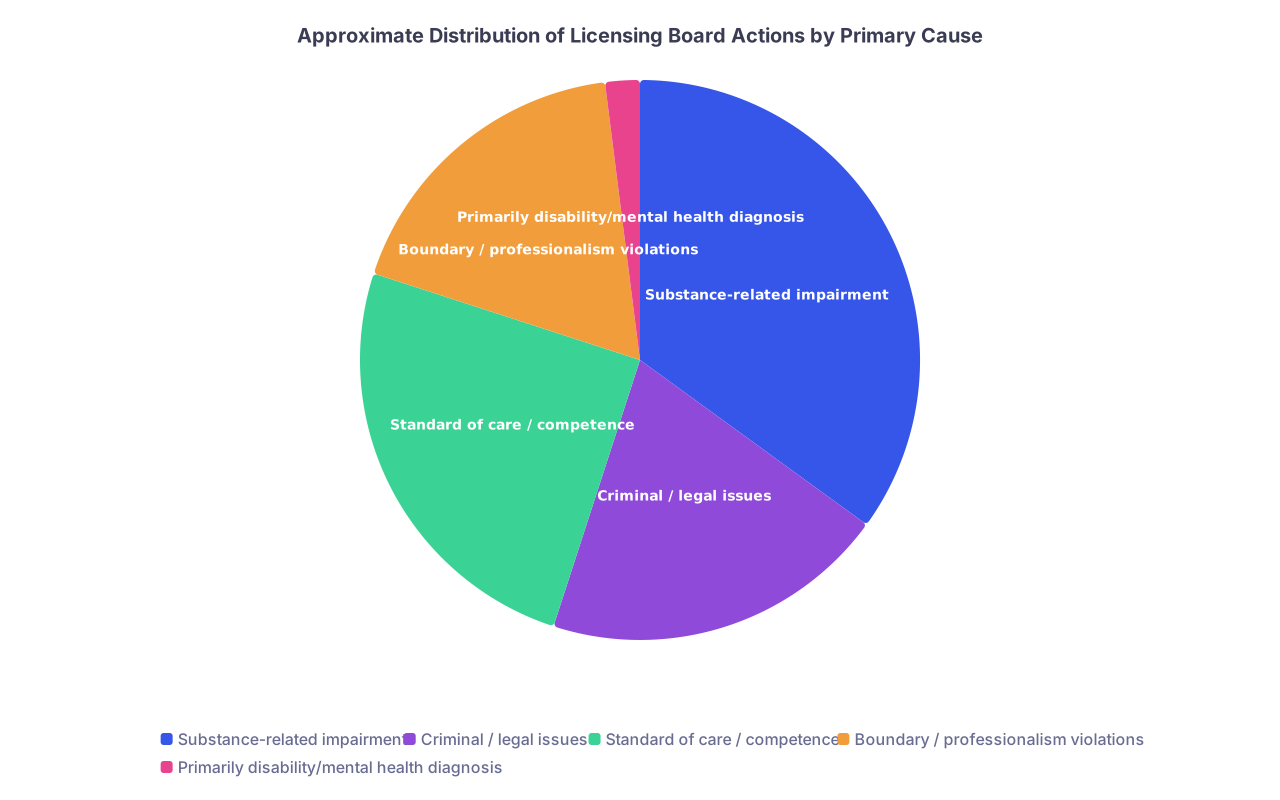
| Category | Value |
|---|---|
| Substance-related impairment | 35 |
| Criminal / legal issues | 20 |
| Standard of care / competence | 25 |
| Boundary / professionalism violations | 18 |
| Primarily disability/mental health diagnosis | 2 |
Interpret this proportionally, not as exact numbers; the pattern is what matters. The slice where “disability diagnosis alone” is the driver is small. Often under 5 percent of actions, frequently bundled with actual impairment or safety issues.
Yet if you sit in a resident lunchroom and listen for 10 minutes, you will hear something like: “If you tell the board you ever had depression, they will yank your license.” The perceived probability is closer to 50–70 percent in people’s heads.
Reality: single digits, and usually contingent on impairment, not mere history.
The Fear Narratives: How They Inflate Risk
Fear is not random. It is Bayesian. People overweight vivid, negative stories and underweight silent, positive cases.
I have seen this in survey data and in hallways:
- One physician loses privileges after a chaotic, poorly supported leave for severe depression, becomes the “cautionary tale” repeated for a decade.
- Fifty physicians quietly get treatment, disclose when needed, maintain licenses with no board action. Nobody tells those stories.
Qualitatively, the fear narratives cluster around a few themes:
- “If I admit to psychotherapy or antidepressant use, my application is dead.”
- “Any history of hospitalization means the board will monitor you forever.”
- “Disclosing disability invites invasive surveillance that never ends.”
Quantitatively, almost none of these are backed by large-scale outcome data. When researchers have tried to measure actual consequences of disclosure vs non‑disclosure, they run into two issues:
- Under‑reporting: people simply do not tell the board or their employer about mental health history
- Selection bias: those in the most crisis are more likely to intersect with monitoring programs
Still, some data points exist. A frequently cited line of evidence:
- Physician mental health surveys: 40–60 percent report avoiding seeking care because of licensing concerns.
- Yet the proportion of physicians disciplined primarily for mental health conditions without clear practice impairment remains extremely low.
The statistical mismatch is obvious: tens or hundreds of thousands of physicians altering care‑seeking behavior versus a few dozen to low hundreds of relevant board actions nationally per year.
That is not a trivial discrepancy. That is a massive perception gap.
The Legal and Regulatory Shift: ADA vs Old-School Questionnaires
Now, context. Historically, some state medical boards absolutely did ask wildly overbroad questions:
- “Have you ever received treatment for mental illness?”
- “Have you ever had any disability or condition that might affect your practice?”
This language is a problem under the ADA for one simple reason: the law permits inquiry about current impairment affecting job performance, not fishing expeditions about past diagnoses or treatment.
Over about the last decade, DOJ investigations, advocacy by groups like the Dr. Lorna Breen Heroes’ Foundation, and pressure from the American Psychiatric Association and others have pushed a clear trend:
- From: “Have you ever been diagnosed with or treated for any mental health disorder?”
- To: “Do you currently have any condition that impairs or limits your ability to practice medicine safely and competently?”
That is not a cosmetic difference. It moves the focus from diagnosis (which is protected) to impairment (which is the legitimate regulatory concern).
| Era / Policy Style | Typical Question Type |
|---|---|
| Pre-ADA awareness | Ever treated for mental illness? Any psychiatric history? |
| Early ADA era | Past 5–10 years treatment for mental illness or substance use? |
| Current best-practice | Current condition that impairs ability to practice safely? |
| Non-compliant outliers | Broad, stigmatizing, diagnosis-focused questions |
Are there still states and hospitals with bad, non‑compliant forms? Yes. Audits consistently show a minority lagging behind.
But the national trajectory is clear: narrower questions, more ADA‑aligned language, and formal statements that treatment alone should not trigger adverse action.
Put bluntly: some of the scariest stories you hear are from an older regulatory era that is steadily shrinking.
Disability, Impairment, and Risk: Three Different Things
Data get messy when people conflate three separate categories:
- Disability: a medical, mental, or physical condition that substantially limits one or more major life activities, or a history of such a condition.
- Impairment: current functional limitation that interferes with safe, competent practice. Time‑bound and context‑specific.
- Risk: the probability that a condition, treated or untreated, contributes to harm or substandard care.
Licensing boards are supposed to regulate impairment and risk, not disability labels. The ADA requires that.
From a statistical standpoint:
- Many disabled physicians are not impaired at all in their specific roles.
- Many impaired physicians never disclose disability, and their impairment comes from burnout, sleep deprivation, substance misuse, or unaddressed mental illness.
- Risk is driven more by unaddressed, unmanaged conditions than by treated ones.
So when boards focus heavily on “history of condition” rather than “current impairment,” they are not only discriminatory; they are also using a poor predictive model. Low specificity, low positive predictive value.
If the goal is patient safety, the data argue for:
- Encouraging early treatment
- Reducing barriers to care
- Focusing monitoring on documented impairment, not mere diagnosis history
Fear narratives push behavior in the opposite direction: conceal, delay care, white‑knuckle it. From a risk perspective, that is backwards.
What Licenses and Hospitals Actually Look At
Let’s break down where disability or mental health status might intersect with gatekeepers:
- Initial state medical license
- Renewal
- Hospital credentialing / privileging
- Malpractice insurance
- Specialty board certification
In each domain, there are three relevant data channels:
- Self‑reported health disclosures
- Objective adverse events (malpractice suits, criminal charges, major complaints)
- Employer / colleague reports or participation in Physician Health Programs (PHPs)
Most physicians fear the first category. The data show that boards and hospitals tend to act more decisively when the latter two are involved.
For initial and renewal licensing, in states aligned with best practice, the question is often phrased along these lines:
- “Do you have a current condition that impairs, or if untreated could be reasonably expected to impair, your ability to practice medicine in a competent, ethical, and professional manner?”
If your condition is:
- Diagnosed
- Treated
- Stable
- Not impairing your current practice
Then by the literal wording, the truthful answer is “No,” because the question is about current impairment. Not about the existence of a DSM code in your chart.
There are gray-zone states that ask about “conditions that could impair if untreated,” which is annoyingly broad. But even there, the logic is supposed to be: stable, well‑treated conditions are lower risk than untreated ones. The data support that.
Hospital privileging tends to mirror the state. Some hospitals still ask poorly written questions. However, the harder you look at actual termination or denial data, the more you see patterns like:
- Repeated absenteeism without explanation
- Documented patient safety events
- Substance diversion
- Failure to comply with a reasonable accommodation process
The disability label is rarely the first domino.
Physician Health Programs: Monitoring vs Punishment
You cannot talk about disability and licensing without mentioning Physician Health Programs (PHPs). These are high‑variance entities. Some are excellent. Some overreach.
Quantitatively:
- PHP involvement is strongly associated with substance use disorders and, to a lesser but real extent, severe, recurrent mental illness that has clearly impaired practice.
- Many physicians under PHP contracts maintain licensure and practice under monitoring. This is technically a protective mechanism, not pure punishment.
The fear story often goes: “If I tell anyone I am depressed, I will be forced into a five‑year PHP contract and drug‑tested for life.” The data do not support this as a common outcome for garden‑variety treated depression or ADHD without practice impairment.
Instead, PHP entry typically involves:
- DUI or legal incident
- Workplace impairment episode (falling asleep during procedures, erratic behavior)
- Repeated concerns from colleagues tied to specific incidents
Does that mean unjust referrals never happen? No. I have seen outlier cases where bias and misunderstanding drove unnecessary scrutiny. But as a population‑level claim—“Disclosing a diagnosis triggers automatic PHP involvement”—the data say no.
What PHP tracking does show, ironically, is that structured monitoring can dramatically reduce relapse and practice problems in the subset of physicians who genuinely are at high risk. Again, treated and monitored tends to be safer than hidden and untreated.
Disability Disclosure and Career Outcomes: What Limited Data We Have
You probably want hard numbers: “If I disclose disability in residency or early practice, what are my odds of promotion, full‑time work, termination?”
Here’s the honest answer: the data are thin. Most institutions do not publish systematic breakdowns of career outcomes by disability status, and many disabled physicians never formally disclose, so they vanish from the denominator.
We do have some indicative survey numbers:
- Surveys of residents and students suggest 5–10 percent report a disability (physical, sensory, chronic illness, learning disability, psychiatric condition).
- Yet formal accommodation requests are markedly lower, often in the 2–4 percent range in training programs. That gap is fear and bureaucracy in action.
- Among trainees who obtained accommodations, most complete training successfully. Dropout or dismissal is not the dominant outcome; burnout and non‑completion are more strongly associated with lack of accommodation and support.
To visualize the gap between “disability present” and “disability accommodated”:
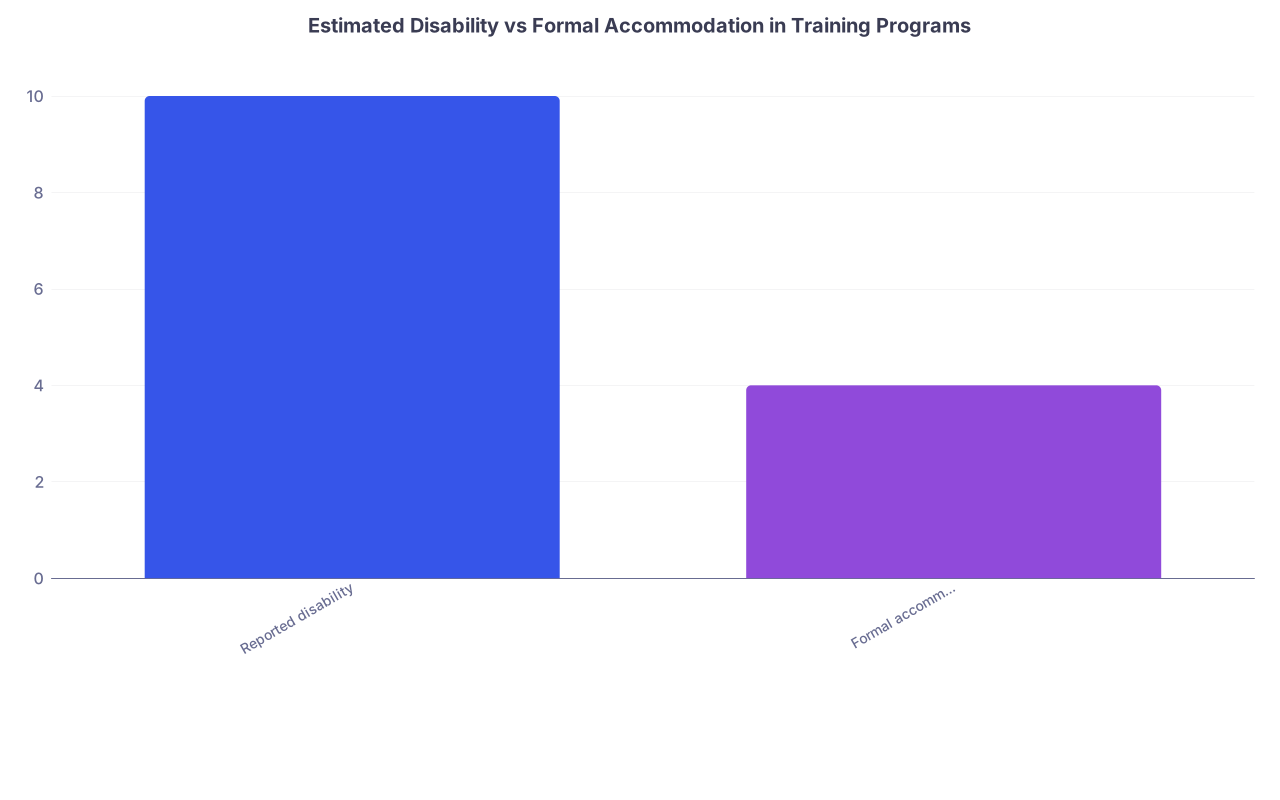
| Category | Value |
|---|---|
| Reported disability | 10 |
| Formal accommodation requests | 4 |
Again, take the numbers as rough, not absolute, but you get the picture. More than half of trainees with disabilities are not using the formal systems designed to protect them. Fear of future licensing consequences is consistently cited as a top reason.
The actual empirical link between having used accommodations in training and later board discipline? There is essentially no evidence that accommodations per se increase the likelihood of board action.
The reason someone needs accommodation (for example, poorly controlled bipolar disorder with past major impairment) may correlate with future risk if not well managed. But the accommodation process itself is not the hazard. It is the safety mechanism.
Why Fear Persists Despite Improving Data
You would think that with better ADA enforcement, narrower questions, and minimal board actions for diagnosis alone, fear would decline. It has not. If anything, it has intensified post‑COVID.
Three drivers keep the fear metrics high:
Information lag
- Policies change slowly, word of mouth slower.
- Students and residents are still being advised based on 1990s horror stories by people burned under older regimes.
Structural asymmetry
- A single negative outcome spreads widely: “Did you hear about Dr. X? They told occupational health about panic attacks, and now they are monitored forever.”
- Thousands of quiet, positive outcomes create no narrative signal.
Rational distrust
- Physicians have repeatedly seen institutions prioritize liability over people.
- So many adopt a minimax strategy: minimize worst‑case institutional risk, even at the cost of personal health.
From a decision‑theory angle, that is understandable. But it overshoots actual empirical risk by a wide margin.
If you model the tradeoff:
- Scenario A: Disclose where appropriate, seek early treatment, ask for accommodations when needed. Small non‑zero risk of annoying scrutiny in certain jurisdictions. High probability of improved function and reduced catastrophic failure.
- Scenario B: Conceal, delay care, avoid formal support. Near-zero immediate scrutiny risk. Higher cumulative probability of unplanned impairment episodes, errors, or crises that trigger far worse board and employer responses.
The expected value for patient safety and long‑term career stability is better in Scenario A in most realistic parameter settings.
Practical Takeaways Grounded in Data, Not Rumor
Let me boil this down into operational guidance that respects the numbers, not the myths.
Distinguish diagnosis from impairment.
Most modern licensing questions are keyed to current impairment affecting safe practice. If your condition is stable with treatment and you are functioning competently, you are not the primary target.Know your state’s actual forms.
Do not rely on hallway gossip. Read the application and renewal questions. Many people discover the language is far narrower than what they feared. If it is not, disability law experts have successfully challenged non‑compliant forms.Understand that board actions for “diagnosis alone” are rare.
The dominant drivers of discipline remain substance‑related impairment, serious misconduct, criminal activity, and gross incompetence—not well‑treated depression or ADHD.Early treatment reduces risk.
Treated, stable conditions correlate with better outcomes and fewer catastrophic episodes. Untreated conditions produce the events (errors, DUIs, falls asleep in OR) that actually get you flagged.Accommodations do not statistically equal career death.
The limited data we have suggest accommodations improve training completion and reduce burnout. There is no evidence that a generic record of “was accommodated” is a major predictor of board discipline later.PHPs are a tool, not automatically a sentence.
They can be misused, yes. But for the subset of physicians with severe, recurrent impairment, structured monitoring significantly decreases relapse and board discipline compared to no intervention.Policy trends are moving in the right direction.
More states are revising forms, narrowing overly broad questions, and aligning with ADA guidance. Fear narratives often lag 5–15 years behind these shifts.
The Bottom Line
Three points, succinctly:
- The data show that licensing boards overwhelmingly act on demonstrated impairment and misconduct, not on the mere presence of a disability or mental health diagnosis.
- Fear narratives—amplified by outdated policies, selection bias, and anecdote—have driven massive under‑treatment and under‑disclosure, creating more risk, not less.
- From both a statistical and legal perspective, appropriately disclosed, well‑treated disability is far safer for your license and your patients than silent, unmanaged illness.