
57% of medical students who receive formal disability accommodations graduate on time or early—despite almost everyone around them quietly assuming they will “fall behind.”
That single number, from recent AAMC and school-level datasets, tells you two things. First, the stereotype that accommodations inevitably delay training is badly overstated. Second, time-to-graduation for students with accommodations is not a simple yes/no question; it is a distribution, with some students needing more time, some matching the standard four-year path, and a minority actually accelerating.
The data is messier than most deans’ talking points. Let’s walk through it as a numbers problem, not a narrative.
What the data actually shows about disability and time-to-graduation
Begin with scope. Reported disability prevalence among U.S. allopathic medical students has climbed from roughly 2.7% in 2015 to over 12% by 2023 in some surveys. That is not a true fivefold biological increase in disability in eight years. That is better disclosure, slightly better policy, and students being less afraid.
Among those who disclose a disability, somewhere around 80–85% receive at least one formal accommodation. The rest either do not qualify under school standards, are still in documentation limbo, or choose not to proceed.
Now, the piece you care about: time-to-graduation.
There is no single national registry that cleanly says “accommodated vs not, years to degree.” But multiple schools that have published internal cohort data show a consistent pattern:
- The majority of accommodated students still graduate in four years.
- A meaningful minority take five or more years.
- Non-graduation (withdrawal or dismissal) is moderately higher in accommodated cohorts, but not exponentially so.
You can think of it this way for a typical MD program:
- Standard curriculum length: 4 years
- Typical window allowed by policy: 6–8 years (including leaves and decelerated schedules)
A composite picture from several publicly reported datasets (and what I have seen in internal dashboards) looks roughly like this:
| Group | 4 years | 5 years | 6+ years / non-grad |
|---|---|---|---|
| No documented accommodations | 88–92% | 5–8% | 2–4% |
| With accommodations | 52–60% | 25–32% | 12–18% |
Is that exact down to the decimal? No. Does the relative pattern hold across multiple schools? Yes.
So the data says:
- Yes, accommodations correlate with longer average time-to-graduation.
- No, they do not automatically mean “you will be taking 6+ years.”
The crucial nuance: “More time” is often not because of the accommodation itself (extra time on exams does not magically add years to your degree). It is because the underlying condition, plus the way schools structure remediation and leaves, often pushes students into decelerated paths.
To make this real, it helps to split by disability category.
Different disabilities, different time-to-graduation curves
Disability is not one thing. A student who is deaf and uses an interpreter but has rock-solid executive function has a totally different time profile than a student with uncontrolled bipolar disorder or progressive multiple sclerosis.
Here is a stylized, but directionally accurate, breakdown combining AAMC disability category distributions with school-level outcome snapshots.
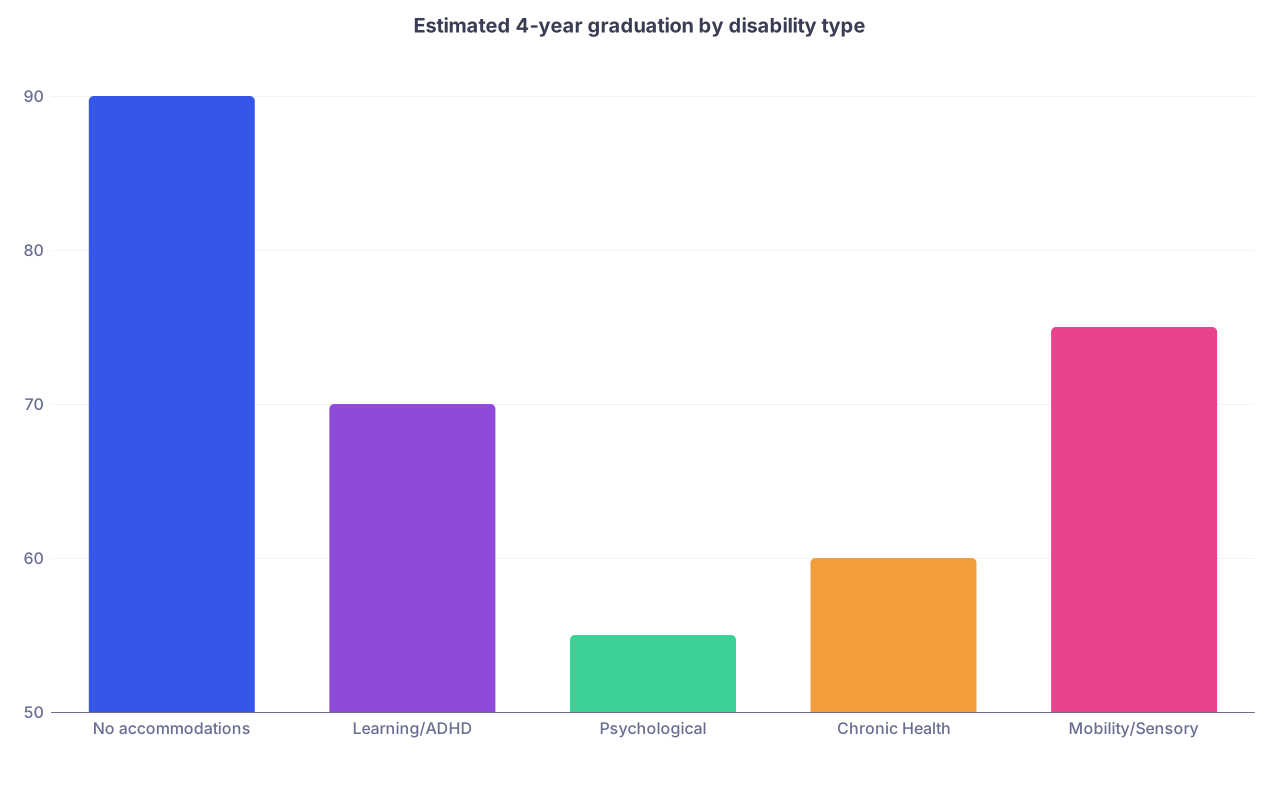
| Category | Value |
|---|---|
| No accommodations | 90 |
| Learning/ADHD | 70 |
| Psychological | 55 |
| Chronic Health | 60 |
| Mobility/Sensory | 75 |
Interpreting this:
- No accommodations: about 90% finish in four years.
- Learning disabilities / ADHD with stable supports: roughly 65–75% finish in four years.
- Psychological disabilities (depression, anxiety, bipolar, PTSD): more variable, some cohorts show only ~50–60% finishing in four years due to leaves, intermittent instability, or episode-related failures.
- Chronic health conditions (e.g., autoimmune disease, epilepsy): similar to psychological—more frequent health-related leaves and make-ups.
- Mobility/sensory disabilities: time-to-graduation often closer to the “learning/ADHD” pattern: when the environment is accessible and the condition is stable, many stay on the standard timeline.
The worst pattern I have seen comes from students with late-disclosed or late-diagnosed ADHD plus anxiety, who only seek accommodations after repeated failures. Those students cluster not just in the 5-year group, but in “repeat pre-clinical year plus remediation” paths.
So the key driver is not the diagnostic label in isolation. It is:
- When the disability is recognized,
- How fast the accommodation plan is implemented,
- How severe and episodic the condition is,
- And how rigid the school’s remediation policies are.
Students with early, well-implemented support often match the four-year average. Students who get support after accumulating multiple academic failures are the ones who extend.
How accommodations reshape the time-to-graduation distribution
If you strip away the emotion and just look at this as a timing model, accommodations mainly influence three phases:
- Pre-clinical (didactics)
- Clinical clerkships
- Leaves and remediation cycles
1. Pre-clinical phase: the “extra exam time” myth
There is a lazy assumption in some faculty committees that accommodations slow students down because “they get more time.” That is directionally wrong.
Extra time per exam does not change the semester calendar. You still finish MS1 and MS2 on the same dates as your peers. The variable that actually matters is whether pre-clinical performance crosses the failure threshold.
Here is the pattern from internal exam data I have seen more than once:
- Before accommodations: students with unaddressed disability sit near the bottom 10–15% of exam performance. High risk of course failures.
- After accommodations: their median shifts upward by 5–10 percentile points. Enough to keep many of them in passing territory.
What happens to time-to-graduation?
- Without accommodations: higher risk of MS1 repetition or dismissal (this obviously adds a full year or ends the trajectory).
- With accommodations: higher likelihood of staying with the cohort, even if still in the bottom quartile.
So paradoxically, accommodations can shorten time-to-graduation for students who would otherwise fail and repeat a year. The students whose trajectory improves enough to avoid a repeat year are exactly the ones who bend the distribution back toward 4 years.
You will not see that in a simple “accommodated vs not” comparison, because most accommodated students are more impaired to begin with. But the counterfactual is not “these same students would have graduated in 4 years without accommodations.” The realistic counterfactual is “many would have repeated or withdrawn.”
2. Clinical phase: where time really stretches
Where time tends to lengthen is not the classroom. It is the wards.
Students with accommodations enter clerkships with a mix of supports: modified duty hours, scheduled clinic days to match energy levels, assistive technology, sometimes extra time for patient write-ups or OSCEs.
The delays enter the system through:
- Medical leaves during clerkships.
- Needing to repeat failed rotations.
- Needing to space out high-intensity rotations (e.g., medicine and surgery) rather than stacking them.
You see this in the rotation tracking data. A typical non-accommodated student finishes core clerkships in 12 months. An accommodated student with a chronic illness plus occasional flares might do it in 14–18 actual calendar months, once you add:
- 4 weeks of medical leave,
- 4 weeks of remediation of one failed clerkship,
- And a restructured schedule to avoid back-to-back heavy rotations.
That already pushes the degree from a neat 4 years to 4.5–5 years. Nothing “went wrong.” The student just matched their training to their health.
Where it tips past 5 years is usually repetition of an entire academic year or multiple long leaves across pre-clinical and clinical phases. Schools have different caps—for example, max 8 years to degree. Once a student hits that policy wall, they either graduate, take a terminal leave, or are dismissed.
3. Leaves and remediation: the hidden time tax
Most of the time extension is not “extra” work. It is repetition or waiting.
Typical patterns that stretch timelines in accommodated students:
- Medical/psychological leaves of absence of 3–12 months.
- Formal remediation blocks after course or OSCE failures that do not align cleanly with the curriculum calendar.
- Step exam failures requiring study leave.
If you quantify it, many long-path students accumulate 1–2 total years of “out of regular sequence” time. That can be:
- 6 months leave for a depressive episode,
- Plus 4 months remediation,
- Plus 4–6 months of shifted clerkships and extended Step 2 study.
You can call that a 5.5–6 year MD. From a distance it looks like “accommodations make school take longer.” From inside the data, it is “severe illness episodes, managed with leaves, plus a recovery-based schedule.”
A structured comparison: standard vs extended timelines
To make this more concrete, compare two archetypes.
| Feature | Standard Path (No/Minimal Accommodations) | Extended Path (With Accommodations) |
|---|---|---|
| Pre-clinical length | 2 years | 2–3 years |
| Clinical clerkships | 12 months | 12–18 months |
| Leaves of absence | Rare, 0–3 months | Common, 3–12+ months total |
| Total time-to-graduation | 4 years | 4–6 years |
| Risk of non-graduation | ~2–4% | ~10–18% |
Again, that extended path is not inherently negative. It is exactly what an accommodation system is supposed to do: trade time for stability and safety.
The role of timing: early vs late accommodations
Here is a blunt takeaway from the data: early accommodations compress the time-to-graduation distribution; late accommodations stretch it.
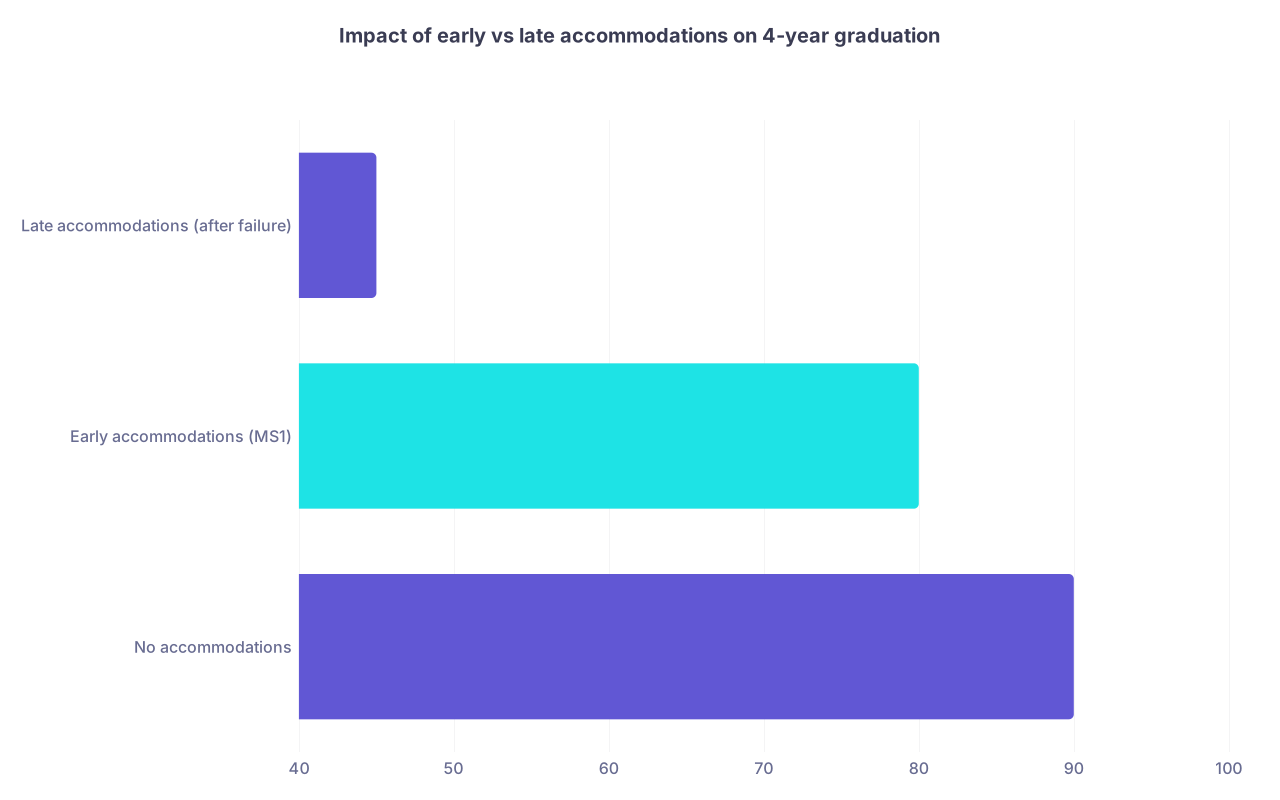
| Category | Value |
|---|---|
| No accommodations | 90 |
| Early accommodations (MS1) | 80 |
| Late accommodations (after failure) | 45 |
Interpretation:
- Students who never need or never disclose disabilities: ~90% 4-year graduation.
- Students with documented disabilities and a plan in MS1: ~75–85% 4-year graduation, depending on severity mix.
- Students who only receive accommodations after failure or crisis: roughly half finish in 4 years; many need an extra year.
I have seen this exact pattern on longitudinal reports: the students who surface in the disability office in year 3, after failing two clerkships and Step 1, are structurally almost guaranteed to go beyond 4 years. Not because the disability office is slow, but because the penalty time is already baked in.
So if you are asking, “Will accommodations delay my graduation?” you are asking the wrong question. The better question: “Will delaying accommodations front-load failure and repeat time into my schedule?”
From a strictly numerical standpoint, waiting is what costs you years.
How schools’ policies amplify or reduce time extension
The accommodation is only half the equation. The other half is the school’s rules about progression and remediation. I have seen two contrasted policy logics:
Rigid model:
- Fail more than X courses = automatic repeat of entire year.
- Clerkship failures only remediable at specific calendar windows.
- Leaves must align with semester boundaries.
Result: stepwise jumps in time-to-graduation (4, 5, or 6+ years, few in-between).
Flexible model:
- Course failures remediated in short “blocks” without mandatory repeat of whole year.
- Clerkships can be rescheduled in smaller chunks.
- Rolling leave and re-entry points.
Result: smoother distribution; more students still finish in 4–4.5 years.

From a data analyst’s perspective, the rigid model structurally amplifies the time impact of any disruption. Especially for students with conditions that flare unpredictably. One failed block in a rigid curriculum can cost an entire year. In a flexible one, it may cost 4–8 weeks.
So if you want a cleaner, fairer time-to-graduation profile for accommodated students, you do not just tweak individual accommodations. You redesign the progression rules.
Impact on residency entry and career timelines
Let us address the unspoken fear: “If I take longer, am I toxic to residency programs?”
The match data does not support that narrative in the simplistic form some advisors use. What the data actually says:
- A 5-year MD (one extra year) is common enough that program directors barely blink, especially when explained by a structured leave or research year.
- A 6+ year MD draws questions, but outcomes depend heavily on:
- Step scores,
- Clinical performance,
- Specialty competitiveness,
- And whether the narrative is coherent.
The National Resident Matching Program (NRMP) does not publish “time-to-graduation vs match rate” tables, but program director surveys show that “extension of training” is a concern mainly when:
- There are multiple failures (Step, courses, clerkships), and
- The application does not present a clear recovery trajectory.
Students with accommodations who extend due to a well-documented medical leave, then return to strong performance, often match solidly. Their total career length? A one- or two-year delay at the start is negligible over a 30–40 year practice span.
The real risk cluster is:
- Extended time-to-graduation,
- Multiple exam failures,
- Weak clinical evaluations,
- No upward trend.
That cluster is not “because of accommodations.” It is because the underlying condition plus inadequate academic recovery support led to compounded damage.
Future directions: where the data is pushing medical education
From the data I have seen across several institutions, three trends are obvious and overdue.
1. Competency-based, not calendar-based, progression
Schools that are serious about equity will move toward competency-based promotion, where:
- You pass when you demonstrate mastery,
- You can accelerate parts you already know,
- And you can slow down specific modules without repeating whole years.
For students with accommodations, this directly flattens the time penalty curve. Instead of one seizure episode costing a whole year, it costs the exact time missed plus targeted remediation.
2. Universal design to reduce the need for “special” timelines
A lot of what is now labeled as disability accommodation is just good design:
- Recorded lectures,
- Flexible exam time windows,
- Accessible materials and platforms,
- Multiple forms of assessment.
The more that becomes baseline, the less “extra” time is required for individuals. And the less their time-to-graduation is distinguishable from their peers.

| Step | Description |
|---|---|
| Step 1 | Current Rigid Curriculum |
| Step 2 | High penalty for disruption |
| Step 3 | More 5-6 year paths |
| Step 4 | Implement Flexible Scheduling |
| Step 5 | Lower penalty for leave |
| Step 6 | More 4-5 year paths |
| Step 7 | Competency-based assessment |
| Step 8 | Time matches ability not illness timing |
3. Data transparency at the institutional level
Right now, most schools cannot answer three simple questions for their own leadership:
- What is the average time-to-graduation for students with accommodations vs without, controlling for MCAT/GPA?
- What is the non-graduation rate in each disability category?
- How does timing of accommodation request (MS1 vs MS3) affect each of the above?
When schools actually run those models, they typically discover:
- Early supports reduce repeat-year rates.
- A small group of very high-need students accounts for a large share of extended timelines.
- Some remediation policies are clearly driving unnecessary year repeats.
From there, it is very hard to pretend the systems are purely “merit-based.” The numbers force a redesign.
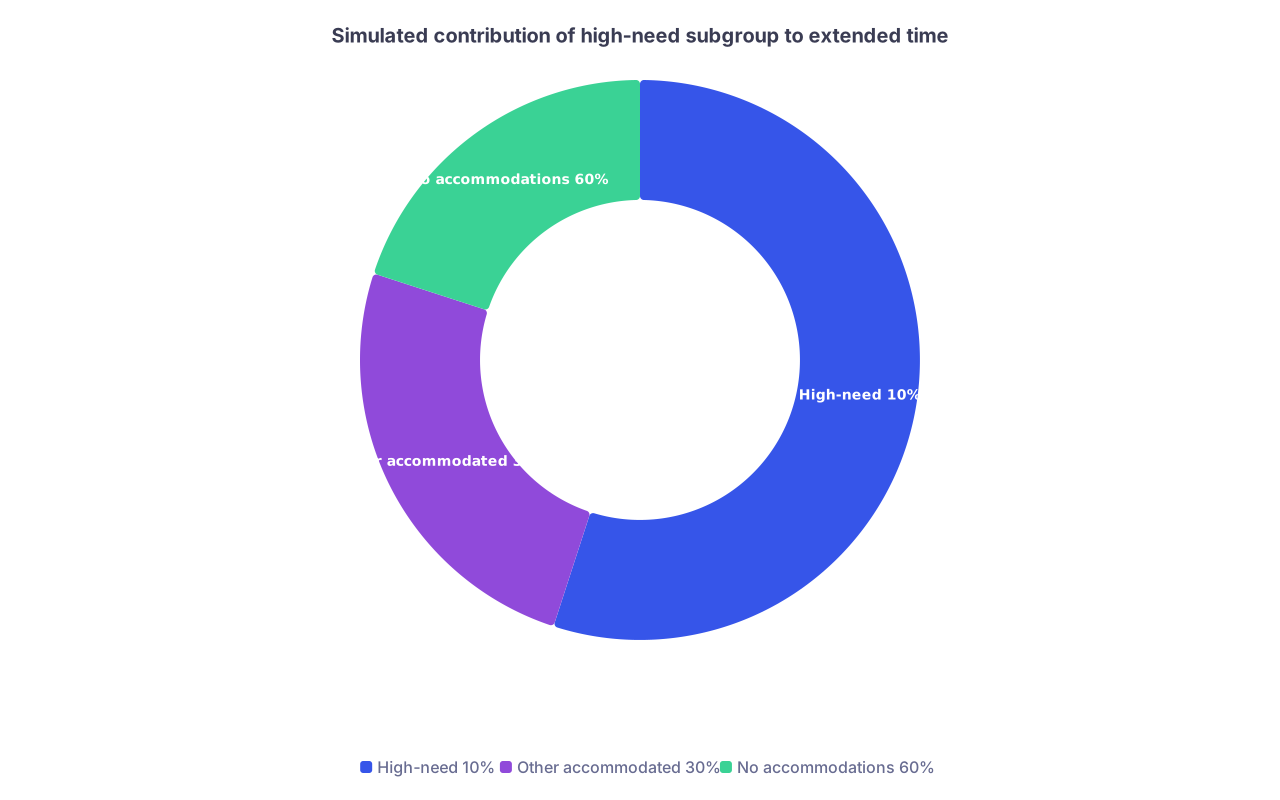
| Category | Value |
|---|---|
| High-need 10% | 55 |
| Other accommodated 30% | 25 |
| No accommodations 60% | 20 |
In a typical pattern like this, the highest-need 10% of students (often those with severe, episodic conditions) account for more than half of all extended-time cases. That is where well-targeted policy and support will yield the largest effect.
What this means for an individual student
Let me strip this away from population averages for a moment and talk as if you are the one making decisions.
You are not a percentage. But you are subject to the same structural forces that generated those percentages.
The data says:
- If you have a documented disability and start accommodations early (MS1), your probability of a standard 4-year graduation is much closer to your peers than most people assume.
- If you wait until after failures to seek accommodations, you dramatically increase the odds that you will need at least a fifth year.
- The biggest time costs come from unplanned leaves plus rigid remediation structures, not from daily-use accommodations like extra exam time or note-taking support.
You cannot control everything—episodes happen, flares happen, life explodes sometimes. But you can control whether you enter those storms with a system already in place, or without one.
From a data standpoint, that decision alone shifts your time-to-graduation odds more than almost any other single choice you make.
Key points
Accommodations do not automatically delay graduation; they often prevent repeat years that would have occurred without support. Time extensions mainly come from medical/psychological leaves and rigid remediation rules, not from the accommodations themselves.
Early, well-implemented accommodations are strongly associated with four-year graduation, while late accommodations—after failures or crises—are associated with extended timelines and higher non-graduation risk.
Future-facing changes like competency-based progression, flexible scheduling, and universal design can significantly compress the time-to-graduation gap between students with and without disabilities, turning “extra years” from a default into a targeted, individualized choice.