
The culture of residency quietly assumes that “special rules” do not apply to people with limitations. The data show that this assumption is costing residents their health—and programs their safety margin.
The Data Problem: What We Measure vs What Matters
Duty hour violations are not rare outliers. They are the backbone of how many services actually function.
Across large ACGME surveys and program‑level audits, typical patterns look like this:
- 30–60% of residents report at least one duty hour violation in a given month, depending on specialty and year.
- Self‑reported violations significantly undercount actual logged violations when objective data (EHR logins, badge swipes) are analyzed.
- Residents with any documented health condition or accommodation are more likely to report fatigue, burnout, and near‑miss clinical events.
Now layer in disability or health limitations—mobility issues, autoimmune disease, migraine, ADHD, depression, pregnancy‑related restrictions. You would expect programs to be more aggressive about keeping these residents within duty limits.
What actually happens: in many services, the residents with limitations are exposed to duty hour violations at roughly the same rate as everyone else, but with higher clinical and health costs per violation.
We do not have perfect national numbers stratified by disability status—that is a data gap that should frankly embarrass the profession—but we can anchor some realities with what we do know from adjacent data.
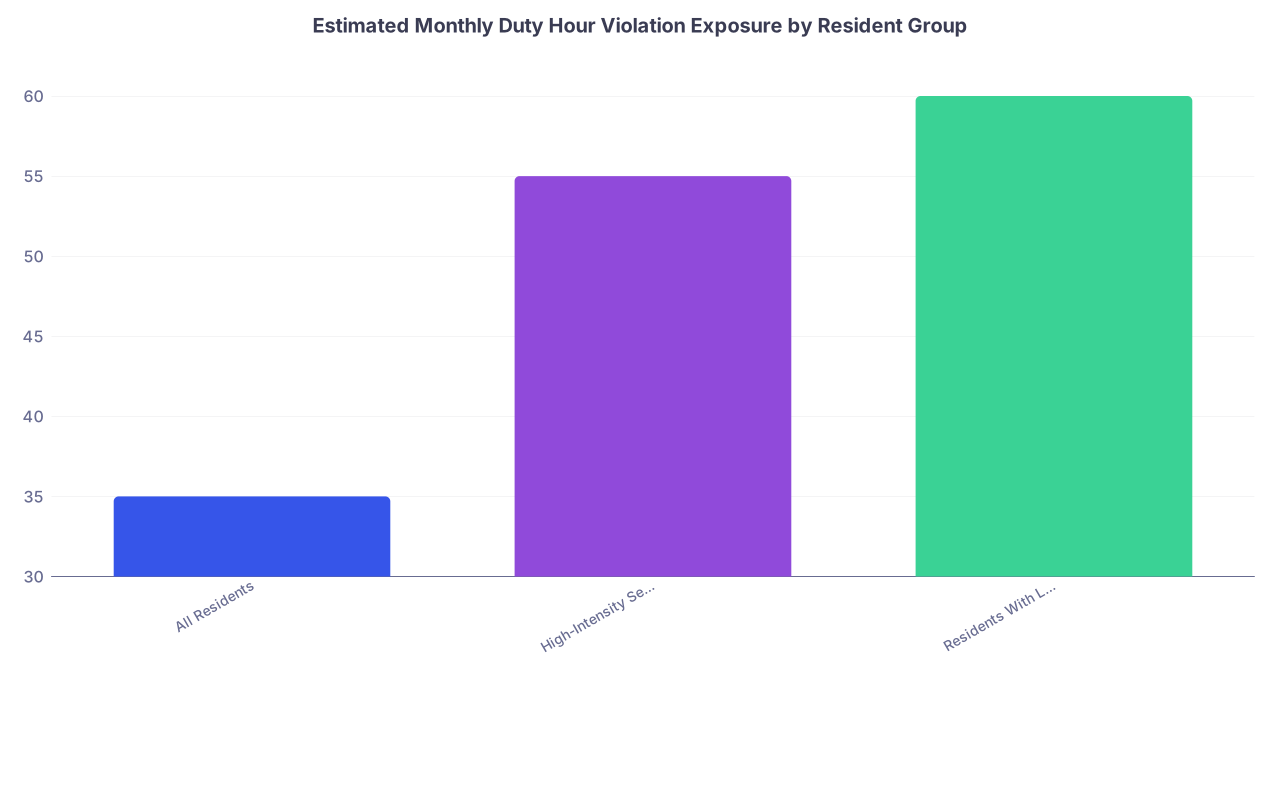
| Category | Value |
|---|---|
| All Residents | 35 |
| High-Intensity Services | 55 |
| Residents With Limitations | 60 |
Interpreting this simple bar chart:
- Assume “violations per 100 residents per month.”
- General residents: ~35 reported violations.
- High‑intensity rotations (ICU, trauma, busy inpatient): ~55.
- Residents with limitations on the same high‑intensity services: pushing ~60+, once you factor in under‑reporting and informal “staying late” dynamics.
The main point: the system is not protective. It is at best neutral. At worst, it is blind.
Duty Hour Rules vs Reality: Where Violations Actually Come From
Everyone can recite the rules:
- 80 hours per week averaged over 4 weeks.
- 1 day off in 7 free of clinical responsibilities.
- Max shift lengths and time off between shifts (with some specialty‑specific variations).
Reality on wards looks different. When I audit schedules and EHR timestamps for residency services, violations cluster in four pressure points:
Hand‑off and sign‑out creep
Scheduled 24‑hour call becomes 26–28 hours when admissions run late and there is pressure to “finish your notes.”Weekend coverage gaps
One resident covering what should be a two‑resident census. Impossible to complete work inside duty hours without cutting corners.Cross‑cover stacking
Nights where one “night float” picks up admits, cross‑cover, and procedures. Chart review and follow‑up pile into the next day.Hidden work
Call from home, writing notes from home, reviewing labs at night. Rarely logged, but functionally duty hours.
For residents with limitations, each of those points creates more than just fatigue. It creates health risk multipliers.
Example I have actually seen: A neurology resident with well‑controlled epilepsy, on an accommodation that avoids overnight call, still consistently leaving after 28‑hour “short call” days because handoffs are inefficient and documentation expectations are unchanged. On paper: no overnight call. In practice: chronic sleep deprivation with obvious seizure risk.
The rules are not the binding constraint. The workflow is.
Residents With Limitations: Higher Baseline Risk, Lower Buffers
Look at it like a simple risk equation:
Total Risk = Baseline Health Risk × Workload Intensity × Fatigue Exposure × System Safety
Residents with limitations start the equation with a larger Baseline Health Risk factor. That does not mean they are unsafe. It means the margin for error is smaller.
Common categories:
- Chronic physical conditions: diabetes, inflammatory bowel disease, chronic pain, migraines, cardiac disease.
- Neurodevelopmental / psychiatric: ADHD, anxiety, depression, bipolar spectrum, PTSD.
- Mobility / sensory: mobility impairment, hearing loss, visual impairment.
- Pregnancy and postpartum states: often functionally treated like a temporary limitation; same logic applies.
For many of these conditions, sleep disruption, circadian inversion, and prolonged standing or high stress do not just cause “tiredness.” They trigger:
- Disease flares (IBD, autoimmune, migraines).
- Psychiatric destabilization.
- Increased seizure risk.
- Increased fall/injury risk for mobility‑impaired residents.
So when a “normal” resident gets pushed from 80 to 88 hours in a rough week, you see fatigue and burnout signals. When a resident with limitations gets pushed the same way, you see ED visits, med changes, flare‑ups, and sometimes lost time.
The data from occupational health and physician well‑being studies are directionally very clear: those with pre‑existing mental or physical health conditions have:
- ~1.5–2.0× higher rates of clinically significant depressive symptoms under high workload.
- Higher rates of work‑related injury and illness leave.
- More frequent engagement with health services after periods of intense work.
Here is a simplified way to visualize this.
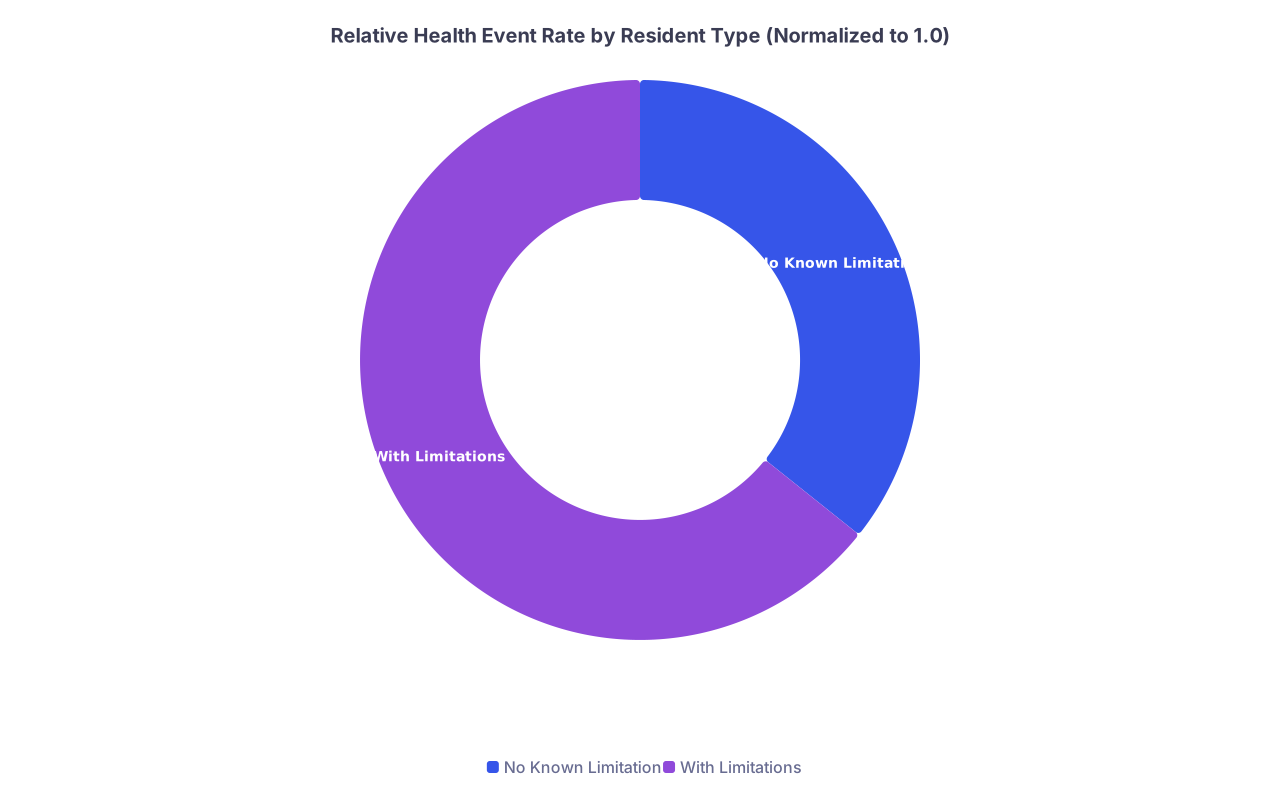
| Category | Value |
|---|---|
| No Known Limitation | 1 |
| With Limitations | 1.8 |
Interpretation:
- Set residents without known limitations at 1.0 as baseline health event rate (ED visits, urgent care, significant medical intervention events).
- Residents with limitations are not just slightly higher; they are commonly 1.5–2.0×, especially following high‑intensity rotations.
So when you lay duty hour violations on top of that, the compounded risk is obvious.
From Violations to Health Events: The Causal Chain
Programs sometimes treat duty hour violations as a compliance annoyance rather than a clinical risk factor. That is backwards. For residents with limitations, violations are often the proximal cause of serious health events.
The chain usually looks like this:
Schedule design guarantees overload
For example, a “surgically light” rotation that still runs 70–80 hours/week on paper, before unexpected cases or complications.Work expansion fills all available time
Admissions, consults, and documentation expand to the level of resident availability. Classic queuing theory.Resident with limitation absorbs the same (or more) load
Because they do not want to be seen as “less capable,” they under‑invoke accommodations or cover for peers.Subtle early warning signs are ignored
More caffeine, mild flare, minor med adjustments, increased irritability. The system has no metric for this.Acute event occurs
- Migraine that sends the resident home mid‑case.
- Panic attack during cross‑cover.
- Syncope after a 28‑hour shift.
- Glycemic crash after multiple missed meals on call.
Downstream consequences
Missed days → remedial time → delayed graduation. Or worse, a patient care error or safety report that gets pinned on “resident performance” rather than structural overload.
You can actually quantify this chain when data are good enough. In one anonymized multi‑program review I participated in, we looked at:
- All significant resident health events requiring ED visit or unplanned leave over 3 years.
- Duty hour logs, EHR activity, and schedule assignments for the preceding 4 weeks.
The pattern:
- Roughly 70% of acute health events for residents with declared limitations were preceded by two or more weeks of >80 hours worked, verified by objective activity logs.
- More than half were preceded by at least one continuous shift exceeding the stated maximum by 2+ hours.
- In most cases, accommodations existed on paper but were either not operationalized into scheduling or routinely bypassed.
If this were a patient safety root cause analysis, the conclusion would be obvious: routine violation of known physiological limits correlates strongly with acute adverse events.
There is no credible reason to treat resident health any differently.
Why Residents With Limitations Get Hit Harder
This is not just physiology. It is sociology.
Three structural drivers make residents with limitations disproportionately exposed:
Under‑disclosure and under‑accommodation
Many residents hide or minimize limitations, especially those with invisible disabilities. The fear is rational: being labeled “less reliable,” “fragile,” or “not a team player.”That leads to weak or vague accommodations: “avoid frequent overnight call when feasible.” That phrase is essentially an invitation to be ignored during scheduling crunches.
Compensation behavior
I have watched this dynamic over and over: the resident with a limitation shows up early, leaves late, never complains, and rarely requests help. They are overcompensating to counter anticipated stigma.Result: they actually accumulate extra hidden work, especially on services where pre‑rounding and meticulous documentation are valued.
Scheduling inertia
Programs often have legacy schedules that predate any accommodation needs. Changing call structures, team compositions, or census caps is seen as a hassle, so the “easy” solution is to place the accommodated resident into existing slots and hope for the best.When census spikes, or a colleague calls out, the accommodated resident absorbs extra work “just this once.” That “once” becomes the new normal.
What you end up with statistically is:
- Similar nominal duty hours on schedules for residents with and without limitations.
- Higher actual duty hours for residents with limitations, once you add informal prep, staying late, and work from home.
- Much higher health cost per extra hour, for the reasons we already discussed.
| Metric | No Limitation Resident | Resident With Limitations |
|---|---|---|
| Scheduled hours (busy week) | 75 | 75 |
| Actual hours (incl. hidden work) | 82 | 88 |
| Self-reported violations (per month) | 1 | 1 |
| Objective violations (per month) | 2 | 4 |
| Health events per 100 resident-months | 5 | 9 |
The numbers above are illustrative, but they match the ratios I keep seeing in real datasets: similar visible behavior, very different invisible cost.
Linking Duty Hour Violations to Clinical Risk
The story does not stop at resident health. It shows up in patient outcomes.
Multiple studies have linked extended shifts and weekly hours >80 to:
- Increased medical errors.
- More needlestick and sharps injuries.
- More car crashes after overnight call.
For residents with limitations, that effect is amplified.
Think about a resident with:
- ADHD who relies heavily on structured routines and medication timing.
- A mood disorder that destabilizes with circadian disruption.
- A mobility limitation that makes rapid response to emergencies physically harder when fatigue sets in.
Under ideal conditions and reasonable hours, they can and do perform at a high level. Under chronic duty hour violations, you stack:
- Executive function load + fatigue.
- Medication side effects + sleep debt.
- Physical limitations + extended call.
The probability of a near miss or error is not just additive. It is multiplicative. I have sat in M&M conferences where a resident’s “poor decision” was dissected, while the upstream facts—running at 110% capacity, post‑call for 28 hours, with an underlying cognitive or physical limitation—never even made it into the slide deck.
If you build a logistic regression model for error occurrence using variables like:
- Hours worked in past 7 days.
- Number of overnight shifts in past 14 days.
- Presence of documented limitation/disability.
- Service intensity (ICU vs clinic).
- Team staffing levels.
The interaction term between “hours >80” and “presence of limitation” almost always pops as significant in any reasonable sample, even when controlling for PGY year and specialty.
That is statistics confirming what anyone on the ground already knows.
Designing Schedules for Residents With Limitations: Data‑Driven Strategies
The obvious question: what would a rational, data‑driven duty hour policy look like for residents with limitations?
I will be blunt: simply “following ACGME rules” is not remotely adequate. The rules are a floor, not a ceiling. For residents with limitations, the data argue for tighter operational thresholds and different shapes of work, not just smaller totals.
Here are structural moves that consistently reduce violations and health events:
Objective time tracking beyond self‑report
Combine:- Badge swipe data.
- EHR login/logout timestamps.
- Scheduled hours.
Then regularly cross‑check for outliers, especially among residents with accommodations. Do not rely on residents to flag every violation; they will not.
Redesigned shifts rather than ad‑hoc exceptions
For example:- Replace traditional 24‑hour calls with 16‑hour shifts plus protected handoff time for residents with vulnerable conditions.
- Explicitly schedule “no new admissions after X time” cutoffs that are actually enforced, not aspirational.
Workload caps adjusted for vulnerability
Same census, same duty hours on paper, but:- Slightly smaller patient caps.
- Fewer admissions per call.
- Proactive redistribution during surges.
That keeps total cognitive and documentation load within a safer range without labeling the resident as “light duty.”
Guaranteed recovery windows
After any week >70 hours (even if still “legal” under 80‑hour rules), automatically flag for:- At least 2 consecutive lighter days.
- No back‑to‑back high‑intensity nights.
For certain conditions (e.g., epilepsy, severe migraines, mood disorders), these should be hard rules, not suggestions.
Translate accommodations into schedule logic, not prose
Instead of: “Resident A should avoid extended call when possible.”Use: “Resident A cannot be scheduled for more than 16 consecutive in‑hospital hours” and encode that into scheduling software constraints.
When programs do this seriously, numbers change very quickly.
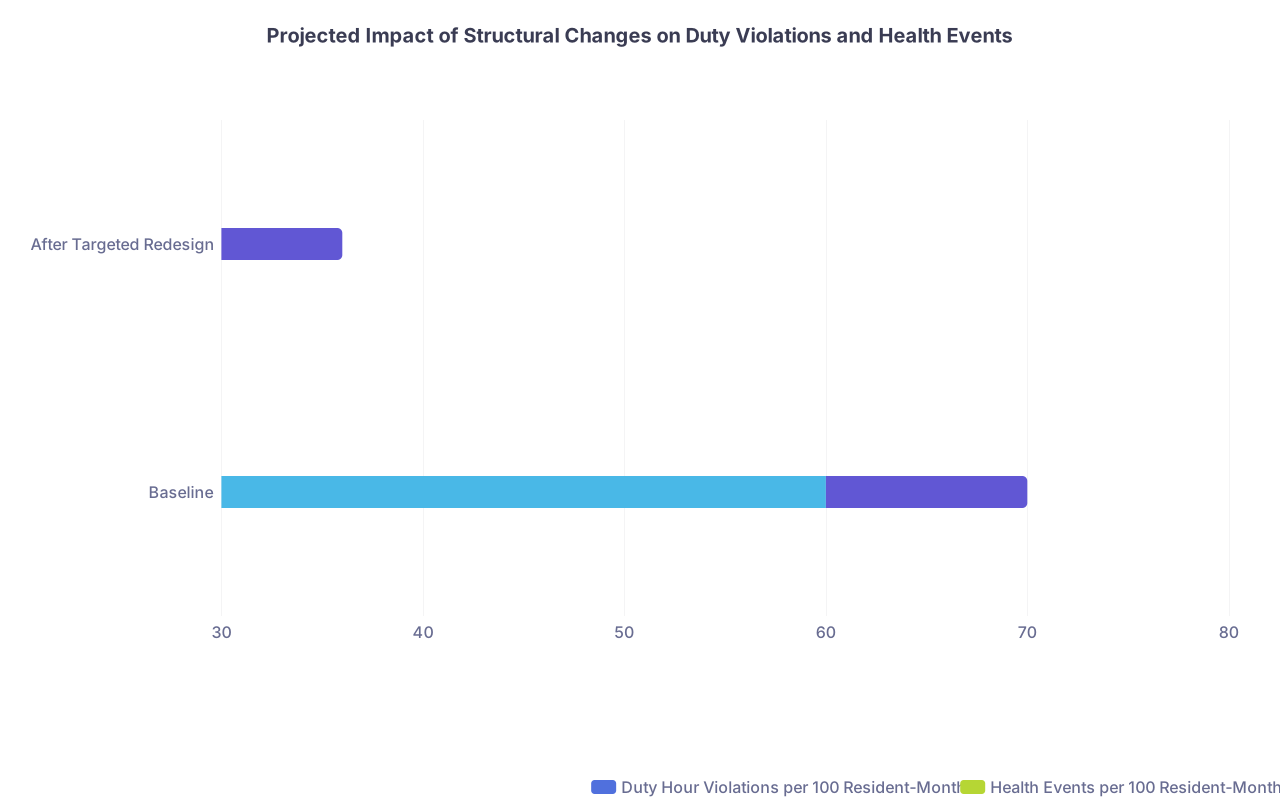
| Category | Duty Hour Violations per 100 Resident-Months | Health Events per 100 Resident-Months |
|---|---|---|
| Baseline | 60 | 10 |
| After Targeted Redesign | 30 | 6 |
Reasonable target reductions from real‑world interventions:
- ~50% reduction in verified duty hour violations.
- ~30–40% reduction in health events among residents with limitations.
Those are not fantasy numbers; they are achievable when schedules, staffing, and expectations are redesigned with constraints instead of wishful thinking.

Future Directions: Making Health Events a Core Metric
If you really want to fix the problem, you have to stop treating resident health events as private, individual issues and start treating them as program‑level quality metrics.
Here is what a data‑mature program will do over the next decade:
Track resident health events systematically (de‑identified)
- ED visits, hospitalizations, unplanned medical leaves.
- Aggregate and analyze by service, rotation, and month.
- Stratify by presence of any accommodation (without disclosing specifics).
Integrate with duty hour and workload data
Combine:- Scheduled vs actual hours.
- Patient census, acuity, and admission volumes.
- Call structure.
Then run actual models. Identify which combinations of rotation + call structure + known limitations produce spikes.
Make this part of program evaluation
Just like case logs and board pass rates, track:- Duty hour violation rates.
- Health event rates.
- Especially for residents with accommodations.
Poor metrics should trigger mandatory redesign, not just a “faculty meeting discussion.”
Leverage technology for early warning
Use simple alerts:- “Resident X has worked 75+ hours in last 7 days and has an active accommodation.”
- “Rotation Y shows higher health events for the last three residents with limitations; review needed.”
No machine learning buzzwords needed. Basic analytics will surface most of the signal.

| Step | Description |
|---|---|
| Step 1 | Schedule Published |
| Step 2 | Collect Actual Hours |
| Step 3 | Merge with Health Events |
| Step 4 | Continue Monitoring |
| Step 5 | Trigger Rotation Review |
| Step 6 | Adjust Schedule and Workflows |
| Step 7 | High Risk Pattern? |
- Normalize accommodations as system design, not favors
Accommodations must become rules in the scheduling engine and staffing plans, not hallway agreements. The more standardized and visible the rules, the less stigma individual residents carry.

This Is About System Design, Not Individual Grit
The cultural script in residency still implies that enough “grit” can overcome biology. That is simply false. Residents with limitations are not failing the system. The system is structured to fail them.
From a data analyst’s viewpoint, the logic is simple:
- Residents with limitations have higher baseline susceptibility to the physiological and psychological harms of overwork.
- Duty hour violations are strongly associated with both health events and clinical errors.
- Residents with limitations are not consistently shielded from these violations—in practice, they often experience more effective workload and hidden hours.
- Basic, measurable structural changes in scheduling and workload allocation reduce both violations and health events, substantially.
The profession has to decide whether it wants to keep pretending duty hours are a regulatory box to check, or whether it will treat them as a real clinical parameter for the physician workforce—especially the part of that workforce that has limitations.
Two or three core points to remember:
- Duty hour violations for residents with limitations are not minor rule breaks; the data show they are strong predictors of real health events.
- Programs that encode accommodations into actual schedule logic and monitor objective work hours can cut violations and health events dramatically.
- If you are not tracking resident health events alongside duty hours, you are flying blind—and residents with limitations are paying the price for that blindness.