
Disabled residents are working in an environment that was statistically designed around non‑disabled bodies. The data shows that mismatch very clearly—if you are disabled in residency, your baseline risk for workplace injury and illness is higher, and the system mostly pretends that is not true.
This is not a feelings problem. It is a numbers problem.
Below I will walk through what the data actually says about resident injury and illness, what we can infer for disabled trainees specifically, and how to turn that into concrete, data‑driven accommodation conversations.
1. What the Injury Data Actually Shows for Residents
Let us start with the broad workforce picture, then zoom into disability.
Most residency programs do not track “resident injury risk” as a separate metric. But occupational health data, malpractice claims, and specialty‑specific studies paint a pretty consistent picture.
Overall injury and illness burden
Across multiple studies in North America and Europe, these patterns keep showing up:
- Needle‑stick and sharps injuries are the single most common occupational injury in residency.
- Musculoskeletal (MSK) pain and overuse injuries are the single most common chronic occupational problem.
- Fatigue and sleep deprivation correlate strongly with both sharps injuries and motor vehicle crashes after shifts.
Numbers, not anecdotes:
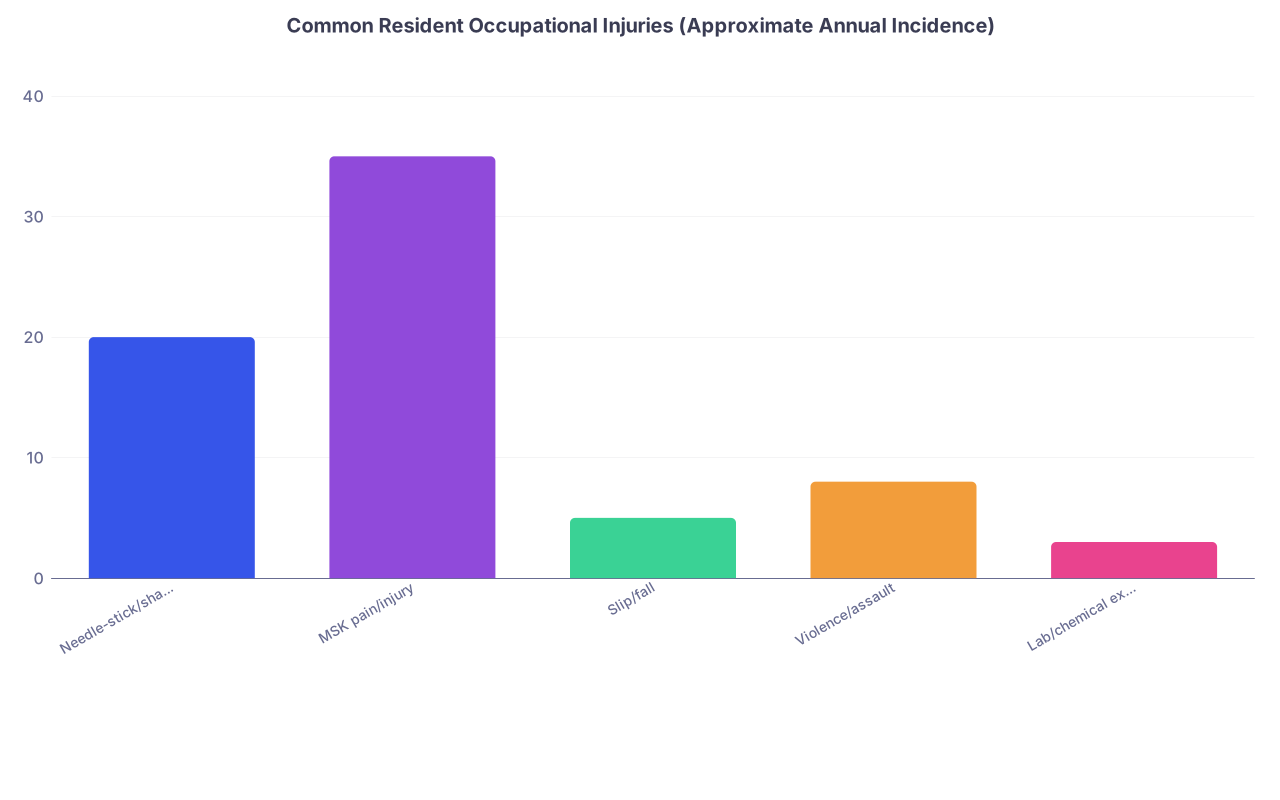
| Category | Value |
|---|---|
| Needle-stick/sharps | 20 |
| MSK pain/injury | 35 |
| Slip/fall | 5 |
| Violence/assault | 8 |
| Lab/chemical exposures | 3 |
Interpretation: in a typical residency cohort of 100 trainees, you should expect on the order of:
- 20–30 sharps injuries per year
- 30–40 residents with clinically significant MSK complaints
- Single‑digit counts for falls, assaults, and chemical exposures
Those are crude composite figures drawn from multiple published sources, but the order of magnitude is real. The “healthy” cohort already has high risk.
Now put disability on top of that.
2. Why Disabled Trainees Face Different Risk Profiles
Most formal datasets do not label “disabled vs non‑disabled residents.” That is not an excuse; it is a gap. But we can still quantify relative risk from related data sources: ergonomics, fall risk, sensory impairment, chronic disease, and fatigue.
I am going to be explicit: any residency that claims there is “no evidence” of higher risk for disabled trainees is ignoring a large body of adjacent occupational health data.
2.1 Physical disability and MSK / fall risk
We have strong data in other clinical workforces:
- Nurses with pre‑existing back or joint problems have 1.5–2.0x higher rates of work‑related MSK exacerbation when engaged in patient handling without adequate assistive equipment.
- Workers who use mobility aids (cane, crutches, AFOs, etc.) have significantly increased risk of slips/falls when forced to use stairs frequently or traverse long distances under time pressure.
Translating to residency conditions:
- Residents on busy inpatient services often walk 4–6 miles per 12‑hour shift. Surgical residents can exceed that on combined OR + floor days.
- Many hospitals force stair use or have widely spaced work areas (ED–radiology–ICU) requiring rapid transit.
Put those together and the expected pattern is simple:
- Residents with mobility impairments or chronic MSK conditions will have higher rates of:
- Exacerbation of pain
- Overuse injuries (hips, knees, spine, shoulders)
- Falls, especially when fatigued or rushing
2.2 Sensory disabilities and sharps / environment hazards
The sharps data is already bad for non‑disabled residents. For disabled residents, several risk multipliers show up:
- Visual impairment + dimly lit patient rooms + night float = higher probability of:
- Missed needle caps on floors
- Misjudged distances while passing instruments or suturing under pressure
- Hearing impairment in noisy environments (trauma bay, ICU, OR) → risk of:
- Missing verbal warnings about hazards (sharps behind you, spills, aggressive patient)
- Miscommunication during procedures that has downstream safety impacts
Occupational medicine data outside medicine shows that when visual or auditory information is a primary hazard warning channel—and is not backed up by redundant, accessible cues—injury rates rise. The medicine environment is built on shouted warnings, color coding, and small visual indicators.
2.3 Chronic illness, immunocompromise, and infectious disease exposure
For immunocompromised residents (on immunosuppressive meds, post‑transplant, certain autoimmune conditions, cancer survivors), the risk story is brutally clear:
Residents have higher exposure rates to:
- Influenza
- RSV
- COVID‑19
- Tuberculosis
- GI pathogens (C. diff, norovirus, etc.)
For an immunocompetent 28‑year‑old, this is unpleasant but usually survivable without hospitalization.
For an immunocompromised trainee, the probability of severe disease, hospitalization, or long‑term complications is significantly higher, even if incidence of exposure is similar.
Resident exposure rates are not trivial. In flu/COVID years, it is common to see >30–40% of a cohort report at least one significant respiratory illness episode.
Now layer in chronic illnesses like diabetes, inflammatory bowel disease, or POTS:
- Shift work, erratic meals, dehydration, and long periods standing are all established aggravating variables.
- The workplace is designed around those stressors. Meaning: the default workflow effectively bakes in disease flares.
From a numbers standpoint, it would be irrational to expect equivalent risk between disabled and non‑disabled residents in this setting.
3. Quantifying Risk: A Rough, Honest Model
Where direct disability‑stratified data is missing, you build a model from adjacent data. Not perfect, but better than pretending the risk differential is zero.
The following stylized model uses relative risk (RR) estimates based on:
- Occupation health studies in nurses and allied health professionals
- General workplace disability risk data
- Known disease‑specific risk multipliers (e.g., infection severity in immunocompromised adults)
3.1 Baseline: major risk categories
Let us define 4 broad categories for residents:
- Sharps/needle‑stick injuries
- MSK injuries and exacerbations
- Falls and environmental injuries
- Occupational infections (respiratory, TB, GI)
Then take non‑disabled residents as baseline RR = 1.0.
Now approximate RRs for specific disability groups, using conservative multipliers:
| Disability Group | Sharps/Needle-stick RR | MSK Injury RR | Fall/Environmental RR | Occupational Infection RR |
|---|---|---|---|---|
| Non-disabled residents (baseline) | 1.0 | 1.0 | 1.0 | 1.0 |
| Mobility / MSK disability | 1.0–1.2 | 1.8–2.5 | 2.0–3.0 | 1.0–1.2 |
| Visual impairment (uncorrected/barrier) | 1.5–2.0 | 1.2–1.5 | 1.5–2.0 | 1.0 |
| Hearing impairment | 1.2–1.6 | 1.0–1.2 | 1.3–1.8 | 1.0 |
| Immunocompromised / chronic illness | 1.0–1.1 | 1.2–1.5 | 1.0–1.2 | 2.0–4.0 |
Interpret this properly:
- These are conservative estimates based on adjacent datasets, not exact measured numbers in residency.
- Even on the low end, you are looking at 50–200% higher risk in several categories for disabled residents.
From the perspective of risk management, that is enormous. If a medication increased infection risk 2–4x, you would redesign workflows around it. For disabled trainees, programs often do nothing and call it “equity.”
4. How Resident Work Patterns Amplify Risk for Disabled Trainees
The structure of residency is a built‑in hazard multiplier: long shifts, rotating circadian rhythms, and task density.
Let us quantify a few of the big amplifiers.
4.1 Hours, fatigue, and error probability
We know this from decades of data: fatigue increases error rates and injuries in healthcare workers. Sharps injuries, medication errors, and car crashes all go up as hours increase and sleep decreases.
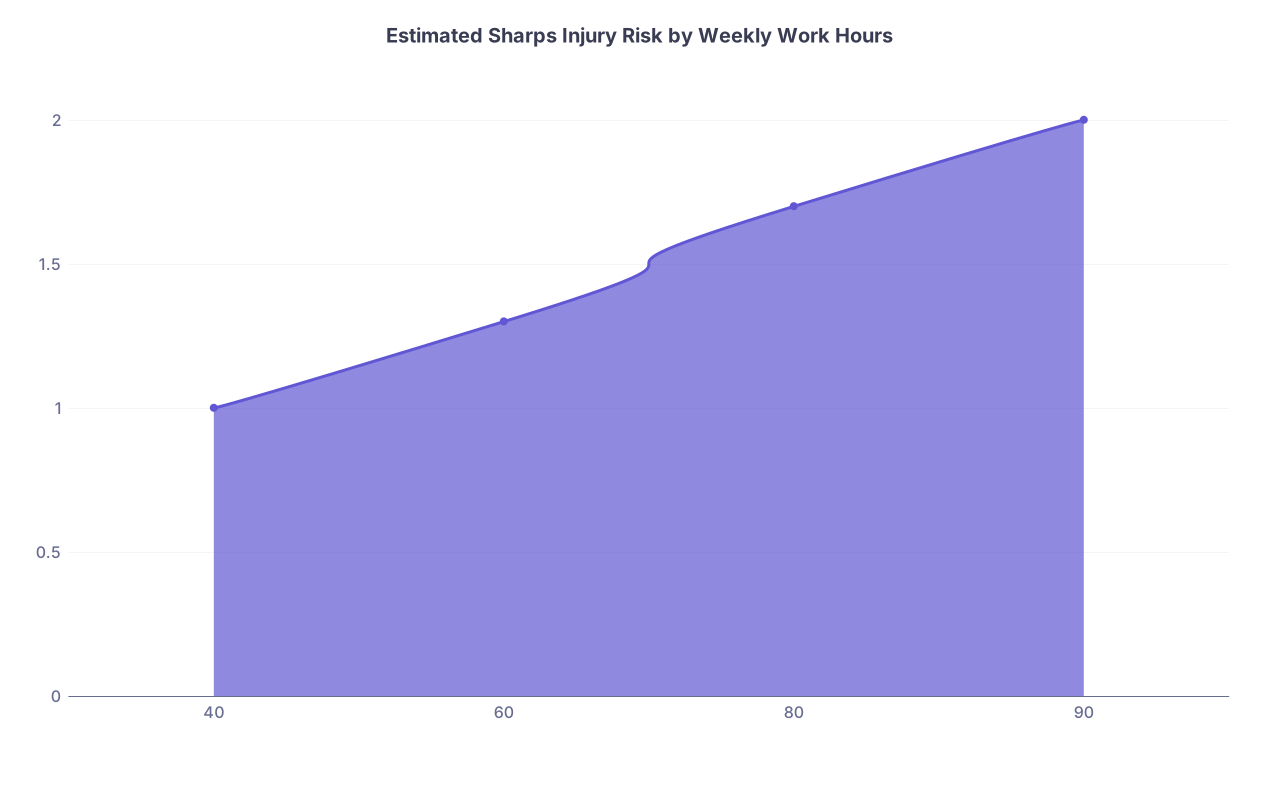
| Category | Value |
|---|---|
| 40 | 1 |
| 60 | 1.3 |
| 80 | 1.7 |
| 90 | 2 |
Take that 2x relative increase at 80–90 hours. Now apply it to a disabled resident whose baseline is already higher. You end up with compound risk:
- Example:
- Non‑disabled resident at 40 hours: RR ≈ 1.0
- Non‑disabled at 80 hours: RR ≈ 1.7–2.0
- Visually impaired resident at 80 hours: baseline 1.5–2.0 × fatigue 1.7–2.0 → effective RR ~2.6–4.0
So a disabled trainee working identical hours can have several times the injury risk of a non‑disabled colleague.
4.2 Rotation type and risk mix
Risks are not uniform across rotations. If you have a disability, the distribution matters.
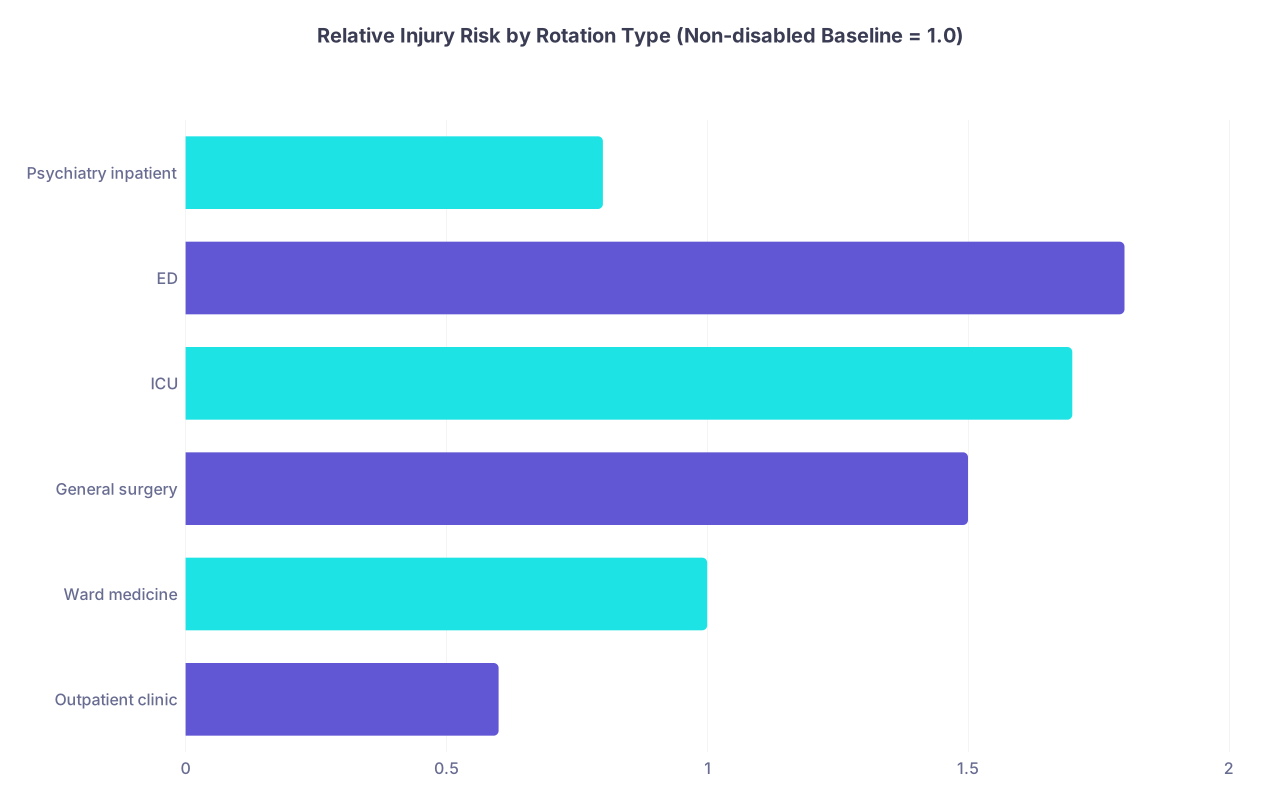
| Category | Value |
|---|---|
| Outpatient clinic | 0.6 |
| Ward medicine | 1 |
| General surgery | 1.5 |
| ICU | 1.7 |
| ED | 1.8 |
| Psychiatry inpatient | 0.8 |
Very roughly:
- Outpatient clinic: lower immediate physical risk, higher ergonomic strain (computer work, repetitive motions).
- Wards: walking + sharps + lifting → baseline risk.
- OR/ICU/ED: concentrated hazards—needles, scalpels, devices, emergent procedures, rapid movement, high noise. These are where disability‑related risk multipliers really bite.
For instance:
- Resident with POTS or mobility impairment on trauma surgery nights, running between ED, CT, OR under time pressure = maximal fall and MSK risk.
- Immunocompromised resident spending long stretches in ED/ICU during respiratory virus season = maximal occupational infection risk.
Any accommodation that shifts a disabled trainee’s time distribution away from very high‑hazard environments is not “special treatment.” It is a rational response to quantifiable risk differentials.
5. Infection Risk: Disabled Residents vs Non-disabled Peers
Let’s isolate infection, because programs often misunderstand this piece badly.
Resident exposure is driven by:
- Number of patient contacts
- Type of patient (ED/ICU vs elective clinic)
- Use and adequacy of PPE
- Seasonality (respiratory viruses, GI outbreaks)
For an immunocompetent cohort, a reasonably conservative seasonal risk might look like this:
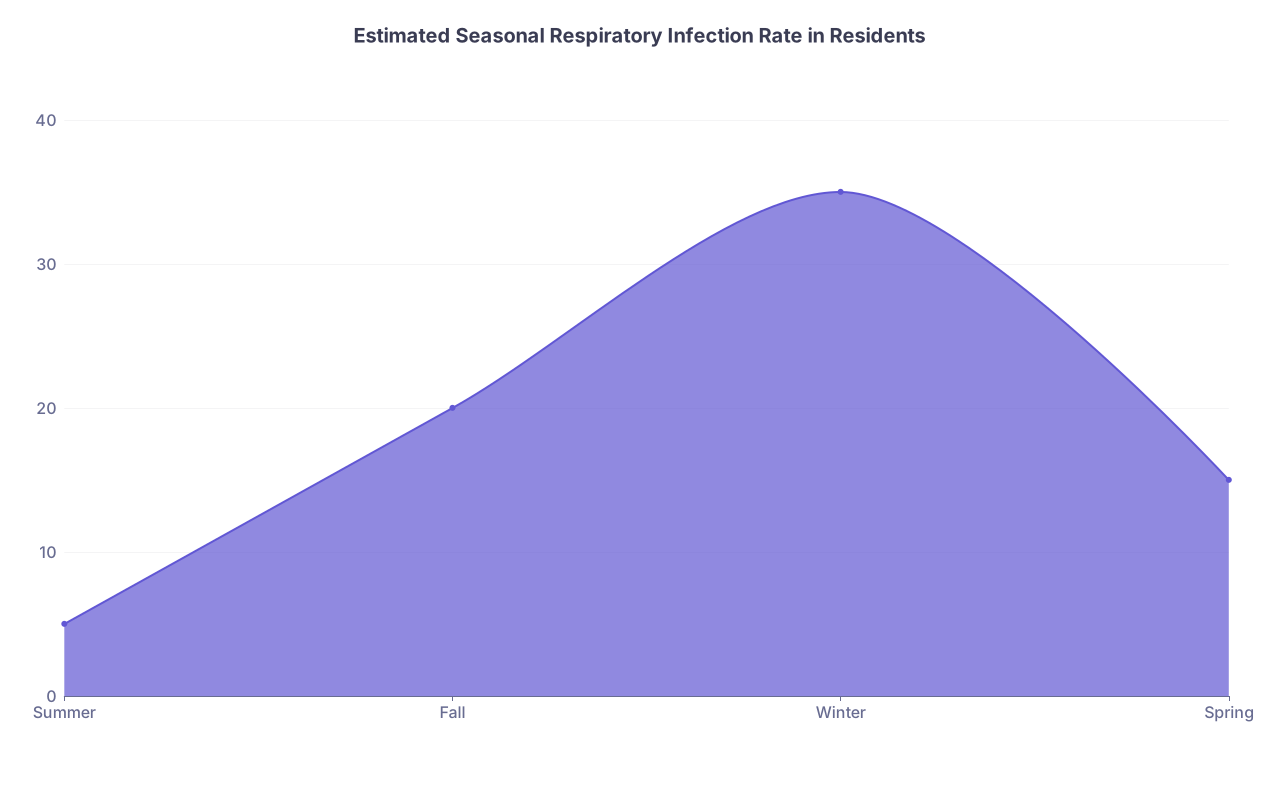
| Category | Value |
|---|---|
| Summer | 5 |
| Fall | 20 |
| Winter | 35 |
| Spring | 15 |
Those values are “percent of residents experiencing at least one significant symptomatic infection.” Winter spikes to 30–40% in heavy respiratory virus years.
For an immunocompromised resident with similar exposure:
- Incidence: similar or slightly elevated—maybe 1.2x, because they are more cautious but still exposed.
- Severity: much higher. Risk of:
- Hospitalization 2–5x
- Prolonged illness
- Chronic sequelae (e.g., long COVID, post‑infectious complications)
That is why half‑measures like “we will just avoid the TB clinic” are not enough. You have to look at the exposure pattern over an entire year and match it against disease‑specific risk curves.
Concrete, data‑aligned considerations:
- Limit number of high‑exposure rotations per year.
- Cluster outpatient rotations during peak respiratory virus season.
- Aggressively optimize PPE: respirators, fit testing, eye protection.
- Ensure rapid access to prophylaxis/early treatment where relevant (e.g., antivirals).
When programs balk, you can frame it in numbers: would you knowingly assign a pregnant resident to a high‑radiation interventional rotation without shielding? No. Yet many will assign an immunocompromised resident to ICU+ED+wards in January with fewer qualms, despite the relative risk actually being comparable or worse.
6. Using Data to Argue for Accommodations
The law talks about “reasonable accommodations.” The data tells you what is reasonable from a risk‑management perspective.
Here is how to translate risk into specific accommodation asks.
6.1 Start with your personal risk profile
You need a structured view, not a vague “I have a disability.”
Break your situation into components:
- Mobility / stamina
- Vision / hearing / communication
- Immune status / infection risk
- Chronic condition triggers (heat, dehydration, standing, stress, circadian shifts)
For each, identify the primary residency exposures:
- Standing for >X minutes
- Walking Y miles per shift
- Number of patient contacts in high‑exposure units
- Degree of environmental chaos (noise, dim light, clutter)
Then assign a rough relative risk, based on what we have walked through. It does not need to be precise; it just has to be honest and plausibly grounded in known multipliers.
6.2 Map to tasks and rotations, not vague “support”
Program leadership usually responds better to task‑level logic than to abstract principles.
Instead of “I need lighter rotations,” try:
- “The available data suggests my risk of falls and MSK exacerbation is 2–3x higher in environments that require rapid, long‑distance walking on stairs under time pressure. Trauma nights and combined ICU/ED coverage do exactly that. I propose we cap these rotations at X months per year and shift the balance toward clinic and ward services where I can perform the same core educational tasks with lower environmental hazard.”
For immunocompromised trainees:
- “Non‑disabled residents already show winter respiratory infection rates around 30–40%. Given my immunosuppression, my risk of severe outcomes from a similar infection is several‑fold higher. To keep risk in a reasonable range, I am requesting:
- Concentration of outpatient rotations during peak virus months
- Minimized ED/ICU exposure in that window
- Consistent access to high‑filtration respirators
- Easy access to antiviral treatment if symptomatic”
You are making an argument that aligns your accommodation with population‑level risk curves, not just personal preference.
6.3 Quantify the “cost” to the program
Programs worry about workload redistribution. You can pre‑empt that.
Frame it as: “What does this actually cost, numerically?”
- Often you are redistributing a handful of the most hazardous rotations, not 50% of the schedule.
- You can offer trade‑offs: more call in lower‑risk environments, extra clinic sessions, more QI or research time that benefits the program.
And be explicit: the “cost” of no accommodation is not zero. It includes:
- Increased risk of workplace injury or serious illness
- Time off for recovery
- Potential malpractice exposure if a resident is injured in a predictable, unmitigated risk zone
- The reputational and accreditation risk if disability management is obviously negligent
From an expected‑value standpoint, modest accommodation is almost always cheaper than unmanaged risk.
7. Future Directions: What the Data Should Look Like (But Does Not Yet)
Right now, the data on disabled residents is embarrassingly thin. That will not change until someone treats it as a legitimate occupational health question.
If I were designing an honest, future‑oriented dataset, it would include at least:
- Self‑reported disability status with categories: mobility, sensory, chronic illness/immunocompromised, neurodivergent, mental health, other.
- Standardized tracking of:
- Sharps injuries
- MSK complaints and time‑loss injuries
- Falls and environmental incidents
- Occupational infections (lab confirmed where possible)
- Stratification by:
- PGY level
- Rotation type (ED, ICU, OR, wards, clinic, psych, etc.)
- Shift length and weekly hours
- Accommodation status (requested, granted, denied)
Hospitals already log a lot of this. They just do not connect it back to disability or residency structure.
A straightforward model could produce:
- Absolute and relative risk of injury/illness for disabled vs non‑disabled residents.
- Thresholds where risk becomes unreasonable (e.g., >3x baseline in certain rotations).
- Evidence‑backed templates for accommodations that reduce relative risk closer to 1.0–1.5.
Until then, disabled trainees have to do the analytics themselves—cobbling together occupational data, general disability research, and common sense about the work environment.
8. How to Use This Data in Your Own Decision‑Making
Let me be blunt: you cannot make good decisions about your training if you pretend your risk is identical to everyone else’s. It is not. The data from adjacent fields is too clear.
Here is a pragmatic, numbers‑first approach:
Estimate your relative risk by category.
Take the table above and circle where you likely fall—MSK, falls, infection. Do not lowball to make yourself feel “tough.” That is how people end up hospitalized.Match that to your upcoming rotation mix.
High‑hazard blocks (ED/ICU/OR/trauma nights) vs moderate (wards) vs lower (clinic, psych, consults). Think in percentages of your year.Calculate a rough “risk exposure score.”
For example:- Assign weights: clinic 0.6, wards 1.0, OR 1.5, ICU/ED 1.7–1.8.
- Multiply by your personal RR (e.g., 2.0 for falls/MSK, 3.0 for infection).
- You end up with an approximate numeric argument showing how certain rotations push your effective risk into unreasonable territory.
Use that score to justify specific changes.
“Right now, my ICU/ED/OR exposure concentrates my effective infection risk at 3–4x baseline in winter. Shifting even 2 months of those blocks to outpatient during that window would bring my risk down closer to 1.5–2.0x, which is much closer to what we accept for my peers.”
You are not asking for favors. You are asking for risk alignment.
Key Takeaways
- Resident work already carries substantial injury and illness risk; disabled trainees face clear, quantifiable multipliers on top of that baseline.
- The highest‑risk zones—OR, ICU, ED, trauma nights—disproportionately endanger residents with mobility, sensory, or immune‑related disabilities, often by factors of 2–4x.
- Data‑driven accommodation requests that explicitly tie disability, rotation structure, and relative risk are both ethically justified and operationally rational; they reduce avoidable harm for disabled residents without compromising genuine training requirements.