
You are in your M4 year. You have a diagnosis that affected you in pre-clinicals and on the wards. Student Health knows. The disability office helped with extra time on exams and maybe a reduced call schedule for a rough clerkship.
Now you are staring at your GME onboarding packet. Occupational health forms. “Essential functions” attestations. Nothing about accommodations. And you are thinking:
“Who is supposed to tell GME what I need? Does Student Health handle it? The disability office? Do I have to start all over and re-prove my diagnosis? And what if my program director finds out everything?”
Here is the reality: nobody is coordinating this for you. Unless you force it. That is what this article is about—turning a messy, fragmented system into something you can actually work with.
1. Understand the Three Players (And What They Do Not Do)
First thing: stop treating Student Health, the disability office, and GME as one big “school.” They are three different systems with different jobs, different legal obligations, and different blind spots.
If you do not understand where each one begins and ends, you will get bounced around like a bad consult.
Student Health
Core role: your medical care. Vaccines, TB testing, mental health treatment, meds refills, sometimes short-term therapy.
What they do:
- Diagnose and treat conditions
- Document your medical status
- Provide letters or forms that confirm your diagnosis and functional limitations (if you ask, and if they are willing)
What they do not do:
- Decide your accommodations
- Communicate directly with GME or the disability office without your explicit permission
- Manage your legal rights under ADA
Treat them as: your clinician, not your advocate or legal shield.
Disability / Accessibility Office (for students)
Core role: determine academic accommodations while you are a student. They are your ADA / Section 504 mechanism on the UME side.
What they do:
- Review disability documentation
- Determine reasonable accommodations in the academic and clinical student environment
- Give you letters or forms to instructors, clerkship directors, testing centers
- Maintain confidential disability records in the student domain
What they do not do:
- Automatically transfer your accommodations to residency or GME
- Control what GME does or does not grant
- Manage occupational health / fitness-for-duty issues
They live in the student world. Residency is the employee world. Different laws, different structure.
Graduate Medical Education (GME) / Residency Program
Core role: employer-side training program. Administers your residency employment and ACGME requirements.
What they do:
- Set essential job functions for residents
- Coordinate with institutional HR and Employee/Workplace Disability / ADA office
- Implement workplace accommodations if properly requested through the correct channel (often the Employee ADA office, not directly through your PD)
- Manage schedules, leave, call, rotations
What they do not do:
- Automatically accept student accommodations as a template
- Handle your personal health data directly (they should not be your treating clinicians)
- Proactively design accommodations for you without a formal process
In many institutions, there is a separate Employee Disability / ADA office. That is usually your real counterpart to the student disability office once you hit GME.
2. Map Your Institution’s Structure (Before Things Blow Up)
Most people only discover the gaps when something goes wrong mid-intern year. Do not do that.
You need a map: who does what, where records live, who talks to whom, and what is siloed.
Step 1: Identify all relevant offices
You are looking for:
- Student Health / Student Wellness / Counseling Center
- Student Disability / Accessibility Services
- GME Office
- Occupational Health / Employee Health
- Employee / Workplace Disability / ADA / Office of Institutional Equity (name varies)
- HR (less for coordination, more for policy backup)
Step 2: Write down what each one controls
Make a one-page personal map. Something like:
| Office | Primary Role | Domain |
|---|---|---|
| Student Health | Clinical care, documentation | Student |
| Student Disability Office | Academic accommodations | Student |
| GME Office | Residency training oversight | Employee |
| Occupational/Employee Health | Fitness for duty, screenings | Employee |
| Employee/Workplace ADA Office | Workplace accommodations | Employee |
Keep this in your notes. You will refer back to it when someone says “we do not handle that” and you need to know where to go next.
Step 3: Confirm data silos
Ask explicitly:
- Does the Student Disability Office share records with GME or Employee ADA? (Usually no, without consent.)
- Does Student Health automatically communicate with Occupational Health? (Sometimes yes, often no, always with varying rules and consents.)
- Does GME ever get told about disability status automatically? (Should not happen without your authorization, but bad practices exist.)
You want clear answers here. If someone gets evasive, that is your red flag to control your information very carefully.
3. Build Your Personal Coordination Plan: Step-by-Step
You need a protocol—your own. Not “vibes,” an actual plan.
Step 0: Decide your disclosure strategy
This is not about whether you “deserve” accommodations. You do. The question is how much you disclose and to whom.
Ask yourself:
- What are my non‑negotiable needs to function safely (for me and patients)?
- Do I need schedule structure? Reduced night float? Extra time for documentation? Quiet testing rooms?
- How visible is my condition? (A seizure disorder is different from dyslexia is different from depression.)
- How bad is the risk if I under-disclose and crash mid‑PGY‑1?
My bias: err on the side of formal, documented accommodation channels rather than “I will just tough it out and see.” I have seen that go badly more often than not.
Step 1: Get your documentation locked down (Student Health or your own clinician)
Ask your treating clinician(s) for:
- A clear diagnosis (or, if they will not specify diagnosis, at least a well-described set of functional limitations)
- Duration: chronic, intermittent, time-limited
- Functional impact:
- Concentration / processing speed
- Physical stamina
- Fine motor skills
- Night work / circadian disruption
- Response to stress, sleep deprivation
- Specific functional constraints, not “needs 20% less call.” Example:
- “Should avoid more than 24 continuous hours awake.”
- “Requires predictable access to restroom every 2–3 hours.”
- “Requires the ability to take short movement/stretch breaks every 60–90 minutes.”
- “Needs access to text-to-speech for dense reading tasks.”
You are not asking them to design accommodations. You are asking them to define limitations and needs.
Keep:
- A clean PDF of the letter
- Their contact information for verification
Step 2: Close out your student accommodations on paper
Before graduation:
- Meet with the Student Disability Office.
- Ask for:
- A summary letter of the accommodations you had and why (at a functional level, not diagnostic gory details).
- Clarity on what they can and cannot share with future institutions, and under what consent.
- Explicitly ask:
“If I sign a release, can you share a high‑level summary of my accommodation history with another institution’s disability or ADA office?”
Get that answer in writing if possible.
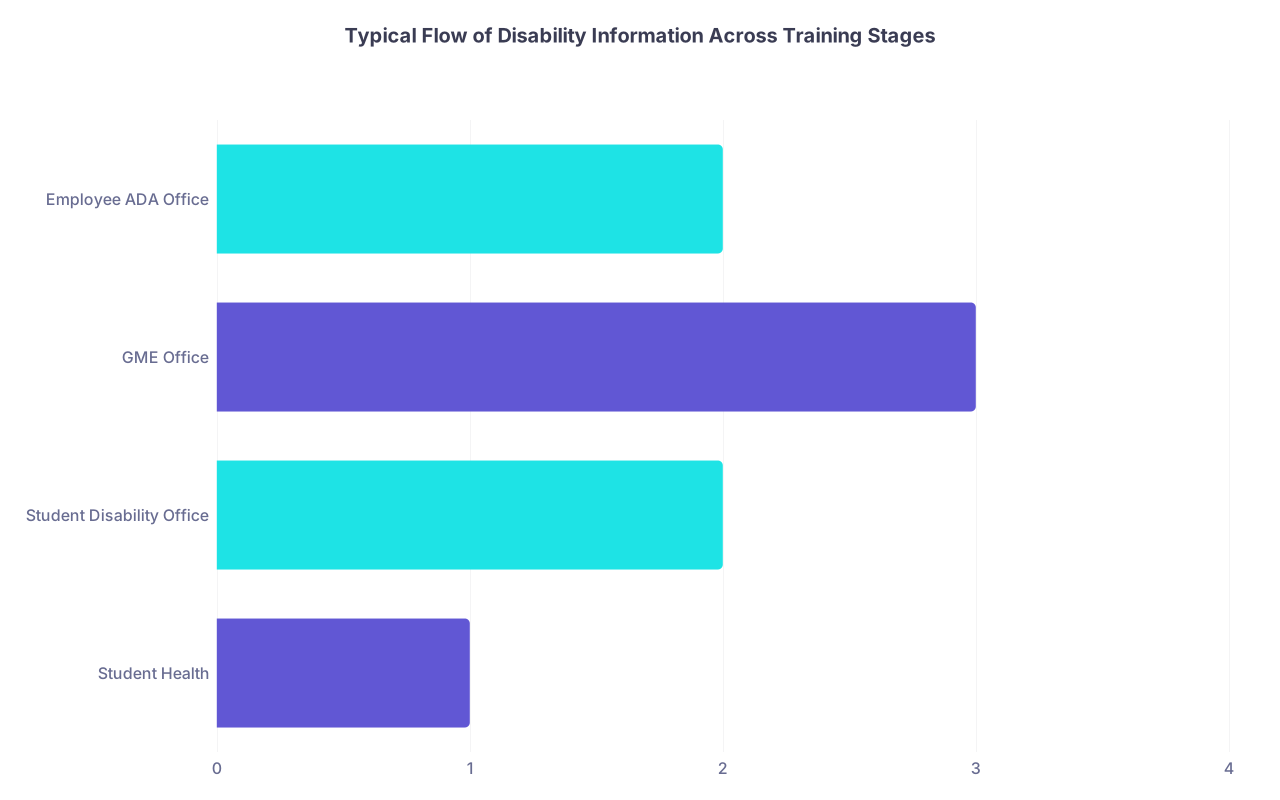
| Category | Value |
|---|---|
| Student Health | 1 |
| Student Disability Office | 2 |
| GME Office | 3 |
| Employee ADA Office | 2 |
Legend: Higher values reflect typical role in handling disability-related planning (1 = low, 3 = high).
Step 3: Identify the GME-side ADA entry point
Do not start with your PD unless you absolutely have to. You want the process, not personalities.
Your targets:
- Employee / Workplace ADA office
- Sometimes labeled “Reasonable Accommodations Office,” “Disability Services for Employees,” or housed under HR or Equal Opportunity
Your message to GME coordinator (not PD) can be very simple:
“I will need to engage with the institution’s employee accommodation process prior to starting residency. Could you please share contact information for the office that handles ADA accommodations for employees/house staff?”
Get that email, phone number, and website.
4. How to Coordinate Without Oversharing
The hardest part is threading the needle: get what you need without giving everybody your complete health history.
Here is a practical playbook.
Step 1: Start with the Employee ADA office
Email them directly. Example script:
Subject: Incoming Resident – Request to Initiate ADA Accommodation Process
Dear [Name or Office],
I am an incoming resident physician in [Program], starting [Month/Year]. I have a documented disability and would like to initiate the process for evaluating reasonable accommodations before my start date.
Could you please let me know:
- What documentation you require from my clinician(s), and
- Your recommended timeline to complete this process prior to my start?
I would prefer to keep my specific diagnosis confidential outside of your office and any other need‑to‑know parties involved in the formal process. I am happy to provide detailed documentation directly to you.
Sincerely,
[Your Name]
Now you have:
- The right office
- A timestamped record that you initiated early and reasonably
Step 2: Decide what to let Student Health and disability offices do
If you are staying at the same institution for residency:
- Student Health might also function as Employee Health. That can blur lines. Clarify what chart they are using when they see you as an “employee.”
- Student Disability Office should not manage your employee accommodations, but they can:
- Help you articulate what worked and what did not as a student
- Provide documentation of prior accommodations (with your consent)
If you are moving to a new institution:
- You control which documents move.
- You usually do not need the new place to talk to your old Student Health. You need:
- Your treating provider’s letter
- Your own copy of prior accommodation letters (optional but often useful)
Step 3: How to use Student Health strategically
You want Student Health (or your PCP / psychiatrist / specialist) to:
- Provide updated, clear documentation focused on function
- Align on realistic safety limits (e.g., “this person can do nights but no more than X consecutive shifts” vs. “no nights at all”)
Do not ask them to:
- Write, “They need a light call schedule” (too vague and usually ignored)
- Negotiate directly with your program
- Email your PD
You keep them in a clinician role. You do the coordination via formal accommodation channels.
5. Translating Needs into Residency-Compatible Accommodations
Residency is not college. You cannot just say, “I need no call, no nights, no weekends” and expect that to pass as “reasonable.”
You have to translate needs into modifications that still allow you to meet essential program requirements, often in a different way.
Step 1: Know the typical buckets of accommodations
In residency, the more common viable adjustments look like:
- Schedule structure
- More advanced notice of schedule changes
- Protected time for weekly therapy or medical appointments
- Avoidance of back‑to‑back very long shifts when not essential
- Workload / environment
- Quiet space for documentation when possible
- Permission to use assistive technology (dictation, text‑to‑speech)
- Call / Night work
- Modified distribution of night shifts (e.g., more spread out, or concentrated blocks with recovery time)
- Avoiding specific patterns that trigger medical issues (e.g., no more than X consecutive nights)
- Testing / Evaluations
- Extra time for written in‑service exams
- Separate room for exams
- Leave / Recovery
- Planned medical leave blocks
- Temporary step‑back or reduced schedule if there is a defined medical event
Step 2: Convert your clinical limitations into concrete options
Take your clinician letter and ask yourself:
- What schedule rules follow from this?
- What environmental tweaks actually matter day‑to‑day?
Example:
Limitation: “Requires consistent sleep window to control seizures.”
- Possible accommodations:
- Limit on consecutive night shifts
- Advanced scheduling to allow planning of sleep pattern
- Avoidance of rotating from nights to early days without rest intervals
- Possible accommodations:
Limitation: “Processing speed impairment and difficulty in noisy environments for written tasks.”
- Possible accommodations:
- Extended time on exams
- Occasional access to a quieter location for complex documentation tasks
- Permission to use dictation / assistive software
- Possible accommodations:
You bring those proposals into the conversation with the Employee ADA office. They evaluate against “reasonableness” and essential job functions, and then formalize what is actually granted.

| Step | Description |
|---|---|
| Step 1 | Incoming Resident |
| Step 2 | Gather Clinician Documentation |
| Step 3 | Contact Employee ADA Office |
| Step 4 | Interactive Process Meeting |
| Step 5 | Accommodation Plan to GME |
| Step 6 | Modify Requests or Explore Alternatives |
| Step 7 | Implemented in Schedule/Training |
| Step 8 | Reasonable? |
6. What to Tell Your Program Director (And When)
This is the part everyone worries about. Reasonable. PDs control your schedule, your evaluations, your future letters.
You do not need to hand your PD your full psych history. But you cannot expect them to adjust a schedule they know nothing about.
Here is a sane approach.
Step 1: Let the ADA process lead
In a well-run institution:
- You work with the Employee ADA office
- They generate a formal accommodation plan with non-diagnostic language:
- “Resident is approved for X”
- That plan is sent to GME / PD as a directive: “Implement these conditions.”
If you have that, you do not need to negotiate or justify. You just might want to add context.
Step 2: Decide your disclosure depth
You have a few levels:
Bare minimum (rights-protective)
- PD knows: you have approved accommodations: “X, Y, Z.”
- PD does not know: your diagnosis, specifics of your medical history.
- Upside: privacy.
- Downside: some PDs get suspicious or frustrated when they do not understand the “why.”
Moderate disclosure (my usual recommendation)
- PD knows:
- You have a documented condition.
- Broad category only if you are comfortable (e.g., “a chronic neurologic condition that affects sleep,” “a learning disability that impacts reading speed,” “a mental health condition that is stable with treatment”).
- You are working through formal channels.
- You still keep intimate details private.
- PD knows:
Full disclosure (selected situations)
- Only if you trust your PD deeply or your condition will be unmistakably obvious (e.g., frequent hospitalizations, visible mobility aids) and context really helps.
Step 3: How to have the conversation
Example template (short meeting or Zoom) once accommodations are in motion or approved:
“I wanted to let you know I have a documented medical condition that has required accommodations in the past to maintain safe and sustainable functioning. I have already engaged with the institution’s Employee ADA office.
They will send any approved accommodations directly to you and GME. My priority is to meet all the program’s expectations and essential requirements while making sure I can do that safely over the long term.
I do not expect you to manage the medical side—my clinicians and the ADA office are handling that. I just wanted to be proactive and let you know this process is in motion so that any schedule impacts are not a surprise.”
You have:
- Shown professionalism
- Avoided oversharing
- Taken the pressure off the PD to make medical judgments
7. Handling Conflicts and Dumb Responses
Sometimes offices mishandle this. I have seen:
- GME say, “We do not do accommodations; everyone works the same.” (Wrong and illegal.)
- Student Disability Office tell M4s, “We are done once you graduate, good luck.” (Unhelpful, but common.)
- PDs insist on knowing your full diagnosis “for safety.” (Not their lane.)
You need a conflict plan.
Step 1: Know your escalation points
Potential allies:
- Employee ADA office (they are usually your strongest backing)
- Institutional Ombuds office
- Office of Equity / Compliance
- Your specialty’s national organization (informal advice)
- Legal counsel (especially if there is clear ADA violation)
Step 2: Red-flag statements and how to respond
If you hear:
“We just do not accommodate residents.”
Response:“I understand residency has essential functions that must be met. I am pursuing this through the ADA process, which is designed to evaluate what is reasonable while preserving those requirements. I would like to continue that process with the appropriate office.”
“If you need accommodations, maybe you cannot do this specialty.”
Response:“That is a significant statement. The ADA office is reviewing my functional limitations and essential job requirements for this role. I would like any determinations about my ability to meet essential functions to go through that formal process.”
“We will need your full psychiatric records to decide.”
Response:“I am happy to provide detailed documentation from my treating clinicians to the Employee ADA office. I am not comfortable sharing full medical records outside of that channel.”
You do not need to fight on the spot. You need to redirect to the proper process and document what was said.
Step 3: Document everything
- Save emails.
- After verbal conversations, send a quick summary email:
“To recap our conversation earlier today, my understanding is that… If I have misunderstood, please correct me.”
That written record is what protects you if the situation escalates.

8. Timeline: When to Do What
Here is a rough timeline you can adapt.
During M3–M4 (if you already know you have a condition)
- Tighten your documentation (Student Health / treating clinicians).
- Meet with Student Disability Office to get a summary of prior accommodations.
- Ask explicit questions about transitioning to GME (how they usually see it go).
After you Match (ideally within 2–4 weeks)
- Identify the GME institution’s Employee ADA office and Occupational Health.
- Email Employee ADA office to start the process.
- Confirm what they need from your clinician and by when.
1–2 months pre-start
- Ensure your clinician has sent documentation.
- Complete any formal accommodation request paperwork.
- Attend any interactive process meeting.
- If something big is on the table (e.g., altered call structure), ask when and how GME will be notified.
First month of residency
- Have a short, controlled conversation with your PD (if not already done).
- Check that the accommodations are actually implemented in your schedule / workflow.
- If not, politely flag to the ADA office: “Approved accommodations are not yet reflected in my schedule; how should we address this?”
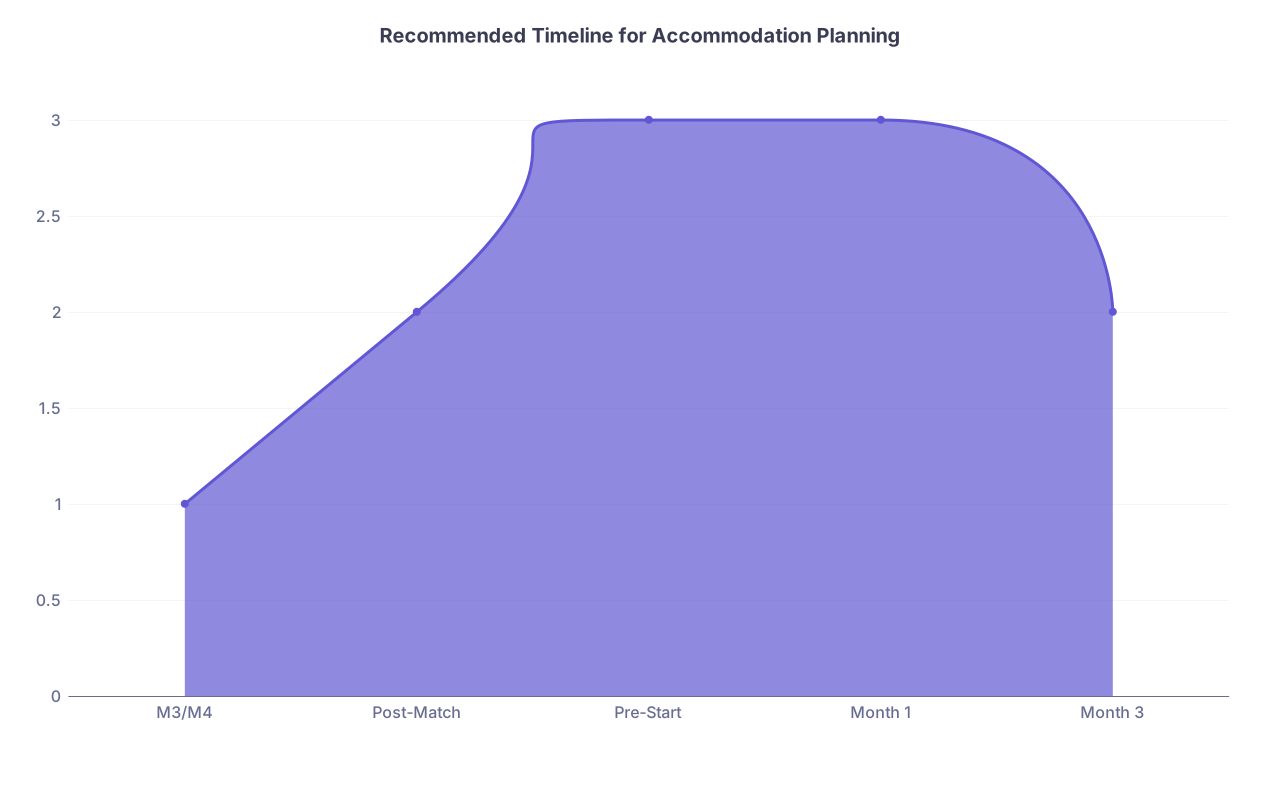
| Category | Value |
|---|---|
| M3/M4 | 1 |
| Post-Match | 2 |
| Pre-Start | 3 |
| Month 1 | 3 |
| Month 3 | 2 |
Legend: Higher values represent intensity of coordination tasks.
9. Common Coordination Fail Patterns (And How to Fix Them)
Let me be blunt. These are the top ways this goes sideways, and how you course-correct.
Pattern 1: Waiting until you are in crisis PGY‑1
You “see how it goes” and then melt down on night float in October.
Fix:
- You can still start the ADA process mid‑year. It is harder, but absolutely doable.
- Document the functional problems you are having (not just “I feel bad,” but “I cannot safely drive home post‑call,” “I am making medication errors after 30-hour shifts”).
- Engage your clinician and Employee ADA office together.
Pattern 2: Over‑disclosing to the wrong person
You tell your PD your full trauma history, then realize they had no idea how to handle that and now everything feels weird.
Fix:
- Pull things back into formal channels.
- Email PD:
“I appreciate your willingness to listen when I shared more background about my health. For clarity and to maintain appropriate boundaries, I am working through the Employee ADA office regarding any accommodations. You will receive any relevant information through that process.”
- Then stop sharing clinical detail and let the system do its job.
Pattern 3: No one talks to each other
Student Health says, “Talk to disability.” Disability says, “We stop at graduation.” GME says, “Ask Occupational Health.” Occupational Health says, “Ask your PD.”
Fix:
- Ask specifically: “Who is the Employee ADA / accommodations coordinator for employees and house staff?”
- If they still bounce you, go to HR or the institutional equity office:
“I am an incoming resident requesting information about how to initiate an ADA accommodation request. I have asked several offices and been redirected multiple times. Who is the designated coordinator for employee accommodations?”
Keep pushing until you get a name and email. Then anchor everything there.

FAQ (Exactly 4 Questions)
1. Do I have to disclose my diagnosis to my program director to get accommodations?
No. You typically do not have to disclose your specific diagnosis to your PD. The correct path is through the Employee / Workplace ADA office, which receives your detailed medical documentation and then issues an accommodations plan phrased in functional terms (“X is approved for Y adjustment”). Your PD needs to know what to implement, not your DSM code. Some residents choose to give high‑level context, but that is a strategic choice, not a legal requirement.
2. What if my institution does not seem to have an Employee ADA office?
Almost every sizable institution does; it may just be buried under a different name: “Workplace Accommodations,” “Office of Institutional Equity,” “Equal Opportunity Office,” or “HR – Disability Services.” If you truly cannot find it on the website, email HR or the GME office and ask explicitly for “the office that coordinates ADA accommodations for employees and house staff.” If you meet continued resistance, the next step is the institution’s compliance or equity office.
3. Can I transfer my medical school accommodations directly to residency?
No. Prior accommodations are informative but not automatically binding. Different role, different legal framework (student vs employee). What you can do is:
- Bring a summary of your prior accommodations to the Employee ADA office.
- Use that as evidence of what has worked and what may be reasonable. They will still evaluate your current role, essential functions, and documentation to determine a new plan.
4. What if my requested accommodation is denied as “not reasonable”?
You have options. First, ask for the rationale in writing, including which “essential functions” it would interfere with. Second, explore alternative accommodations that address the same limitation with less disruption (for example, limits on consecutive nights rather than complete removal of night shifts). You can also involve your treating clinician to clarify functional limits and negotiate alternatives. If you believe the denial is inconsistent with ADA standards, you can discuss with the institutional equity/ compliance office or seek outside legal counsel for advice.
Key Points to Remember
- Treat Student Health, the student disability office, and GME as separate systems with different roles; your job is to connect them strategically, not assume they will coordinate for you.
- Anchor everything around the Employee / Workplace ADA office once you match—this is the proper gateway for residency accommodations, not your PD’s inbox.
- Translate your medical limitations into concrete, residency-compatible accommodations and push the process early, on paper, and through the right channels—before crisis forces the issue.