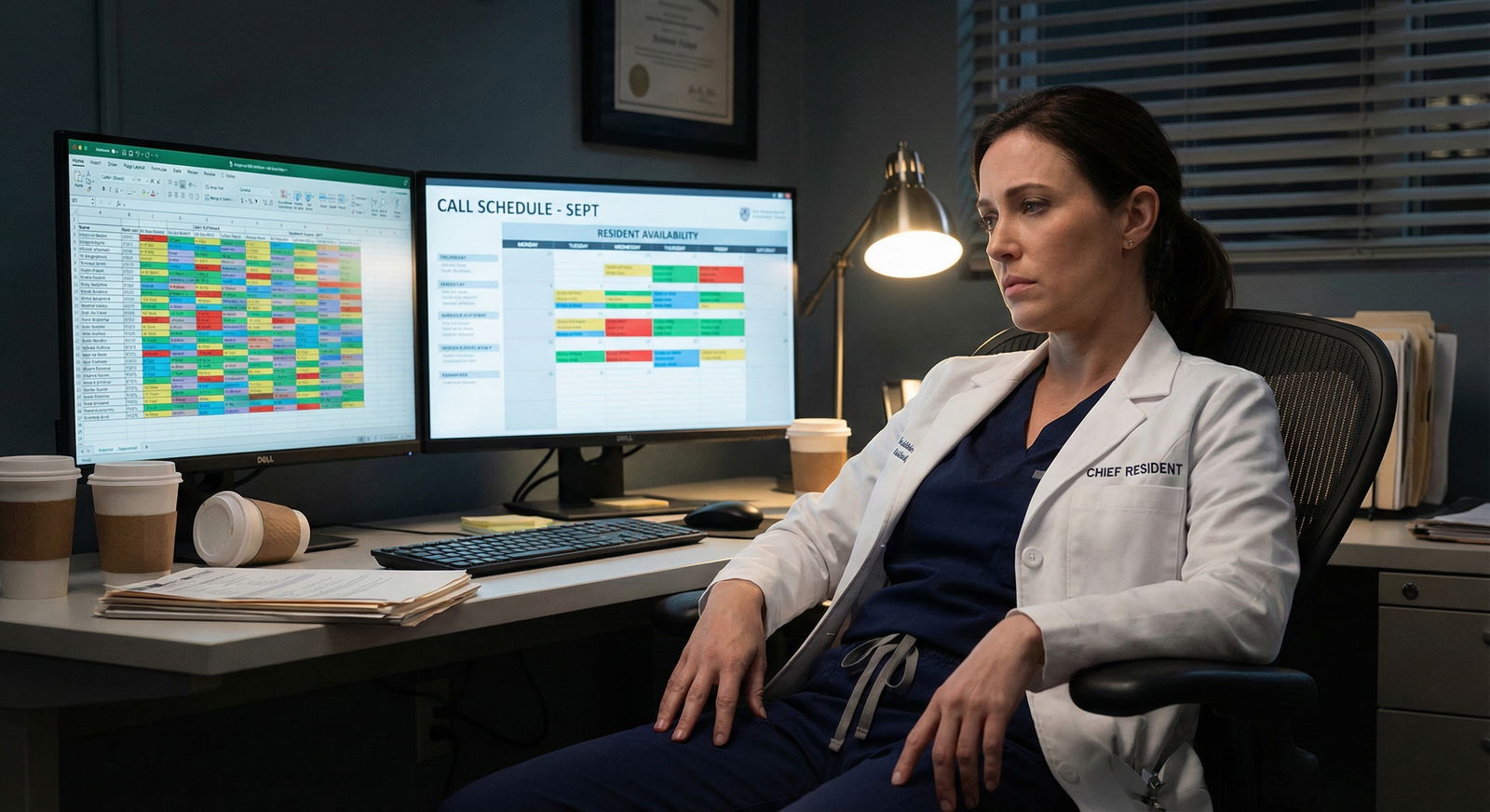
The default call schedule is hostile to anyone with a chronic health condition.
You will not fix that by “toughing it out.” You fix it by redesigning the schedule around hard limits.
Let me walk you through how to do that without blowing up your relationships with chiefs, GME, or your colleagues—and without destroying your body in the process.
1. Start With Non‑Negotiables: Define What “Unsafe” Means For You
If you skip this step, you will accept a bad schedule out of guilt or fear. Do not do that.
You need clear, medical, operational limits. Not vibes. Not “I prefer mornings.” Concrete rules your body cannot safely break.
Think in four categories:
Hours and Rest
- Maximum total hours per week you can safely handle.
- Minimum uninterrupted sleep window you need regularly (e.g., 6 hours).
- Maximum consecutive days you can work before a break.
- How many night shifts in a row your condition can tolerate.
Circadian and Timing Issues
- Are true overnights unsafe? (e.g., seizure disorder triggered by sleep deprivation, severe migraine, adrenal insufficiency).
- Do sudden flips from days to nights (or vice versa) wreck you?
- Do you need a semi-stable wake/sleep time for medication timing, blood sugar, cortisol, etc.?
Physiologic Triggers
- Heat, dehydration, long periods without access to bathroom or food (IBD, POTS, diabetes, pregnancy).
- Prolonged standing or rushing between locations.
- High-stress periods that predictably flare symptoms (e.g., 3 a.m. codes after 18 hours awake).
Recovery Requirements
- How many “recovery days” you need after a night shift.
- How quickly you crash when you stack long days.
Write these as binary rules, not suggestions. Example:
- “No more than 2 consecutive overnight calls.”
- “At least 10 hours between end of duty and next start.”
- “No 28‑hour in-house calls; can do 14–16 hours max with protected 30‑minute nutrition/bathroom breaks every 4–5 hours.”
- “No flip from overnight to 7 a.m. start the next day.”
- “Must avoid more than 3 consecutive long (>12 h) shifts.”
This list is the backbone of your accommodation request and any call schedule negotiation.
2. Understand Your Levers: What Can Actually Be Changed
You are not rewriting ACGME rules. You are working within them.
So you need to know what levers exist:
- Shift length: In-house 24s versus 12s, home call, night float, late “short call” shifts.
- Shift sequencing: How many in a row, order of days/nights, post‑call days.
- Distribution: Number of calls per month, which weekends, holidays.
- Role during call: Primary vs backup, cross-cover vs admitting, procedural vs non-procedural.
- Location: One site versus moving between multiple hospitals on the same shift.
Most programs have more flexibility than they admit at first. I have seen:
- Residents moved from 24‑hour in‑house calls to a combination of night float + day shifts.
- People with seizure disorders removed from overnight in-house call entirely and placed into “evening admitter until midnight + backup from home” structures.
- Call “density” reduced (fewer calls per month) with compensatory clinic, QI work, or administrative tasks to keep duty hours.
Your goal is not to work less overall (though sometimes that is required). It is to redistribute the work into safer patterns.
3. Bring Disability Services and GME In Early (Before You’re Drowning)
If you wait until you are already crashing on nights, you are negotiating from a stretcher.
You want three players aligned:
-
- Provides a clear medical letter with:
- Diagnosis (at least by category if you want some privacy).
- Functional limitations (not “should rest more” but “cannot safely perform extended overnight in-house call due to X; requires stable sleep period of Y hours between 23:00 and 07:00 three nights per week,” etc.).
- Specific restrictions tied to safety for you and patients.
- Ask them explicitly: “Please write this in operational terms that a program director can schedule around.”
- Provides a clear medical letter with:
Institutional disability / ADA office
- They translate medical limitations into accommodation language.
- They are your shield when the program’s knee‑jerk answer is “that’s unfair to others.”
- Push for concrete accommodations, not just vague “flexibility as needed.”
GME and Program Leadership
- Program director
- Chief residents / scheduler
- Sometimes HR or GME dean
You want a formal accommodation plan that may include:
- No overnight in-house call.
- Maximum X night shifts per week.
- Protected recovery day after each overnight.
- Limit on consecutive long shifts.
- Priority access to call rooms (for brief rest).
- Permission to carry snacks/fluids and to step away briefly for meds or bathroom.
Once that is in writing, the call schedule has to respect it. Now you are not “asking for a favor.” You are enforcing policy.
4. Design Specific Call Models That Are Actually Safe
Now the practical part. Let us build some call structures that tend to work for residents with chronic health conditions.
The exact pattern will depend on your specialty, but the principles are the same.
A. Replace 24‑Hour In‑House Calls
If 24s flatten you, focus on:
Night float model: You do 5–7 consecutive nights of 12–14 hours, then several days off or light days.
- Works if your body does better with stable nocturnal schedule for a block.
- Bad if any night‑time wakefulness is dangerous (e.g., poorly controlled epilepsy).
Evening admitter + home backup
- Shift: 15:00–23:00 in-house admitting, then at home as backup with expectation of minimal interruptions.
- Senior or another resident covers 23:00–07:00 in-house.
- Your total duty hours stay reasonable; no 24‑hour stretches.
Split-call
- Example: Two residents each cover 12 hours instead of one doing 24.
- You consistently take the earlier half (e.g., 07:00–19:00) or the later half (19:00–07:00) depending on what is safer.
B. Shape the Week: Avoid Load Spikes
The dangerous patterns are:
- “Light” week, then a single week with 3 calls, 2 clinics, 1 conference day and no true rest.
- Day–night–day flips (e.g., day shift → overnight call → post‑call clinic the next morning).
You want:
Steady, capped intensity
- Example: No more than 1 in‑house call every 4 days.
- Or no more than 2 night shifts per week.
Predictable off days
- True off days (no clinic, no notes, no research meetings).
- At least one weekend day off most weeks, and no streak of >12 consecutive days worked.
C. Protect Circadian Rhythm And Recovery
For conditions heavily influenced by sleep (most), use:
Fixed call days
- Example: You always do weekend days, never nights.
- Or you always take Friday evening admits instead of Saturday overnights.
Protected post‑call
- No “voluntary” post‑call clinics. They are not voluntary once you feel obligated.
- Hard rule: Off duty by X time with no exceptions for hand‑offs to clinic.
Here is a simple comparison of unstable versus safer weeks for someone with moderate fatigue issues:
| Day | Unstable Week | Safer Week |
|---|---|---|
| Mon | 7a–7p | 7a–5p |
| Tue | 7a–7p | 7a–5p |
| Wed | 7a–7p, then 7p–7a overnight | 7a–5p |
| Thu | Post‑call + clinic 1–5p | Post‑call off |
| Fri | 7a–7p | 7a–5p |
| Sat | 24‑hour call | 7a–7p (day call only) |
| Sun | Post‑call but “finish notes” | True day off |
The second schedule has less romantic “I survived a 30” energy. But it is survivable long term.
5. Be Honest About Your Energy Budget, Not Your Ideal Self
This is where many high-achieving residents sabotage themselves. They design a schedule for the person they wish they were, not the person whose joints, nerves, or mitochondria they actually have.
Use a brutally honest exercise:
Track your symptoms and performance for 3–4 weeks on your current schedule.
Note:
- Which days you needed PRN meds, rescue inhaler, extra steroids, or pain meds.
- Days you made more errors, forgot tasks, or felt unsafe.
- Days after which you needed a whole day in bed.
Assign each day a “cost” from 1–5:
- 1 = Could do this indefinitely.
- 3 = Tough but sustainable a few times per month.
- 5 = Absolutely unsustainable; leads to flare or risk.
Then build your schedule so the weekly “cost” stays below a certain threshold. For example, never exceed 18–20 points per week.
You are not weak for doing this. You are doing what anesthesiologists do with meds: dosing to effect without toxicity.
To visualize energy usage across a sample month with and without accommodations:
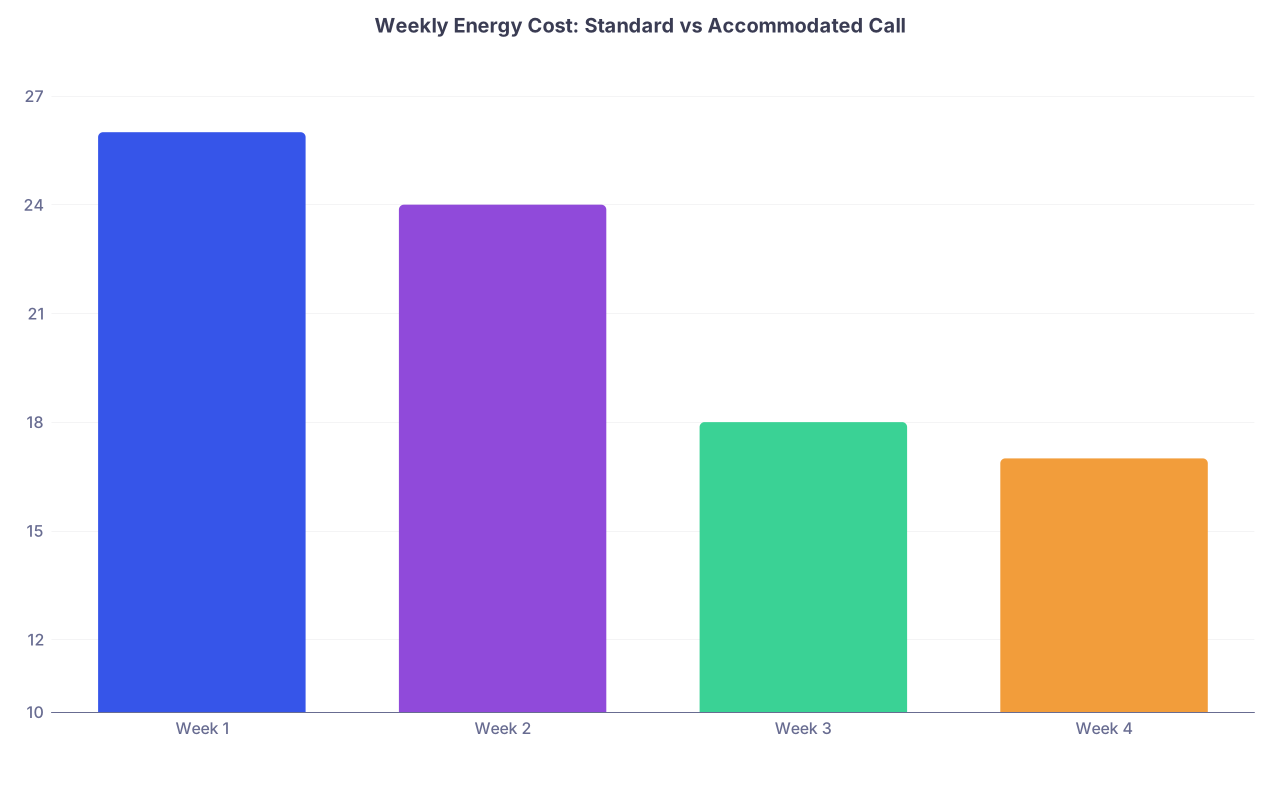
| Category | Value |
|---|---|
| Week 1 | 26 |
| Week 2 | 24 |
| Week 3 | 18 |
| Week 4 | 17 |
Assume 20 is your personal “danger line.” The first two weeks are a problem. The last two are closer to safe operating range.
6. Negotiate Without Becoming “The Problem Resident”
You know the fear: ask for accommodation, get labeled “not a team player,” and watch your evals quietly tank.
Here is how you reduce that risk:
A. Frame It As Patient Safety And Program Protection
Do not lead with “I am exhausted.” Lead with:
- “I have a documented medical condition. My doctor and disability office have recommended specific restrictions to keep me safe to practice.”
- “If I take 24‑hour calls, there is a real chance I will become impaired at 3–4 a.m. This is not safe for patients or the program.”
- “I would like to propose a call structure that keeps my total hours and educational experiences comparable, while eliminating the unsafe patterns.”
That shifts the conversation from “favor” to “risk management.”
B. Offer Trade‑offs That Do Not Involve You Overworking Later
Classic trap: “Sure, you can skip that night, just do 3 extra clinics and a weekend of notes.”
Result: you are just as sick, slightly more resentful.
Better trade‑offs:
- Non‑overnight high‑value shifts: Early morning admits, evening observation unit coverage, ED consults until 23:00.
- Unpopular but safer tasks: Weekend discharges 7a–3p, quality improvement coverage, M&M prep, protocol work.
- Educational contributions: Teaching sessions for juniors, case-based sessions, simulation support—during safe hours.
Spell it out:
- “I am happy to take extra Friday afternoon admits or Sunday morning discharges instead of overnight call. That way coverage is maintained and my limitations are respected.”
C. Get It In Writing, Not Just From Chiefs
Chiefs change every year. If your accommodation lives only in their group chat, it will evaporate.
You want:
- Email from GME or program director confirming specifics of your accommodation.
- Clarification about:
- Duration (e.g., entire training vs reevaluated annually).
- Which rotations it applies to.
- Who is responsible for implementing it (usually chiefs).
When a new chief comes in:
- Forward that email.
- Have a short, direct meeting:
- “I have an ADA accommodation for call. Here is the documented plan. I am happy to help you think through how to apply this on ICU, wards, and electives.”
7. Sample Safer Call Structures For Common Conditions
Let me be concrete. These are patterns I have seen work.
A. Autoimmune Disease With Fatigue (e.g., SLE, RA)
Common problems: flares triggered by sleep loss and infection; fatigue spikes.
Safer design:
- No more than 1 in-house call per week, capped at 16 hours.
- No back-to-back call + clinic days.
- Priority for:
- Daytime admitting shifts.
- Early finish on non-call days (e.g., 7a–4p rather than 7a–7p whenever coverage allows).
- Long-call ICU weeks replaced with:
- More frequent but shorter shifts.
- Protected off day mid‑block.
B. Diabetes (Type 1 especially)
Common problems: hypoglycemia with missed meals/erratic sleep; DKA risk with illness/dehydration.
Safer design:
- Scheduled, protected breaks for:
- Glucose checks.
- Insulin dosing.
- Quick food intake.
- Avoid:
- 24‑hour calls without guaranteed access to food and a refrigerator or supplies.
- Rotations where you are stuck in long OR cases without predictable breaks, unless the team explicitly supports planned breaks.
- Call pattern:
- Night float with stable schedule may be fine if you can plan meals and insulin.
- Or early admits until 23:00 + home call, with clear backup if you become symptomatic.
C. Migraine, Epilepsy, Severe Sleep Disorders
Common problems: triggers from sleep deprivation and circadian chaos.
Safer design:
- Eliminate true overnight in-house call.
- Instead:
- Evening shifts ending by 23:00.
- Home backup with expectation that primary call handles 90% of events.
- Require:
- At least X nights per week with 7–8 hours protected sleep during your habitual sleep window.
- Rotate:
- If you must do any nights, block them, do them consistently for that rotation, and build in several days recovery afterward.
8. Build A Micro‑Protocol For Each Call Shift
Macro-schedule matters. But what you do during a call shift often decides whether you crash.
Build a simple “call survival protocol” specific to your condition:
Before Call
- Standard pre-call routine:
- Take baseline meds at the same time each day.
- Pre‑hydrate aggressively if POTS, kidney issues, or migraines.
- Pack:
- Pre-portioned snacks with protein and complex carbs.
- Your meds in labeled containers.
- A refillable water bottle, electrolyte packets if needed.
- If sleep is critical:
- Nap 60–90 minutes in the afternoon if you are on nights.
During Call
- Set timers:
- Example: Alarm every 4 hours to check blood sugar, stretch, or take pain meds.
- Guard small breaks like procedures:
- “I need 5 minutes to take my medication, then I will see the next consult.”
- Use the call room strategically:
- 20‑minute power naps between admissions when safe.
- You are not a hero for staying awake just to scroll on your phone.
After Call
- Non-negotiable routine:
- Go home as soon as sign-out is safe and complete.
- Light snack, shower, dark room, sleep.
- Do not:
- Run errands.
- “Quickly” catch up on research.
- Accept add-on tasks.
After a few calls, adjust the protocol:
- Which snack timing prevented hypoglycemia?
- Did a 20‑minute nap help or wreck your sleep later?
- Do you need to shift some meds earlier/later on call days?
To outline this as a quick visual process:

| Step | Description |
|---|---|
| Step 1 | Pre call meds and packing |
| Step 2 | Start call shift |
| Step 3 | Set timers for breaks |
| Step 4 | Mid shift quick check - symptoms ok |
| Step 5 | Continue with scheduled breaks |
| Step 6 | Take meds, short rest, notify senior if worsening |
| Step 7 | End of call sign out |
| Step 8 | Post call - go home |
| Step 9 | Sleep and recovery |
9. Use Data To Prove Your Schedule Is Working (Or Not)
Program directors and GME respond better to data than to “I feel worse.”
Track three things after implementing your new call schedule:
Symptom metrics
- Number of flares per month.
- ER visits, steroid bursts, migraine days, recorded seizures, etc.
Performance metrics
- Duty hour violations.
- Near-miss events.
- Feedback from seniors/attendings on reliability and patient care.
Fatigue and function
- Simple 1–10 fatigue rating daily.
- Days you needed to call out or leave early.
Plot before vs after accommodations. For example:
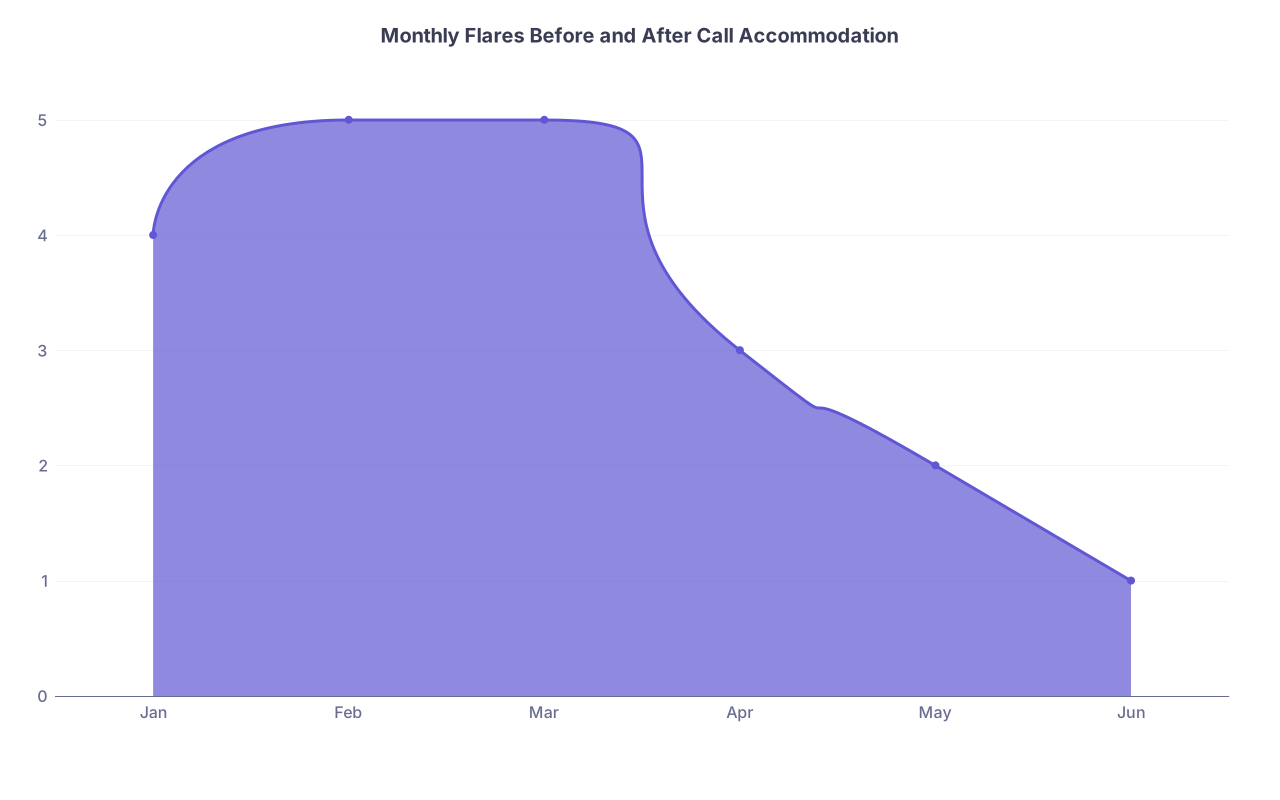
| Category | Value |
|---|---|
| Jan | 4 |
| Feb | 5 |
| Mar | 5 |
| Apr | 3 |
| May | 2 |
| Jun | 1 |
You can say:
“In the 3 months before accommodation, I had 14 documented flares and 2 ED visits. In the 3 months after, with adjusted call, that dropped to 6 flares and 0 ED visits, and my evals have been stable or improved.”
Hard to argue with that.
10. Future Of Call For Residents With Chronic Conditions (And How To Push It Forward)
Most current call structures were built for a different era: fewer regulations, fewer women, fewer physicians with openly declared chronic illness. They are outdated.
Where this is going—and where you can help push:
- Shift‑based models as default.
- Fewer 24s. More 8–12 hour shifts with robust handoff systems.
- Tiered call responsibilities:
- Residents with certain conditions doing:
- Early and late shifts.
- Home backup with clear activation thresholds.
- Daytime high-acuity work instead of overnight.
- Residents with certain conditions doing:
- Data-driven accommodations:
- Programs actually tracking fatigue, sick calls, and adverse events relative to call patterns and making permanent changes.
- Transparent accommodation templates:
- GME offices maintaining standard accommodation models (e.g., “Option A: reduced nights, Option B: modified shift lengths”) instead of reinventing the wheel for each resident.
You do not have to be the crusader for all future trainees. But by insisting on a structured, rational approach to your own call schedule, you are quietly building precedent. That matters.