The standard training model assumes you have infinite energy. You do not. And pretending you do is the fastest way to crash your career and your health at the same time.
If you are a flare-prone trainee (chronic pain, autoimmune, POTS, long COVID, severe migraines, sickle cell, whatever your label is), you cannot copy your classmates’ schedules and hope for the best. You need a personal energy management plan as carefully designed as any treatment protocol.
This is not about “self-care.” This is about survival and performance. Done correctly, you will protect your health, reduce flares, and actually look more reliable to your program, not less.
Here is how to build that plan step by step.
1. Start With a Ruthlessly Honest Energy Audit
You cannot manage what you have not measured. Right now, your sense of your limits is probably based on panic and guilt, not data.
Spend 2–4 weeks tracking three things, daily:
- Energy
- Symptoms
- Demands
Very simple system, no fancy apps needed. Use a notes app or a tiny pocket notebook.
Track:
Energy (0–10)
- 0–2: barely functioning
- 3–5: can do basics, anything extra costs you
- 6–8: functional for work and 1–2 extras
- 9–10: rare unicorn days
Symptom severity (0–10)
Rate the thing that most limits you (pain, fatigue, dizziness, cognitive fog, GI, etc.)Major activities with rough time
- Clinical hours (e.g., “0700–1800 wards; 30 min break”)
- Commute
- Studying
- Admin tasks (charting, MyChart messages)
- Household (laundry, groceries, childcare)
- Sleep (time in bed + estimated quality)
Triggers you notice
- Sleep < 6 hours
- Standing > 3 hours
- Skipped meals
- Heat exposure
- High stress confrontations
- Infection exposures, menstrual cycle phase, etc.
Write it in 30–60 seconds at lunch and before bed. Do not “optimize” yet. Just watch.
After 2–4 weeks, quickly review:
- On what days were your symptoms worst?
- What did the previous 48 hours look like?
- What combination reliably destroys you? (e.g., “post-call + clinic + 2 hours studying”)
You are looking for patterns, not perfection. Identify:
- Your average sustainable energy band (maybe you live at 4–6, not 7–9)
- Your early warning signs (e.g., word-finding trouble, eye burning, joint stiffness)
- Your personal “red zones” – combinations that almost always trigger a flare within 24–48 hours
Write these out clearly. This is your base map.
2. Define Your “Energy Budget” Like It Is Money
Treat energy like cash. You get a variable but limited deposit each day. If you overspend, you go into debt and pay interest as a flare.
You need:
- A daily average budget
- A max “do not cross” line
- A flare-recovery budget
Step 2.1 – Categorize tasks by energy cost
Be specific to you, not some generic spoon theory.
Build three lists:
High-cost (HC) – almost always drain you, often trigger symptoms
Examples:- 24-hour calls / night float
- 12+ hour OR days in lead
- Fast-paced clinic with >20 patients
- Back-to-back required conferences with no breaks
- Standing > 2 hours without chance to sit
- Heated conflict with staff/patients
- Long public transit or driving in heavy traffic
Medium-cost (MC) – doable, but you need to watch duration
Examples:- 8–10 hour wards day with short breaks
- Rounding where you can intermittently sit
- 2–3 hours focused studying
- Family responsibilities that require leaving the house
Low-cost (LC) – either restorative or at least neutral
Examples:- Seated charting in a quiet area
- Reading while lying down
- Low-stimulation admin tasks
- Gentle stretching, breathing exercises
- Short phone calls with supportive people
- Meals, snacks, hydration
Now estimate “energy points” for yourself. For instance:
- HC task (full day): 7–9 points
- MC task (per 2–3 hour block): 2–3 points
- LC task: 0–1 point, often restorative
You do not need precision. This is about relative cost.
Step 2.2 – Decide your daily capacity bands
Based on your tracking, give yourself:
- Baseline capacity: e.g., 10 points on an average non-flare day
- Upper safe limit: e.g., 12–13 points. Above this, you reliably crash within 48 hours
- Flare day capacity: e.g., 3–5 points, max, for essential tasks
Now convert that into something you can actually use.
Example:
- One 10–12 hour wards day with rounds, pages, admissions = 7–8 points
- That leaves 2–3 points for everything else that day: commute, food, basic life tasks. That is it.
So if you “add” 3 hours of intense studying at night, plus cooking, plus a long call with a friend, you are almost certainly over budget.
On paper, map one typical week using estimated points. You will usually see the problem instantly: 4–5 consecutive over-budget days, then an inevitable crash you have been calling “random.”
3. Build an Early-Warning and Triage Protocol
Most flare-prone trainees run themselves off a cliff because they ignore early warnings. By the time you admit you are in trouble, you are already in a 7–10 day flare.
You need a stepwise protocol for:
- Yellow flag days (early warning)
- Orange flag days (serious risk)
- Red flag days (active flare)
Design it like you would a clinical pathway.
Yellow flag: “If these show up, I change something today”
Pick 3–6 individual signs that consistently show 12–48 hours before a flare. Examples:
- Word-finding difficulty or typing simple errors
- Heavier limbs or “concrete legs” feeling
- Subtle joint stiffness / prodromal pain
- New brain fog with simple tasks
- Lightheaded on standing that you have not had all week
- Needing coffee to feel minimally functional (more than usual)
Your Yellow Flag Protocol might include:
- Cap total day to baseline capacity (e.g., 10 points, not 12–13)
- Convert 1–2 MC tasks to LC or drop them completely
- Add:
- 1 extra snack with protein + salt (for POTS / fatigue types)
- 500–1000 mL extra fluids spread across day
- 10–15 minutes lying flat mid-shift if possible (call it “restroom break” if you must)
- Text a trusted person: “Yellow flag day. I am adjusting down.”
This is not for sympathy. It is accountability so you actually adjust.
Orange flag: “Change the plan for next 24–72 hours”
Orange = multiple yellow signs or a known trigger event (post-call, infection, menstrual flare, etc.).
Your Orange Flag Protocol might include:
- Informing chief or attending you are not available for extra shifts / swaps
- Hard cap on any optional:
- Moonlighting
- Research meetings that can be rescheduled
- Social commitments outside the house
- In-rotation adjustments you can implement:
- Sit whenever not actively required to stand
- Swap non-essential tasks with co-residents (you take phone calls while they do long transport, then repay on a better day)
- Pre-emptive symptom management:
- Scheduled meds instead of PRN for 24–48 hours (discuss with your treating physician beforehand)
- Compression, salt, fluids if you deal with orthostatic issues
- Planning a reduced next day if possible (swap a long study block for spaced repetition flashcards while lying down)
Red flag: “You are in a flare – protect core functions only”
Red = you are already flared: high pain, crushing fatigue, cognitive fog, severe GI, frequent presyncope, or whatever your version looks like.
Your Red Flag Protocol should be as standardized as possible before you need it. Include:
- Minimum non-negotiable obligations (so you do not decide while panicking):
- If on an ICU month, maybe your threshold to call out is different than on an outpatient elective, but that needs clarity in advance with your program and your own doctor.
- Call-out criteria, written:
- I will call my program if:
- I cannot safely stand or walk for X minutes
- Pain > 8/10 despite meds and rest
- Cognitive fog such that I cannot track simple notes or orders
- Repeated near-syncope or active vomiting
- I will call my program if:
- Home flare routine:
- Prioritized:
- Sleep and horizontal rest
- Hydration, electrolytes, easy calories
- Medications per flare plan from your specialist
- Minimal communication (automated out-of-office, brief text to key people)
- Prioritized:
Do not invent these criteria alone. Build them with your treating clinician so you are not guessing what “too sick to work” means.
4. Translate Your Plan Into the Real Training Environment
A personal plan that ignores the actual structure of your program is fantasy. You have to map your rotations and responsibilities against your energy budget.
Step 4.1 – Map rotation types by typical energy demand
Use your experience or ask senior residents / classmates. Label each rotation as HC, MC, or LC based on typical days for you.
| Rotation Type | Energy Category | Typical Day Points |
|---|---|---|
| Inpatient ICU | High | 9–11 |
| Surgical Services | High | 8–10 |
| Busy Medicine Wards | High | 7–9 |
| Outpatient Clinic | Medium | 5–7 |
| Elective / Research | Low–Medium | 3–6 |
Now look at your yearly schedule:
- Where are the back-to-back high energy months?
- Where are potential “recovery” blocks (electives, research, lighter clinic)?
If you have any choice at all (and often you have at least some):
- Avoid stacking two heavy inpatient months right before known flare-prone periods (e.g., winter infection season, menstrual cycle pattern, allergy season).
- Protect your lower-intensity blocks and communicate to leadership that you may need them to remain as scheduled due to medical reasons.
Step 4.2 – Design daily “energy pacing” rules
For each rotation category, set simple rules.
Example, busy wards month:
- 0700–1800 clinical = 7–8 points
- Rule:
- No high-intensity study (question marathons) that night on >9 hour days
- Max 45–60 minutes of low-intensity review (anki, passive reading) while lying down
- No social commitments on post-call days other than simple dinner / phone call if you feel okay
- Bedtime window fixed (e.g., in bed by 22:00 whenever not on call)
Example, clinic month:
- 0800–1700 clinic = 5–6 points
- You have 4–5 points left
- Rules:
- Up to 2 hours focused studying 3–4 days a week
- 1 social / family outing on a designated lighter day
- One full “reset” evening per week: no studying, no social obligations, early sleep
Put these rules in a one-page “If this, then that” format. You should not be reinventing decisions every night when you are exhausted.
5. Protect Your Capacity With Boundaries and Micro-Accommodations
Now the part everyone hates: telling other humans “no.”
Let me be explicit: good boundaries make you look more professional, not less, when you are consistent and clear. Flailing, last-minute cancellations, and near-fainting in the OR do much more damage to your reputation than calmly saying, “I cannot safely take an extra shift this week.”
Boundaries you probably need
- No “heroics” on post-call days
- Do not agree to extra clinic or research meetings when you are post-call, unless truly mandatory.
- Fixed maximum weekly hours when possible
- For moonlighting / extra research: cap it. E.g., “I never exceed X extra hours a week.” That is law.
- Protected wind-down window
- Non-negotiable 45–60 minutes pre-sleep with no charts, no email, no studying. Sleep is your primary medication.
Micro-accommodations you can often get without formal paperwork
Depending on your environment and relationships:
- Sitting during teaching or rounds whenever physically possible
- Standing breaks during long conferences
- Swapping occasional late shifts for earlier ones with a co-resident
- Doing more phone follow-ups / chart review, less physical transport
- Strategically choosing patient rooms near the nurse station to reduce walking (if you assign yourself)
You do not have to open your entire medical file to ask:
“Hey, my joints have been rough this week. Would you mind if I sit during sign-out as long as I am still fully engaged?”
Most attendings will not care as long as you are present and contributing.
6. When and How to Formalize Accommodations
Sometimes micro-adjustments are not enough. If you reliably crash on standard schedules, especially on high-intensity rotations, you probably need formal disability accommodations.
Formal accommodation is not admitting defeat. It is a structured way to align program demands with your actual capacity.
Common reasonable accommodations for flare-prone trainees
These vary by institution, but I have seen all of these granted across programs:
- Modified call schedule:
- No 24-hour in-house calls; use night float or shorter night shifts instead
- Reduced frequency of overnight calls (e.g., q5 instead of q3)
- Rest breaks:
- Guaranteed 10–15 minute seated break every X hours
- Quiet space designated for lying down if needed
- Clinic modifications:
- Slightly lower patient load for select half-days
- Longer appointment slots for complex patients to prevent frantic overwork
- Schedule protections:
- Avoidance of back-to-back high-intensity rotations
- Guaranteed at least 10 hours between shifts
- Examination accommodations:
- Extra time
- Separate room
- Permission to lie down / take brief movement breaks
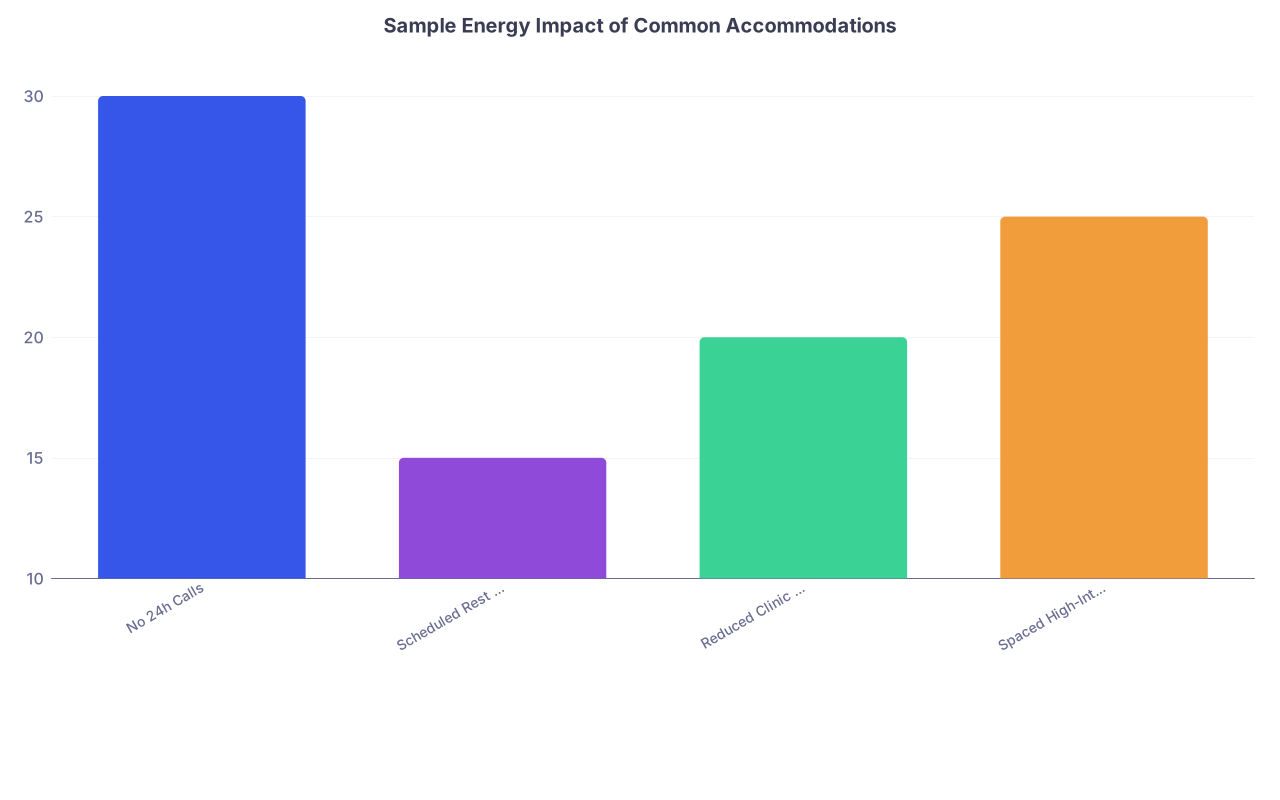
| Category | Value |
|---|---|
| No 24h Calls | 30 |
| Scheduled Rest Breaks | 15 |
| Reduced Clinic Load | 20 |
| Spaced High-Intensity Rotations | 25 |
(Values here = approximate percent reduction in daily/weekly energy drain I have seen in real trainees. Not scientific, but directionally accurate.)
How to approach this without blowing up your relationships
You want three pillars:
Medical documentation
- A clear letter from your treating physician stating:
- Your diagnosis (or at least functional limitations if you prefer privacy)
- The functional impairments (cannot safely sustain X hours standing, needs regular rest breaks, high risk with overnight shifts, etc.)
- Specific recommended accommodations phrased in functional language
- A clear letter from your treating physician stating:
Disability / student affairs office on your side
- Do not start with your PD. Start with the office whose job it is to interpret the law.
- Bring your energy tracking summary. Show patterns. You will look organized, not dramatic.
Concise, non-defensive script for leadership
- Example for a resident:
“I have a chronic medical condition that affects my stamina and flare pattern. I have worked with my physician and the GME office, and they have approved some specific accommodations so I can function safely and consistently during training. I remain fully committed to meeting all ACGME requirements. The proposed changes are: [list]. I am happy to adjust specifics with you as long as the functional needs are met.”
- Example for a resident:
Avoid vague language like “I need less stress” or “I cannot work so much.” Focus on safety and function. That is what program directors actually care about, and they are usually much more flexible than trainees assume when you present a concrete, legally supported plan.
7. Build a Weekly “Energy Management Meeting” With Yourself
You can design the best plan in the world and still blow it by Thursday because you never look at it again.
You need one recurring 20–30 minute meeting with yourself each week. Treat it like a required conference.
Use three steps:
Step 7.1 – Quick review of past week
- Look at your energy log. Skim, not analyze to death.
- Ask:
- What were the worst 2 days? Why?
- Did I hit any Yellow/Orange/Red flags? Did I follow my plan?
- What helped? What was obviously too much?
Write 2–3 bullet takeaways. Done.
Step 7.2 – Forecast the coming week
Lay out:
- Rotations / shifts (you know these)
- Known extra demands:
- Exams
- Presentations
- Family commitments
- Medical appointments
Assign a predicted energy cost to each day:
- Light / Moderate / Heavy / Critical (post-call, exam day, etc.)
Now pre-decide:
- Which nights are study-heavy vs. deliberately light?
- Which day is your “reset” evening?
- Which commitments you will proactively decline or reschedule?
Do this before the week starts, not in the moment when guilt and FOMO are loud.
Step 7.3 – Write 3 concrete rules for that week
Examples:
- “No studying after 21:30 on workdays.”
- “Post-call day: home, shower, food, sleep. No errands.”
- “If I hit Yellow flag on a non-post-call day, I cancel social plans and drop to flashcards only.”
Put those rules in your calendar or on a sticky note near your bed. Visibility matters.
8. Integrate Symptom Management Into Your Workday, Not Just At Home
Most trainees treat meds, hydration, and symptom control as afterthoughts. You cannot. These are as critical as your stethoscope.
Daily “medical kit” you bring to work
- Key scheduled and PRN meds in clearly labeled compartments
- Protein-rich portable snacks (nuts, jerky, cheese sticks, protein bars)
- Electrolyte packets or salty snacks if orthostatic issues
- Water bottle you actually like
- Compression garments or braces if prescribed
- A small card with:
- Your Yellow/Orange triggers
- 2–3 simple interventions you can do on the ward (sit, hydrate, med)

Pre-planned micro-interventions
On each rotation, scout:
- Quiet corners where you can sit unnoticed for 5 minutes
- Routes that minimize walking
- Bathrooms or call rooms where you can briefly lie down if needed
Then set internal rules like:
- Every 2–3 hours:
- 3–5 minutes sitting, deep breathing, quick snack / water
- If you are about to ignore this, remember: prevention is usually faster than recovering from a crash later. This is not “wasting time.”
9. Upgrade Your Studying to Match Your Energy Reality
You do not have the luxury of wasting 3 hours on inefficient studying. Your brain is one of your most fragile organs during a flare.
Key adjustments:
Short, intense blocks on better energy days
- 25–40 minutes focus, 5–10 minutes break
- Use questions and active recall, not endless passive reading.
Passive, lower-energy methods on tired days
- Watching brief videos at lower speed, light reading, spaced repetition cards while lying down
- The goal is maintenance, not heroics, on heavy rotation days.
Create an “absolute mini-studywin”
- Example: “10 flashcards before bed, no matter what.”
- If you hit that, you call it a win on your worst days. Protects your confidence and progress.
Batch the heavy cognitive work
- On lighter rotation days or days off, do:
- Longer question blocks
- Deep reading or content gaps
- On lighter rotation days or days off, do:
Align this with your weekly energy planning. Do not schedule your biggest study pushes the day after a 28-hour call. That is asking for a flare and poor retention.
10. Protect Yourself From Guilt and Comparisons
I will be blunt: if you keep judging yourself against your healthiest, most sleep-deprived-but-resilient co-resident, you will make self-destructive decisions.
Your job is not to have the same schedule as everyone else. Your job is to:
- Meet the competency standards
- Keep yourself medically stable enough to finish training
- Do right by your patients over the long arc of your career
A few anchors:
- “I cannot afford the energy games healthy people can.”
- “My extra discipline goes into recovery and prevention, not extra productivity.”
- “I am managing a dual workload: medicine + chronic illness.”
That last one is key. You are working two demanding jobs at once. Pretending otherwise does not make you strong. It makes you reckless.
11. When the Plan Breaks (Because It Will)
You will have weeks where everything goes wrong:
- Influenza + call
- Unpredictable COVID exposure policy change
- Family crisis during boards study
- A toxic attending who refuses small accommodations
When your plan fails, you do three things:
Stabilize first, analyze later
- Use Red Flag Protocol if needed.
- Survive the flare with basic safety and symptom management.
Post-mortem, not self-attack
Very short:- What were the top 1–2 overload events?
- Where did I ignore my yellow/orange flags?
- What single rule could have prevented 50% of this?
Update one element of the plan
- Maybe you tighten your call-out criteria.
- Maybe you add an explicit boundary about moonlighting.
- Maybe you formalize an accommodation you tried to manage informally.
Then move forward. You are running an experiment on your body under extreme conditions. Iteration is the point.
Key Takeaways
- You must treat your energy like a finite budget, not a moral test. Track it, cost it, and plan around it.
- Build concrete, written protocols for yellow/orange/red days so you act early instead of crashing hard.
- Align rotations, studying, accommodations, and boundaries with your actual capacity, not with what “everyone else” does.
Do that, and you stop hoping you will “just get through” and start running a deliberate, sustainable training career while living with a flare-prone condition.