Most people get USMLE accommodations denied the first time because they treat it like a form, not a legal-grade dossier. That is the mistake you cannot afford to make.
If you want accommodations approved on the first attempt, you must stop thinking like a student filling out an application and start thinking like a lawyer building a case. Because that is exactly what this is: you are proving, with evidence, that you have a disability under the ADA and that specific accommodations are necessary, not just helpful.
Here is the exact, step-by-step plan I give students who want to maximize their chances of a first-pass approval.
Step 1: Decide Early That You’re Going to Apply (6–12 Months Out)
Waiting until 6–8 weeks before your USMLE exam to “see how studying goes” is how you end up in panic mode with a rushed, weak file. Do not do that.
You should strongly consider applying for accommodations if:
- You have a documented disability (ADHD, dyslexia, specific learning disorder, anxiety, depression, visual or hearing impairment, chronic health condition, etc.)
- You received accommodations on prior high-stakes exams (SAT, ACT, MCAT, LSAT, GRE, board exams in another country)
- You have a long history of school-based accommodations (IEP, 504 plan, university disability office plan)
- You suspect a disability and your performance is consistently below what your knowledge/effort would predict (e.g., reading is painfully slow, you run out of time despite knowing material, or your anxiety physically shuts you down during exams)
If any of that sounds like you, commit now: you are going to submit for accommodations. That decision alone changes your timeline and priorities.
What to do in this phase
Mark your target exam window.
- Step 1 or Step 2 CK: ideally pick a month, not an exact day yet.
- Count backward 6–9 months. That is your accommodations prep start.
Check NBME/USMLE deadlines and guidance.
Go directly to the NBME accommodations page (for Step exams) and read their entire guidelines for your disability category. Twice. Note every phrase like:- “Documentation must include…”
- “Recent evaluation defined as…”
- “Objective evidence of functional limitation…”
Tell your school’s disability office now.
Do not wait. Say clearly:- “I plan to request USMLE accommodations. I need support building a strong file and confirming my history of accommodations.”
Start a dedicated “USMLE Accommodations” folder.
Physical binder + digital folder. You will live in these.Subfolders:
- Medical/clinical records
- Psychoeducational/psychological evaluations
- School/university accommodation letters
- Prior standardized testing decisions
- Drafts of your personal statement and forms
Step 2: Update (or Get) a Proper Evaluation That Meets NBME Standards
Most denials I have seen come from this: the evaluation is old, shallow, or not aligned with NBME expectations.
NBME is very explicit: they want recent, comprehensive, diagnostically sound evaluations that show functional impairment under exam-like conditions.
2.1 Find the right evaluator
You want someone who:
- Has experience with USMLE or similar board exam accommodations
- Knows ADA/504 standards
- Is willing to write a detailed, test-based report, not a one-page note
Look for:
- Clinical psychologist or neuropsychologist for ADHD/learning disorders
- Psychiatrist or psychologist for mental health conditions
- Relevant specialist (e.g., ophthalmologist for visual impairment, neurologist for seizure disorder, rheumatologist for chronic pain impacting function)
Ask them directly:
- “Have you previously written reports for USMLE or NBME accommodations?”
- “Are you familiar with their documentation requirements?”
If they hesitate, keep looking.
2.2 Timing of evaluation
NBME often expects:
- Learning/attention disorders: evaluation within the last 3–5 years (closer to 3 is safer)
- Psychiatric conditions: often within 1 year
- Physical/medical conditions: documentation reflecting current status and prognosis
Err on the side of more recent.
2.3 What the evaluation must include
Push your evaluator to cover these. Do not assume they will.
For ADHD/learning disorders:
- Full diagnostic interview: developmental, academic, medical, psychiatric history
- Standardized tests:
- Cognitive (e.g., WAIS, WISC, similar)
- Academic achievement (reading, writing, math) under timed conditions
- Processing speed, working memory
- For reading issues: measures of reading rate, accuracy, comprehension with time limits
- Symptom rating scales from multiple sources (self, maybe parent/partner, maybe teacher/professor)
- Clear DSM-5 diagnosis with criteria explicitly linked to data
- Explicit discussion of:
- How symptoms affect standardized testing
- Why standard time is insufficient
- Why your requested accommodation (e.g., 50% extra time) is necessary
For psychiatric conditions:
- Detailed history, course, and severity
- Current treatment and response
- Specific symptoms that impair test performance (e.g., panic attacks, dissociation, concentration difficulty)
- Objective evidence where possible (rating scales, hospitalizations, function reports)
- Clear statement on why accommodations are required (not just “would help”)
For physical/medical conditions:
- Diagnosis, onset, and current status
- Functional limitations in test conditions:
- Sitting tolerance, pain, need for movement
- Vision/hearing limitations
- Need for medications, food, restroom access, or medical devices
- Rationale for each accommodation:
- Extra breaks
- Adjustable seating
- Separate room
- Assistive technology
- Stop-the-clock breaks for medical needs
Step 3: Reconstruct and Prove Your “History of Accommodations”
USMLE is obsessed with one question: Have you historically needed and used similar accommodations in comparable settings?
If you got extended time on the MCAT and your med school exams, your file is already stronger. If you did not, you must work harder to show that the disability existed and impacted you, even if it was under-recognized.
3.1 Collect every prior decision and letter you can
You are building a trail. Hunt down:
- K–12: IEPs, 504 plans, letters from school psychologists
- College/university:
- Disability office accommodation letters
- Emails confirming extended time, reduced distraction rooms, note takers, flexible attendance, etc.
- Medical school:
- Official accommodation letters each semester/rotation
- Any dean’s letters referencing your disability support
- Standardized tests:
- SAT/ACT/MCAT/other professional exams:
- Approval letters
- Denial letters (yes, those too; they show you have been trying to address this issue)
- SAT/ACT/MCAT/other professional exams:
Do not rely on memory. Get PDFs. Print them.
3.2 If you never had formal accommodations
This is where a lot of smart, high-functioning students get burned. They “pushed through” without accommodations, got into medical school, and now NBME asks: “If you are so impaired, why no prior accommodations?”
You must answer that, clearly and directly.
Common valid explanations:
- Undiagnosed until adulthood due to:
- Lack of access to evaluation
- Cultural/family stigma
- Masking/overcompensation that fell apart with increasing academic load
- Schools that refused or discouraged formal accommodations
- Informal accommodations (teachers letting you test in office, extra time after school) that were never documented
You will handle this in your personal statement (more on that later), backed up by:
- Current evaluation showing lifelong pattern of symptoms
- Old report cards/teacher comments (slow reader, careless mistakes, “bright but inconsistent”)
- Documentation of recent decline in performance as demands increased
Step 4: Choose the Right Accommodations and Match Them to Evidence
This is where many applications weaken themselves: asking for the wrong thing or asking for everything without clear justification.
NBME is not impressed by wish lists. They want a tight match between:
- Documented functional impairment
- Test conditions
- Specific requested accommodations
4.1 Common USMLE accommodations
| Accommodation | Typical Rationale |
|---|---|
| 25–50% extra time | ADHD, learning disorders, slow reading |
| Extra/stop-the-clock breaks | Medical conditions, anxiety, diabetes |
| Separate room | Severe anxiety, tics, sensory issues |
| Screen reader | Visual impairment, reading disability |
| Paper exam or large print | Visual or processing issues |
You do not need all of these. You need the few that directly address your specific barriers.
4.2 Build a “symptom → barrier → accommodation” map
Do this in plain language first. Example for ADHD + reading disorder:
Symptom: Very slow reading speed under time pressure
Barrier: Cannot complete blocks on time despite studying, leaves 10–15 questions blank per block
Accommodation: 50% extra time per block
Symptom: Cognitive fatigue, difficulty sustaining attention for long periods
Barrier: Performance drops sharply in final blocks of long exam days
Accommodation: Extra breaks between blocks and/or multi-day testing
You will later mirror this logic in your physician/psychologist letter and your personal statement.
4.3 Be realistic
NBME is more comfortable approving:
- 25% extra time vs. 100%
- Extra breaks vs. stop-the-clock for every minor discomfort
- Multi-day format when there is a clear medical or psychiatric justification
If you ask for the maximum (e.g., double time, private room, stop-the-clock, paper exam, and snack breaks) without overwhelming evidence, you look opportunistic. Ask for exactly what your data supports.
Step 5: Coordinate Your Team: You, Evaluator, Treating Clinicians, and School
Strong applications are consistent. Weak ones contradict themselves or sound copy-pasted.
You want four aligned voices:
- Your personal statement
- Psychological/medical evaluation report
- Treating clinician letters (psychiatrist, therapist, neurologist, etc.)
- School disability office / dean letter
5.1 Brief everyone with the same core narrative
Send each clinician:
A short summary (1 page) of:
- Your diagnosis
- Your main functional limitations under test conditions
- What accommodations you are requesting
- Prior history of accommodations (or lack thereof and why)
The NBME documentation guidelines for their role (print or PDF)
Your tentative test window
Tell them clearly:
- “NBME requires detailed, specific functional descriptions and clear rationale for each accommodation. Generic ‘support letters’ will not help.”
5.2 What each letter should contain
Evaluator report (core document):
- Detailed testing and diagnosis as above
- Clear functional impact on test-like tasks
- Explicit line:
- “It is my professional opinion that [Name] requires [X accommodation(s)] to demonstrate their true knowledge and skills on the USMLE.”
- Then justify each accommodation separately.
Treating clinician letter (psychiatrist, therapist, specialist):
- Confirm diagnosis and duration
- Describe symptom course and stability
- Describe functional impairment in settings similar to USMLE (long days, time pressure, sustained attention, sitting, etc.)
- Confirm that, despite appropriate treatment, residual symptoms remain that interfere with test performance
- Explicit support for accommodations:
- “I strongly support [Name]’s request for 50% extended time and additional breaks, as these address their documented difficulties with processing speed and fatigue.”
School disability office / dean letter:
- Confirm you are registered with disability services
- List accommodations approved for medical school exams
- Describe your actual use of those accommodations
- Comment on performance difference with vs without accommodations if known
Step 6: Write a Hard-Hitting Personal Statement (Not a Sob Story)
Your personal statement is not a novel about your suffering. It is a structured narrative that answers four questions NBME quietly asks:
- What is your diagnosis and how long has it affected you?
- How does it impair your test taking, specifically?
- What is your history of trying to address it (treatment, previous evaluations, accommodations)?
- Why are these exact accommodations necessary now?
6.1 Structure your statement
Aim for 1.5–3 pages, clean and direct.
Suggested outline:
Opening: clear diagnosis and context
- “I am requesting accommodations on the USMLE Step 1 exam due to a documented diagnosis of ADHD, combined presentation, and specific learning disorder with impairment in reading, as detailed in the enclosed psychological evaluation dated [date].”
Brief developmental and academic history
- When symptoms appeared
- How they showed up (slow reading, careless errors, extreme test anxiety)
- Any early interventions or lack thereof
History of evaluations and accommodations
- Dates of major evaluations
- Prior accommodations (or attempts to obtain them) in high school, college, standardized tests, and medical school
- Where things went wrong if you were under-accommodated
Detailed description of how you experience high-stakes exams
- Use concrete examples:
- “On NBME practice exams, I typically leave 5–10 questions per block unanswered despite knowing the material. I consistently run out of time while still reading the passages.”
- “On medical school shelf exams, I require the full extended time I am given; on untimed practice questions, my accuracy rises by 10–15 percentage points.”
- Use concrete examples:
Tie symptoms to requested accommodations
- Use that “symptom → barrier → accommodation” logic explicitly.
Close with a professional, firm request
- Reiterate:
- Your diagnoses
- Your history of accommodations
- The exact accommodations you seek
- Your commitment to demonstrating your true competence under fair conditions
- Reiterate:
6.2 Tone
- Professional, factual, specific.
- Not angry. Not begging.
- Think: physician documenting a complex case, not student pleading for mercy.
Step 7: Assemble and Check the Application Like a Legal File
This is where sloppy work kills good cases: missing pages, inconsistent dates, illegible scans, vague forms.
7.1 Build a master checklist
Directly from NBME’s website for your disability category, build a checklist. For example (ADHD/learning disorder):
- Completed applicant forms (all sections)
- Personal statement
- Comprehensive psychological/neuropsychological evaluation (date, evaluator credentials)
- Academic history and transcripts
- Documentation of prior accommodations (school letters, standardized tests)
- Treating clinician letters
- School disability office letter
- Any objective performance data (NBME practice scores showing timing issues, etc.)
7.2 Name and organize files clearly
If submitting electronically, label like this:
01_Application_Form_Lastname.pdf02_Personal_Statement_Lastname.pdf03_Psych_Eval_2025-01-10_Lastname.pdf04_Psychiatrist_Letter_2025-01-12_Lastname.pdf05_Med_School_Disability_Letter_2025-01-08_Lastname.pdf06_Prior_Accommodations_SAT_MCATS_Lastname.pdf
Make it easy for a reviewer to follow your story.
7.3 Look for inconsistencies
Before you send:
- Do dates align? (Diagnosis date vs. treatment start, vs. accommodations start)
- Are diagnoses named consistently? (ADHD vs. ADD, “processing disorder” vs. specific learning disorder in reading)
- Are requested accommodations the same across all letters and forms?
Fix inconsistencies before submission. Reviewers absolutely notice.
Step 8: Submit Early and Prepare for the Waiting Period
NBME review can take 4–8+ weeks, sometimes longer in peak seasons. You cannot control that timeline, but you can control when you get in line.
8.1 Submit as early as allowed
- Aim to submit 3–4 months before your intended exam window.
- Do not schedule your exam until:
- You have a decision, or
- Your school and you have a backup plan if the decision is delayed/denied.
8.2 Confirm receipt
After submitting:
- Verify:
- All documents were received
- Nothing is missing or corrupted
- Take screenshots or save confirmation emails.
8.3 Keep studying strategically
Here is the reality: you cannot pause your life waiting on NBME.
While you wait:
- Study under standard conditions for now, but occasionally simulate with your requested accommodations (longer blocks, extra breaks) so you know what that feels like.
- Do not bank on approval. Build baseline competence either way. But do everything you can to make approval likely.
Step 9: If You Are Denied, Respond Like a Professional, Not a Victim
The goal is first-attempt approval. But I would be lying if I said strong cases never get denied. It happens. Sometimes for bad reasons, sometimes because the documentation genuinely had gaps.
If you are denied, you do not send an angry email saying they are unfair. You treat the denial letter like a consultant’s report telling you exactly what to fix.
9.1 Dissect the denial letter
NBME typically states:
- That they reviewed your file
- Which documentation they found lacking or unconvincing
- Their rationale for denial
Common reasons:
- “Insufficient objective evidence of impairment”
- “Evaluation not recent enough”
- “No documented history of similar accommodations on standardized exams”
- “Requested accommodations not sufficiently justified by data provided”
Translate those into action items.
9.2 Build a targeted appeal
You do not resend the same file with a longer personal statement. You fix what they flagged.
Examples:
- If they said your testing was outdated → get an updated evaluation explicitly referencing the denial and addressing their concerns.
- If they questioned lack of prior accommodations → strengthen your narrative and add supporting documents about prior barriers to diagnosis or access.
- If they doubted severity of impairment → include more concrete evidence (practice exam data, work-based performance evaluations, symptom scales).
Ideally, share the denial letter with your evaluator and clinicians and ask them to write addenda targeting each NBME criticism.
Step 10: Future-Proof Yourself for Step 2 CK and Beyond
If you are early in medical school and reading this, you have a massive advantage: you can build your accommodation record well before you touch USMLE.
10.1 Institutional habits that help your future file
- Register with disability services now, not just before Step 1.
- Use your accommodations consistently on medical school exams. Do not “save” them for USMLE only.
- Keep copies of each term’s accommodation letter. Archive them.
10.2 Track objective performance data
Keep:
- Scores on practice NBME exams with and without timing constraints
- Shelf exam performance vs. untimed practice question performance
- Any structured feedback from faculty about your test-taking difficulties
This is gold later when you need to prove that extra time or breaks materially change performance.
Quick Visual: Your 6–9 Month Timeline

Common Pitfalls That Get First Applications Denied
If you remember nothing else, avoid these:
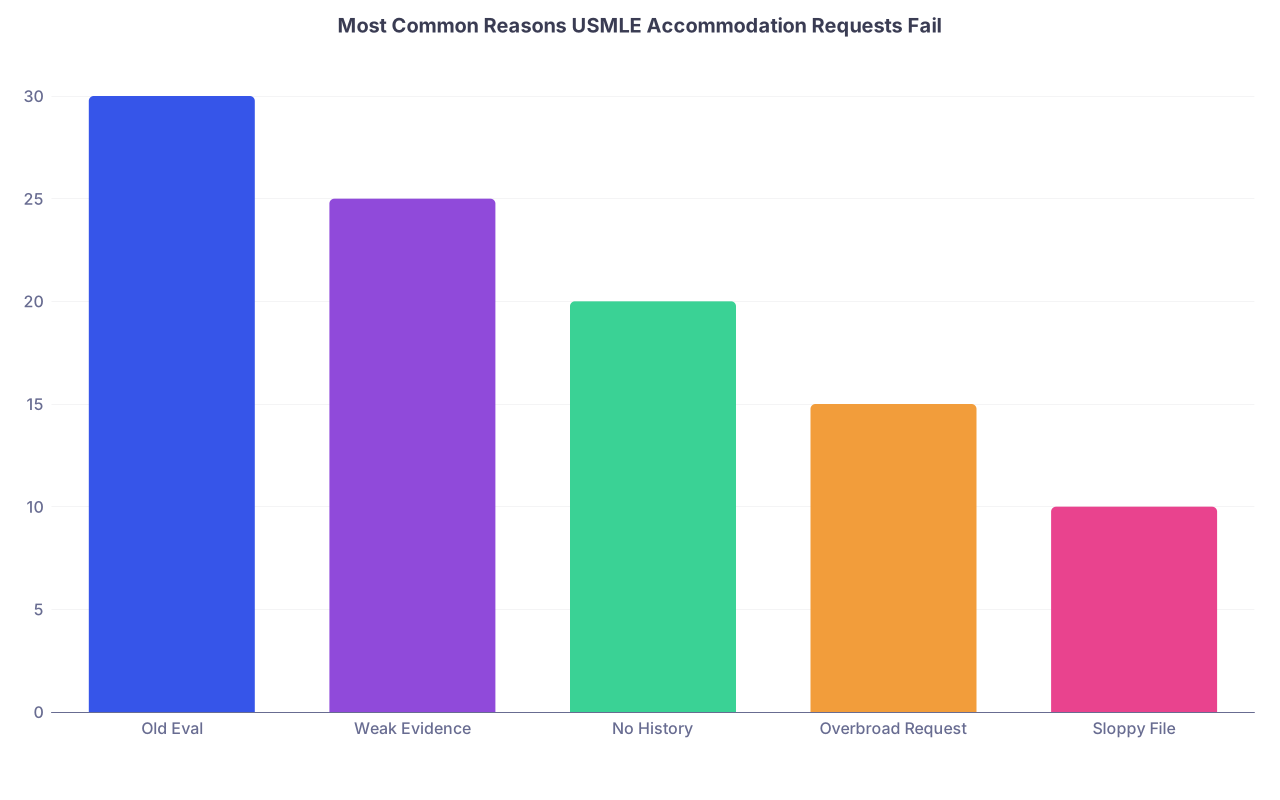
| Category | Value |
|---|---|
| Old Eval | 30 |
| Weak Evidence | 25 |
| No History | 20 |
| Overbroad Request | 15 |
| Sloppy File | 10 |
- Old, shallow evaluations – “ADHD diagnosis” with no timed testing or functional data
- Vague letters – “Student works hard and deserves extra time” is useless
- No attempt to explain missing accommodation history
- Requesting maximal accommodations with minimal justification
- Disorganized or incomplete submission
You avoid all of these by following the steps above. Methodically. No shortcuts.
What You Should Do Today
Do not just “plan to look into this.” That is how months evaporate.
Your next action, today:
- Open a new folder on your computer titled
USMLE_Accommodations_[YourLastName]. - Download the official NBME/USMLE accommodations guidelines for your disability category and save them there.
- Send one email to your school’s disability office or dean:
- “I am planning to request accommodations for USMLE [Step X] and would like to schedule a meeting to review my documentation and plan the process.”
That one email starts the clock. And if you treat this like building a legal-grade case, not just filling out forms, you give yourself a real shot at approval on the first attempt.