Most medical schools are not “hostile” to disability. They are disorganized and legally nervous. If your disability file is weak, vague, or chaotic, you pay the price—not them.
This is fixable.
You can build a disability documentation file so clear, so well-structured, and so aligned with legal and medical standards that denying reasonable accommodations becomes extremely hard to justify. That is the goal: not to “beg for help,” but to create a professional-grade record that forces the system to take you seriously.
I am going to show you exactly how to do that.
Step 1: Understand What You Are Actually Building
You are not “sending paperwork.” You are building an evidentiary record.
Think of your disability file as three things at once:
- Clinical summary – Does your file show that you have a real, diagnosed condition with functional limitations?
- Legal record – Does it satisfy ADA / Section 504 standards for disability and reasonable accommodation?
- Operational blueprint – Can an overworked disability dean read it in 15 minutes and clearly see:
- What your disability is
- How it impacts specific med school tasks
- What exact accommodations you need
- Why those accommodations are reasonable
Most students only focus on #1. They send a diagnosis note and a psych report and hope. That is not enough.
You are going to build a bulletproof file that hits all three.
ping, Accommodation History & Requests](https://cdn.residencyadvisor.com/images/articles_svg/chart-core-components-of-a-bulletproof-disability-file-7886.svg "Core Components of a Bulletproof Disability File")
| Category | Value |
|---|---|
| Clinical Documentation | 40 |
| [Functional Impact Map](https://residencyadvisor.com/resources/disability-accommodations/template-writing-effective-disability-impact-statements-for-trainees)ping | 35 |
| Accommodation History & Requests | 25 |
Step 2: Set Up the Architecture of Your File
Before you chase documents, build the structure. If you set this up now, updating and expanding your file will be easy for years.
Create two parallel systems:
- Master digital folder (on your own drive, with backup)
- Shareable packet (PDF) you send to the school
Recommended digital folder structure
Create a folder named:Disability_File_[YourLastName]_[Year]
Inside it:
01_Diagnoses_and_Evals02_Treatment_Records03_Functional_Impact_Maps04_Accommodation_History05_Current_Accommodation_Request06_Correspondence_with_School07_External_Exam_Accommodations(NBME, USMLE, MCAT, etc.)08_Notes_and_Planning
Use consistent naming:
2024-03-10_PsychEval_ADHD_DrSmith.pdf2023-11-01_Letter_PCP_ChronicMigraine.pdf2024-05-15_AccommodationLetter_PriorCollege.pdf
Your future self (and, frankly, your lawyer if it ever comes to that) will thank you.
Step 3: Nail the Clinical Documentation (But Do It Strategically)
Doctors write terrible disability documentation all the time.
“I recommend extra time because the student has ADHD.”
Completely useless.
You need clinicians who understand disability accommodations and are willing to write in the language schools and testing agencies actually respect: diagnosis → evidence → functional limitation → recommended accommodation → rationale.
What you need for a strong clinical core
At minimum, you want:
Clear diagnostic statement(s)
- ICD-10 codes if possible
- Duration and stability of condition
- Expected course (stable, episodic, progressive, etc.)
Objective evidence or testing (where appropriate)
- Neuropsychological or psychoeducational testing for ADHD, learning disabilities, cognitive issues
- Visual / hearing testing for sensory issues
- Cardio / neuro / rheumatology workup for physical or systemic issues
Current treatment and management
- Medications, therapy, devices, assistive tech
- Any side effects that affect performance (e.g., fatigue, sedation, GI issues)
Functional limitations, written in practical terms
Not “attention difficulties.” Instead:- “Requires significantly extended time for reading dense medical material.”
- “Cannot stand longer than 15–20 minutes without significant pain.”
- “Experiences unpredictable vertigo 1–2 times per week, lasting up to 2 hours.”
The gold-standard clinician letter template
Ask your clinician to include, in one single integrated letter:
- Diagnosis and history
- Testing summary (if applicable)
- Functional limitations tied to med school tasks
- Specific accommodation recommendations + rationale
Yes, you can draft a skeleton for them and ask them to modify. Busy clinicians actually appreciate this.
Here is the structure you want:
- Statement of diagnosis, date of onset, severity
- Brief course / treatment
- Bullet list of functional limitations:
- Difficulty sustaining reading focus beyond X minutes
- Slowed processing speed on complex written material
- Limited ability to stand, walk, lift, or perform fine motor tasks
- Bullet list of recommended accommodations, each with:
- Accommodation (e.g., 50% extended time on written exams)
- The limitation it addresses (e.g., slow processing speed)
- A short justification (e.g., consistent with past testing / history)
You are not asking for advocacy fluff. You are asking for structured, defensible documentation.
Step 4: Translate Symptoms into Med School Functional Impact
This is where most files fall apart. Schools do not accommodate diagnoses. They accommodate functional limitations.
You need to map your disability to specific med school demands:
- Lectures and self-study
- Small groups / PBL
- Written exams (block exams, finals)
- Practical exams (OSCEs, clinical skills)
- Clinical rotations (rounding, procedures, call, night shifts)
- Required technical standards (observation, communication, motor, intellectual, professional behavior)
Create a one-page document in your 03_Functional_Impact_Maps folder called:Functional_Impact_MedSchool_[YourLastName].pdf
Structure it like this:
| Med School Task | Disability Impact | Example Outcome |
|---|---|---|
| 2-hour written exam | Slowed processing, reading fatigue | Incomplete exam despite knowing material |
| 8-hour ward shift | Orthostatic intolerance, fatigue | Dizziness, near-syncope, decreased stamina |
| Fast-paced oral pimping | Word-finding issues, processing delay | Knows answer later, appears unprepared |
| Prolonged standing in OR | Joint pain, limited mobility | Cannot complete full case without pain |
| Night call | Sleep disorder, cognitive slowing | Increased errors, safety risk |
This document is for you and for the disability office. It translates “I have X condition” into “Here is how X collides with your curriculum.”
You will use this map to justify your accommodation requests.
Step 5: Document Your Accommodation History (This Is Powerful Evidence)
Schools and testing agencies put a lot of weight on history of prior accommodations. They want to see that:
- Your disability is not new
- Your limitations are consistent
- The requested accommodations have been used before
Collect and keep:
- Formal accommodation letters from:
- Undergrad
- Post-bacc
- Other grad programs
- MCAT, SAT, GRE, NBME shelf exams, etc.
- Emails confirming specific implemented accommodations
- Any formal learning plans or 504 / IEP documents from earlier schooling
Scan and compile them into 04_Accommodation_History.
Then build a one-page summary:Accommodation_History_Summary_[YourLastName].pdf
Columns:
- Institution / exam
- Years
- Diagnosed condition(s) documented
- Accommodations granted
Example:
| Institution/Exam | Years | Diagnosis Documented | Key Accommodations Granted |
|---|---|---|---|
| State University | 2018–2022 | ADHD, LD-Reading | 50% extra time, reduced distraction |
| MCAT | 2021 | ADHD | 50% extra time, separate room |
| Post-bacc Prog | 2022–2023 | ADHD, Anxiety | Note-taker access, flexible deadlines |
This summary goes right near the front of your packet. It tells the school: this is not new, and others have already agreed these accommodations are reasonable.
Step 6: Design a Clear, Targeted Accommodation Request
Now you know:
- What your diagnosis is
- How it functionally impacts med school tasks
- What accommodations have worked before
Time to make a clean, precise, written request. Do not rely on ad hoc conversations.
Create:Accommodation_Request_MedSchool_[YourLastName].pdf
Structure:
Brief intro (3–4 sentences)
- Who you are (MS1, MS2, etc.)
- Diagnoses (just names, details are in clinician letters)
- Purpose: requesting reasonable accommodations for disability
Functional impact summary (half page max)
- 4–6 bullet points summarizing key limitations relevant to the curriculum
- Keep it tied to tasks, not emotions
Requested accommodations, grouped by context
Examples:
Didactic / preclinical:
- 50% extended time on written exams and quizzes
- Reduced-distraction testing environment
- Access to lecture recordings and captioning
- Priority seating in lecture to minimize visual/auditory distraction
Clinical skills / OSCE:
- Extra time for written components
- Permission to use assistive device (e.g., stool, brace)
- Adjusted scheduling to avoid back-to-back physically demanding stations
Clinical rotations:
- Modified call schedule (e.g., no 28-hour calls; capped at 16–18 hours)
- Limited consecutive night shifts
- Permission for brief seated breaks every X hours
- Parking accommodations or access to specific entrances
Brief rationale for each accommodation
For each, do a three-part line:
- Barrier: “Standard timed 2-hour exams do not allow enough time given slowed reading speed and processing documented in neuropsychological testing.”
- Accommodation: “50% extended time for all written exams.”
- Rationale: “Consistent with prior accommodations at [Institution] and supported by [Clinician Name]’s report dated [date].”
This is the document that makes your file “bulletproof.” It tells the school exactly what you need and why, with all the evidence already sitting behind it.

| Step | Description |
|---|---|
| Step 1 | Collect Clinical Docs |
| Step 2 | Map Functional Impact |
| Step 3 | Summarize Accommodation History |
| Step 4 | Draft Specific Requests |
| Step 5 | Submit Packet to School |
| Step 6 | Interactive Process Meeting |
| Step 7 | Written Determination |
| Step 8 | Appeal or Adjust if Needed |
Step 7: Build a Communication Record with the School
You want everything documented. Calm, professional, timestamped.
Your goals with communication
- Show you are proactive and reasonable
- Create a clear record of what you asked for and when
- Capture any verbal promises in follow-up emails
Create an email folder: Disability_Accommodations_MedSchool. Save every message, both ways, as PDFs to 06_Correspondence_with_School.
First contact email template (adapt, do not copy-paste blindly)
Subject: Request to Initiate Disability Accommodation Process
Body (tight and formal):
Dear [Disability Services Director / Dean],
I am a [year] medical student at [School] with documented disabilities, including [diagnosis labels only]. I am writing to formally initiate the process of requesting reasonable accommodations for the medical school curriculum and assessments.
I have assembled a comprehensive documentation packet that includes recent clinical evaluations, a summary of functional limitations relevant to medical training, and a record of prior accommodations granted at other institutions and standardized testing agencies.
Please let me know the preferred method to submit these materials and schedule a time to discuss appropriate accommodations.
Sincerely,
[Name]
[Student ID]
Then immediately log the date and content in a simple tracking sheet (spreadsheet or note). You are building a timeline.
Step 8: Prepare for the “Interactive Process” Meeting
Disability offices like to call it a “conversation.” In practice, it is an informal hearing where they test:
- How consistent your story is with your documentation
- Whether your requests sound reasonable or excessive
- Whether you have thought about patient safety and technical standards
Do not wing it.
Before the meeting
Have printed or digital-on-screen:
- Your Accommodation Request document
- Functional Impact Map
- Clinician letters (at least top-level summary accessible)
- Prior accommodation summary
Prepare to:
- Explain your disability in 3–4 sentences
- Describe 2–3 concrete examples of how it affected your performance in real settings
- Clearly state your top 3 “non-negotiable” accommodations
What to say and what not to say
Good:
- “Timed exams have consistently been a barrier for me, even when I know the content. That is why extended time has been granted previously by [X, Y, Z].”
- “My goal is to meet the same standards as my peers with adjustments to the format, not the content.”
- “I want to comply with all technical standards; I just need reasonable modification to how I demonstrate those abilities.”
Bad:
- “I just get really anxious and overwhelmed.” (Too vague; tie it to tasks.)
- “It would be nice to have…” (You are not asking for niceties; you are asking for ADA accommodations.)
- “My doctor said I must have this.” (They hate being cornered by outside authority; instead, say, “My clinician recommended…” and tie it to function.)
Immediately after the meeting, write a brief summary email to whoever you met with:
Thank you for meeting with me today to discuss disability accommodations. As I understand it, we discussed the following possible accommodations: [list]. You mentioned that the next steps are [X] and that a written determination would be provided by [approximate timeframe]. Please let me know if I misunderstood anything.
That email becomes part of your record.
Step 9: Create a Clean, Shareable “Packet” PDF
You now have a robust folder system. The school, however, wants a single file or a few organized uploads.
Create a master packet PDF:
Disability_Accommodations_Packet_[YourLastName]_[School]_[Year].pdf
Recommended order:
Cover page
- Name, student ID
- Contact info
- Diagnoses (labels only)
- Date
Accommodation Request document (the one you drafted)
Functional Impact Map
Accommodation History Summary
Clinician letters and reports
- Most recent and most comprehensive first
- Testing reports clearly labeled with dates
Prior formal accommodation letters from other institutions / exams
This is what you send or upload. Keep the rest of your folder system intact as your private archive.
Step 10: Plan for High-Stakes External Exams (NBME, USMLE)
Your med school is not the only gatekeeper. Licensing and board exams have their own accommodation processes that can be even stricter.
Here is the good news: everything you have built so far is exactly what they want.
But you must tighten it:
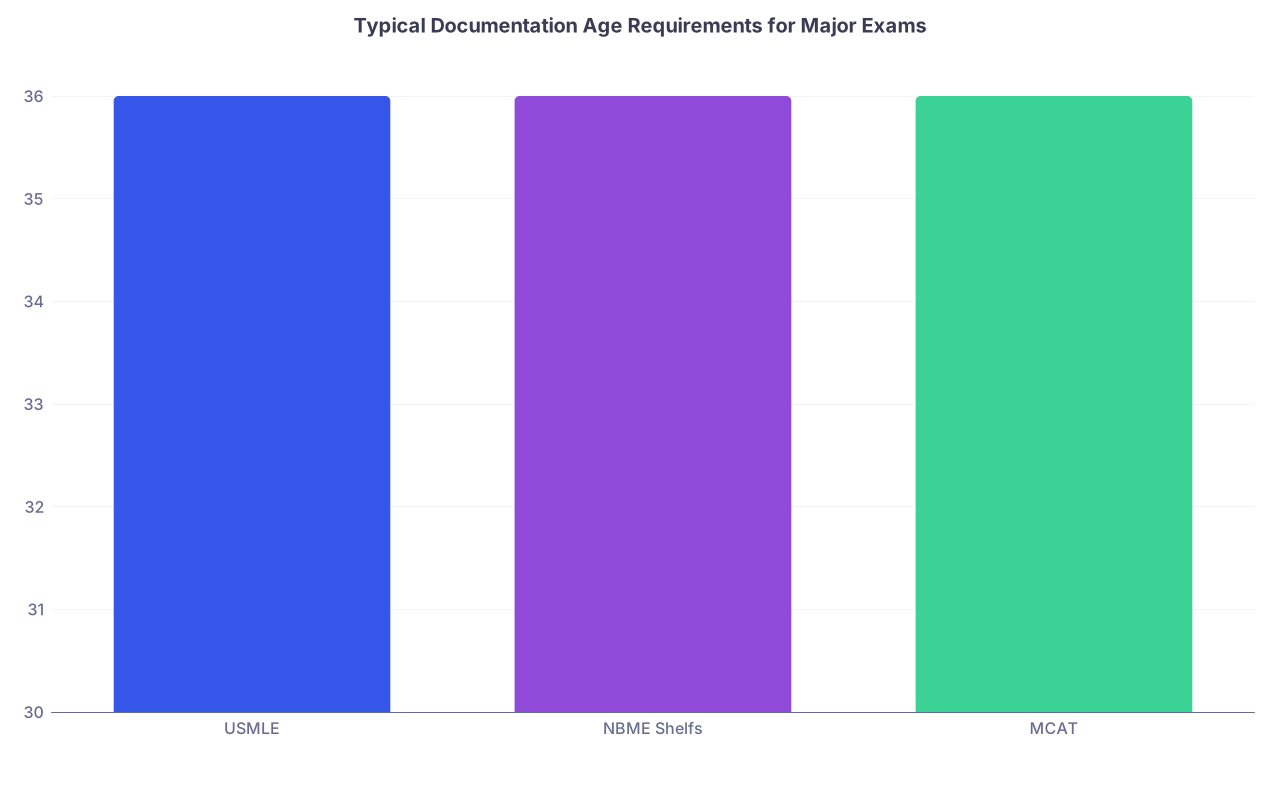
- They prefer recent documentation (often within 1–3 years)
- They want proof of longstanding impairment
- They care whether your requested accommodations match what you currently receive in med school
So:
- Keep your clinical evaluations updated (especially for ADHD / LD)
- Make sure your med school’s official accommodation letter is specific (time-and-a-half, separate room, assistive tech, etc.)
- Save every external accommodation determination letter (NBME subject exams, for example)
Create a separate PDF:External_Exam_Accommodation_Packet_[YourLastName].pdf
that reuses most of your core materials but highlights:
- Longitudinal history of impairment
- Consistency of accommodations across settings
- Objective testing data
| Category | Value |
|---|---|
| USMLE | 36 |
| NBME Shelfs | 36 |
| MCAT | 36 |
(Values are “months since last full evaluation” many agencies are comfortable with; always check their current policy.)
Step 11: Maintain and Update Your File Over Time
A disability file is not a one-off. It is a living record.
You should:
- Add every new clinician letter
- Add every new accommodation determination (positive or negative)
- Keep a simple timeline document:
- Date – Action – Outcome
This matters when:
- You transition from preclinical to clinical years (different accommodations)
- You change schools, take a leave, or transfer
- You need to appeal a decision or file an OCR complaint
- You apply for residency and need to discuss disability with GME
Step 12: Know When and How to Escalate
Most issues resolve at the disability office level if your file is strong. Some will not.
If:
- They deny core accommodations without clear, written rationale
- They say “we do not do that here” (red flag phrase)
- They claim “technical standards” without specific explanation
You:
- Ask for written explanation of the denial
- Politely reference the ADA / Section 504 and your history of prior accommodations
- Consider:
- Internal appeal
- Consultation with an education/disability attorney
- Filing a complaint with the Office for Civil Rights (OCR)
Your bulletproof file is your leverage. OCR and attorneys are much more effective when your record is organized, consistent, and clearly shows you tried to work with the school.

| Step | Description |
|---|---|
| Step 1 | Denied or Insufficient Accommodations |
| Step 2 | Request Written Rationale |
| Step 3 | Internal Appeal |
| Step 4 | Consult Disability Attorney |
| Step 5 | File OCR Complaint |
Step 13: Integrate “Future of Medicine” Tools Intelligently
This is not just about paperwork. It is about how disabled physicians will function in a changing medical world.
Your file can and should reference assistive technologies that are increasingly standard:
- Screen readers, dictation software, smart note-taking tools
- Ergonomic equipment, adaptive devices, exoskeleton supports
- Digital workflow modifications (EMR shortcuts, templates)
Schools are slowly getting more comfortable with these. If you can show:
- Your condition
- The functional barrier
- The assistive tech that neutralizes that barrier
- And that it does not lower the standard of care
You are not just asking for tradition-bound accommodations. You are modeling the future of accessible clinical practice.

The Short Version: What Actually Makes Your File Bulletproof
You do not win this by emotion or volume. You win it by structure.
Three core moves:
Connect the dots from diagnosis → functional limitations → med school tasks → specific accommodations.
If a stranger can read your packet and see that chain clearly, you are ahead of 90 percent of students.Show consistency over time and across institutions.
Prior accommodations, longitudinal documentation, and updated evals make it much harder for a school or exam board to claim “no evidence.”Document everything and keep your system updated.
Emails, meeting summaries, determination letters, and a clean digital archive turn your “ask” into a professional record that commands respect.
You are not asking for favors. You are building a case. Build it well once, and it will carry you through med school, board exams, and into residency.