
The culture of “push through no matter what” in medicine is broken—and your body will prove it to you the hard way.
And if you’re living with a chronic illness or disability, the fear isn’t theoretical. It’s specific and sharp:
What if I have a flare and miss too many call nights this block?
What if I tank my evals?
What if they say I’m “not reliable” and I get pushed out?
You’re not crazy for spiraling there. The system has punished people for less. I’ve watched residents sob in stairwells after being told, “Everyone’s tired,” when what they really meant was, “I’m in actual medical crisis and I’m terrified to admit it.”
Let’s walk through this like adults who’ve seen how ugly this can get—and also what your realistic safety nets are.
First: You’re Not the First Resident to Miss Call
Programs act like everyone does 28 shifts, 7 calls, infinite cross-cover, and never blinks.
Reality: residents miss call all the time.
- Viral illness
- COVID quarantines
- Pregnancy complications
- Mental health crises
- Surgical recoveries
- Flares of autoimmune conditions, migraines, seizures, GI issues, you name it
And guess what: the hospital didn’t shut down. The schedule flexed. Someone cross-covered. A chief scrambled. People were annoyed, sure. But systems exist for this.
Your situation feels catastrophic because:
- You’re already afraid you’re “too much work” as a disabled/chronically ill trainee.
- You’re counting every missed call like it’s another nail in your coffin.
- You’ve heard the horror stories and you assume you’re next.
But there are patterns to how this usually plays out, and they’re not all doom.
What Actually Happens If You Miss Multiple Calls in a Block
Let me be blunt: missing one call for a flare? Barely a blip. Missing several? People notice. But notice does not automatically equal “You’re done.”
Think of it in three layers: clinical reality, administrative response, and long‑term consequences.
1. Clinical reality: people need coverage, and it sucks for them
When you’re out:
- Your co-residents may pick up extra cross-cover or an extra call.
- Chiefs hunt for coverage, maybe dip into jeopardy or backup.
- Attendings may quietly resent “another hole in the schedule.”
This can translate into you feeling guilty and like a burden. That guilt makes you minimize your symptoms next time. That’s how people end up in the ED after trying to do nights with a 103 fever.
But that short-term chaos doesn’t equal “you’re failing the rotation.” It just means the machine grinds a bit louder for a while.
2. Administrative response: they start asking patterns-of-care questions
If you miss multiple calls in one block (say 2–4, depending on the block length), here’s what I’ve actually seen happen:
- Chiefs send a “Hey, are you okay / we need a doctor’s note / can we plan for this?” email.
- Program leadership flags you as “needs follow-up” for wellness / support / potential accommodations.
- Someone starts whispering about whether you can meet graduation requirements if this continues.
This is where it gets scary in your head: “They’re tracking me. I’m a problem now.”
But this is also exactly the point where you gain leverage if you lean into formal disability and schedule systems instead of relying on “being a team player.”
The Legal Reality: You Are Not Required to Destroy Your Body for a Residency
Let me say this clearly: residency is a job. You are an employee. Disability laws apply.
You’re not asking for “special favors” when you say, “I have a documented condition, I need accommodations.” You’re asking for what the law already gives you.
| Fear in Your Head | Actual Legal / Structural Reality |
|---|---|
| They’ll fire me if I can’t push through | Disability laws protect qualified employees |
| I can’t ask for changes mid-rotation | You can request accommodations any time |
| I’ll be seen as weak or unprofessional | “Professionalism” can’t legally override disability |
| I have to disclose to everyone | You usually disclose to GME/HR, not every attending |
Is the culture always aligned with the law? No. Does bias vanish because ADA exists? Absolutely not.
But when the conversation shifts from “Why are you missing call?” to “What reasonable accommodations do you need?” you’re no longer just defending your character. You’re invoking structure, policy, documentation. That changes everything.
Concrete Worst-Case Scenarios (And What They Actually Look Like)
You’re not lying awake at night imagining mild inconveniences. You’re seeing these:
- I’ll fail the rotation.
- I’ll be flagged as unprofessional or unreliable.
- I’ll have to repeat the year.
- I’ll get non-renewed and never practice.
- Word will spread and no fellowship will touch me.
Let’s walk them out.
“I’ll fail the rotation”
Could happen? Yes. Common? No, if you communicate and have documentation.
Rotation failure usually needs at least one of these:
- Unsafe care or major professionalism issue
- Repeated unexcused absences or no-shows
- A pattern over time, not one bad block with documented medical issues
What actually happens more often:
- You get an “incomplete” or “needs extension” for that rotation.
- You make up some call/clinics later in the year or PGY2/PGY3.
- It feels humiliating, but it’s not a career-ender.
“They’ll label me unprofessional”
This is the one that bites, because “professionalism” is vague and weaponizable.
Things that will hurt you:
- Not communicating until last minute “I can’t come” repeatedly.
- Saying yes to shifts you physically can’t do, then disappearing mid‑call.
- Ghosting emails from chiefs/program directors about concerns.
Things that often get mis-labeled as “unprofessional” but are defensible if documented:
- Calling out from multiple shifts for a documented flare.
- Asking for schedule changes before the block starts.
- Saying no to additional voluntary shifts when you’re already at your physical limit.
You can’t fully control other people’s fairness, but you can control your paper trail.
How to Protect Yourself Before a Flare Hits
You can’t control when your body decides to implode. But you can set up buffers.
1. If you’re not officially registered as having a disability, fix that
I know. You don’t want the label. You don’t want to be “that resident.”
But here’s the ugly truth:
If you keep things informal, you get informal protection. Which is to say, basically none.
You want:
- Documentation with GME / HR / institutional disability office.
- A written list of what your diagnosis is and what limitations it causes (even if intermittent).
- A record of prior accommodations (extra time in exams, flexible clinic scheduling, etc., if you had them in med school).
Once that exists, conversations about missed call shift from “Why weren’t you there?” to “How do we accommodate your condition while still meeting training requirements?”
That’s a huge difference in tone and power.
2. Get specific about your “red lines”
Vague “I get flares sometimes” is hard to work with. Helpful is:
- “Overnight call plus post‑call clinic triggers X symptoms.”
- “More than Y nights in a row is not sustainable.”
- “I decompensate quickly under sleep deprivation and need Z recovery time.”
You and your treating clinician can outline concrete danger zones. That makes accommodations much more realistic:
- Fewer consecutive nights vs complete removal from nights.
- Protected “rest days” after a sequence of calls.
- Being placed in rotations where jeopardy coverage is robust.
What To Do When You’re In a Flare and Missing Calls Right Now
Let’s say the nightmare is already happening. You’ve missed 2–3 calls this block. You’re panicking. You’re doom-scrolling policies at 2 am.
Here’s the order of operations.
Step 1: Treat it like an actual medical issue, not a moral failure
You’re not “weak.” You’re sick. Start with that frame.
- Contact your treating clinician.
- Get a note that clearly states: “X condition, Y limitations, today’s flare prevents safe participation in overnight call.”
- If you’re in the ED/inpatient yourself, your documentation is even stronger.
Step 2: Communicate up the chain—clearly and early
Don’t just text your co-resident five minutes before sign-out.
Bare minimum email (and keep it):
- To: chief residents, rotation director (or program coordinator if that’s the norm)
- CC: yourself, maybe program director if this is recurrent
- Subject line: “Medical flare and inability to safely perform overnight call [date]”
Content: short, factual, mentions your condition, mentions you’re under doctor’s care, offers to discuss accommodations formally.
You want a dated record that you didn’t just vanish.
Step 3: Loop in whoever handles disability/medical leave at your institution
GME office, HR, disability office—whoever that is.
Send:
- A brief summary: chronic condition, current flare, missed X shifts, worried about requirements.
- Ask explicitly: “I’d like to discuss formal accommodations and how to handle current missed call nights to remain in good standing.”
They cannot help you with what they don’t officially know.
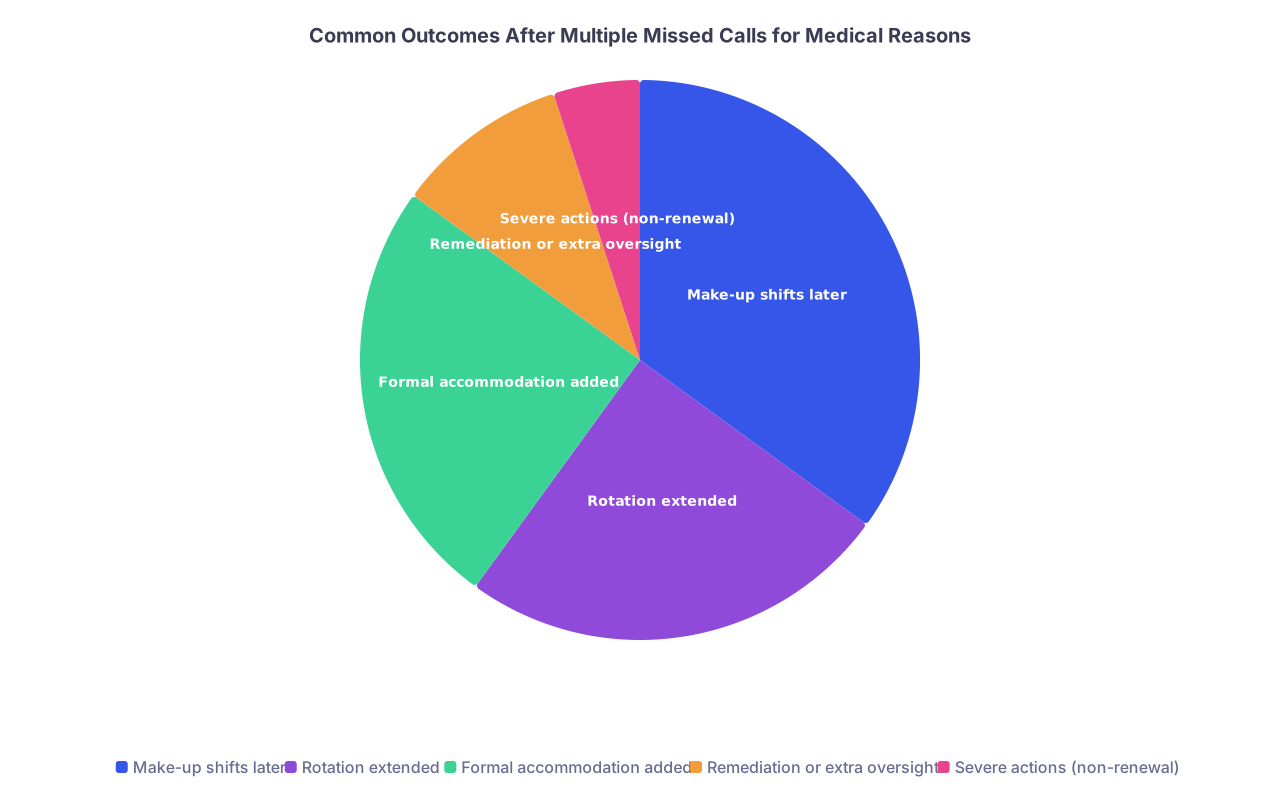
| Category | Value |
|---|---|
| Make-up shifts later | 35 |
| Rotation extended | 25 |
| Formal accommodation added | 25 |
| Remediation or extra oversight | 10 |
| Severe actions (non-renewal) | 5 |
Notice that last slice. Yes, worst-case exists. But it’s the exception, not the default, when you have documentation and engage early.
How Many Missed Calls Is “Too Many”?
This is what your brain is screaming: “What’s the line? 1? 3? 5? When am I ruined?”
There is no universal cutoff, and anyone who gives you a hard number is lying. But patterns I’ve seen:
- 1–2 calls out in a month: People mostly shrug.
- 3–4 in a month: Chiefs and PDs start to think about patterns and workload fairness.
- Repeated heavy call-outs across multiple blocks: That’s when serious conversations start about schedule redesign, leave, or extended training.
Key point: frequency + pattern + communication = how “bad” this looks.
Someone who:
- has clear medical documentation
- communicates early and respectfully
- participates as fully as they can when well
…is viewed very differently from someone who:
- no-shows call
- gives vague “not feeling great” with no follow-up
- repeatedly leaves co-residents hanging with last-minute surprises.
Your illness doesn’t define your professionalism. Your behavior during your illness does.
Could They Force Me Out of Residency?
Short answer: yes, they can non-renew your contract if they believe you can’t meet core requirements—even with accommodations.
But that is usually the end of a long trail of:
- Documented concerns
- Attempts at accommodations or adjusted schedules
- Maybe a leave of absence
- Remediation plans
People don’t usually get blind-sided with “you missed too many nights this one month, you’re out.” It builds.
A more common path:
- You miss multiple calls over several months due to flares.
- Program says, “We’re worried you can’t safely do this schedule. Let’s talk about accommodations or maybe a period of medical leave.”
- You adjust or go on leave.
- You come back with a new plan (sometimes extended training time).
Is that scary and disruptive? Yes. Career-ending? Usually not.
Planning for the Future: Can You Actually Do This Specialty?
This is the question you’re probably too scared to say out loud.
“What if my illness and this specialty just don’t match?”
Harsh truth: for some people, that’s real. Night-heavy, procedural, or high-intensity call specialties (surgery, OB/GYN, some ICU-heavy tracks) can be brutal on certain chronic conditions.
But “brutal” ≠ automatically impossible.
Real scenarios I’ve seen:
- Residents with autoimmune disease move from q4 overnight in-patient blocks to more clinic-heavy electives and longer training to meet case logs.
- Someone with severe migraines works out a pattern of exemption from back-to-back nights, but still does some call.
- A resident with epilepsy shifts away from night float to more day-heavy months and uses a different call structure within their program.

The key question is not “Can I force myself through this exact schedule?” It’s:
“Can I meet the bona fide core requirements of this specialty with reasonable and sustainable accommodations?”
If the honest answer (over time, with data from your body) is no, then the next hard conversation is about pivoting—within your field (same specialty, different type of practice) or to a different path that doesn’t destroy you.
That is not failure. That’s self-preservation.
How to Talk to Your Program Without Imploding
You’re imagining the meeting where your PD says, “So. You’ve missed several calls.”
Your heart’s racing already.
Here’s a framework to not crumble:
Lead with safety and facts, not apology theatre.
“My condition flared severely these weeks. I was not safe to do overnight patient care. I have documentation from my treating physician.”Acknowledge impact on the team without self-erasure.
“I know my absences put extra pressure on the team, and I don’t want to keep doing that.”Pivot to problem-solving and accommodations.
“I’d like to work with you and GME/disability services to create a plan so I can meet graduation requirements in a way that’s medically safe.”Ask directly about requirements.
“What specific targets do I have to meet—number of calls, specific rotations, minimum nights—so we can see what’s flexible and what isn’t?”
You’re trying to move the conversation from “Are you committed?” (which is coded and biased) to “What is essential vs schedulable?”
You Are Not Disposable, Even If the System Treats You Like You Are
You’re terrified that if you aren’t constantly available, you’ll be seen as less worthy. Less dedicated. A problem.
Medicine has soaked you in this from day one: the best trainees are the ones who never say no, never get sick, never need anything.
But here’s the thing nobody says out loud:
That trainee breaks. In year 1, or year 5, or year 10 of attending life. But they break.
You’re just being forced to confront human limits earlier because your body refuses to play pretend.
That’s not weakness. That’s information.
Use it. Structure around it. Demand that your training adapt to your reality, not the other way around.
You might still miss calls. You might still need extra time. You might have to do some really painful rethinking of specialty, schedule, or long-term career shape.
But none of that erases the fact that you belong in this field as much as anyone else.
FAQ: “What If I Have a Flare and Miss Too Many Call Nights This Block?”
1. Will missing multiple calls automatically fail my rotation?
No, not automatically. If your absences are medically documented and you communicate clearly, the more common outcomes are: making up shifts later, extending the rotation, or adjusting your schedule. Failure typically requires either unsafe behavior, chronic unexcused absences, or a long-standing pattern of concerns—not just one rough month with a flare.
2. Should I disclose my disability to my program if I haven’t yet?
If your condition is severe enough to repeatedly affect call, yes, you should strongly consider formal disclosure through GME/HR or your institution’s disability office. Without that, every absence looks like a separate one-off problem. With documentation, your situation becomes a structured accommodation issue instead of a vague “professionalism” concern.
3. Can I ask to be taken off call completely?
You can ask, but whether it’s granted depends on your specialty, program policies, and what’s considered an essential function of your role. Some specialties might be able to modify the type or frequency of call instead of removing it entirely. That’s where a formal accommodations process comes in—your job is to articulate your limits, and the program’s job is to see what’s reasonably modifiable without compromising training standards.
4. Could this ruin my chances at fellowship or future jobs?
Not by default. Programs don’t typically send out “this resident missed X calls” memos. What matters more in the long run is your overall performance, letters of recommendation, and whether you meet core training requirements. Chronic issues that lead to major professionalism flags or non-renewal can impact future opportunities—but again, that’s usually after multiple steps, not one bad block.
5. What’s one thing I should do today if I’m scared this might happen?
Email your treating clinician and ask for a clear, up-to-date letter describing your diagnosis, typical flares, and specific work limitations (especially around nights and prolonged shifts). Having that ready means that if a flare hits and you have to miss call, you’re not scrambling for proof—you already have a foundation for a real accommodations conversation.
Open your rotation schedule for the current or upcoming block. Identify exactly which call nights scare you most—and send one email today (to your clinician, your disability office, or your chief) starting the conversation about how to handle them before your body makes the decision for you.