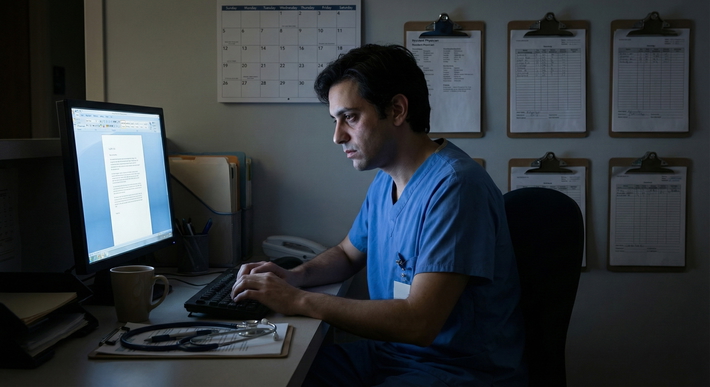
The myth that you must be “perfectly healthy and constantly available” to advance in medicine is toxic—and wrong.
The Fear Behind Asking for Time Off
You’re not just asking, “Can I take time off for treatment?”
You’re really asking:
- Will my PD secretly blacklist me?
- Will colleagues see me as “less committed”?
- Will I lose my promotion, fellowship chances, or leadership track?
- Will I never catch up to my peers again?
And under all of that:
“If I take care of my body, am I sacrificing my career?”
You’re not crazy for thinking this way. Medicine trains us to equate worth with productivity and availability. I’ve heard attendings literally say, “If you can sit, you can work.” I’ve seen residents dragging an IV pole on rounds. I’ve seen people in chemo wigs on call.
So when you need real time off—for surgery, chemo, radiation, mental health treatment, pregnancy complications, long COVID, you name it—it feels like you’re breaking some unwritten rule.
Let’s drag this into the light and answer the actual question:
Can taking time off for treatment derail your promotion timeline?
Short answer: It can change it. It does not have to destroy it. And it’s way less catastrophic than your 3 a.m. brain is telling you.
What Actually Controls Your “Timeline” (Not Just Vibes)
There’s the fantasy version of promotion (do everything flawlessly, on time, nonstop) and then there’s how it actually works on paper.
For trainees (med students, residents, fellows), “promotion” usually means:
- Advancing to the next year (MS2 → MS3, PGY1 → PGY2, etc.)
- Graduating on time
- Getting letters and being seen as “strong” for the next step
For attendings, it’s:
- Title changes (Instructor → Assistant Professor → Associate, etc.)
- Leadership roles (director, chief, committee chairs)
- Tenure or contract renewal
- Salary steps and academic rank
Here’s the part everyone forgets: most of these things are built around requirements, not vibes. Number of rotations. Number of clinic sessions. RVUs. Publications. Years in rank.
Time off interacts with those requirements. It doesn’t automatically equal “you’re done.”
| Stage | Time Off Effect |
|---|---|
| Med school | May delay clerkships |
| Residency | Might extend graduation |
| Fellowship | Similar to residency |
| Early attending | Can shift promotion dates |
| Academic track | Can extend tenure clock |
Does that mean your progression might be delayed by months or a year? Yes.
Does that mean your career is over? No. Not even close.
Your Worst-Case Scenarios vs Reality
Let’s lay out the actual nightmare thoughts.
1. “If I take time off, I’ll be seen as unreliable forever.”
I won’t lie: some people in medicine are terrible about this. There are attendings who equate illness with weakness. There are residents who roll their eyes when anyone is out. That’s real.
But the formal system isn’t “you got sick once → no promotion ever.” Programs and institutions care about patterns of chronic non-performance without a legitimate reason, not a documented medical leave with a return plan.
What actually matters:
- Do you communicate early and clearly?
- Do you follow the leave process (FMLA, institutional policies, GME rules)?
- When you’re back, can you meet requirements with the adjusted timeline?
I’ve seen plenty of people:
- Take 3–6 months off for cancer treatment and still match into fellowship.
- Take maternity leave twice in residency and still become chiefs.
- Go out on mental health leave and still end up in highly respected attending roles.
Were their timelines altered? Sometimes, yes.
Were they permanently branded “unreliable”? No.
2. “If I’m not advancing on the same schedule as my peers, I’ve failed.”
This one hurts because it’s not just about logistics. It’s about shame.
Your brain tells you:
- “Everyone I started with will be ahead of me.”
- “I’ll always be the one who needed ‘extra time.’”
- “If I can’t keep up, maybe I don’t belong.”
But medicine is already full of “non-standard” paths:
- People who took extra research years in med school
- People who switched specialties and “lost” a year
- International grads who redid training
- Parents who went part-time for a stretch
And quietly? A lot of those people end up more grounded, more deliberate, and frankly, better physicians.
A delayed timeline is not the same as a derailed timeline. They feel the same in your chest, but they’re not the same in reality.
3. “My PD will punish me for taking time off.”
Some programs suck. Let's be honest. Some PDs absolutely mishandle leave, are passive-aggressive, or push people to come back too early.
But there are also strong guardrails:
- ACGME requirements
- Institutional HR policies
- FMLA (if you qualify)
- Disability laws (ADA in the US, equivalents elsewhere)
Does that guarantee fairness? No. But you’re not completely at the mercy of one person’s opinion, even if it feels that way.
And the decent PDs—the ones you want advocating for you—care a lot more about:
- You being safe and actually fit to work
- You not crashing and burning mid-rotation
- Not getting sued for ignoring disability/medical needs
Legal and Policy Reality Check (Without the Legalese)
You’re probably scared to even say “accommodations” or “disability” out loud because it feels like admitting weakness on your record.
Here’s the blunt reality for the US (other countries have similar concepts):
- The Americans with Disabilities Act (ADA) protects you if you have a condition that substantially limits major life activities (this can include chronic illness, mental health, etc.).
- You’re entitled to reasonable accommodations, which can include modified schedules, time off, and sometimes extended training or delayed milestones.
- FMLA (if eligible) gives up to 12 weeks of job-protected leave for serious health conditions.
And no, saying the words “I may need an accommodation” does not automatically brand you as unemployable. If anything, it creates a paper trail that makes it harder for a program to quietly retaliate against you.
Are there subtle forms of discrimination that still happen? Yes. I’d be lying if I said otherwise.
But you’re not asking for a favor. You’re exercising a right. That mental shift matters.
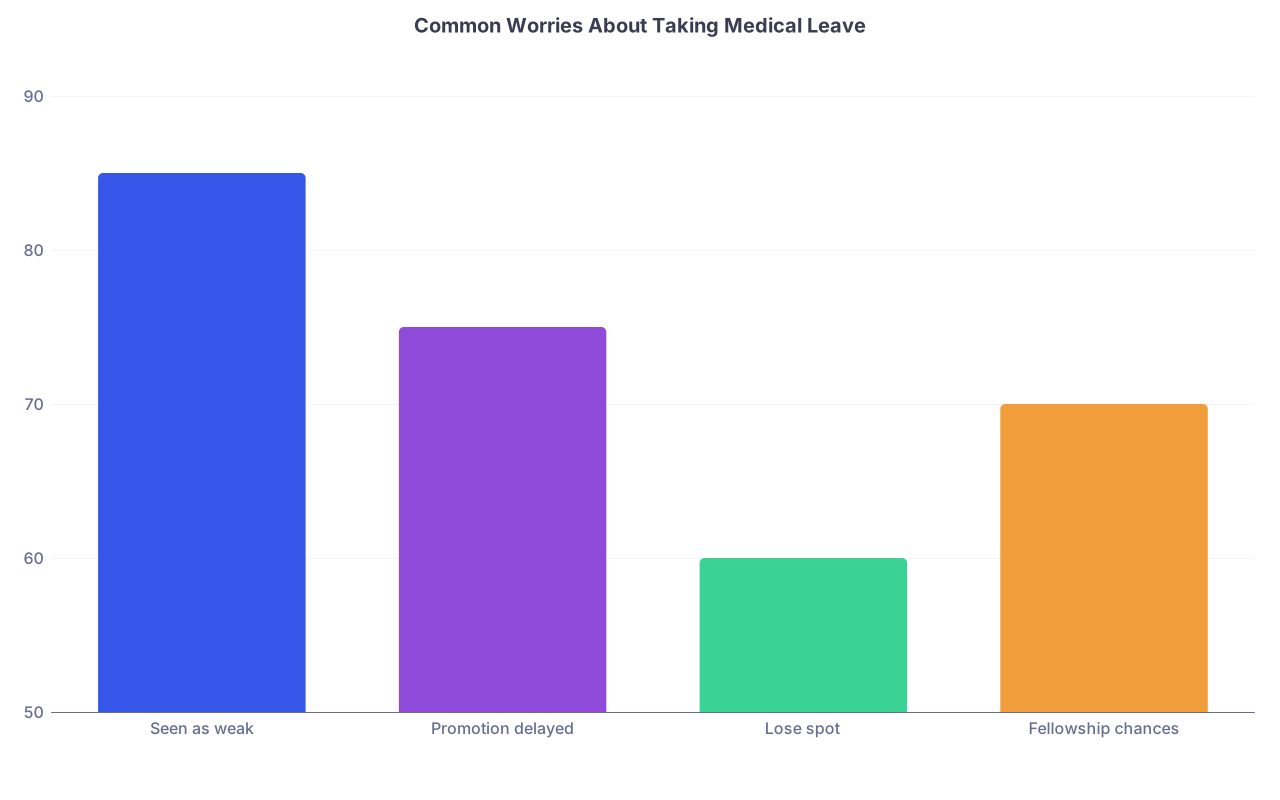
| Category | Value |
|---|---|
| Seen as weak | 85 |
| Promotion delayed | 75 |
| Lose spot | 60 |
| Fellowship chances | 70 |
(Those numbers aren’t from a specific study—I’m just being honest about how often I hear these exact fears.)
How Time Off Actually Plays Out in Training
Let’s talk concrete.
Med School
If you need time off for treatment:
- You might delay or pause a clerkship
- You might take a leave of absence for a semester or year
- You might graduate “out of sync” with your original class
Schools are used to this. People take LOAs for:
- Mental health
- Family emergencies
- Illness
- Research
- Pregnancy and childcare
Residency and fellowship applications care more about:
- What you did with the time
- How your letters describe your performance
- Whether you explained any gaps clearly and calmly
Program directors are busy. A one-line “Took a medical leave for treatment, fully recovered and returned to full clinical duties” is not the career death sentence your brain imagines.
Residency / Fellowship
This is the big one everyone panics about.
ACGME and specialty boards typically:
- Require a certain number of weeks worked per year
- Allow a certain number of weeks off (vacation, sick leave, parental leave)
- May require training extension if you go beyond that
Worst-case realistic scenario:
- You need months off for treatment
- Your graduation is delayed by 3–12 months
- You might start fellowship or attending work later than planned
Is that painful and annoying? Yes.
Is that the end of your career? No.
Plenty of residents:
- Extend residency for a few months
- Start fellowship off-cycle
- Or delay fellowship by a year and work as a prelim or research fellow
None of that screams “broken permanently.” It just screams “medicine, but with illness, which is… life.”
Early-Career Attendings / Academic Track
Here the fear is: “If I step back now, I’ll never catch up.”
Most institutions have mechanisms like:
- Tenure clock extension
- Part-time appointments
- Modified duties for a defined period
- Medical leave policies that preserve your position
Yes, it can slow promotions like Assistant → Associate Professor.
But hitting that title 1–2 years later is not failure. Most people outside your own head will not care.
How to Protect Your Future While You Protect Your Health
Here’s the control you do have, even when your body is pulling the fire alarm on you.
1. Get your medical documentation in order
- Clear diagnosis or at least “working diagnosis”
- Recommended treatment plan
- Expected time frame
- Functional limitations (fatigue, standing, cognitive load, etc.)
Programs don’t need every lab value; they need enough to justify leave and/or accommodations. This helps HR and GME back you up.
2. Talk to the right people in the right order
If you’re in training:
- Start with a confidential support person if possible: student affairs, GME office, ombuds, or disability office.
- Then bring in your program director with a plan or support from those offices.
If you’re faculty:
- HR and your institution’s disability/accommodations office are often safer starting points than just your division chief.
Don’t do this alone in a hallway conversation with a rushed attending. You want things:
- Documented
- Routed through the correct process
- Framed as “medical leave and accommodation” not “I’m randomly disappearing for a bit”

| Step | Description |
|---|---|
| Step 1 | Health problem |
| Step 2 | See treating clinician |
| Step 3 | Get documentation |
| Step 4 | Contact HR or student affairs |
| Step 5 | Discuss options and rights |
| Step 6 | Inform PD or supervisor |
| Step 7 | Finalize leave plan |
| Step 8 | Return with support plan |
3. Ask directly about impact on promotion / graduation
This part is scary, but you need clarity:
“Can you walk me through how this leave will affect my graduation date / promotion timeline?”
You want answers to:
- Will my training be extended?
- How will this affect my eligibility for boards or fellowship?
- Are there off-cycle options?
- Can my academic/promotion clock be paused?
If they dodge, follow up in writing:
“Just to make sure I understand, based on our conversation, if I take X weeks off, what happens to my PGY advancement / academic rank timeline?”
Paper trail. Always.
4. Protect your mental narrative
This sounds cheesy, but it matters. Without doing this, you will torture yourself.
You need one or two sentences you can live with when someone asks:
“Why was your training/progression slightly delayed?”
Examples:
- “I took a semester off in med school for medical treatment and came back full-time after that.”
- “I had a medical leave in residency that extended my graduation by six months, and I’m fully back to full duties now.”
- “I had a medical issue that required a short leave; my promotion timeline was adjusted, but my responsibilities and performance have been strong since returning.”
That’s it. You don’t owe people your MRI results.

The Hardest Truth: Your Body Won’t Wait for the Perfect Career Moment
Let me be blunt, because I’ve seen this up close:
Pushing through serious illness to “protect your timeline” can wreck both your health and your career.
Examples I’ve seen:
- A resident delayed mental health treatment until they were suicidal on call. That led to an emergency leave that was longer and messier than if they’d stepped back earlier.
- An attending ignored worsening autoimmune disease, ended up hospitalized multiple times, and had to take a longer leave than if they’d paced themselves.
- A trainee hid chemo, tried to work through it, made errors, and almost got dismissed—not for being sick, but for unsafe performance.
Programs can work with you around planned, documented, reasoned time off.
They can’t do much when you collapse mid-rotation after months of silent suffering.
You’re not choosing between:
- A perfect, uninterrupted career
vs - A broken, delayed, damaged one
You’re choosing between:
- A career built around a real human body with limits
vs - No career because you burned out or broke down trying to be invincible
What You Can Do Today To Lower the Panic
Here’s where to start, even if you feel like you’re barely keeping your head above water.
Write down your specific fear in one sentence.
“If I take 3 months off for treatment, I’ll never finish residency and no one will hire me.”Under it, force yourself to list:
- One person you’ve known (or heard of) who had time off and is still practicing.
- One way your program could adjust (extension, off-cycle, etc.).
Draft a 3-line email to a safe person: “I’m dealing with a medical issue and may need time off or accommodations. I’d like to understand what options exist and how this might affect my progression.”
If you can handle one more step:
Find your institution’s disability services / HR medical leave page and skim it. Just skim. You don’t have to memorize anything.

The Bottom Line
Yes, time off for treatment can adjust your promotion or graduation timeline.
No, it does not have to derail your entire career.
The hidden truth no one says out loud: a lot of doctors have non-linear timelines. The straight-through, never-sick, perfect CV is the exception, not the rule.
You’re allowed to be a doctor and a human being whose body sometimes needs more care than a weekend off.
You don’t have to choose between staying alive and staying promotable.
FAQ (Exactly 4 Questions)
1. Will taking medical leave automatically delay my graduation or promotion?
Not automatically. It depends on how much time you take and what your program or institution requires for completion. There are usually thresholds—like minimum weeks of training per year. Short leaves might fit within existing allowed time (vacation, sick leave). Longer leaves may trigger a required extension. You won’t know for sure until you ask directly, “If I take X weeks, what happens to my graduation/promotion date?”
2. Will future programs or employers see my leave as a red flag?
Most of the time, no—especially if you returned and functioned well afterwards. Application reviewers care more about your performance and letters than about a well-explained gap. A simple explanation like “I took a medical leave during training and successfully returned to full duties” is usually enough. People are more concerned about unexplained gaps or ongoing performance issues than a documented, time-limited medical leave.
3. Should I hide my health condition to avoid hurting my career?
Hiding it can backfire. If your condition affects your ability to work safely, performance issues might become the bigger problem—and those do hurt careers. Disclosing to the right people (HR, student affairs, disability office, PD) allows you to get formal support and accommodations. You don’t have to tell everyone. Keep it need-to-know. But complete secrecy while you’re struggling increases the risk of critical incidents, burnout, and much messier consequences.
4. What if my program or boss reacts badly when I ask for time off?
Unfortunately, that happens. If you get a dismissive or hostile response, loop in others—HR, GME, disability services, ombuds, or a trusted faculty mentor. Put things in writing. Ask for clarification about policies. Sometimes just involving formal structures makes people behave more reasonably. In worst cases, yes, it might strain relationships—but that’s still better than sacrificing your health. And if a place punishes you for needing treatment, that says more about them than about your worth as a physician.
Open your calendar and your email right now. Block 30 minutes this week to talk with HR, student affairs, or your disability office about what medical leave or accommodations actually look like at your institution—before you’re in full crisis mode.