
The biggest lie in residency culture is that you either “do everything” or you don’t belong in medicine.
I’m going to say the quiet part out loud: yes, there are residents who cannot safely perform certain required procedures. Some because of disability. Some because of injury. Some because of pregnancy. Some because of sheer human limitation. And no, their careers don’t automatically evaporate.
You’re not the first person to worry: “What if there’s something I literally can’t do?”
You’re just the first one in your circle brave enough to say it out loud.
Let’s go straight at the nightmare scenarios you’re spinning in your head.
The Fear You Won’t Say Out Loud
You’re probably thinking something like:
- “What if my hands shake too much for central lines?”
- “What if my spinal cord injury means I can’t do chest compressions?”
- “What if my visual field cut makes procedures unsafe?”
- “What if chronic pain keeps me from standing for long surgeries?”
- “What if my seizure disorder makes them think I’m a liability?”
And the real fear under all of that:
“Will they kick me out of residency and ruin my career because I physically can’t do something ‘required’?”
Let me be blunt: programs can’t legally operate on the “do everything or get out” model. They act like they can. They talk like they can. They give you those macho speeches about “we all pull our weight here.” But they live in the real world:
- With the Americans with Disabilities Act (ADA) and Section 504
- With GME oversight
- With risk management and lawyers
- With accreditation bodies that like documentation and policies
And they’ve already dealt with this. Vision limitations. Mobility limitations. Pregnancy-related restrictions. Religious restrictions on certain procedures. Residents with tremors. Residents who developed cancer in PGY-2 and couldn’t do call.
You are not inventing a new problem. You’re just afraid of being the “difficult one.”
What “Essential Functions” Really Means (And How Programs Use It Against You)
The phrase that messes with all of us: “essential functions” or “technical standards.”
Programs hide behind this wording:
“You must be able to perform all essential functions with or without reasonable accommodation.”
Sounds innocuous. It’s not.
Here’s how it actually works in the real world:
| Area | On Paper (Scary Version) | In Reality (Messy Version) |
|---|---|---|
| Procedures | Must perform all core procedures | Often shared, traded, reallocated |
| Call | Must take full call schedule | Adjusted for pregnancy/disability |
| Physical Tasks | Must lift, transport, compressions | Often done as a team, with help |
| Documentation | Must chart in EMR independently | Assistive tech often used |
Programs do NOT get to unilaterally declare that “every single listed procedure” is absolutely essential for you personally, with zero flexibility, in every case. That’s exactly what ADA is meant to push back against.
But here’s the catch:
They will try to casually talk like everything is essential, and you either do all of it or you’re “not fit for residency.” That’s culture. Not law.
And culture is loud. Law is quieter. You’re hearing the loud voice right now.
“Reasonable Accommodation” When the Job Is Literally Life-Or-Death
The big question:
If you can’t safely perform a required procedure, is that a “you problem” or a “they must accommodate you” problem?
Legally, the answer is: it depends on whether:
- You’re a “qualified individual with a disability”
- The requested accommodation is “reasonable”
- It doesn’t create “undue hardship” or fundamentally change the training
That language is vague on purpose, which is awful when you’re anxious. So let’s make it less abstract.
Real examples I’ve seen or heard about:
Resident with severe hand tremor:
- Couldn’t safely place central lines.
- Program shifted those procedures to co-residents; in return, this resident took more complex floor work and consults.
- Still graduated. Went into a non-procedural subspecialty.
OB/GYN resident with pregnancy + complications:
- Restricted from long cases and heavy lifting for months.
- Co-residents swapped call, faculty adjusted schedules, some case numbers rebalanced later.
- No one revoked her MD.
IM resident with partial visual field loss:
- Couldn’t safely do certain bedside procedures.
- Program documented accommodations, emphasized supervising/consult-heavy roles, and adjusted procedural expectations.
- Still board-eligible. Different career path than initially planned, but not destroyed.
Is every program this thoughtful? No. Some are lazy or hostile. Some will drag their feet or gaslight you into thinking you’re the problem.
But the pattern is clear:
Accommodations in procedural stuff usually look like redistribution, not magic superpowers.
You’re not asking them to invent robot hands. You’re asking them to adjust who does what when the task is unsafe for you. That’s the core of a “reasonable” request in a team-based clinical environment.
What If I Literally Can’t Do X Procedure… Ever?
This is the scenario that keeps you up at 2 a.m.:
“I have a permanent limitation. I will never be able to safely intubate. Or do a lumbar puncture. Or stand for a 6-hour case. What then?”
Let’s split this into two questions:
- Can your residency program still reasonably train you?
- Can you still have a career in that specialty (or some specialty)?
1. Residency program reality
Residencies aren’t monoliths. They do a ton of things besides that one procedure.
General rule of thumb:
- If the procedure is occasionally done and easily covered by others → higher likelihood of accommodation.
- If the procedure is central to the specialty and done constantly (e.g., cutting in surgery) → accommodation gets trickier but not always impossible.
- If patient safety is directly at risk when you attempt it → they’re on the hook to keep you from being forced into doing it.
That last one is key:
If you know something is unsafe for you to do, and they try to push you into doing it anyway, they’re increasing their own liability. Hospitals genuinely hate liability. This is leverage you don’t think you have.
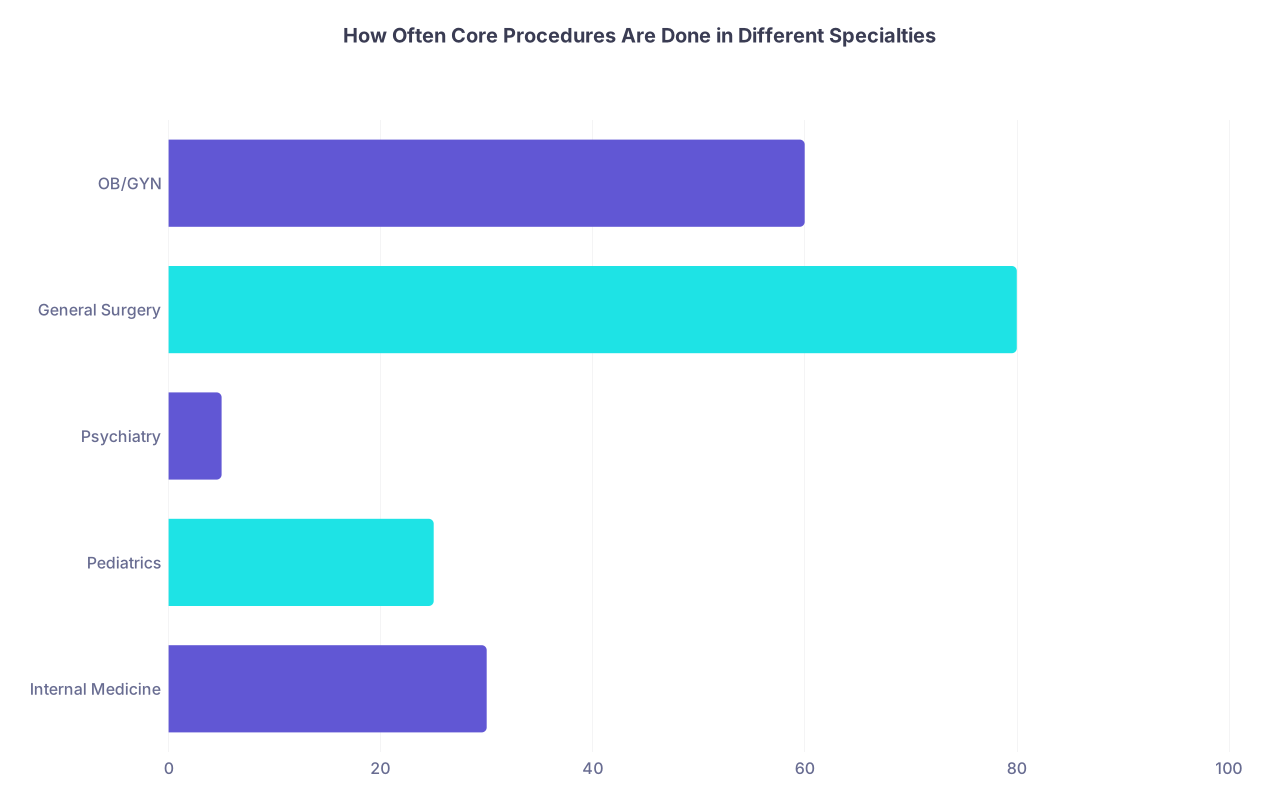
| Category | Value |
|---|---|
| Internal Medicine | 30 |
| Pediatrics | 25 |
| Psychiatry | 5 |
| General Surgery | 80 |
| OB/GYN | 60 |
2. Long-term career reality
Hard truth: there are some procedures that are basically inseparable from certain procedural-heavy specialties. It’s hard to imagine being a general surgeon who can never safely hold instruments in the OR.
But here’s what people never tell you:
- There are non-procedural niches inside almost every field.
- There are adjacent specialties that use the same knowledge, different physical tasks.
- There are academic, consult, diagnostic, and telehealth roles where you never touch a scalpel.
You might not end up doing exactly what you imagined as an MS1. Almost no one does anyway.
The real disaster scenario isn’t disability or limitation.
It’s silence, denial, and pretending everything is fine until something actually goes wrong.
How Often Do People Actually Get Kicked Out Over This?
Way less often than your brain is telling you.
Residents get pushed out most commonly for:
- Chronic unprofessional behavior
- Repeated, unremediated clinical judgment issues
- Dishonesty
- Vanishing from work / repeated no-shows
- Serious boundary or safety violations
“Couldn’t perform X procedure safely due to documented medical limitation, disclosed early, with accommodation requests” is not the classic pattern.
Do people get treated badly or forced into “voluntary resignations” sometimes? Yes. Especially when they don’t know their rights and don’t document anything.
But getting removed just for a disability-related procedural limitation — with no attempt at accommodation, no reassignment, no exploration of options — is exactly the sort of thing lawyers drool over and institutions try to avoid.
This is why you don’t handle it with casual hallway conversations.
What You Should Actually Do if You’re Worried About a Specific Procedure
Let’s say there’s a concrete thing you know is an issue:
- Central lines
- Intubations
- Chest compressions
- Long OR cases
- Anything requiring fine motor skills, vision, or physical strength you don’t have
Here’s the order I’d follow (and yes, I’m assuming you’re as anxious and worst-case oriented as I am):
1. Stop confiding only in peers
Your co-interns are great. They are not your legal protection. They’re also tired, scared, and sometimes selfish when workloads are involved.
You need formal channels.
2. Talk to Disability/Access Services (not just GME)
Most hospitals have some version of:
- Office of Disability Services / ADA Coordinator
- Employee Health
- HR / Equal Opportunity
You want to:
- Get your condition documented
- Ask what accommodations they’ve seen for residents before
- Frame it as: “I’m committed to safe patient care and want to identify what’s realistic and reasonable for me.”
Don’t start with: “Will they kick me out?”
Start with: “How have you handled similar situations?”
3. Put things in writing
Verbal conversations disappear. Emails live forever.
When you disclose, do it in a way that leaves a trail:
- Briefly describe your limitation.
- Emphasize patient safety.
- Explicitly say: “I am requesting reasonable accommodation under the ADA.”
That last line flips the situation out of vague “complaint” territory and into “legal framework” territory. People act differently when they know that.

| Step | Description |
|---|---|
| Step 1 | Recognize limitation |
| Step 2 | Document with physician |
| Step 3 | Contact Disability or ADA Office |
| Step 4 | Email PD and GME about accommodation |
| Step 5 | Interactive process meeting |
| Step 6 | Agreed accommodations in writing |
| Step 7 | Monitor and adjust as needed |
4. Be concrete about the risk, not dramatic
Instead of:
- “I’m scared to do procedures.”
Try:
- “Because of X condition, my fine motor control / stamina / vision is impaired in Y situations. I’m concerned this creates a patient safety risk for central line placement / LPs / prolonged OR standing.”
Programs know “I’m scared” is vague.
They know “documented physical limitation” is not.
5. Propose realistic alternatives
You’re not begging for special treatment. You’re proposing redistribution in a team system.
Examples:
- Swapping more complex admissions or family meetings in exchange for fewer procedures
- Taking more night float shifts without procedures in exchange for less procedural-focused rotations
- Doing simulation-based learning for conceptual understanding, even if you’re not the hands-on operator
You show you’re trying to contribute, not escape.
The Ugly Part: When the Program Is Hostile
Sometimes, despite doing everything “right,” a program responds with:
- “We can’t accommodate this.”
- “If you can’t do all required procedures, you’re not cut out for this specialty.”
- “You’re putting your co-residents at a disadvantage.”
You will immediately internalize that as: “I’m the problem.”
Here’s the part you need to hang onto:
Hostile does not always mean correct. It often means “we don’t want to figure this out.”
If this starts happening, you do three things:
Keep everything in email or immediately summarize conversations in an email:
“Per our discussion today, you stated that…”Involve someone outside the program:
- ADA/Disability office
- GME office
- Ombudsperson
- Sometimes even a lawyer who knows employment/disability law (earlier is better than later)
Quietly start gathering information about:
- Transfer options
- Alternative specialties
- Non-clinical or less-procedural clinical paths
Not because you’re doomed. Because you protect your future before you’re in crisis.

The Part Everyone Forgets: Medicine Is Bigger Than Procedures
Residency culture worships procedures. Lines. Tubes. Cutting. “I did 20 of these last night.”
But the actual healthcare system runs on:
- Judgment
- Communication
- Pattern recognition
- Teaching
- Systems thinking
- Chronic disease management
- Policy and administration
- Telehealth
- Diagnostics (radiology, path, etc.)
You’re terrified that not being able to do x, y, or z procedure makes you “less of a doctor.”
Reality: There are attending physicians out there:
- Who haven’t done a central line in a decade
- Who don’t intubate because anesthesia handles it
- Who never see the OR
- Who practice only telemedicine
- Who do policy, quality, or informatics full-time
You won’t feel that reality during residency. You’ll feel like the entire world is your current program and its attitude.
It’s not.

Quick Reality Check: You’re Not an Impostor for Needing Limits
This is the part the anxious brain rejects:
- Being cautious about patient safety is good doctor behavior.
- Recognizing a real physical limitation is responsible, not weak.
- Asking for accommodations is using the system as designed, not gaming it.
- You can contribute massively to patient care without doing every single high-risk procedure yourself.
You’re not failing the system by having a body or brain that doesn’t match some 1970s fantasy of the “ideal resident.”
The system is failing you when it acts like that fantasy is still the rule.
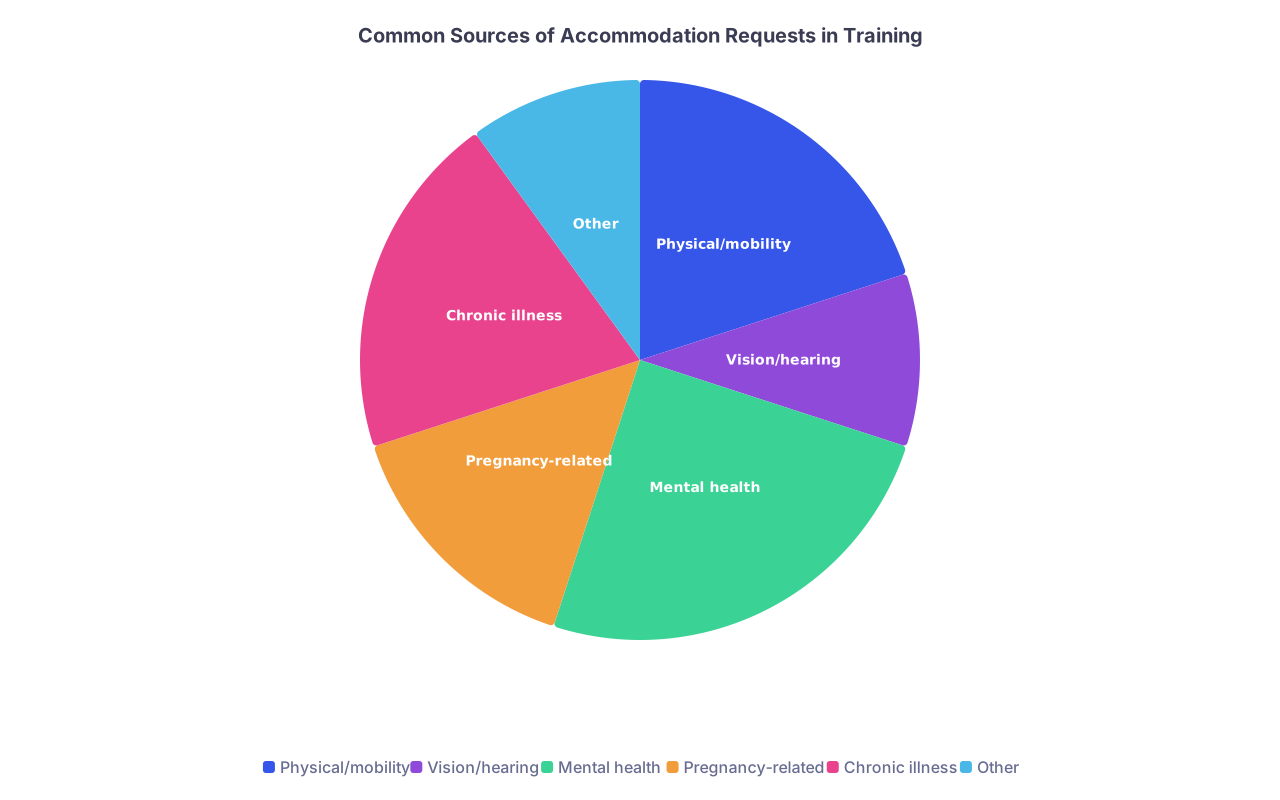
| Category | Value |
|---|---|
| Physical/mobility | 20 |
| Vision/hearing | 10 |
| Mental health | 25 |
| Pregnancy-related | 15 |
| Chronic illness | 20 |
| Other | 10 |
FAQ (Exactly 6 Questions)
1. Can a residency program legally fire me if I can’t do a required procedure because of a disability?
They can terminate a resident who can’t perform the essential functions of the job even with reasonable accommodation. But that’s a high bar. They’re supposed to engage in an “interactive process” to see what can be adjusted first: workload, task distribution, supervision, rotation structure. If they jump straight to “you’re out” without real accommodation attempts or documentation, that’s shaky legally and something you’d want a lawyer or ADA office to look at closely.
2. Should I disclose my limitation before I match, during interviews, or wait until I’m in residency?
From a pure self-protection standpoint, most people disclose after they’ve matched, not during interviews, unless the limitation is so central it fundamentally affects what they can safely train in. Before you disclose anywhere, talk to an attorney or disability office about timing and wording. Programs shouldn’t discriminate, but bias is real. Once you’re in the program, you have more concrete standing, and the focus shifts toward “how do we accommodate this?” instead of “should we rank this person?”
3. What if I’m not sure if it’s a “real” limitation or just anxiety about procedures?
Then you treat both as real until proven otherwise. Talk to a physician (your own, or occupational health), maybe a therapist, and your simulation center faculty. If they see objective tremor, stamina issues, vision problems, etc., that’s data. If it looks like pure performance anxiety, that’s still not a moral failure — it’s something that needs support, coaching, maybe therapy, and graded exposure. But don’t gaslight yourself by saying “it’s probably just in my head” while also feeling unsafe at the bedside.
4. Can I still be board-certified if I didn’t complete every procedural minimum personally?
Boards care that you completed an ACGME-accredited residency and that your program attests you’re competent. Case/procedure logs matter, but they’re not always a perfect reflection of “my two hands did 100% of these.” If accommodations meant you did fewer of some procedures and more of others, programs sometimes document equivalence, simulation experience, or team-based care. You need your program on board here. If they’re not, it becomes a conversation about alternative paths, fellowships in less procedural niches, or shifting specialties.
5. What if my co-residents resent me for not doing as many procedures?
Some might. They’re burned out and will frame anything that shifts work as “unfair.” That doesn’t mean they’re right. The institution has a legal and ethical duty to accommodate disability; your peers are not the final judges. You can help by visibly pulling weight in other ways — taking more admissions, helping with notes, doing hard family meetings — but their resentment is not proof you don’t belong. It’s proof they’re exhausted in a broken system.
6. Is it ever better to switch specialties rather than fight for accommodations?
Sometimes, yes. If your limitation clashes constantly with the core daily work of the field (e.g., major motor limitations in surgery where your program is openly hostile), fighting might burn you out more than it helps. Switching to a less procedural specialty (psych, path, radiology, heme/onc, hospitalist, etc.) can be a strategic move, not a surrender. The key is: don’t let fear make the decision alone. Talk to disability experts, mentors outside your program, and if needed, an attorney — then choose the path that preserves both your career and your sanity.
Key takeaways:
- Not being able to safely perform a specific procedure does not automatically disqualify you from residency or medicine.
- You have legal rights to request reasonable accommodations, and those often look like redistribution of procedural tasks, not “do everything or leave.”
- Silence and denial are the real dangers. Document your limitations, use formal channels, and protect your future early instead of waiting for a crisis.