
The myth that you can be fired from residency just for asking for disability accommodations is flat‑out wrong.
But I know that doesn’t stop the 3 a.m. panic spiral.
You’re probably running through every worst‑case scenario in your head:
If I ask for extra time after call, will they think I’m weak?
If I disclose ADHD or a chronic illness, will they quietly push me out?
If I ask for help, do I basically put a target on my back?
Let’s walk through this like someone who’s seen residents on both sides of this: the ones who suffered in silence until they broke, and the ones who nervously asked for adjustments and did not get fired, blacklisted, or dragged to some secret GME tribunal.
You need clarity, not vague reassurance. So I’m going to be blunt.
The short answer: No, you cannot legally be fired for asking for disability accommodations
If all you remember from this is one sentence, make it this:
Asking for disability accommodations, in good faith, is a protected activity under U.S. law (ADA / ADAAA, Section 504). Firing you because you asked is illegal retaliation.
Does that magically mean programs never do shady things? Of course not. There are petty PDs, clueless chiefs, and risk‑averse HR people everywhere. But the law is not ambiguous here.
You are legally protected when you:
- Disclose a qualifying disability (physical, mental, visible, invisible, chronic, intermittent)
- Request a reasonable accommodation
- Participate in an interactive process to figure out what’s reasonable
You are not required to:
- Use magic legal words like “ADA” or “reasonable accommodation”
- Disclose every detail of your diagnosis to your PD
- Prove you’re “disabled enough” in the first email
And you absolutely are not supposed to be punished just because you say, “Hey, I have [condition], and I think I may need some adjustments to safely do my job.”
That said, I know the real fear isn’t “is it technically legal?”
It’s “can they do something shady and pretend it’s performance‑based?”
We’ll get there.
What programs can and can’t do when you ask for accommodations
Here’s where a lot of the anxiety comes from: the gap between what’s legal on paper and what messy humans actually do in hospitals.
| Scenario | Legally OK? |
|---|---|
| Meet with you and ask about job‑related limitations | Yes |
| Ask for medical documentation via HR/Occ Health | Yes |
| Deny an accommodation that’s not reasonable | Yes |
| Fire you *because* you requested accommodation | No |
| Retaliate with worse schedules or evaluations | No |
What they can do (and it’s not always hostile)
They can:
- Send you to HR or Occupational Health and ask you to get documentation from a provider. Annoying? Yes. Illegal? No.
- Ask clarifying questions about your functional limitations, like “Do nights trigger your condition?” or “Is standing for long periods a problem?”
- Say no to specific accommodations that:
- Eliminate essential job functions (
you must still see patients) - Create undue hardship (
we can’t give you every weekend off for three years in a tiny 3‑resident program) - Fundamentally alter the training requirements (
we can’t just not train you in inpatient medicine if it’s a core requirement)
- Eliminate essential job functions (
What they can’t do is treat your request like a character flaw.
They cannot legally:
- Shorten your contract or not renew you because you disclosed or asked
- Suddenly start documenting vague “professionalism” concerns right after you request accommodations as payback
- Tell other residents your diagnosis or details about your condition without need‑to‑know justification
Do some programs still do petty, subtle retaliation? Yes. But that’s wrong and risky for them, not for you. And there are ways to protect yourself if you suspect that’s happening.
The big ugly fear: “They’ll say I’m unsafe and kick me out”
This is the nightmare scenario: you ask for accommodations → they decide you’re not “fit for duty” → you’re pushed out “for patient safety.”
Here’s the hard truth: residents can be fired or non‑renewed for legitimate performance or safety issues. But that’s not the same as:
“I asked for disability adjustments” → “You’re fired.”
The law draws a line between:
- Being unable to safely perform essential functions even with reasonable accommodations
vs. - Being disabled and needing reasonable accommodations to safely perform
Only the first one can justify termination legally, and even then, programs are supposed to show they tried accommodations first and they truly didn’t work or weren’t feasible.
Most of the time, what actually happens is less dramatic and more bureaucratic:
- You get referred to occupational health
- They do a “fitness for duty” assessment
- They recommend certain restrictions or adjustments
- GME figures out if they can set up a workable schedule or role within ACGME rules
Is it fun? No. Is it scary? Yes.
Is it automatically a trap to remove you? No.
If they were already unhappy with your performance, they might use this moment to tighten the screws. That’s where documenting everything and getting support matters.
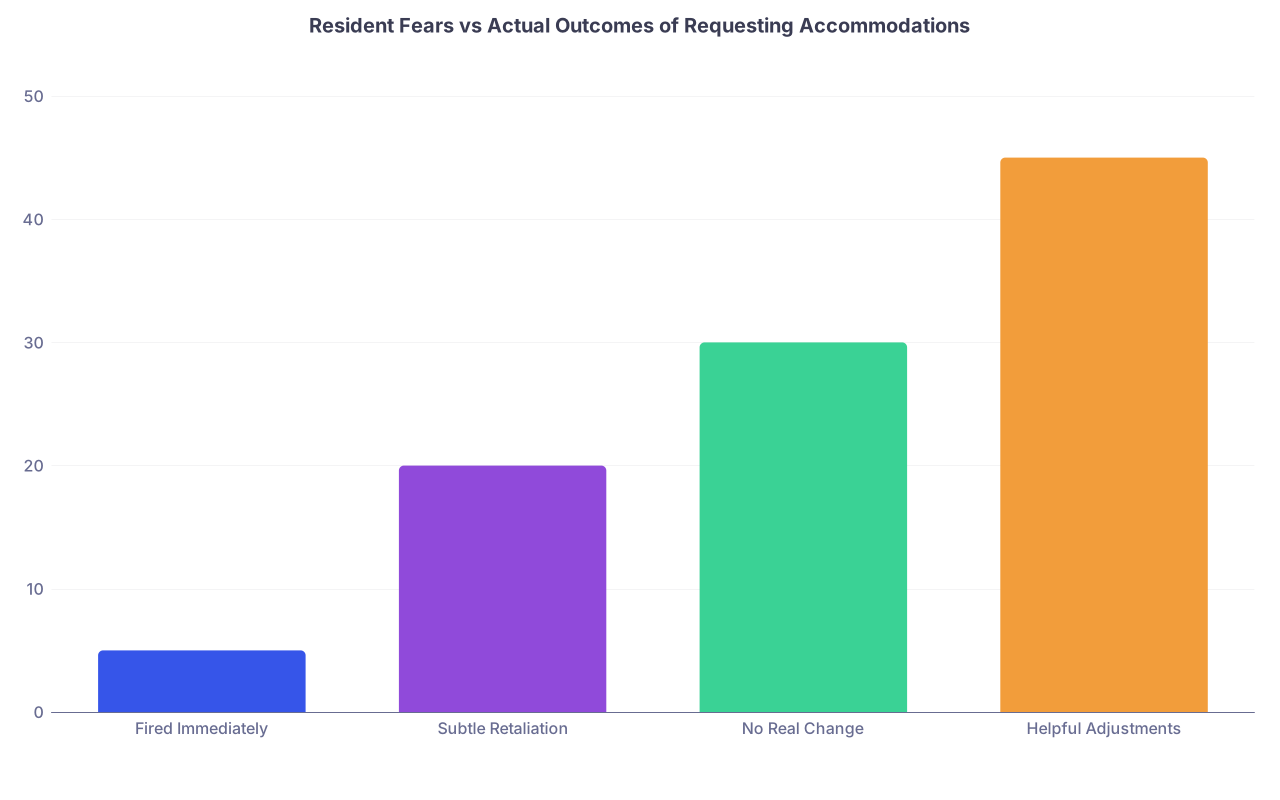
| Category | Value |
|---|---|
| Fired Immediately | 5 |
| Subtle Retaliation | 20 |
| No Real Change | 30 |
| Helpful Adjustments | 45 |
(Those numbers obviously aren’t exact data, but the pattern tracks with what I’ve seen: more residents quietly do OK or get real help than get destroyed. You just don’t hear their stories because they’re not on Reddit at 2 a.m.)
What actually happens when you ask (step by step, not the horror‑movie version)
Forget the catastrophic brain‑movie for a second. Here’s the real, boring version of what usually happens when you ask for disability adjustments in residency.

| Step | Description |
|---|---|
| Step 1 | You ask PD or GME for help |
| Step 2 | Referred to HR or Occ Health |
| Step 3 | Provide medical documentation |
| Step 4 | Interactive discussion |
| Step 5 | Reasonable plan created |
| Step 6 | Implementation and follow up |
In real life, it looks something like this:
You send a cautious email to your PD or program coordinator:
“I have a medical condition that affects [sleep / stamina / focus / mobility] and I’d like to talk about what adjustments might be possible to help me safely meet my training requirements.”
They usually loop in:
- GME office
- HR / Disability services
- Sometimes Occ Health
You talk more about limitations, not your whole trauma history. For example:
- “I can’t safely work 28‑hour calls back‑to‑back due to [condition].”
- “I need predictable access to restroom breaks due to GI issues.”
- “I have ADHD and need occasional quiet space to complete notes without constant interruptions.”
They probably ask for:
- A letter from your treating clinician that spells out:
- Diagnosis (sometimes limited)
- Functional limitations
- Suggested accommodations
Then:
- They figure out what fits within ACGME rules and staffing reality
- You may get:
- Adjusted call frequency
- Protected appointment time
- Assistive tech / ergonomic adjustments
- Slight schedule modifications
- You do not usually get:
- “No nights ever” in a small program
- “No inpatient medicine at all” in IM
- Exemption from core competencies
Is there risk of awkwardness? Yes. Some PDs have never handled this well. Some will overshare, some will under‑communicate, some will make it weird.
But none of this is “instant firing” territory.
Where your fears aren’t totally irrational (and how to protect yourself)
I’m not going to gaslight you: there are risks. Not legal “they can fire you for asking” risks, but “they might behave badly and pretend it’s unrelated” risks.
Common anxiety triggers:
“They’ll start calling me unprofessional.”
I’ve seen this. A resident asks for accommodations, and suddenly feedback includes “not a team player” because they asked to leave post‑call at a reasonable time.“They’ll say I’m not meeting expectations.”
Sometimes PDs will push harder on evaluations after an accommodation request.“They’ll ‘non‑renew’ me instead of firing me.”
Programs sometimes use non‑renewal at year‑end instead of mid‑year termination, claiming “overall fit.”
So what can you do without going full tinfoil hat?
Document quietly. You are not paranoid for:
- Saving emails where you request accommodations
- Writing down dates, conversations, and who was in the room
- Following up verbal conversations with short recap emails:
“Just to confirm what we discussed today…”
Get allies:
- GME office (not just your PD)
- Institutional disability office (yes, most teaching hospitals have one, even if hidden)
- A trusted attending who doesn’t think “residents should suffer because we did”
And if it feels really off:
- Reach out to the house staff union (if you have one)
- Quietly consult with a disability rights or employment lawyer, especially if termination or non‑renewal is hinted at soon after you disclose
You’re not being dramatic. You’re protecting your career.

Should you disclose at all? Or just try to push through?
Ah, the classic self‑destructive option:
“I’ll just power through, maybe I won’t need help, I don’t want to be ‘that resident.’”
I’ve seen how that ends:
- Panic attacks mid‑rounds
- Missed diagnoses because your brain is fried and you’re beyond your limits
- Documentation mistakes that become “patient safety” issues
- Formal remediation when you actually needed accommodations, not discipline
Not disclosing and not asking for help doesn’t protect you. It just removes the legal and institutional framework that’s supposed to shield you.
There’s a nasty pattern where someone:
- Struggles silently
- Underperforms because their condition isn’t supported
- Gets written up or remediated
- Then tries to ask for accommodations
- And the program says, “This is a performance problem, not a disability issue”
Is that defensible for them? Not always. But it’s a messier fight for you.
If you’re already clearly struggling, asking for accommodations sooner rather than later gives you:
- A legitimate paper trail that yes, this is disability‑related
- Support backing you up when people question your schedule adjustments
- A much stronger argument if someone tries to label everything “unprofessional”
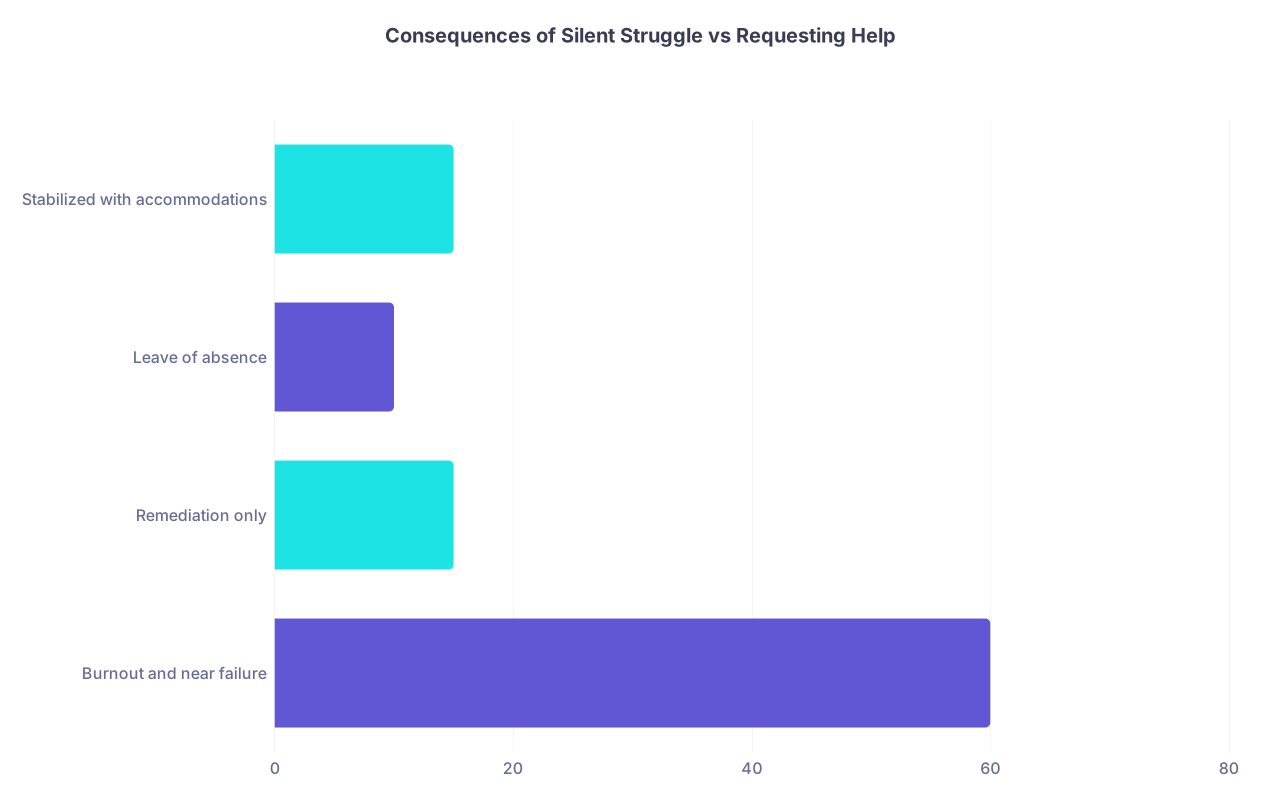
| Category | Value |
|---|---|
| Burnout and near failure | 60 |
| Remediation only | 15 |
| Leave of absence | 10 |
| Stabilized with accommodations | 15 |
Again, this is more pattern than precise data, but you get the point. White‑knuckling your way through residency rarely ends in a heroic montage. It ends in something breaking.
Tactical advice: how to ask in a way that minimizes risk
You can’t eliminate all risk, but you can be smart about it.
A few principles:
Lead with functions, not your whole diagnosis autobiography.
“I have a condition that affects my stamina and sleep. I’m concerned about safely doing multiple 28‑hour calls back‑to‑back.”Put it in writing, even if short.
Email creates a time‑stamped record you asked for help before things blew up.Involve the right structures.
Ask: “Should I also be in contact with GME or HR/Disability Services to discuss this formally?”Don’t volunteer to do more than is safe just to look “strong.”
That backfires. If you tell them you can handle everything, it’s harder later to say, “Actually I cannot.”
And if someone says something sketchy like:
- “We don’t really do accommodations in residency.”
- “If you can’t handle this schedule, maybe this isn’t the right career for you.”
You quietly screenshot or write that down somewhere safe. That’s gold if things escalate.

The future: this will get better, but you’re stuck in the in‑between
The culture is shifting. Glacially, but still.
- More residents talk openly about ADHD, depression, autoimmune disease, chronic pain, hearing loss.
- More institutions have formal disability offices tied into GME, not just for students.
- Lawsuits and complaints have made programs much more cautious about blatant discrimination.
But right now, you’re in the awkward middle era:
Legal protections exist. Cultural acceptance is lagging. Individual PD attitudes vary wildly.
What that means for you:
You are not wrong to be scared.
You are also not doomed if you ask for help.
Residents with:
- MS using cooling vests and schedule tweaks
- ADHD with structured check‑ins and note‑writing strategies
- Hearing loss with amplified stethoscopes and paging accommodations
- Chronic GI issues with protected bathroom and hydration breaks
…are finishing training every year.
They’re not on the front page of anything. Because the story “Resident quietly gets accommodations and graduates” is boring. But it’s real.

FAQ – Exactly 6 Questions
1. Can I actually be fired from residency just for asking for disability accommodations?
No. Firing you because you requested accommodations is illegal retaliation under the ADA and related laws. Programs might try to disguise retaliation as “performance issues,” which is why documenting timelines and conversations matters. But the act of asking itself is protected.
2. Do I have to tell my program director my exact diagnosis?
Not necessarily. You usually need to disclose enough for them (through HR/Occ Health) to understand your functional limitations and what accommodations might help. Detailed medical records go to health/disability services, not your PD. Your PD generally gets: “Resident has documented limitations related to [broad category] and should have [specific accommodations].”
3. Can they say I’m ‘not fit for duty’ and remove me after I disclose?
They can send you for a fitness‑for‑duty evaluation. If, even with reasonable accommodations, you truly can’t safely perform essential job functions, they may limit duties or, in extreme cases, end your training. But that’s about actual ability, not about punishing you for asking. And they’re expected to try reasonable accommodations first, not jump straight to removal.
4. Will asking for accommodations ruin my chances of a good fellowship or job later?
Programs and employers are not supposed to share your medical or disability information. What they can share are evaluations of your performance. If your accommodations help you perform better and more consistently, that usually helps your record, not hurts it. The biggest career risk is often uncontrolled, unsupported impairment, not a well‑managed, documented condition.
5. What if my program subtly punishes me after I ask, like worse schedules or bad evals?
That can be retaliation, even if it’s not labeled that way. Start tracking dates: when you disclosed, when evaluations changed tone, when schedules shifted. Save emails. If you’re in a union, talk to them. If not, consider quietly contacting a disability rights or employment lawyer, especially if non‑renewal or termination enters the conversation.
6. I’m not sure I’m ‘disabled enough.’ Should I still ask?
If your condition is significantly impacting your ability to function safely, consistently, or sustainably in residency, you’re not “making it up.” Many qualifying disabilities are invisible, intermittent, or mild‑to‑moderate but still very real under the law. You don’t need to be on the verge of collapse or in a wheelchair to deserve adjustments that keep you functioning and safe.
Bottom line:
You can’t legally be fired for asking for disability adjustments.
The bigger danger is struggling in silence until it becomes a performance crisis.
If you’re already thinking about accommodations, you’re not weak—you’re trying to make residency survivable without destroying yourself in the process.