
The way clinical evaluators “adjust” expectations for disabled trainees is not written anywhere—but it absolutely shapes your career.
I’m going to tell you how it actually works behind closed doors. The hallway conversations. The wink‑and‑nod “we’ll be understanding” that sometimes helps you, and sometimes quietly caps your ceiling.
This is the stuff you will not hear in an orientation session.
The Unspoken Calibration: How Expectations Really Shift
Here’s the first uncomfortable truth: most attendings and program leadership do change their frame of reference when they know a trainee is disabled. But they won’t say that out loud, and they definitely won’t put it in your evaluation.
The logic they use is usually some mix of:
- “Fairness”: comparing you to what they think is reasonable for you, not the generic trainee
- “Patient safety”: anytime disability could intersect with speed, stamina, or procedure execution
- “Future practice”: deciding (quietly) whether you’re “safe to pass” into independent practice
In meetings, I’ve heard some version of this dozens of times:
- “Given her visual impairment, I think she’s doing very well.”
- “He’s slower on notes, but considering his processing issues, this is acceptable.”
- “We should not expect her to run to codes; that’s not realistic—judge her on everything else.”
On paper, you’ll still see the same anchors: “meets expectations,” “exceeds expectations,” “below expectations.” But the internal bar they use for those phrases might not be the same as for your peers.
Here’s the catch: sometimes this works to your benefit in the short term (you pass the rotation, you’re “supported”). Long term, it can translate into:
- Lukewarm letters: “despite challenges, they met expectations”
- Shielding from certain opportunities: no ICU month, no surgical electives, no high-acuity nights
- Quiet risk labels: “fine for outpatient,” “not for high-intensity settings”
No one sends you a memo saying this happened. You just don’t get the same doors opened.
Where Expectations Actually Get Adjusted (And How)
The adjustment is not one big decision. It shows up in small, repeated choices across different domains.
1. Speed and Productivity
The dominant hidden metric in clinical training is speed. Number of patients seen. Notes finished by X time. Response time to pages.
Disabled trainees—especially those with mobility differences, chronic fatigue, ADHD, autism, or learning disabilities—hit this wall early.
Here’s what evaluators quietly do:
- They create a separate mental “speed curve” for you.
- They stop expecting you to see as many patients.
- They praise “organization” or “thoroughness” instead of volume.
Typical comments in meetings:
- “She only saw three patients on wards, but her notes were excellent.”
- “It takes him longer to pre-round because of his mobility issues; I don’t think we should hold that against him.”
Sometimes they’ll explicitly redistribute your workload. One resident with a mobility impairment told me how team structure “naturally shifted” so he had fewer floor patients and more consults. That was not random. That was a group of attendings deciding, “We’ll protect him from failing by lowering volume.”
The danger: those same people then write in your summative letters that you are “best suited for outpatient, longitudinal care,” or that you “thrive with manageable patient volumes.” That’s code. Other faculty read it and hear: “Do not put this person in high-acuity settings.”
2. Procedures and “Hands-On” Skills
Procedures are where evaluators get nervous. They’re thinking about liability, board exams, and their own name on your competency sign-offs.
For disabled trainees—especially with fine motor, visual, or mobility issues—here’s the pattern I’ve watched in multiple programs:
- They let you try procedures early in the rotation.
- If you struggle once or twice, they fast-forward to “Maybe we tailor expectations.”
- Senior residents or other students start getting the procedures first “for efficiency.”
Then, behind closed doors:
- “He is not going to be a proceduralist; that is okay.”
- “We shouldn’t push her to do central lines; focus on basics.”
They’ll mark your procedures as “observed,” “assisted,” sometimes “performed with supervision,” but the internal sense is: “We will not expect mastery here, as long as they are safe and know the indications/contraindications.”
On the surface, that can feel compassionate. Underneath, it can quietly shunt you away from whole categories of careers. I’ve watched a disabled intern quietly steered away from anesthesia and EM with the phrase “I’m not sure that’s the best fit with your strengths.”
No one wrote down: “We adjusted expectations on procedures.” They just changed what they offered and how strongly they recommended anything.
3. Stamina, Call, and Nights
If you have chronic illness, mobility limitations, or fatigue-related conditions, this is where the adjustment becomes blatant—but still unofficial.
Teams and leadership start phrasing things like:
- “We’ll be flexible with call.”
- “You don’t have to take as many nights.”
- “We’ll modify your schedule where needed.”
Sometimes this is formally processed through accommodations. Often it’s not—just whispered hallway favors from friendly chiefs: “We’ll swap you off this night float block.”
Here’s what actually happens in the evaluation pipeline:
- Your hours and call burden become part of your narrative.
- Faculty remember you as “less tested under pressure.”
- Committees ask, “Have they done full-call equivalents?” when promotion or independently signing out comes up.
I’ve heard attending comments exactly like:
- “She’s never done a full ICU night, so I can’t say I’ve seen her under maximum stress.”
- “We reduced his call because of his health, so my evaluation may not reflect typical performance.”
Translated: “We adjusted expectations. We’re not fully vouching for them in high-stress, high-volume roles.”
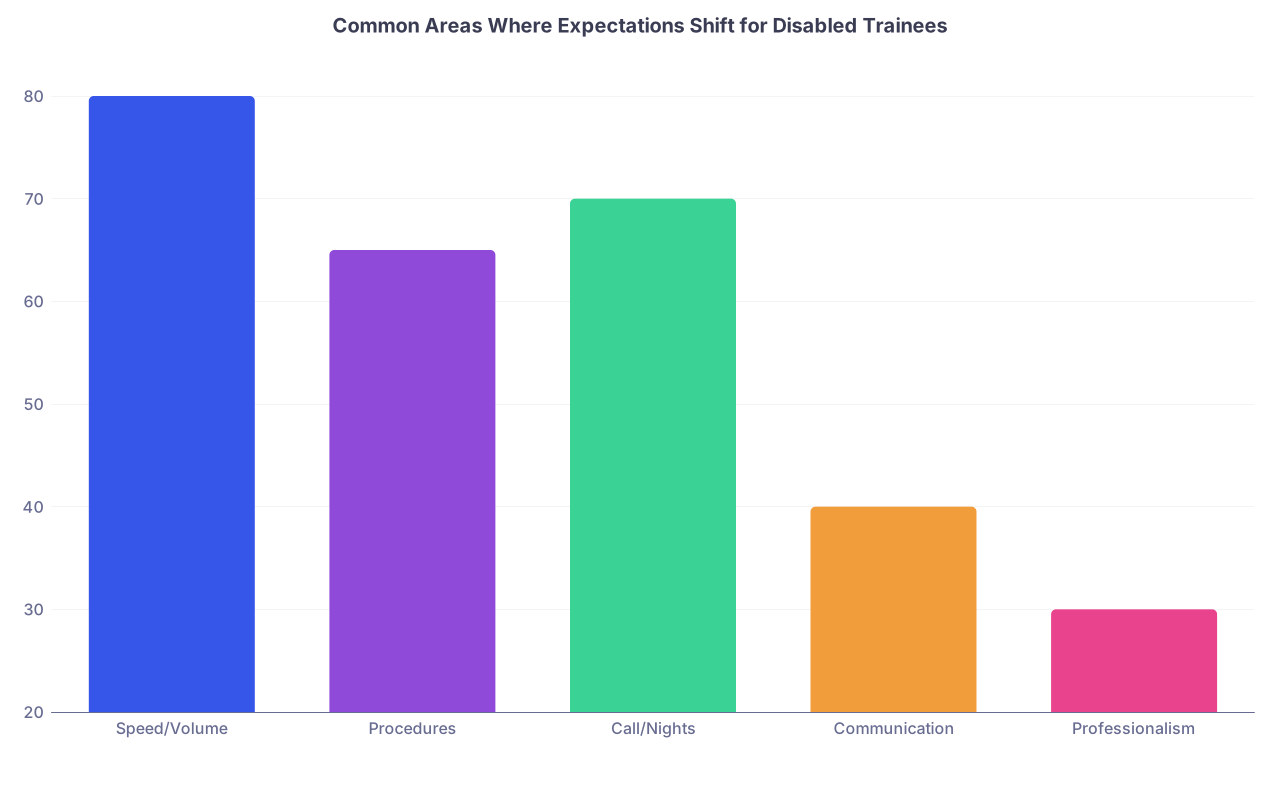
| Category | Value |
|---|---|
| Speed/Volume | 80 |
| Procedures | 65 |
| Call/Nights | 70 |
| Communication | 40 |
| Professionalism | 30 |
The Double Standard: “Supportive” vs “Soft Bigotry of Low Expectations”
Here’s the part people dance around: not all adjustments are benevolent. Some are just bias dressed up as compassion.
There’s a fine line between:
- Reasonable alteration of expectations based on essential, non-negotiable job functions
and
- Deciding, quietly, that a disabled trainee will never be as good, and grading them on a lower bar forever
I’ve watched both.
Some attendings think they’re being kind by constantly saying:
- “Given everything he’s dealing with, he’s doing well.”
- “She’s not the fastest, but she’s trying hard.”
That “given everything” clause is a trap. Once evaluators start prefacing your performance with explanations, they’ve stopped seeing you as purely competent. You become “competent despite.” That bleeds into every narrative document about you.
Good evaluators—and there are some—do this differently:
- They separate essential outcomes (safe patient care, clinical reasoning, reliability) from non-essential style (speed, handwriting, how you stand on rounds).
- They hold you to the same safety and reasoning bar, but allow different routes to get there.
Bad evaluators:
- Quietly lower the safety bar because they “feel bad” failing you.
- Or, conversely, hold your disability against you when you ask for adjustments and label you “less committed.”
You’re not going to change who’s assigned to you. What you can do is recognize which type you’re dealing with and adjust how transparent, assertive, and documented you keep things.
How “Quiet Adjustments” Play Out in Evaluation Meetings
Let me walk you through what actually happens in a clinical competency committee (CCC) or promotions meeting when your name comes up and you’re a disabled trainee.
This will sting a bit, but you’re better off knowing.

| Step | Description |
|---|---|
| Step 1 | Case Review Starts |
| Step 2 | Context Comments First |
| Step 3 | Performance First |
| Step 4 | Pass with Notes |
| Step 5 | Discuss Accommodations |
| Step 6 | Pass with Conditions |
| Step 7 | Remediation or Non Promotion |
| Step 8 | Known Disability? |
| Step 9 | Any Concerns? |
| Step 10 | Essential Competencies Met? |
Here’s how it sounds behind closed doors:
Context leads
If someone on the committee knows you’re disabled, that usually comes first.
“Just so everyone remembers, she has a chronic pain condition and got schedule accommodations.”Concerns are filtered through disability
“Is her tardiness related to her condition?”
“Is the slower note-writing because of her processing issues, or is it time management?”The central question becomes:
“Given their limitations, are they still safe and competent enough to move forward?”
Notice the shift? For non-disabled trainees the question is, “Are they competent?” For disabled trainees it often becomes, “Are they competent enough, considering?”
At this stage, expectations get bent in both directions:
- Marginal performers may be pushed through because faculty feel guilty failing “the disabled resident.”
- Or strong-but-different performers are blocked from certain next steps because people are anxious about optics, risk, and “fit.”
You don’t see any of this on your summative evaluation. You just see generic language that hides the private debate.
The Role of Formal Accommodations (And How They Change the Game)
One of the biggest mistakes disabled trainees make is assuming informal kindness equals protection. It does not.
When you rely entirely on hallway promises—“We’ll be flexible,” “Don’t worry about call,” “We’ll give you extra time”—you give evaluators enormous unchecked discretion in how they judge you.
Formal accommodations reshape where expectations can be adjusted legitimately and where they cannot.
Here’s how evaluators think when there’s a formal letter:
- “Their reduced call load is an approved accommodation; I cannot dock them for not taking as many nights.”
- “They’re allowed extra time on notes/EPIC documentation; I need to judge quality, not speed.”
With no letter and just “we were being nice”:
- “He just didn’t do as much as others.”
- “She missed several calls; I know she’s ill, but we still need people who can meet the demands.”
You don’t want your entire performance to be “normalized downward” with no paper trail backing why things looked different.
Get the accommodation letter. Then carefully negotiate its use so you don’t end up overprotected and underexposed to the experiences you actually need.

Where Programs Quietly Draw the Line
There are areas where programs will flex heavily. And there are areas where they will not bend, even if they like you and empathize.
They won’t always tell you which is which until you bump into the wall.
Here’s the behind-the-scenes breakdown:
| Domain | Commonly Adjusted | Rarely Adjusted / Protected Line |
|---|---|---|
| Speed/Volume | Fewer patients, longer note time | Ability to handle *some* baseline load |
| Call/Nights | Reduced frequency, no nights | Exposure to emergencies at some point |
| Procedures | Fewer, alternative tasks | Basic safety for specialty-specific skills |
| Physical Tasks | No running, no heavy lifting | Ability to respond in *some* timely way |
| Cognitive Load | Extra time, quiet space | Core clinical reasoning and judgment |
When discussions get tense in committees, you’ll hear phrases like:
- “If they cannot meet this bar, I do not see how we can graduate them safely.”
- “We can accommodate X, but we can’t alter the essential outcomes for this specialty.”
That’s the phrase everything hides behind: essential outcomes.
Problem is, “essential” is interpreted by whoever has the loudest voice. I’ve watched one PD insist that “running to codes” is essential for internal medicine, and another PD at the same institution calmly state, “No, quick response is essential; running is not.”
Your career can hinge on whose philosophy you’re under.
How You Can Influence the Adjustment (Instead of Being Steamrolled by It)
You can’t completely control how people internally calibrate expectations. You can heavily influence what they feel allowed to say out loud and what ends up documented.
Some pragmatic moves:
1. Force Precision in Feedback
When someone says, “You’re doing great, especially given…,” don’t smile and walk away.
Ask: “Can you be specific about where I’m meeting the same bar as my peers, and where you think expectations are different?”
Yes, it’s awkward. It also makes them declare their mental model. You need to know what bar they think they’re holding for you.
2. Anchor to Outcomes, Not Process
If your disability affects how you work (not whether you get the work done), you want evaluators talking about:
- Quality of reasoning
- Accuracy of orders
- Patient trust and communication
- Reliability in follow-through
Not: “She doesn’t stand the whole time on rounds.”
You can gently redirect:
- “I know my pace is different because of my condition, but I’d like to be evaluated on whether my patients are safe, my notes accurate, and my plans sound. Have you seen any issues there?”
Now they’re on record, at least in conversation, judging you on outcomes.
3. Choose Your Champions Very Deliberately
Disabled trainees don’t have the luxury of random letter writers. You need evaluators who:
- Understand your disability at least at a functional level
- Believe in accommodations and hold high standards
- Can talk convincingly about why you’re safe and competent without turning your disability into a red flag
You want letters that read like:
- “Despite mobility limitations, Dr. X consistently managed a full inpatient panel safely and efficiently through excellent organization and team communication.”
Not:
- “Dr. X overcame many personal challenges; with support, they were able to meet expectations.”
That second one will quietly kill opportunities.
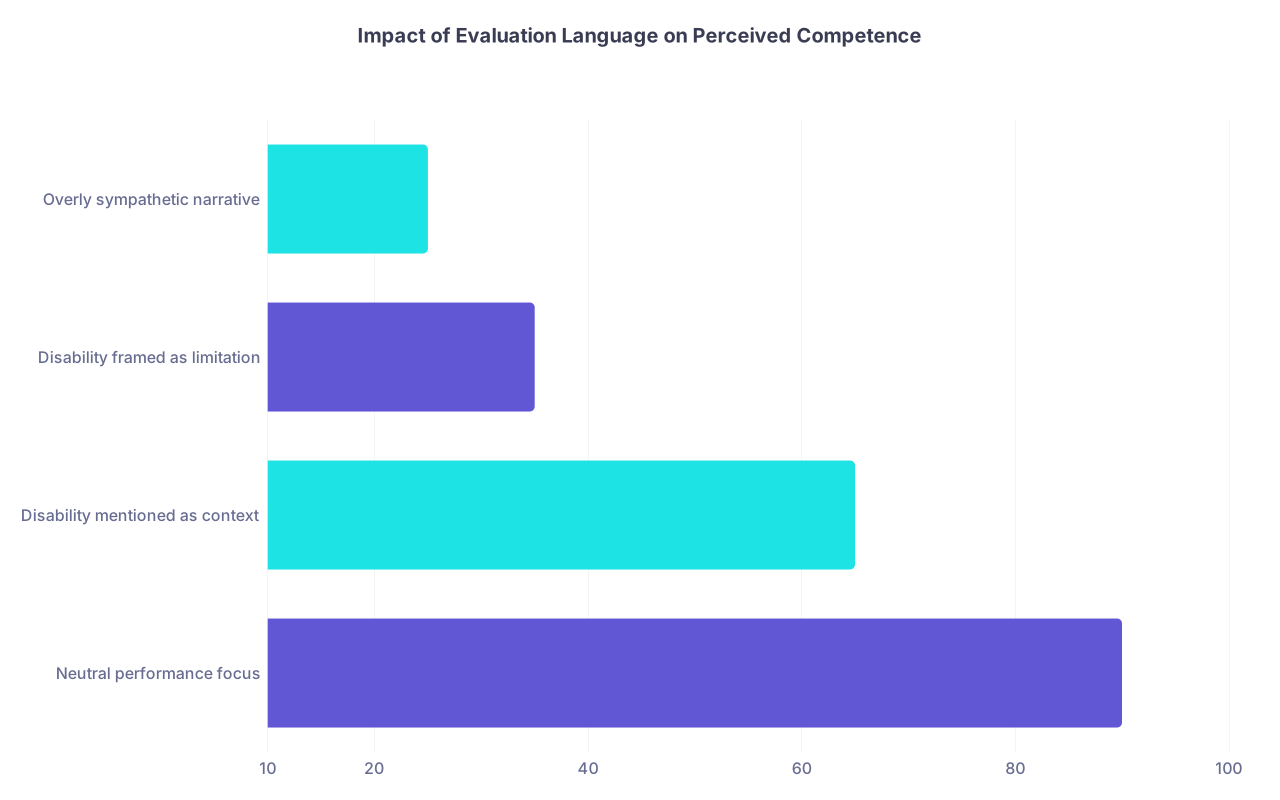
| Category | Value |
|---|---|
| Neutral performance focus | 90 |
| Disability mentioned as context | 65 |
| Disability framed as limitation | 35 |
| Overly sympathetic narrative | 25 |
The Future: Where This Is Actually Headed
Despite everything I’ve just laid out, the system is not static. There are three shifts happening that will change how expectations get adjusted for disabled trainees over the next decade.
1. Competency-Based Assessment With Real Outcomes
As more specialties move to granular, competency-based frameworks, the space for “vibes-based” downgrading or inflated sympathy passes shrinks.
When a program has to show, with data, that every graduate can:
- Recognize sepsis early
- Communicate critical results
- Manage common emergencies with a team
it becomes harder for a committee to say, “Well, we just like them, pass them,” or “We’re nervous, so fail them” without anchoring to explicit competencies.
For disabled trainees, this can be a blessing—if you hit the same outcome bars through different means.
2. Legal and Accreditation Pressure on Non-Discrimination
A few high-profile cases—especially involving disabled residents being dismissed or blocked from advancement—have already quietly scared some institutions. You won’t see public admissions, but inside, risk management is telling PDs:
- “Document actual performance, not your fears about liability.”
- “If you adjust expectations, justify it with job-essential criteria, not disability stereotypes.”
That pressure, ironically, can make programs both more conservative (fear-based gatekeeping) and more structured. But it does push them away from completely freeform, untracked “adjustments.”
3. Growing Critical Mass of Disabled Physicians
As more disabled trainees actually finish and become attendings, the conversation in evaluation rooms changes from hypothetical to concrete:
- “We have a faculty member with similar limitations who is an outstanding clinician.”
- “We know this role can be done safely with X modification; we’ve seen it.”
Once the archetype of “competent, disabled physician” is familiar, the default expectation that disability automatically equals lower ability starts to erode. Slowly, but it does.
We’re not there yet in most places. But I am starting to hear different language in some CCCs than I did ten years ago.

FAQs
1. Should I disclose my disability to evaluators, or will that just bias them?
If your disability will affect schedule, procedures, or visible behavior, hiding it usually backfires. Evaluators will notice differences and start making up explanations—often worse than the truth. Disclosure paired with formal accommodations gives you control over the narrative and anchors expectations to documented adjustments rather than vibes. What you do not need to do is overshare; focus on functional impact: “This is how it affects my work; these are the supports in place; these are the outcomes I can reliably deliver.”
2. How do I tell if someone has secretly lowered the bar for me?
Listen for phrases like “for you,” “given everything,” or “in your situation” attached to praise. Notice if you’re consistently shielded from challenging patients or procedures “to help you out.” If you’re passing rotations while feeling underused and under-challenged, that’s not always kindness—it may be quiet downgrading of expectations. Ask direct questions: “Compared to my peers at this stage, where am I objectively on target, ahead, or behind?”
3. Can I push back if I think expectations are being unfairly lowered or raised because of my disability?
Yes, and you should—but strategically. Align your pushback with the program’s own language: essential competencies, patient safety, accreditation requirements. “I want to make sure I’m meeting the same safety and reasoning standards as my peers; if my path there looks different, I’d like that documented clearly, not assumed as lower performance.” Bring in GME, disability services, or an ombudsperson if needed. Quiet, undocumented pushing-back in hallways rarely changes systemic patterns.
4. Will quiet adjustments in training follow me into my career after graduation?
They can. The residue shows up in letters, in the kinds of rotations you complete, and in what your PD is actually willing to say to fellowship directors or employers on the phone. If you were systematically shielded from high-acuity or procedural work, that narrative can limit your options later. Your job now is to be intentional: secure the experiences you need, insist on accurate language in evaluations, and choose advocates who will describe you as a competent physician who is disabled, not a “good try” trainee who slid by on sympathy.
Key points: Evaluators do quietly adjust expectations for disabled trainees—on speed, procedures, and call—often without ever telling you. Those adjustments can protect you or quietly cap you, depending on how they’re framed and documented. Your leverage lies in formal accommodations, outcome-focused conversations, and carefully chosen champions who refuse to confuse disability with diminished capability.