The steering is real. And often, it has nothing to do with your talent.
If you’re a trainee with a disability, chronic illness, neurodivergence, mental health condition, or even just a “non-standard” profile, there’s a game being played around you that nobody puts in writing. I’ve watched it in committee meetings, heard it in hallway conversations, and seen it shape entire careers.
You won’t find this in the GME handbook. But I’ll tell you how it actually works.
The Unspoken Formula: “Fit,” Risk, and the Hidden Gatekeepers
Program leadership almost never says, “We don’t want disabled trainees in this specialty.” They say:
- “I’m not sure this is the best fit for you.”
- “You might be happier in something with a bit more flexibility.”
- “This is a very physically demanding field, I just worry about your well-being.”
- “Have you thought about something like psych or peds instead?”
On paper, every specialty is theoretically open to you, as long as you can perform the essential functions with reasonable accommodation. In practice, there’s a quiet sorting mechanism, and it’s driven by three things:
Perceived liability and risk
Chairs and program directors ask themselves: “If something goes wrong, will we be blamed for having this resident in this role?” They’ll never say that out loud in front of you. They say it to each other.Service needs and workload
Some specialties survive by squeezing every ounce of labor from residents. Anything that hints at reduced workload, protected time, or accommodation gets viewed as a threat to service coverage.Cultural mythology of the specialty
Every field has a mythology. “Surgery is for warriors.” “Emergency med is for adrenaline junkies.” “Anesthesia is for calm, unflappable machines.” If your disability conflicts with the myth, you get steered. Sometimes aggressively. Sometimes with a smile.
The upshot: people are not just asking, “Can you do the job?” They’re asking, “Will you disrupt the way we’re used to doing things?”
That’s where the steering starts.
Where Steering Shows Up: The Patterns You Don’t See at First
You rarely see this as one dramatic moment. It’s a slow accumulation of nudges.
The “Concerned Mentor” Conversations
You disclose a mobility limitation, ADHD, hearing loss, bipolar disorder, chronic pain, visual impairment, or epilepsy. Or maybe you don’t disclose, but someone has guessed from your notes, your absences, or your med list.
Then it starts:
- An attending pulls you aside: “I just want to make sure you’re thinking long-term. Ortho is very physical.”
- A clerkship director: “You know, anesthesia is a lot of vigilance and long cases. That could be really exhausting with your condition.”
- A faculty mentor: “Radiology could give you more control over your schedule. Maybe look at that?”
On the surface it sounds like caring advice. The problem is not that they mention these realities. The problem is they rarely present it as options you can weigh. They present it as a conclusion they’ve quietly reached for you.
Behind closed doors, I’ve heard versions like:
“I don’t want to encourage her toward neurosurgery. The call alone would wreck her.” “He has significant ADHD; I think something more outpatient, more structured, less chaos. Let’s not push EM.” “With that visual field defect, we’d be exposed if something happened in the OR.”
Nobody is asking you what you’re actually willing to accommodate in your own life.
Away Rotations and Letters: The Quiet Gatekeeping
Another place steering happens: who gets opportunities.
- The student with well-controlled epilepsy is subtly discouraged from trauma-heavy away rotations: “Maybe do a more general surgery elective instead.”
- The resident with chronic back pain is diverted from the hardest MICU month: “We thought this clinic elective would be a better educational fit.”
- The neurology-bound student with mobility aids is told, “We couldn’t find a slot for that interventional rotation, but here’s another general consult month.”
Then the letters follow the pattern:
- “Excellent candidate for internal medicine or other cognitive fields.”
- “I see them thriving in outpatient-oriented specialties.”
That language is not accidental. Faculty write in code to signal to programs what they think you can and cannot handle.
Admissions and Rank Meetings: What Really Gets Said
You want truth? Here’s truth. I’ve sat in those rooms.
A candidate discloses a disability in their personal statement or it’s evident from their file, and discussion goes like this:
“Strong applicant, but I’m worried about physical demands of our surgical program.”
“We’re already stretched thin with coverage. If they need accommodations, how will we manage call?”
“We’ve had issues before that turned into legal headaches. I don’t want to repeat that.”
“Could be a great psychiatrist.” (said about a candidate who applied to anesthesiology)
Notice the pivot: they don’t question the candidate’s intellect. They redirect them mentally to “lower risk” specialties. Psychiatry, pathology, radiology, maybe family med, maybe PM&R. Fields perceived as more “accommodatable.”
This is not always malicious. Often it’s risk-avoidance and institutional self-protection disguised as career guidance.
But from your side of the table, it feels like: “You’re just not cut out for this.”
Why Certain Specialties Trigger More Steering
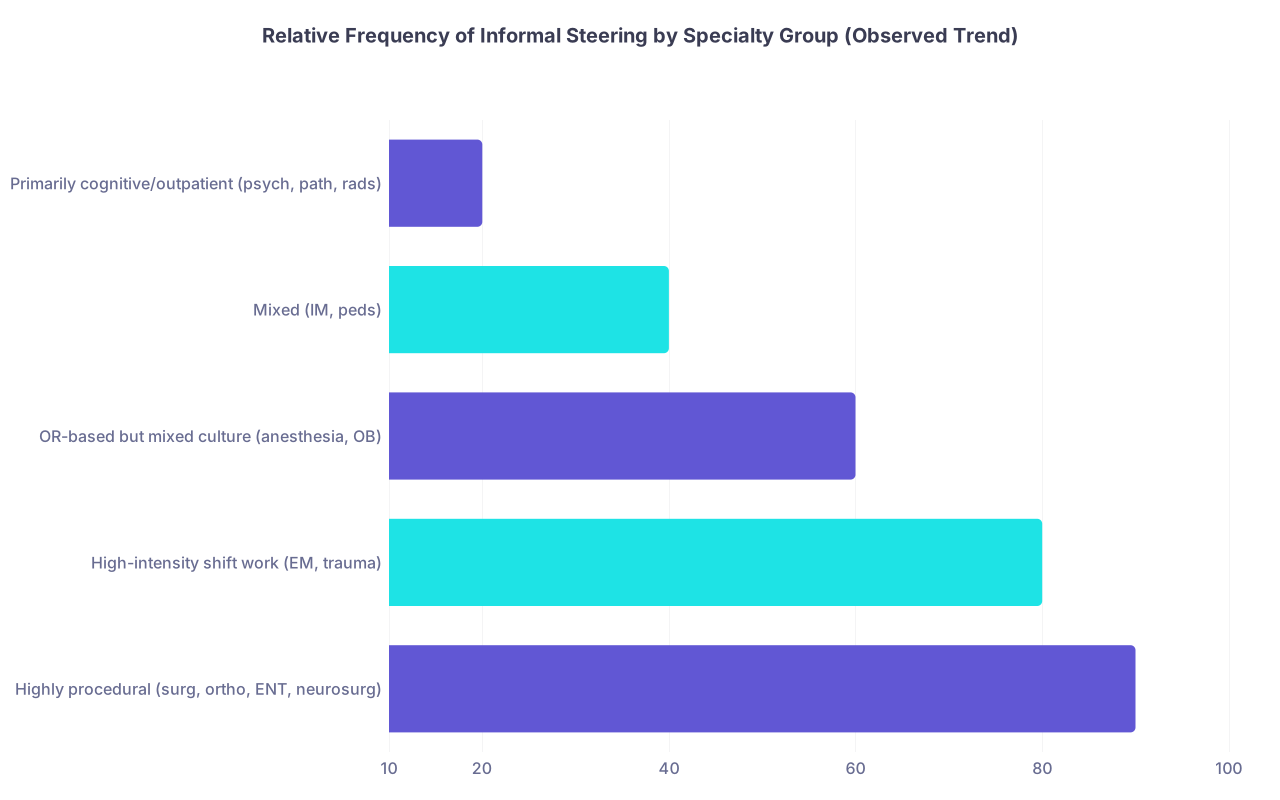
Some fields light up every fear a program director has about disability and accommodation. Those are the ones where the steering is strongest.
| Category | Value |
|---|---|
| Highly procedural (surg, ortho, ENT, neurosurg) | 90 |
| High-intensity shift work (EM, trauma) | 80 |
| OR-based but mixed culture (anesthesia, OB) | 60 |
| Mixed (IM, peds) | 40 |
| Primarily cognitive/outpatient (psych, path, rads) | 20 |
These numbers aren’t from an official study. They reflect what many of us have watched play out for years.
High-Intensity Procedural Fields
Surgery, orthopedics, neurosurgery, ENT, CT surgery. These are the worst offenders.
Reasons they use (again, rarely written anywhere):
- Long cases standing in lead, in one position, sometimes for 8–12 hours.
- Heavy call with brutal hours.
- Culture that glorifies suffering and stoicism.
- Massive service burden; residents are the workforce.
If you have a physical disability, chronic pain, mobility limitation, or a condition that introduces any risk of acute impairment (e.g., seizures, severe migraines, brittle diabetes), this group is where you’ll feel the strongest “Are you sure?” pressure.
What actually happens:
- You’re “advised” to try a rotation in a more cognitive field “just to compare.”
- You get glowing feedback clinically, but the letter carefully phrases your fit as “cognitively strong, excellent for medicine or neurology” while barely endorsing surgery.
- Someone tells you, “You’re talented enough to do surgery, but I worry about the longevity of your career.” That’s often the kiss of death for your confidence.
Emergency Medicine and High-Shift-Load Specialties
Emergency medicine, some ICU-heavy tracks, maybe trauma-focused surgical residencies.
Concerns discussed behind the scenes:
- Unpredictable schedule that wrecks sleep and exacerbates many chronic conditions.
- Sensory overload (lights, noise, chaos) that can be rough for neurodivergent or certain mental health conditions.
- High baseline risk environment; leadership is anxious about “anything that might compromise split-second judgment.”
A trainee with bipolar disorder, PTSD, severe anxiety, or sensory processing differences may be gently “guided” toward fields seen as more controlled or slower-paced.
What this looks like in real life:
- EM attendings praising your performance then saying, “I’m not sure the lifestyle is compatible with your health needs.”
- You asking about EM, and an advisor responds with, “Have you thought about psych? You’re so good with patients’ stories.”
You’re not misreading the subtext.
Anesthesia, OB, and the “Vigilance” Argument
Anesthesiology and obstetrics hold a weird middle ground. Both are highly procedural, high-risk fields, but their cultures vary more by institution.
Steering here often uses language like:
- “Continuous vigilance.”
- “High stakes, rapid decompensation.”
- “Unforgiving environment.”
Trauma history, certain mental health conditions, some neurocognitive disabilities, and even mild visual or hearing impairment can trigger a wave of “concern.”
Is every concern illegitimate? No. But the problem is leadership frequently assumes:
- “This disability = unsafe in these specialties”
instead of:
- “Let’s figure out if this can be safely accommodated.”
That leap is where bias lives.
Cognitive and Outpatient Fields: The Default Dumping Ground
Psychiatry, pathology, radiology, sometimes neurology or outpatient internal medicine become the “safe” recommendations.
I’ve heard this verbatim more than once:
“They’re very bright, but with their condition, I’d push them toward something like psych or path. Lower risk.”
It’s lazy reasoning. And it’s how entire specialties end up disproportionately populated with trainees who were pushed there, not just those who actively wanted to be there.
Again: not wrong to suggest these fields. But it becomes wrong when it stops being mentorship and becomes quiet triage.
How “Accommodation” Gets Weaponized Against You
Here’s the part nobody talks about: once you need accommodations, some people mentally move you into the “problem” category. Even if your performance is strong.
The Essential Functions Shield
Program leadership leans hard on “essential functions.” On paper, that’s legitimate—every job has core tasks. In practice, I’ve seen it misused:
- “Standing for long periods is an essential function of surgery.”
- “Full overnight call without limitation is an essential function of this residency.”
- “Ability to respond to trauma stat pages instantly from anywhere in the hospital is essential.”
Are those always genuinely essential? Sometimes, yes. Sometimes, they’re just the way things have always been structured around resident labor.
If you ask questions like:
- “Can I get a stool for long cases?”
- “Can we adjust call frequency?”
- “Can I have extra time for documentation due to processing differences?”
You trigger a chain reaction:
“If we do it for them, what about everyone else?”
“We don’t have excess residents to cover.”
“Our ACGME case logs depend on full resident participation.”
So instead of redesigning the system, they quietly try to redesign your career plan.
The “We Just Want You to Succeed” Line
You will hear this. Sometimes from people who genuinely mean well, sometimes from people who are protecting the system, not you.
Translation often is:
- “We don’t want to figure out how to accommodate you in this specialty.”
- “We are scared of a lawsuit if something goes wrong here.”
- “We don’t want to carry the burden of structural change.”
So they reposition:
“I just see you thriving more in [less pressured specialty].”
If you’re sick, exhausted, and insecure, that may sound comforting. Sometimes it actually is wise advice. But you should know what’s underneath it before you accept it wholesale.
The Future: Where This Is Actually Heading (Slowly)
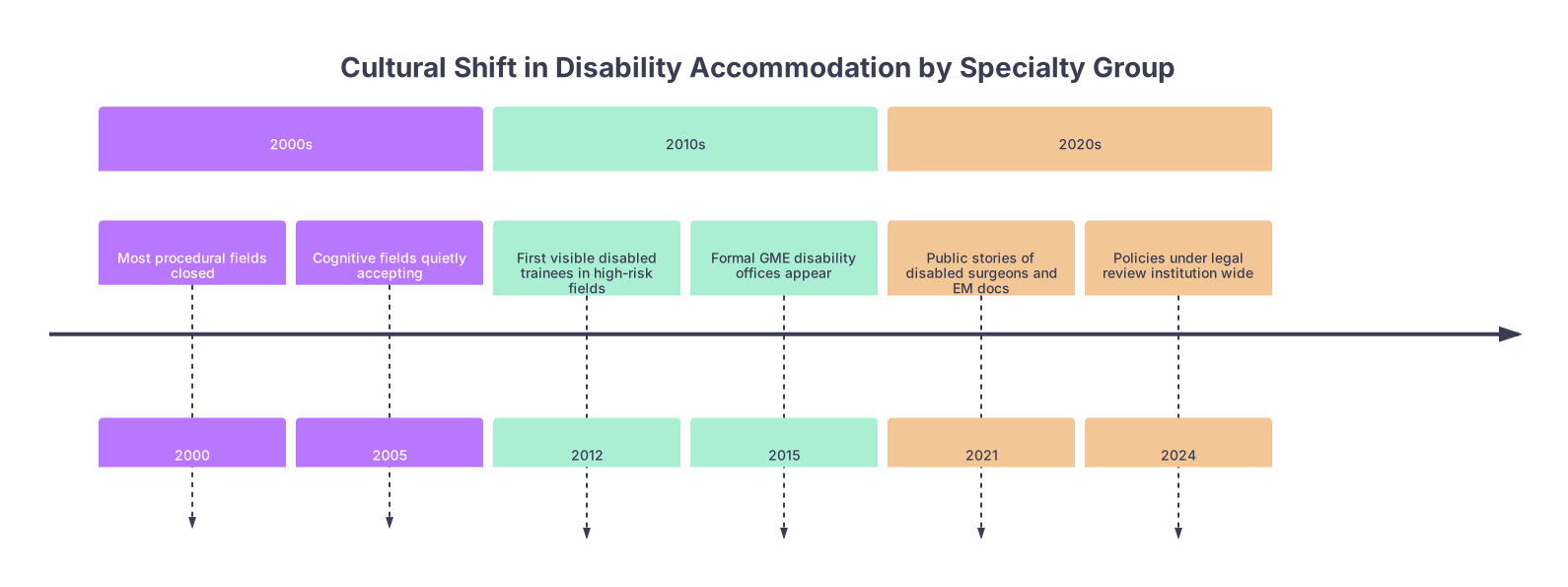
Here’s the good news: the old way is cracking. Not gone. But cracking.
Litigation, Public Scrutiny, and Changing Expectations
Hospitals have been sued. Residencies have been sued. Some have quietly settled, others have made headlines. Academic medicine hates public embarrassment.
Result: more programs are consulting legal and disability offices earlier. More chairs are being told, “No, you cannot just avoid accommodating by steering someone out of that field.”
You see:
- Formal disability offices tied into GME and UME.
- Written policies (finally) on accommodations during clinicals and residency.
- A few brave trainees publicly discussing being deaf surgeons, blind psychiatrists, autistic pediatricians, physicians with MS, chronic pain, or mental illness.
That visibility forces a rewrite of what’s “essential” and what’s just tradition.
Fields That Are Actually Getting Better
Surgery and EM are slower, but even there, change is happening—mostly at big academic centers with institutional pressure and money.
I’ve watched:
- Residents with mobility aids continue in surgical programs with modified OR setups.
- Trainees with ADHD or autism-spectrum traits thrive in EM with structured workflows and tech supports.
- Anesthesia departments hire physicians who use adaptive devices for visual limitations.
None of this is widespread yet. But the myth that “you simply cannot do X specialty if you have Y condition” is being challenged, one uncomfortable case at a time.
| Period | Event |
|---|---|
| 2000s - Most procedural fields closed | 2000 |
| 2000s - Cognitive fields quietly accepting | 2005 |
| 2010s - First visible disabled trainees in high-risk fields | 2012 |
| 2010s - Formal GME disability offices appear | 2015 |
| 2020s - Public stories of disabled surgeons and EM docs | 2021 |
| 2020s - Policies under legal review institution wide | 2024 |
The direction is clear. The pace is frustrating.
How to Protect Yourself Without Burning Bridges
You can’t single‑handedly fix GME culture. But you can stop being an easy target for quiet steering.
Know Your Own Non-Negotiables Before You Listen to Anyone
Most trainees walk into these conversations reactive. They get told “You can’t do X,” and then start defending themselves from a weak position.
Instead, you need a clear internal map:
- What are your actual physical and cognitive limits?
- What accommodations have already proven effective for you?
- What tradeoffs are you realistically willing to accept—for years?
If you walk into mentorship already knowing, “I can stand for 4 hours, not 10. I can work nights but not 5 in a row. I need predictable breaks to manage my condition,” you’ll hear their “concerns” very differently. You’ll know what is realistically impossible vs. what’s just their fear.
Separate Three Questions Other People Muddle Together
Whenever someone suggests steering you, mentally break it apart:
Technical safety:
“Is there a genuine, well-defined safety risk even with accommodation?”System rigidity:
“Is the system just built in a way that makes accommodation hard but not impossible?”Cultural bias:
“Would this be seen differently if an able-bodied trainee asked for the same thing (e.g., parental leave, schedule adjustment)?”
Most pushback you’ll get is a messy blend of all three. Your job is to not internalize it as “I am incapable,” when often the real translation is “Our system is unwilling to flex.”
Document, Don’t Just Talk
You’re playing in a world where memories get convenient.
If you:
- Disclose a disability
- Request an accommodation
- Receive “guidance” steering you away from a field
Put key points in email. Calm, professional, no drama. Example:
“Thanks for meeting with me today about career planning in anesthesiology. As we discussed, with my XYZ condition, I’ve successfully completed [rotations/tasks] with the following strategies: [brief list]. I understand your concerns about [summarize their point]. I’d like to continue exploring whether this specialty is feasible for me with reasonable accommodations, ideally in collaboration with the disability office.”
Now you’ve anchored the conversation. If someone later claims, “We just thought you weren’t interested,” you have a paper trail.
Use the Right Allies
This part matters: your specialty mentor and your disability advocate are often not the same person.
- Your favorite attending may love you but be terrible at understanding disability law.
- Your disability office may understand the law but not the real culture of your specialty.
You need both perspectives. And sometimes, you deliberately keep them separate.
What I’ve seen work best:
- Quietly consult disability services early to map what’s legally reasonable.
- Separately, find at least one mentor in the specialty who is known to not be a dinosaur about wellness and equity.
- When you’re ready, triangulate. Bring data from one conversation into the other, without overexposing yourself.
The Hard Truth: Sometimes the Steering Is Right
Let me be blunt. Not all steering is discrimination. Sometimes, it’s realism you don’t want to hear.
There are scenarios where, even with accommodation, certain specialties are a terrible fit for your specific situation. Or dangerous for patients. Or destructive to your health.
The problem is that programs currently operate like this:
- Overestimate risk in many borderline cases.
- Underestimate their responsibility to adapt.
- Over-personalize systemic failures as your individual “unsuitability.”
Your job is not to prove you can do anything. Your job is to build a life and career that is sustainable and aligned with who you are—including your disability, not pretending it doesn’t exist.
Sometimes that means pushing back against lazy steering and saying, “Actually, I can do this with X, Y, Z modifications.”
Sometimes it means looking at the brutal reality of call schedules, physical demands, or cognitive load and saying, “They’re right. I’d burn out or break down. I’m choosing something else on purpose.”
The power shift happens when it’s your decision, not their quiet disposal.
| Your Profile / Disclosure | What You Hear From Faculty | What They Are Often Thinking |
|---|---|---|
| Mobility limitation, chronic pain | "Have you thought about something more outpatient?" | "We don't want to re-engineer our OR workflow." |
| Epilepsy, migraines, diabetes with complications | "High-stress fields may not be ideal long term." | "We fear an event on call and legal exposure." |
| ADHD, autism, learning differences | "You'd shine in cognitive specialties." | "Our chaotic system is not built to support you." |
| Significant mental health history | "Lifestyle-friendly fields might be wiser." | "We are scared of crisis on our rotations." |
FAQ (4 Questions)
1. Should I disclose my disability when applying to competitive specialties?
There’s no universal answer. If your disability requires visible or structural accommodations that will be obvious on rotations or during training, controlled disclosure framed around your strengths and problem‑solving can preempt rumor and bias. If your condition is well controlled, invisible, and doesn’t require major structural changes, many trainees choose not to disclose during the application phase and instead engage disability services once matched. The key is being strategic, not reactive: understand both the legal protections and the cultural costs in your specific specialty.
2. How do I tell whether a mentor’s steering is genuinely protective or biased?
Watch their reasoning and their flexibility. If they can articulate concrete, specialty‑specific risks, are open to brainstorming accommodations, and still leave the final decision to you, that’s usually protective. If they default to vague “fit,” suggest the same two “safer” specialties to everyone with a health condition, and get defensive when you ask about accommodations, you’re looking at bias and system‑protection, not mentorship.
3. What if I suspect I was ranked lower or not interviewed because of my disability?
You’ll almost never get hard proof; programs are careful about what they write. What you can do is: keep copies of all disclosures and correspondence, consult your school’s disability office and legal counsel if something is egregious (e.g., explicit comments about your disability), and document patterns. Some cases genuinely rise to the level of discrimination complaints; many sit in a gray, hard‑to‑prove zone. Even then, pressure from institutions and GME offices over time is shifting behavior, especially when patterns get documented across multiple trainees.
4. Is it realistic to push into a highly procedural or high‑risk specialty with a significant disability?
Sometimes, yes. I’ve seen it done. But it requires brutal honesty about your own limits, a program leadership that isn’t stuck in 1980, and often a large academic center with infrastructure to support accommodations. You need to be prepared for extra scrutiny, slower culture, and the possibility that you’ll be the first one they’ve ever tried this with. If you choose that route, do it with open eyes, strong documentation, and clear backup plans—not because you’re trying to “prove them wrong,” but because the work itself is worth that fight to you.
Three things to remember:
- Steering happens; it is often about system fear, not your ability.
- Not all steering is wrong—your health and safety are real constraints.
- The power move is to understand the game, get the right allies, and make the final decision yours, not quietly made for you.