
The way promotion boards actually treat residents on long‑term restrictions is not what your GME handbook suggests. It’s more political, more inconsistent, and more dependent on one or two key people than anyone will admit publicly.
I’ve sat in those rooms. I’ve watched residents with significant restrictions get quietly protected and moved forward, and I’ve watched others—often just as capable—get ground down over years and then “non‑renewed” with a paragraph of sanitized legal language. The difference wasn’t their diagnosis. It was how the program viewed them, documented them, and planned around them.
Let me walk you through how it really works.
What “Long‑Term Restrictions” Signal To The Committee
When your file hits the promotion board and there’s a clear, ongoing restriction—reduced hours, no nights, no in‑house call, procedural limits, or extended leave—the board is not just asking, “Can we accommodate this?”
They’re asking four very specific questions:
- Does this person create work or solve work?
- Can we legally justify not promoting them?
- Is the PD willing to go to the mat for them?
- Are we setting a precedent we’ll regret?
Publicly, it’s all about “supporting trainees” and “upholding essential job functions.” In the closed‑door conversation, what I’ve heard over and over sounds more like:
- “Are we getting enough out of this resident to call them competent?”
- “Do we want three more residents asking for the same deal next year?”
- “If something goes wrong post‑graduation, will this come back to us?”
Long‑term restrictions are not just about logistics. They’re a signal. And how that signal is interpreted depends heavily on the culture of your program and—even more—on your program director.
The Three Types of Program Directors You’re Up Against
You’re not dealing with “the institution” in some abstract sense. You’re dealing with a PD archetype. I’ve seen three broad patterns.
| PD Type | Default View of Long-Term Restrictions | Typical Outcome |
|---|---|---|
| The Protector | Challenge to solve | Find a path to promote |
| The Gatekeeper | Risk to reputation | Delay, extend, or exit |
| The Politician | Variable, depends on optics | Case-by-case, often inconsistent |
1. The Protector
These PDs actually believe in accommodation. Not just legally, but philosophically. They’ll say in the meeting:
“We owe it to them; they’ve done everything we’ve asked inside their limits.”
They work backward: “Given these restrictions, what rotations, evaluations, and documentation do we need to promote them safely and defendably?” They pressure faculty to write detailed feedback. They negotiate with the DIO for schedule flexibility. They’re not common, but they exist—often in pediatrics, psych, FM, and some IM programs.
If you’re under one of these PDs, long‑term restrictions are survivable if you remain reliable inside your modified scope. They’ll sell the board on “meeting essential functions via alternative structure.”
2. The Gatekeeper
These are the “standard is the standard” people. Very big on “optics,” “patient safety,” and “what if they’re the only doctor in a rural ED?” You’ll hear things like:
“I’m not comfortable signing off on graduation if they’ve never done nights in the ICU.”
They frame their resistance as ethics and safety, but watch what they actually do. They let remediation linger. They keep extending your training “for more time to demonstrate performance.” They’re not eager to dismiss you right away—they know that’s a legal landmine—but they’ll slow‑roll your promotion until the picture looks untenable.
If you’re in their program with major long‑term restrictions, the default trajectory is: extended training → “continued concerns” → “program not renewed.”
3. The Politician
This PD tracks where the winds are blowing: the DIO, the CMO, legal, and the ACGME climate. Publicly supportive, privately calculating. They say things like:
“We need to be thoughtful about precedent, but we also need to demonstrate we support our residents.”
They’re heavily influenced by: how strong your evaluations are, whether you cause problems, and whether your case has visibility (for example, you’ve involved HR, disability office, or legal). With them, documentation and allies matter a lot more than diagnoses.
They’ll use the promotion board as cover: “The committee had concerns,” even if those concerns were outlined by one very vocal attending.
What Actually Gets Brought Up In The Room
Let me strip away the language and tell you what I’ve actually heard in promotion meetings about residents on long‑term restrictions.
1. “Are they pulling their weight?”
Not in some idealized sense. In the gut sense.
- Do the chiefs complain they have to constantly rearrange schedules to work around you?
- Do co‑residents feel resentful that they’re taking your nights/procedures?
- Are attendings rewriting your notes or finishing your work?
If the answer is “yes” to more than one of these, that negative narrative will walk into the room before your actual evaluations do.
I’ve seen residents with 50–60% FTE restrictions promoted because inside that 50% they were laser‑reliable and valuable. I’ve also seen full‑time residents on relatively minor restrictions (no nights) get crushed because they were seen as chronically “less useful.”
2. “Is there a clear end point?”
Programs love timelines. “This restriction for 6 months” feels very different to them than “ongoing, indefinite restriction.” The former triggers: “Let’s bridge this year and reassess.” The latter triggers: “So… is this now permanent? Can we say they meet the same training standards?”
Even though disability law doesn’t require that your condition have an endpoint, committees mentally divide you into two buckets:
- Temporary modification to preserve a fundamentally standard trainee.
- Permanently different trainee they’re about to certify as “equivalent” to everyone else.
The second bucket gets dissected much more aggressively.
3. “Do we have a paper trail that defends this decision?”
This is where program directors, APDs, and core faculty quietly panic.
They look at:
- Milestone evaluations – Are there concerning “not achieved” boxes, especially in patient care, professionalism, and systems‑based practice?
- Narrative comments – Do evaluations mention “needs a lot of support,” “limited exposure to X,” or “performance constrained by schedule/availability”?
- Previous letters – Any prior documentation about remediation, concerns, “fitness for duty,” or “communication challenges”?
If they’re going to promote you with long‑term restrictions, they want the record to say:
- You met the competencies within your accommodated structure.
- Any deficits were addressed and are now stable/improved.
- Your current performance is not “borderline”; it’s solid.
When that’s not there? The board gets spooked.
The Unspoken Calculation: Risk vs Replacement
There’s another layer almost nobody tells you: cost and replaceability.
At the promotion board, someone—often the PD or DIO—is thinking:
- What’s the risk if we promote them and something goes wrong later?
- What’s the risk if we do not promote and they challenge it (EEOC, OCR, lawsuits, bad press)?
- How hard will it be to fill their spot if we extend or non‑renew?
- How much disruption will we create by reworking call/schedule for another year?
If you’re in a competitive specialty with tight call coverage (surgery, OB/GYN, EM), long‑term restrictions are a bigger logistical headache and a bigger political fight. In more flexible fields (psych, pathology, outpatient‑heavy FM), schedules and workflows bend more easily.
I’ve heard explicit comments like:
“If we extend them, we’re eating an FTE that isn’t working nights or ICU. That’s going to land on the rest of the class.”
And on the flip side:
“If we push them out now, this is going to be a story. And not a good one.”
Your leverage, frankly, increases if:
- Your condition and accommodations are clearly documented and handled through official disability channels, not just handshake deals.
- You’ve already involved institutional mechanisms (disability office, HR, sometimes even an attorney in the background).
- You’ve been high‑functioning and professional within your limits, with strong written support from some faculty.
Then non‑promotion becomes high‑risk for them, not just for you.
How “Essential Functions” Really Get Twisted
You’ll hear a lot about “essential job functions.” That term gets weaponized.
What’s supposed to happen:
The institution identifies actual essential functions of a resident physician role—things that truly cannot be removed without changing the nature of the position. You then assess whether your restrictions still allow those with reasonable accommodations.
What really happens in promotion conversations:
- Nights get called “essential” even in programs where attendings do most of the heavy clinical lifting overnight.
- Certain procedures get labeled “essential” even if community practice patterns vary widely.
- “Full call rotation participation” gets treated as essential, when in reality, post‑grad practice options can be tailored to limitations.
Programs stretch “essential” to include “things we’ve always done” or “things the other residents do.” They’re defending the tradition of training, not strictly the essential functions of the job.
I’ve watched attendings argue a resident must do 24‑hour in‑house OB call to be safe to practice… yet half the graduates go into outpatient gyn or hospitalist work and never touch L&D outside residency. This is not purely about safety. It’s about culture and identity.
What Strengthens Your Position Before The Board Ever Meets
You cannot control the personalities in that room, but you can change what they have to work with. Residents who survive and advance with long‑term restrictions usually have several things in common.
1. Early, formal involvement of the right offices
The worst pattern I see: “We just worked it out informally with my chief and APD.”
That works—until it doesn’t. Then there’s no formal record of disability, no properly documented restrictions, and the promotion board treats all your reduced exposure as under‑performance, not as accommodated training.
The residents who are hardest to push out:
- Have documented disabilities/restrictions through the institution’s disability or ADA office.
- Have clear written accommodation letters that specify limits (for example, “no more than 16 continuous hours,” “no in‑house call,” “primarily outpatient rotations”).
- Have updated letters when things change.
Then, when someone at the board says, “They haven’t done X,” the pushback is: “Yes, because we formally agreed they wouldn’t, and we structured their education accordingly.”
2. Deliberate rotation choices that build a coherent story
If you’re on long‑term restrictions and just hoping the normal rotation schedule will somehow work out in your favor, you’re gambling.
The residents who get through often:
- Load up on rotations where their limitations are least visible and their strengths shine.
- Get strong champions in those areas: attendings who will say, “I don’t care that they didn’t do nights; in clinic and on day wards they are absolutely safe and ready.”
- Avoid repeated experiences in environments that show off their vulnerabilities (for example, if nights trigger your condition and you’re a wreck next morning, you don’t need multiple attendings observing you at your worst).
This isn’t “gaming the system.” This is survival in a system that’s already not neutral.
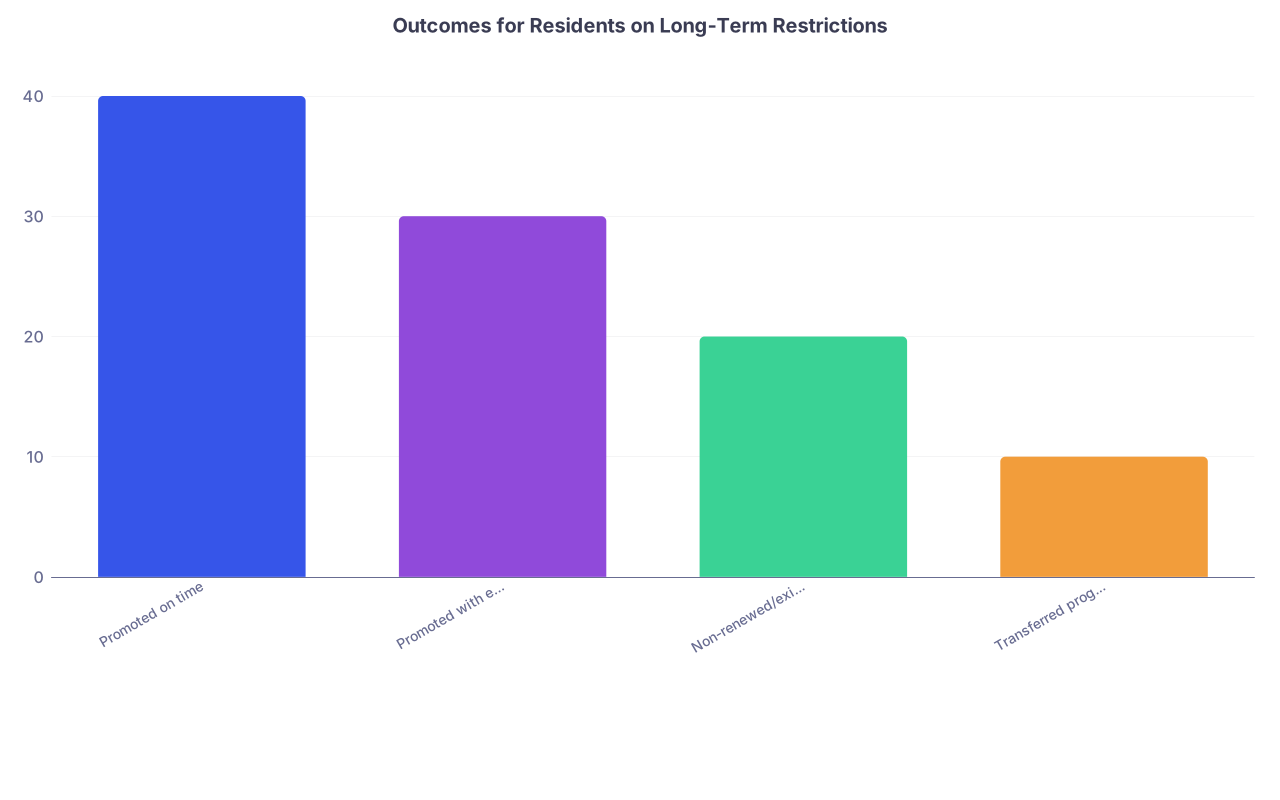
| Category | Value |
|---|---|
| Promoted on time | 40 |
| Promoted with extension | 30 |
| Non-renewed/exited | 20 |
| Transferred programs | 10 |
(I’m not giving you real data here; none of this is systematically studied in a transparent way. But if you informally survey PDs off the record, this rough distribution will not surprise them.)
How The Meeting Actually Plays Out
Let me walk you through a fairly typical scenario.
You’re a PGY‑2 internal medicine resident with:
- Documented chronic health condition.
- Long‑term restriction: no nights, max 60‑hour weeks, emphasis on outpatient and day‑float.
- Solid but not stellar evaluations. Some comments about “limited ICU exposure,” “has not done traditional ward nights.”
At the spring promotions meeting:
The coordinator projects your milestones. A few “meets level,” maybe one or two “somewhat below” in acute care.
PD opens:
“We need to discuss Dr. X. They’ve been on modified schedule due to documented health condition. Overall, faculty feel they’re safe and effective in their current role. We need to decide if they progress to PGY‑3.”One core faculty says:
“I’m comfortable with them on days. They’re thoughtful, they own their patients. I have no concerns about outpatient or daytime hospitalist work.”Another says:
“But they’ve essentially never done nights on wards or ICU. We all know that’s where you really see who can handle acute decompensations.”Someone (often the PD or APD who’s been closest to you) reframes:
“Remember, the accommodation is formal. We adjusted their experiences with that understanding. The question is: have they met the competencies for practice in settings consistent with that?”Someone raises risk:
“What if they take a job where nights or ICU are required? Are we on the hook if something happens?”Legal/HR/GME (if present) redirect:
“We do not credential them for specific jobs. We certify they completed residency under accredited standards. They and their future employer decide fit.”They look at your narrative comments. If they see words like “reliable,” “excellent communicator,” “safe,” “thorough,” and no major professionalism flags, that goes a long way.
If the advocates in the room are strong and the documentation supports them, you get promoted. If the skeptics dominate, you get the classic: “We’re recommending an additional period of training with focus on X and Y.”
And everyone will tell you this extension is “for your benefit.” It might partly be. It’s also because the board is uncomfortable signing off and wants more cover.
Where Things Go Bad: Common Triggers For Non‑Renewal
Long‑term restrictions alone are rarely the explicit reason residents are not promoted. Programs are smarter than that now. What happens instead is clustering.
Here’s the pattern I’ve seen over and over:
- You have a documented restriction.
- Coverage gets tight; resentment builds quietly among co‑residents.
- Attendings start framing normal errors through a different lens: “Given their limitations, I’m concerned they may not be safe in a less supported environment.”
- Small professionalism issues—late notes, missed emails, occasional grumpiness—get magnified into “pattern of unprofessional behavior.”
- Suddenly your file has multiple domains: clinical performance, professionalism, “fitness for duty,” “communication.”
When your name comes up, people don’t say, “This is about disability.” They say, “This is about global performance and professionalism.”
That’s how residents with legitimate disabilities end up out of training with letters that never once use the word “disability,” but everyone in the building knows that was the gravitational center of the whole process.

| Step | Description |
|---|---|
| Step 1 | Resident with long-term restrictions |
| Step 2 | Structured accommodations and advocates |
| Step 3 | Extended training and escalating concerns |
| Step 4 | Outcome depends on documentation and optics |
| Step 5 | Promoted |
| Step 6 | Extended |
| Step 7 | Non-renewal or exit |
| Step 8 | PD stance |
| Step 9 | Board review |
How To Quietly Shift The Odds In Your Favor
Let me be blunt. You cannot make yourself “risk‑free” to a promotion board. But you can make yourself much harder to dismiss and much easier to support.
Here’s what actually moves the needle behind closed doors:
- A PD who can say, credibly: “Within their restrictions, they’re one of our stronger residents. I would let them care for my family.”
- At least two faculty willing to go on record with concrete examples of your competence.
- A clean professionalism record in the 12 months leading up to the decision. Not perfect, but clean—no recent formal write‑ups.
- Clear, consistent documentation of your limitations and accommodations, routed through official channels, not just informal agreements.
- Your own behavior: responsive, prepared, reliable, and—this matters more than it should—non‑combative, even when you disagree.
The residents who get completely screwed tend to be those who:
- Rely entirely on informal, verbal understanding with chiefs or a sympathetic APD.
- Assume everyone in the room understands disability law and will “do the right thing.”
- Let frustration bleed into their daily interactions, feeding a “difficult” or “angry” narrative.
- Never ask to see (or correct) written remediation documentation or milestone summaries.
A Glimpse At The Future: Where This Is Actually Headed
The future is not more lenient. It’s more structured and more documented.
Several trends are already showing up in the background chatter among PDs, DIOs, and legal:
More programs are developing written “essential functions” lists for residents, sometimes overly broad, specifically so they have a defensible framework for saying yes or no to accommodations and promotions.
GME offices are pushing PDs to get much better at written narrative evaluation, precisely because they need to support promotion or non‑renewal decisions when disability is part of the picture.
Some specialties are quietly accepting that not all graduates will be all‑settings‑ready. You’ll see more structured “tracks” that legitimately support residents into niche or outpatient‑heavy roles. That gives them cover to promote someone who never did standard ICU nights.
Residents are increasingly coming in more informed about ADA, OCR, and legal protections. The days of “we just pushed them out quietly” are fading. Programs are now aware: a poorly handled disability case can destroy their reputation for years.
In other words, this whole messy area is moving from vibe‑based to paper‑based. That’s actually good for you—if you understand how the game is being played and position yourself accordingly.
FAQs
1. Can a program legally refuse to promote me solely because I’m on long‑term restrictions?
They won’t frame it that way, and they know better than to write that down. Legally, they’re supposed to evaluate whether you can perform the essential functions of the resident role with reasonable accommodation. In practice, if they deny promotion, the documented reason will be “failure to meet performance standards,” not “disability” or “restrictions.” That’s why your entire documented performance record matters so much.
2. Should I involve the disability office or ADA coordinator, or will that just make things worse?
If you are on anything more than a brief, informal adjustment, you absolutely should involve them. PDs and chiefs change; verbal deals evaporate. Formal accommodations protect you by creating an institutional record that these limits are recognized and agreed upon, which the promotion board then has to respect. Programs are far more cautious about pushing out a resident whose disability and restrictions are formally documented.
3. Do I have to disclose my exact diagnosis to the promotion board?
Generally, no. The disability process typically separates diagnosis from functional limitations. The board usually sees your restrictions (“no nights,” “reduced FTE,” “primarily outpatient”) and the resulting schedule, not your specific diagnosis. Some PDs will know more details, but the official conversation is supposed to center on function and performance, not labels.
4. Is asking for long‑term call or schedule restrictions basically career suicide for competitive specialties?
It definitely makes life harder in call‑heavy fields like surgery, OB/GYN, EM, and some ICU‑driven programs. But “career suicide” is too strong. If you’re high‑performing, your PD is supportive, and the accommodations are formally structured, I’ve seen residents complete training and land reasonable jobs—even if they never did traditional call. The key is aligning future practice with your limitations and getting strong letters from people who’ve seen you at your best.
5. If my promotion is delayed because of my restrictions, should I fight it or accept an extra year?
It depends on the paper trail. If your evaluations are generally positive, your accommodations are formal, and the extension feels like vague discomfort rather than documented deficits, it’s worth at least consulting with the disability office or an attorney before signing anything. If there are clearly documented, specific performance gaps you also recognize, an extra structured year can be genuinely protective. What you should not do is sign off on an extension with ambiguous language you don’t understand; ask to see the written rationale and how success will be defined.
Bottom line: Promotion boards don’t judge you just on your diagnosis or your restrictions. They judge the story your file tells: performance, professionalism, documentation, and how much your PD is willing to fight for you. Long‑term restrictions aren’t a guaranteed death sentence—but they’re never neutral. Treat them as a political and documentation reality, not just a medical one.