You are fired up to advocate for disabled trainees at your institution. GME or UME leadership has finally agreed: “Yes, we need disability impact statements for rotations / didactics / assessments.”
And now you are staring at a blank page.
You know what not to do:
- Not another vague paragraph about “we welcome diverse learners.”
- Not a legalistic nightmare that scares trainees away from disclosing.
- Not a one-off PDF that nobody updates or uses.
You need a reusable template. Clear. Specific. Legally sane. Actually helpful to trainees and faculty.
This is that template. And I am going to show you exactly how to build it, line by line, with language you can copy, adapt, and deploy.
1. What a Disability Impact Statement Is (And What It Is Not)
Let me cut through the confusion.
A Disability Impact Statement (DIS) for trainees is:
- A brief, structured description of:
- The demands of a learning activity, rotation, or program
- How those demands may impact trainees with disabilities
- What accommodations or modifications are commonly possible
- How to get help or request something not listed
It is not:
- Not a list of “essential functions” written only to defend dismissals
- Not a diagnostic filter (“this rotation is only for X type of body/brain”)
- Not an excuse to deny accommodations by declaring tasks “essential” without analysis
- Not a backdoor health questionnaire
You are creating a transparent, practical tool. For three audiences:
- Trainees – So they can plan, disclose intelligently, and request realistic modifications.
- Faculty / preceptors – So they know expectations and boundaries and stop improvising accommodations at 6:45 AM sign-out.
- Administrators / disability services – So they can align accommodations with curricular realities and avoid constant “it depends” chaos.
If your statement does not help those three groups act, it is not effective.
2. Core Principles Before You Write a Single Word
If you skip this, you will write something vague, bloated, and useless. I have seen it happen over and over.
Principle 1: Task-based, not trait-based
You are not writing about “people with ADHD” or “wheelchair users.”
You are writing about:
- Tasks
- Environments
- Time pressures
- Communication modes
Example of bad language:
“This rotation may pose challenges for individuals with mobility impairments.”
Better:
“This rotation involves frequent movement between patient rooms on two connected hospital floors, typically 10–15 short walks per hour.”
Trainees and disability services can map their needs to your tasks. Your job is to clearly state the tasks.
Principle 2: Neutral, non-judgmental tone
No hero narratives. No pity. No “despite disability” language.
Use neutral descriptions:
- “may” instead of “will”
- “many trainees” instead of “most able-bodied trainees”
- Avoid value judgments like “demanding” or “rigorous” as code for “inaccessible”
Principle 3: Separate description from decision
The DIS is not the place to:
- Approve or deny accommodations
- Declare something “non-negotiable” casually
- Diagnose or speculate about specific impairments
It is a data sheet about the learning experience.
Accommodation decisions still happen through the disability office / GME / HR processes. The DIS should point to that process, not replace it.
Principle 4: Brevity with structure
Effective DIS documents are:
- 1–3 pages
- Highly structured (headings, bullet points, consistent order)
- Reusable across rotations / courses
If your template is a 12-page narrative, no one will maintain it, and no one will read it.
3. The Template: Section-by-Section With Sample Language
Here is the core structure I recommend for any Disability Impact Statement for trainees:
- Purpose and scope
- Learning context summary
- Typical schedule and time demands
- Physical demands
- Cognitive and sensory demands
- Communication and interpersonal demands
- Assessment and evaluation
- Common accommodations and flexibility options
- How to request accommodations and who to contact
We will go through each, with sample phrasing you can lift and adapt.
3.1. Section 1 – Purpose and Scope
This is your opening paragraph. You set tone and guardrails here.
Goal:
- Explain what this document is for
- Make clear it is descriptive, not determinative
- Direct trainees with disability-related questions to the proper channel
Sample language:
Purpose and Scope
This Disability Impact Statement describes the typical learning environment, activities, and demands of the [Name of Course / Clerkship / Rotation] for trainees.
It is intended to:
- Help trainees understand what to expect
- Support informed discussions about disability-related needs
- Guide faculty in planning and implementing accommodations in partnership with the institution’s disability services office
This document does not determine eligibility for accommodations and does not list all possible adjustments. Accommodation decisions are made individually, through established institutional processes, based on documentation and interactive discussion.
You can keep this almost identical across all rotations and only change the name.
3.2. Section 2 – Learning Context Summary
One short paragraph. No fluff.
Goal:
- What is this experience?
- Where does it occur?
- At what level of training?
Sample language:
Learning Context Summary
The Internal Medicine Inpatient Clerkship is a 4-week required core rotation for third-year medical students. Trainees join a hospital-based team (attending, resident(s), intern(s)) caring for adult inpatients at [Hospital Name], a large academic medical center. Learning occurs primarily at the bedside, in team work rooms, and in conference spaces.
You are setting the scene. Done.
3.3. Section 3 – Typical Schedule and Time Demands
This is where trainees decide: “Is this survivable with my energy, stamina, and medical needs?”
Be blunt and specific:
- Start time / end time ranges
- Call / night float / weekend expectations
- Variability
Sample structure:
Schedule and Time Demands
- Duration: 4 weeks
- Typical Daily Schedule (weekdays):
- Start time: between 6:30–7:00 AM
- End time: between 5:00–6:30 PM
- Call / Evenings / Nights:
- 1–2 weeks of night float (5 consecutive nights, 8:00 PM–7:00 AM)
- No 24-hour shifts for students
- Weekends:
- Rounds on 1 weekend day per week (approx. 6–8 hours)
Actual hours may vary by team, census, and site. Trainees concerned about fatigue, sleep, or medical treatment schedules may wish to discuss options such as:
- Adjusted or consistent start times
- Alternative to night float when medically required
- Protected time for medical appointments or treatments
Do not hide the rough edges. Trainees know medicine is demanding. They need specifics to plan.
3.4. Section 4 – Physical Demands
This is not a fitness test. You describe what bodies are typically asked to do.
Break it down logically:
- Mobility / locomotion
- Standing / sitting
- Fine motor tasks
- Lifting / carrying
- Environment (stairs, equipment, etc.)
Sample structure:
Physical Demands
Typical physical activities in this rotation include:
- Mobility:
- Walking between patient rooms, workrooms, and conference areas (often 10–15 short walks per hour during rounds)
- Occasional use of stairs; elevators available in most areas
- Posture:
- Standing during bedside rounds or procedures for periods of 20–60 minutes
- Sitting for charting, teaching sessions, and conferences
- Fine Motor Tasks:
- Typing and mouse use for electronic medical record (EMR) documentation
- Writing brief notes on paper checklists (optional at some sites)
- Lifting / Carrying:
- Carrying a laptop, tablet, or small stack of patient lists and notes
- No routine heavy lifting expected for trainees
Trainees who use mobility devices, have limitations with prolonged standing, or experience fatigue/pain with repetitive movement may benefit from:
- Strategic seating during rounds
- Opportunities to sit during teaching and discussions
- Use of portable devices or workstations adjusted for height or seating
You are not promising accommodations. You are describing where they commonly help.
3.5. Section 5 – Cognitive and Sensory Demands
This section is usually the most neglected and the most impactful, especially for neurodivergent trainees, those with mental health conditions, TBI, vision/hearing differences, etc.
Break into subcategories:
- Attention and multitasking
- Memory and information load
- Reading / documentation
- Sensory environment (noise, light, alarms)
Sample language:
Cognitive and Sensory Demands
Typical cognitive tasks include:
- Attention and Multitasking:
- Simultaneous monitoring of multiple patients, lab results, and pages
- Frequent interruptions during work (pages, questions, new admissions)
- Switching rapidly between bedside interactions and EMR tasks
- Memory and Information Processing:
- Retaining and organizing patient histories, exam findings, and plans
- Applying protocols and clinical guidelines to new cases
- Learning and using new EMR workflows
- Reading and Documentation:
- Reading lab and imaging reports on screen
- Writing daily progress notes and orders in the EMR
- Reviewing emails and reference materials
- Sensory Environment:
- Variable noise levels (alarms, overhead pages, conversations in hallways)
- Bright lighting in clinical areas; dimmed lighting in some conference rooms
- Occasional crowded team rounds in small rooms
Trainees who experience challenges with attention, processing speed, sensory sensitivity, or information overload may wish to explore options such as:
- Use of checklists, written summaries, or structured note templates
- Clarification of expectations for independent vs. supervised tasks
- Identified quieter locations for documentation when available
- Scheduled brief breaks when clinically feasible
Again: descriptive, not diagnostic.
3.6. Section 6 – Communication and Interpersonal Demands
Medical training lives and dies on communication. You need to spell out what you actually expect trainees to do.
Consider:
- Verbal communication (patients, families, team, consultants)
- Presentations (case presentations, oral reports)
- Written communication (pages, secure chat, notes)
- Interpersonal dynamics (hierarchy, rapid feedback, conflict)
Sample language:
Communication and Interpersonal Demands
Trainees are expected to:
- With Patients and Families:
- Conduct history-taking and counseling at the bedside or in clinic rooms
- Communicate care plans using lay language
- Manage conversations that may involve distress, frustration, or conflict
- With the Healthcare Team:
- Present patient cases orally during rounds (typically 3–10 minutes per patient)
- Participate in team discussions and teaching sessions
- Communicate via pager, secure messaging, or phone with nurses and consultants
- Style and Environment:
- Most team interactions occur in small groups (3–10 people)
- Communication is often rapid and time-limited, especially during busy periods
- Feedback may be given in real time, sometimes in front of other team members
Trainees with communication-related disabilities, social anxiety, stuttering, hearing loss, or other related conditions may find it helpful to consider accommodations such as:
- Preferential seating to optimize hearing and visual cues
- Use of assistive listening devices or captioning when available
- Structured expectations for presentations (e.g., written outline, time limits)
- Clarified processes for private feedback when possible
You are signaling: “We know not everyone communicates the same way. We can structure expectations.”
3.7. Section 7 – Assessment and Evaluation
This is non-negotiable: trainees need to know what performance will be judged on and how flexible that is.
List all major assessment types:
- Direct observation
- Written exams
- OSCEs / simulations
- Written assignments
- Attendance / participation
Then specify what is usually adaptable and what is structurally rigid (e.g., NBME shelf timing).
Sample language:
Assessment and Evaluation
Performance in this rotation is typically evaluated using:
- Clinical Performance Evaluations:
- Direct observation of patient care, presentations, professionalism, and teamwork
- Narrative feedback and rating scales completed by supervising faculty and residents
- Written or Computer-based Exams:
- National or institutional multiple-choice exam at the end of the rotation
- Standard timing (e.g., 2–3 hours) unless extended time is approved
- Participation and Professionalism:
- Timely attendance
- Responsiveness to pages and messages
- Engagement in team activities and teaching
Many aspects of assessment, such as exam timing, exam setting, and documentation format, may be modified for trainees with approved accommodations. Certain external standardized exams (e.g., NBME subject exams) may have specific accommodation application processes and timelines separate from the institution.
You are preventing surprises and late-breaking crises.
3.8. Section 8 – Common Accommodations and Flexibility Options
This is where institutions usually panic: “If we list accommodations, do we have to give them to everyone?”
Relax. You are listing examples of adjustments that have been successfully implemented. You still route all decisions through the formal disability process.
Organize this by domain:
- Scheduling
- Environment / physical
- Communication / cognitive supports
- Assessment adjustments
| Domain | Example Adjustments |
|---|---|
| Scheduling | Adjusted start times, protected appointments |
| Environment | Accessible workstations, seating on rounds |
| Cognitive | Note templates, checklists, quiet work areas |
| Assessment | Extended time, private room for exams |
Sample language:
Common Accommodations and Flexibility Options
Depending on the individual’s disability-related needs and approved accommodations, the following types of adjustments have been successfully implemented in similar rotations:
- Scheduling and Hours:
- Consistent start times
- Modified call or night responsibilities when medically required
- Protected time for regular medical appointments
- Physical Environment and Equipment:
- Reserved seating during rounds and conferences
- Adjustable-height workstations or alternative documentation locations
- Access to ergonomic keyboards or pointing devices
- Cognitive and Organizational Supports:
- Use of checklists, templates, or structured note formats
- Clarified daily task lists and expectations
- Permission to use digital tools for organization and reminders (within privacy and security policies)
- Communication and Assessment Adjustments:
- Additional time to complete exams or written assignments
- Reduced-distraction exam settings
- Use of assistive technology (e.g., screen readers, speech-to-text) for exams and documentation when approved
This list is not exhaustive. The appropriateness of any accommodation depends on the specific role of the trainee, patient safety, and program requirements, and is determined through the established institutional process.
That last sentence protects you from the “you listed it, therefore I automatically get it” problem.
3.9. Section 9 – How to Request Accommodations and Who to Contact
Do not bury this in fine print. This is often the most practically important part.
Include:
- Disability services office contact
- GME / UME contact if different
- Confidentiality statement
- Timing guidance (apply early)
Sample language:
Requesting Accommodations and Support
Trainees who anticipate disability-related barriers in this rotation are strongly encouraged to connect with the institution’s disability services office as early as possible, ideally at least 4–6 weeks before the start date:
- Office Name: [Disability Services / Accessibility Services]
- Email: [[email protected]]
- Phone: [XXX-XXX-XXXX]
- Website: [URL]
Medical students and residents/fellows may have separate processes and contacts; please refer to institutional guidance for your trainee group.
Accommodation requests and related documentation are handled confidentially in accordance with institutional policy and applicable law. Faculty and clinical supervisors are informed only of the approved accommodations necessary to support performance, not of specific diagnoses.
Trainees who experience emerging disability-related challenges during the rotation may request a meeting with [Role, e.g., Clerkship Director or Program Director] to discuss options and referral to appropriate resources.
You have now given them a direct path forward.
4. Turning This Into a Reusable Institutional Template
You do not want every clerkship or fellowship inventing their own format. That is how you get inconsistencies that haunt you in appeals and grievances.
Here is a simple system to standardize this.
Step 1: Create a master template
Build a master Word/Google Doc with all the headings and stock text from Sections 1, 8, and 9 fixed. Mark modifiable areas with brackets.
Example:
- [Name of Course / Clerkship / Rotation]
- [Hospital Name]
- [Duration]
- [Schedule details]
Step 2: Train course/rotation leaders once
One 60–90 minute workshop. That is all this needs if you come prepared.
Agenda:
- Why we are doing Disability Impact Statements (avoid generic DEI speeches; be concrete: legal risk, trainee retention, fairness)
- Walk through the template section by section
- Show a completed example from a “typical” rotation
- Give them 15–20 minutes to draft sections 2–7 for their rotation
- Collect drafts for centralized review
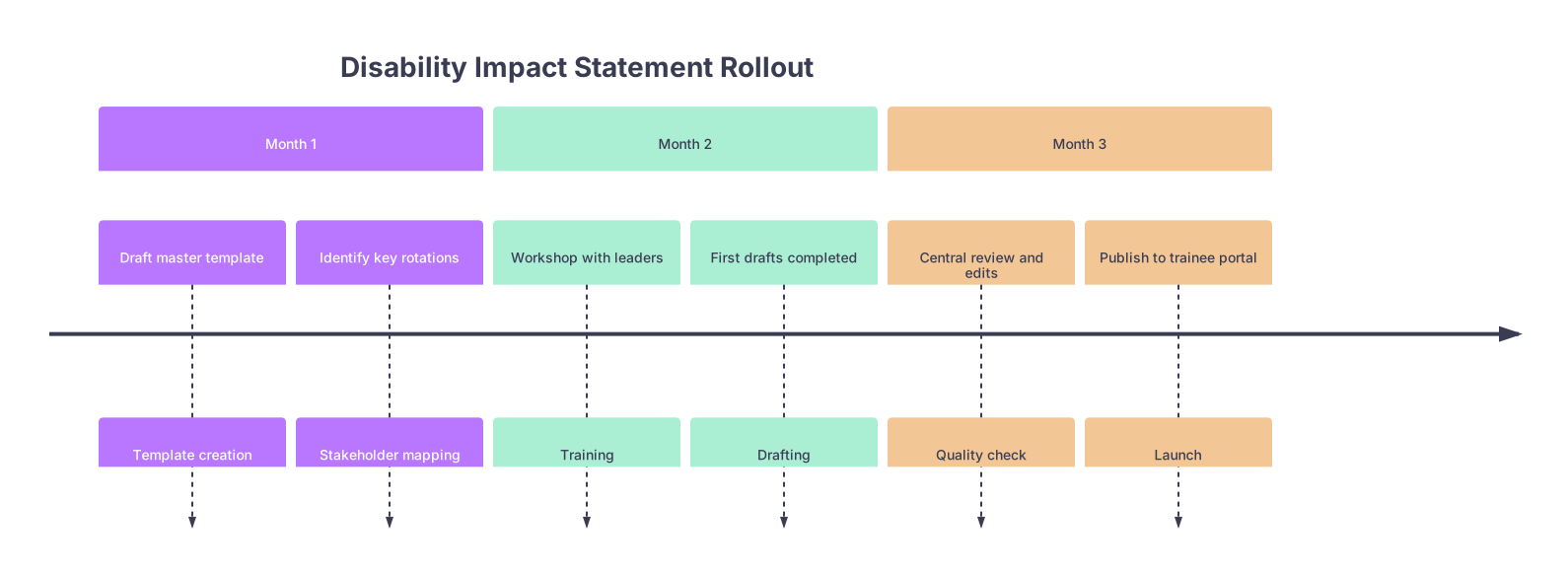
| Period | Event |
|---|---|
| Month 1 - Draft master template | Template creation |
| Month 1 - Identify key rotations | Stakeholder mapping |
| Month 2 - Workshop with leaders | Training |
| Month 2 - First drafts completed | Drafting |
| Month 3 - Central review and edits | Quality check |
| Month 3 - Publish to trainee portal | Launch |
Step 3: Central review by disability-proficient team
You want a small group who actually understands access and law to review drafts:
- Disability services professional
- UME/GME dean or associate dean
- Someone with lived experience of disability in training if possible
They should:
- Remove medicalized language about “impaired students”
- Ensure no “we do not accommodate X” statements that violate law
- Standardize tone and length
Step 4: Publish in one obvious place
Put DIS documents where trainees already look:
- Clerkship handbook / LMS site
- Residency program welcome packets
- Pre-matriculation orientation portal
Do not hide them behind three sign-ins.
Step 5: Annual quick update
Once a year, rotation leaders answer 3 questions:
- Did schedules / hours meaningfully change?
- Did physical locations or major tasks change?
- Did we discover any new pattern of accommodations that should be mentioned?
If “yes,” they update. If “no,” they confirm status quo.
5. Common Mistakes and How to Fix Them Fast
You are going to see these patterns. Stop them early.
Mistake 1: Turning DIS into a marketing brochure
If your DIS reads like:
“This exciting and dynamic clerkship offers unparalleled opportunities in cutting-edge care…”
You have missed the point.
Fix:
Strip all adjectives that are not about objective conditions. Replace with short, factual sentences.
Mistake 2: Overcommitting to specific accommodations
Language like:
“Students will be provided extra time whenever needed.”
That is a litigation trap.
Fix:
Switch to:
“Trainees with approved accommodations may receive extended time as determined through the institutional process.”
You reference possibility, not guarantee without process.
Mistake 3: Sneaky gatekeeping through “essential functions”
A classic move: list half the known world as “essential” so you can deny accommodations later.
For example:
“Essential function: work 80 hours per week without breaks.”
That is not only unreasonable, it is inconsistent with ACGME duty hour rules.
Fix:
List essential functions sparingly and tie them to actual patient safety / accreditation requirements. If you need an “essential tasks” section (for legal or HR reasons), make it a separate document or a clearly labeled sub-section reviewed by counsel and disability services.
Mistake 4: Writing from the “average healthy trainee” assumption
Phrases like:
“Students should have no difficulty standing for several hours.”
This is subtly hostile and scientifically meaningless.
Fix:
Replace with neutral descriptions:
“Rounds may involve standing for up to 60 minutes at a time, typically 1–3 times per day.”
Describe tasks. Not judgments.
Mistake 5: Ignoring psychological and sensory load
If your DIS only mentions walking and lifting, it is incomplete. Many trainees’ disabilities are “invisible”: ADHD, bipolar disorder, PTSD, autism, chronic pain, migraines.
Fix:
Expand Section 5 (Cognitive and Sensory demands) with honest statements about:
- Unpredictability
- Interruptions
- Noise
- Emotional content (end-of-life, trauma, etc.)
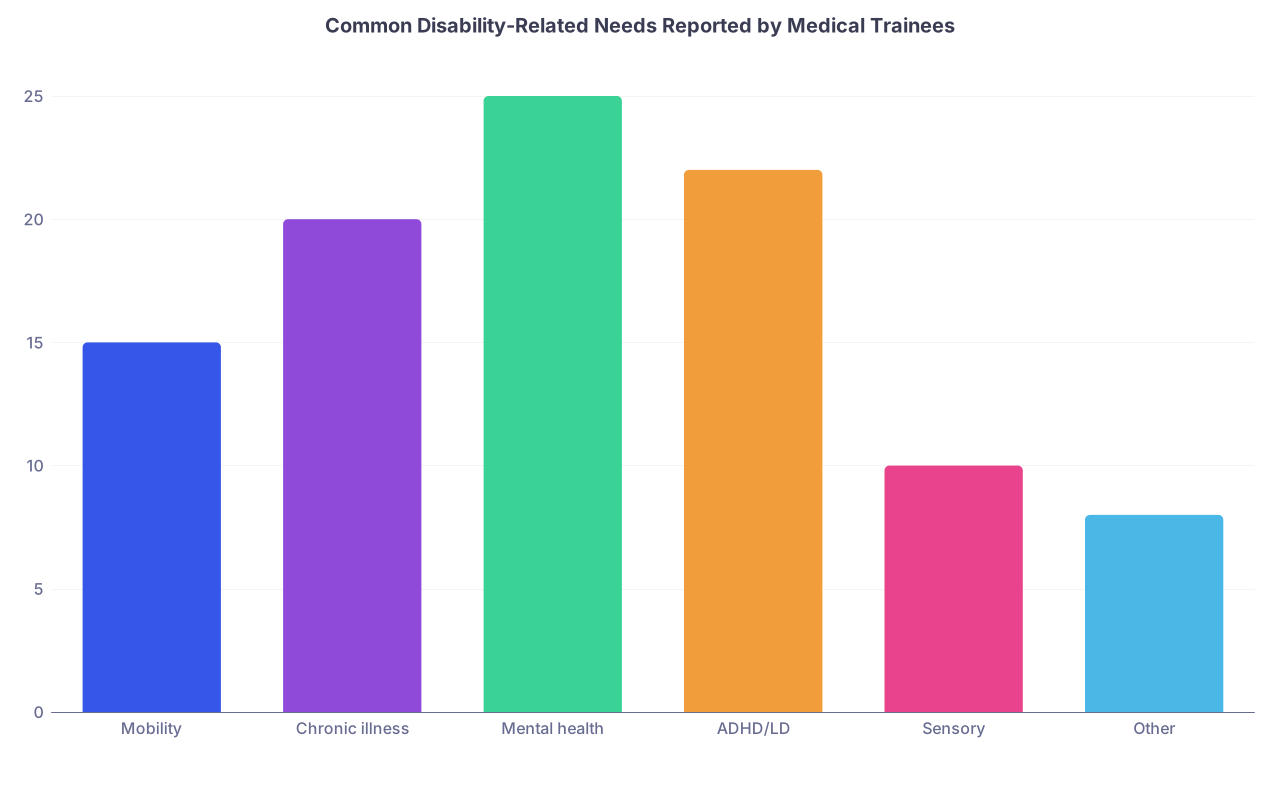
| Category | Value |
|---|---|
| Mobility | 15 |
| Chronic illness | 20 |
| Mental health | 25 |
| ADHD/LD | 22 |
| Sensory | 10 |
| Other | 8 |
6. Example: Condensed Disability Impact Statement for an ICU Rotation
To make this real, here is a compressed, near-ready example you can model from.
Purpose and Scope
This Disability Impact Statement describes the typical learning environment and demands of the 4-week Medical Intensive Care Unit (MICU) rotation for internal medicine residents at [Institution]. It supports informed planning and discussion of disability-related needs. It does not determine eligibility for accommodations, which are handled through institutional processes.Learning Context Summary
Residents provide critical care for medically complex adult patients in a closed 24-bed MICU at [Hospital], supervised by intensivist attendings and fellows. Learning occurs in patient rooms, team workspaces, and conference areas.Schedule and Time Demands
- Duration: 4 weeks
- Weekly pattern: 6 days on / 1 day off
- Typical daytime shift: 6:30 AM–6:30 PM
- Night coverage: 6–7 consecutive night shifts (6:30 PM–6:30 AM) during the block
- High-acuity, unpredictable workload; breaks vary by census and acuity
Physical Demands
- Frequent walking between rooms, bedside monitors, and workstations
- Standing at bedside for procedures (intubations, central lines) up to 30–45 minutes
- Occasional physical assistance with procedures (positioning patients, equipment) for residents who are physically able; nursing and support staff provide primary lifting and transfers
- EMR-based documentation using computer workstations on wheels and fixed desks
Cognitive and Sensory Demands
- Sustained attention to multiple critically ill patients with rapid clinical changes
- High volume of continuous data (vital signs, ventilator settings, labs, imaging)
- Frequent alarms, overhead announcements, and conversations in an open-unit layout
- Time-sensitive decision making and task prioritization, particularly during codes and emergencies
Communication and Interpersonal Demands
- Detailed handoffs using standardized formats twice daily (AM/PM sign-out)
- Family meetings about goals of care, often addressing serious illness and end-of-life decisions
- Rapid interprofessional communication with nurses, respiratory therapists, pharmacists, and consultants
- On-the-fly teaching, feedback, and case discussions with fellows and attendings
Assessment and Evaluation
- Direct observation of clinical care, procedures, team communication, and professionalism
- Daily informal feedback; summative evaluations completed by attendings and fellows at rotation end
- No standardized written exam specific to this rotation
Examples of Common Accommodations
Depending on approved accommodations and patient care needs, prior adjustments have included:
- Ergonomic or seated workstations for documentation
- Strategic scheduling of night vs. day blocks when medically indicated and feasible
- Use of noise-reducing devices that allow response to critical alarms
- Structured checklists for handoffs and daily plans
Requesting Accommodations
Residents who anticipate disability-related barriers in this rotation should contact GME and the institutional disability services office as early as possible: [contact details]. All accommodation decisions are made individually based on the resident’s role, patient safety, and program requirements.
You could hand this to an ICU PD and say: “Start here. Tweak details. Do not reinvent.”
7. What You Should Do Today
Do not try to fix your entire institution this week. Start simple and concrete.
Today:
- Pick one course, clerkship, or rotation that is high-stress or high-acuity (ICU, surgery, EM, inpatient medicine).
- Copy the section headings from this article into a document.
- Spend 30–45 minutes filling in rough draft answers for that one rotation, using the sample language as scaffolding.
Then send that draft to:
- Your disability services office
- The course/clerkship/rotation director
And ask one question:
“What would you change so this is accurate, neutral, and actually useful to trainees?”
Open that blank document now and paste in the section headings. You can refine later. Just get version 1 written.