
You are sitting at your kitchen table with three things in front of you: a denial letter for your short‑term disability extension, an email saying your workplace “cannot continue informal accommodations indefinitely,” and a stack of receipts for things you bought out of pocket because “insurance doesn’t cover that.”
Your body (or brain) is very clear: the disability is not temporary.
But almost every support you have is.
Temporary leave. Temporary loaner equipment. “We’ll see how it goes” accommodations. Case managers who disappear when the episode is labeled “resolved.”
You are seeing the cliff edge. You want a way off the temporary treadmill and into stable, durable, predictable support.
Here is the stepwise strategy to do exactly that.
Step 1: Stop Treating “Temporary” as a Waiting Room
The biggest trap I see: people treating short‑term supports as a holding bay until “things go back to normal.” So they do not build a permanent plan until those temps collapse. By then, they are exhausted and backed into a corner.
You fix this by treating every temporary support as a bridge, not a destination. That means: as soon as you get something short‑term, you immediately ask:
- What happens after this ends?
- What is the permanent version of this?
- Who controls that decision?
Then you move.
Concrete actions in the first 7–14 days
Make a brutally honest status statement
Write down, in one paragraph, how you function on an average bad day right now. Not your best day. Not how you hope to be in six months. Example:
“I cannot stand longer than 5 minutes without severe pain. I need 2–3 hours lying down during the workday. Brain fog limits my ability to concentrate more than 20–30 minutes at a time. I cannot reliably commute 5 days a week.”
This is your anchor. You will use it for doctors, employers, disability forms, and support programs.
List every current support and its end date
- Short‑term disability: ends [date]
- Loaner wheelchair / equipment: return date [date]
- Time‑limited therapy: [X sessions left]
- “Temporary” work from home or reduced hours: review date [date]
- Friend/family help: “until you are back on your feet”
Put it in one place.
Current Temporary Supports Overview Support Type Start Date End/Review Date Who Controls It Short-term disability 2026-01-01 2026-03-31 Employer/Insurer Reduced work hours 2026-01-15 2026-02-28 Manager/HR Loaner mobility device 2026-01-10 2026-04-10 DME Provider Time-limited therapy 2026-01-05 8 sessions left Clinic/Insurance Decide your default assumption
If your condition has lasted 12+ months or has no clear medical endpoint, operate under this assumption:
- “I need to build for long‑term disability support even if some function improves.”
Waiting for someone else to declare your condition “permanent” is how people lose months or years.
Step 2: Build a “Permanent Support Map” Before You Apply to Anything
Permanent support systems are fragmented and confusing on purpose. You fight this by drawing your own map before you start knocking on doors.
You are looking at three domains:
- Income / financial stability
- Environment and tools (home, workplace, community)
- Care and services (ongoing treatment, personal support)
1. Income and financial supports
You want multiple potential anchors, not just “hope the job works out.”
Common durable options:
- Long‑term disability (LTD) through employer or private policy
- Public disability benefits (e.g., SSDI/SSI in the U.S., PIP/ESA in the UK, CPP‑D in Canada)
- Vocational rehabilitation focused on sustainable employment, not just “back to work now”
- Income‑related benefits: housing support, SNAP, council tax reduction, etc.
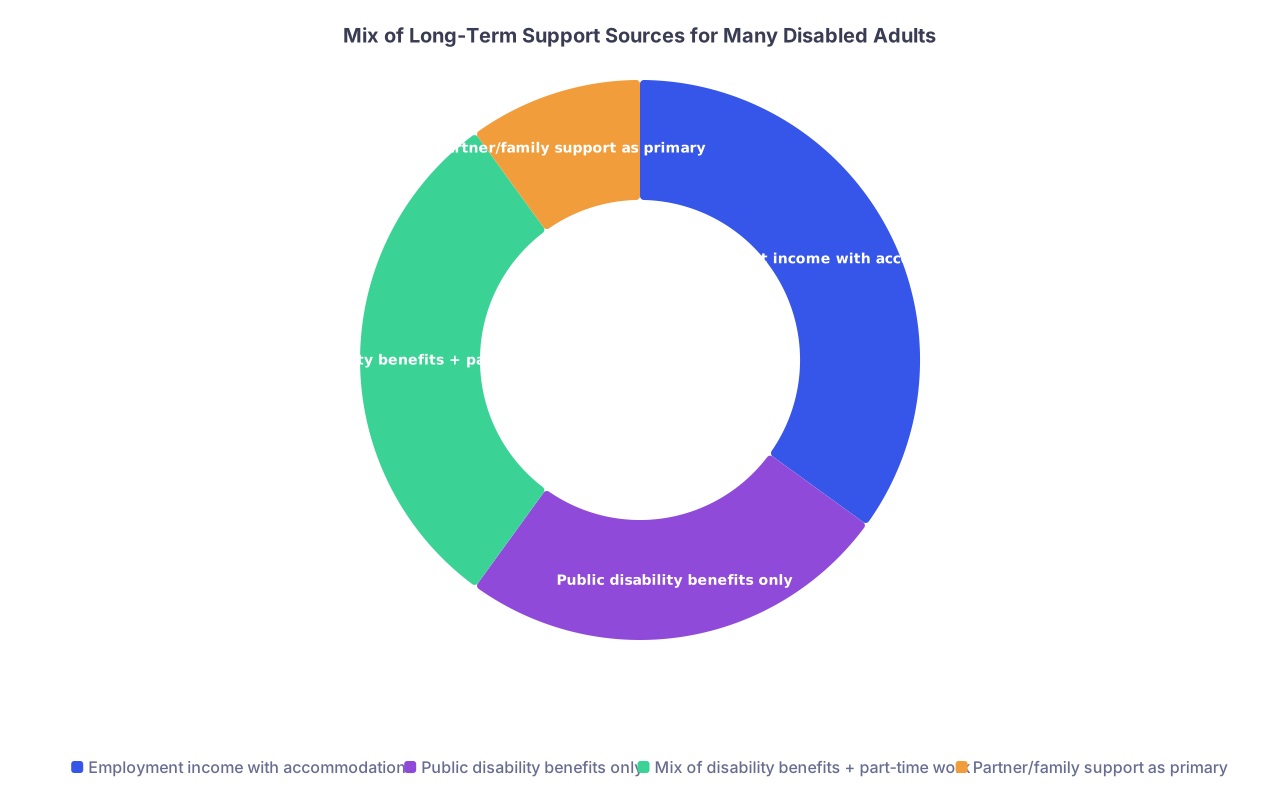
| Category | Value |
|---|---|
| Employment income with accommodations | 35 |
| Public disability benefits only | 25 |
| Mix of disability benefits + part-time work | 30 |
| Partner/family support as primary | 10 |
2. Environmental and equipment supports
Think in categories:
- Home: ramps, grab bars, bathroom modifications, step‑free access, air filtration
- Mobility: wheelchair, scooter, braces, vehicle modifications
- Communication / sensory: hearing aids, captioning tools, visual aids
- Digital access: screen readers, speech‑to‑text, ergonomic devices
For each temporary thing you rely on (loaner wheelchair, friend driving you, short‑term cleaning help), ask:
- What is the permanent analog? (grants, equipment schemes, local authority funding, charities)
- Is there a medical or functional assessment required?
- Who writes the supporting documentation?
3. Ongoing care and personal support
Long‑term supports here might include:
- Community mental health team or long‑term psychotherapy
- Pain management program
- Occupational therapy / physiotherapy with follow‑ups
- Personal care attendants / home health aides
- Peer support and disability advocacy organizations
Do not underestimate how “soft” supports (peer groups, advocates) become critical when systems push back.
Step 3: Convert Medical Uncertainty Into “Functional Evidence”
Permanent supports do not actually care about your diagnosis as much as people think. They care about function over time.
You need evidence of stable or slowly improving impairment over at least several months.
Build a functional timeline
Make a simple monthly record, even if you have to reconstruct the last year from memory and messages.
Month by month, list:
- Work or school status (full‑time, part‑time, off work)
- Key functional limits (standing, lifting, concentration, self‑care, travel)
- Major flares / hospitalizations
- Any assistive devices started that month
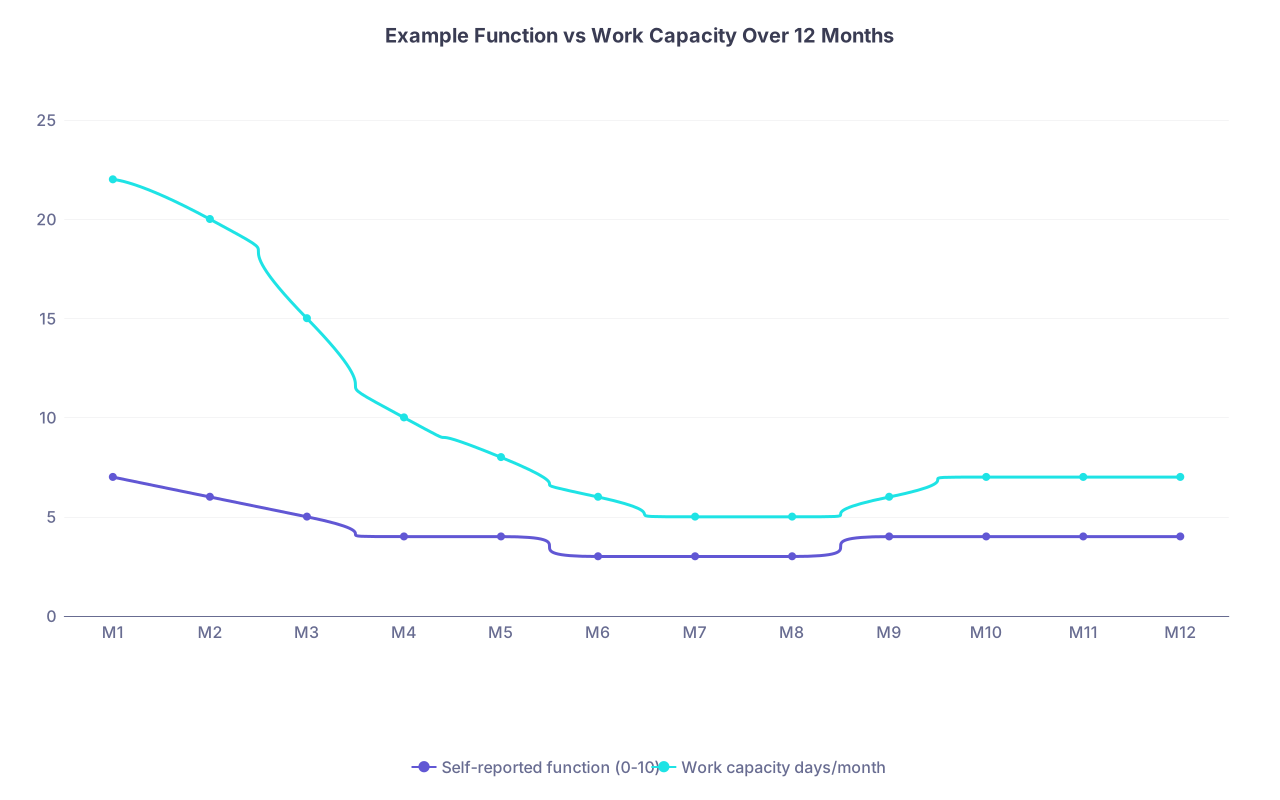
| Category | Self-reported function (0-10) | Work capacity days/month |
|---|---|---|
| M1 | 7 | 22 |
| M2 | 6 | 20 |
| M3 | 5 | 15 |
| M4 | 4 | 10 |
| M5 | 4 | 8 |
| M6 | 3 | 6 |
| M7 | 3 | 5 |
| M8 | 3 | 5 |
| M9 | 4 | 6 |
| M10 | 4 | 7 |
| M11 | 4 | 7 |
| M12 | 4 | 7 |
This does three things:
- Shows that the condition is not a 2‑week blip.
- Shows adjustments tried (reduced hours, assistive devices).
- Shows that even with supports, you are still limited.
Turn this into documents clinicians can use
Doctors are rushed. They will write “chronic pain” and “follow‑up in 3 months” unless you hand them specificity.
Bring:
- Your one‑paragraph “average bad day” description.
- The month‑by‑month functional timeline.
- A short, direct ask:
“I need a letter explaining my long‑term functional limitations for [LTD / disability benefits / workplace accommodations]. Could you include how long this has lasted, what has been tried, and whether full recovery is expected?”
If they hedge, push (politely but firmly):
- “Even if the exact diagnosis is in progress, the functional impact has been the same for 12 months. Can you document that as it stands now?”
You are not asking them to predict the future, just to describe the current reality timeframe.
Step 4: Run a Parallel Track: Keep Work If Possible, Build Disability Options Anyway
People waste years clinging to a collapsing full‑time job because they fear the “permanent disability” label. Others drop out overnight with no plan. Both extremes hurt.
The grown‑up strategy is parallel tracks:
- Track A: Make your current job genuinely sustainable, permanently, if that is feasible.
- Track B: Prepare disability and alternative work supports as if you will need them.
A. Converting “temporary accommodations” to permanent ones at work
Most organizations love “temporary” accommodations because they sound like charity, not obligation. You flip that script.
Key principles:
Shift from “I am recovering from X” to “I have an ongoing condition that requires Y.”
Example email language to HR:
“My condition has been present for over a year and continues to significantly limit my mobility and stamina. Based on my doctors’ assessments, I will need ongoing workplace accommodations to perform the essential functions of my role.”
Anchor your ask in job “essential functions”
Do not lead with “I want to work from home forever.”
Lead with: “To perform [core tasks], I need [specific changes].”For example:
- Essential function: Data analysis, remote‑compatible.
Accommodation: 3–4 remote days per week, flexible start time 10–6 to manage pain and fatigue. - Essential function: In‑person clinic, but not constant standing.
Accommodation: Stool in exam room, scheduled seated documentation blocks, limits on consecutive clinics.
- Essential function: Data analysis, remote‑compatible.
Formalize the process
- Submit a written reasonable accommodation request (not just a chat with your manager).
- Attach medical documentation focusing on functional limits, not just diagnoses.
- Ask for a written outcome and time frame for review (e.g., 12 months, then re‑evaluate, not “2 weeks”).
If they try the classic “Let us just keep this informal for now,” push back:
“Because my condition is long‑term, I would like this documented under our disability accommodation process. That protects both of us and gives clarity going forward.”
B. Building your disability claim while still working
Yes, you can and often should start disability processes while still employed, especially if:
- You are on reduced hours or intermittent leave.
- Your productivity is dropping despite accommodations.
- Your doctor has stated that full‑time work is not sustainable.
Get:
- Policy documents for employer long‑term disability (LTD).
- Eligibility rules and application checklists for public benefits.
Then:
- Confirm required timelines (some LTD plans require you to apply for public disability by a certain month).
- Ask your clinician to document that work hours are medically reduced and why.
You are building a case that if you stop working later, it is not sudden or voluntary; it is the culmination of long‑lasting impairment.
Step 5: Turn “Loaners and Favors” Into Funded, Durable Supports
Informal help is fragile. The person who currently drives you, cleans for you, or helps you shower may not always be available. Good planning assumes that.
Target categories:
- Assistive technology and equipment
- Home modifications
- Regular support with activities of daily living (ADLs)
1. Assistive technology and mobility
For each temporary or borrowed item, ask:
- Do I need this 6–12 months from now?
- Will my function crumble without it?
If yes, you treat it as permanent and look for funding channels:
- Government disability equipment schemes
- Insurance or health system coverage with proper documentation
- Grants/charities (for things like powerchairs, specialized tech)
- Employer support if it is needed to perform work tasks
The documentation needs to say things like:
- “Patient requires a wheelchair for safe community mobility on a long‑term basis (12+ months).”
- “Without this device, patient is unable to safely perform [basic activities].”
Generic “may benefit from” language kills funding requests.
2. Home environment
Occupational therapists (OTs) are your best friend here, if you can get one.
You want:
- A formal home assessment.
- A written report listing recommended modifications and whether they are needed long‑term.
- Cost estimates or at least clear specifications.
Then you route that report into:
- Local authority adaptation programs / state schemes
- Landlord negotiations (with the magic word “reasonable adjustments” or equivalent in your country)
- Charitable grants for larger modifications
Again, the shift is from:
“This would help”
to
“Without X, this person is unable to safely bathe / transfer / enter and exit the home.”

| Step | Description |
|---|---|
| Step 1 | Temporary home help or loaner equipment |
| Step 2 | OT home assessment |
| Step 3 | Written recommendations |
| Step 4 | Apply with OT report |
| Step 5 | Request reasonable adjustments |
| Step 6 | Grant application |
| Step 7 | Permanent modifications approved |
| Step 8 | Funding route |
3. Personal care and daily living support
If family is doing everything “for now,” assume that is temporary unless they explicitly commit long‑term.
To move to durable support:
- Request a needs assessment from social services / local authority.
- Keep a two‑week care log of what others help you with and how long it takes: preparing meals, washing, dressing, toileting, supervision for safety.
Detail matters. “Helps a lot” turns into “no formal support needed.”
“Requires 45 minutes assistance each morning to wash, dress, and safely transfer to chair” gets taken seriously.
Step 6: Use Deadlines to Your Advantage, Not Theirs
Every temporary support has an end date. That is not just a threat; it is a planning tool.
You always want your next support identified and preferably applied for at least one cycle before the current one ends.
Rough timeline rule:
- For anything that requires government disability decision: start 6–9 months before you are desperate.
- For anything that requires workplace decision: push to formalize 2–3 months before the current “temporary” period expires.
- For equipment / home modifications: expect 3–12 months from assessment to installation.
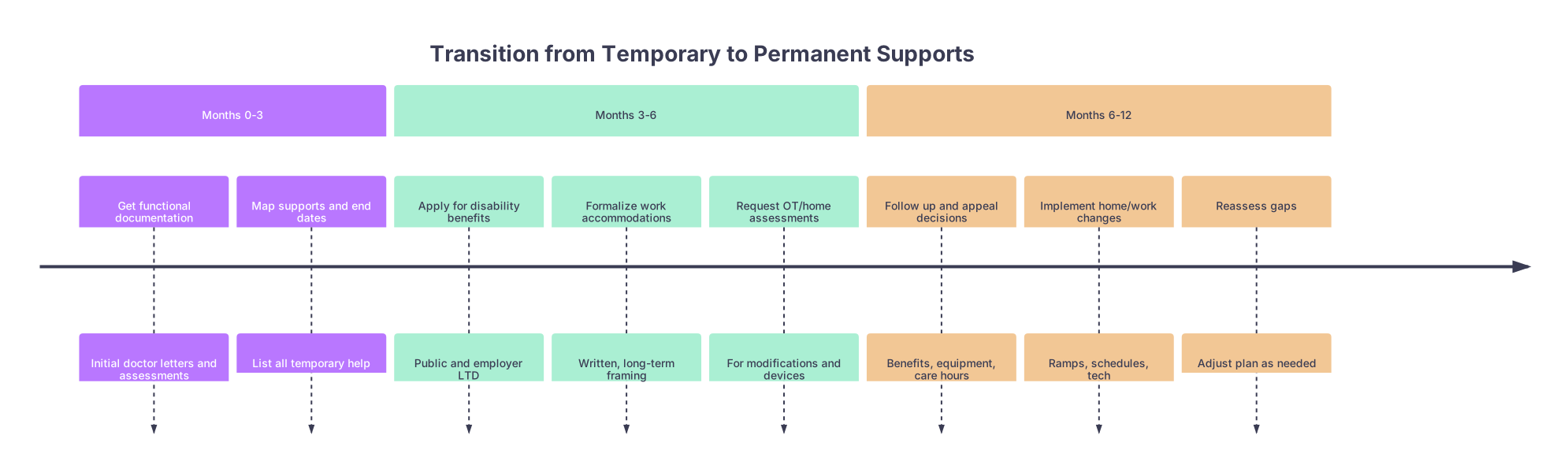
| Period | Event |
|---|---|
| Months 0-3 - Get functional documentation | Initial doctor letters and assessments |
| Months 0-3 - Map supports and end dates | List all temporary help |
| Months 3-6 - Apply for disability benefits | Public and employer LTD |
| Months 3-6 - Formalize work accommodations | Written, long-term framing |
| Months 3-6 - Request OT/home assessments | For modifications and devices |
| Months 6-12 - Follow up and appeal decisions | Benefits, equipment, care hours |
| Months 6-12 - Implement home/work changes | Ramps, schedules, tech |
| Months 6-12 - Reassess gaps | Adjust plan as needed |
If you are already inside that window and panicking, triage:
- Protect income first (LTD, public disability, maintaining some work if possible).
- Protect critical function second (mobility devices, personal care, safe housing).
- Optimize comfort and quality of life once those are not in free fall.
Step 7: Know When to Escalate: Advocates, Legal, and Complaints
You will hit resistance. Some of it is ignorance. Some is cost‑avoidance. Some is outright discrimination.
You do not need to fight every battle alone.
Bring in an advocate early, not as a last resort
Good options:
- Independent disability advocacy organizations
- Condition‑specific charities
- Hospital social workers
- Union reps (if you are employed in a unionized setting)
- Legal clinics specializing in disability rights
They help with:
- Reviewing and strengthening your documentation
- Attending meetings with HR or social services as your support person
- Drafting appeal letters that actually hit the criteria programs use
Use structured escalation, not just anger
When something is denied that you clearly qualify for:
- Request the decision letter in writing with reasons.
- Identify the official appeal pathway and deadline.
- Compare your situation to the written criteria. Close the gaps.
Example structure for an appeal:
- “The decision states X requires that the impairment has lasted 12 months. My enclosed records show symptoms and functional limits from [date] to present.”
- “The decision states I can perform daily living tasks independently. My care log (enclosed) and OT report show I require assistance for [specific tasks] daily.”
If a workplace is stonewalling permanent accommodations:
- Document every request and response in writing.
- If your country has a disability discrimination or equal access law, quote it simply:
“Given my long‑term condition substantially limits my daily activities, I am requesting these as reasonable adjustments under [law].”
Step 8: Plan for the Future of Medicine Without Betting Your Life on It
This is the “future of medicine” part nobody likes to say out loud: yes, treatments are improving. No, you cannot plan your support life on the assumption that “there will be a cure soon.”
Here is the rational approach:
Assume long‑term, welcome improvement
You plan as if your current level of function will last 5+ years:
- You pursue permanent benefits.
- You invest in home modifications that make your life easier now.
- You negotiate stable work patterns.
If medicine catches up and your condition improves? Great. You can scale supports down later.
Programs rarely punish you for improving if you are honest and methodical:
- Some benefits taper with increased work or function.
- Accommodations can be revised or relaxed if you choose.
- Equipment and modifications still increase safety and participation.
Use emerging tools on your terms
“Future of medicine” also means:
- Better remote work tech and digital accessibility.
- More telehealth and home‑based services.
- Growing recognition of chronic conditions like Long Covid as long‑term disabilities.
Leverage these trends for stability:
- Push employers for remote‑first or hybrid roles where your output matters more than your chair time.
- Use telehealth for continuity of care rather than bouncing between in‑person providers you cannot reach.
- Join online patient communities that share specific hacks: which clinics understand your condition, which devices actually last, which schemes are improving.
You are building a support system that can adapt as medicine evolves without leaving you exposed in the meantime.
Quick Example: Putting It All Together
Take a composite scenario:
- 34‑year‑old with post‑viral fatigue and POTS, off work for 6 months on short‑term disability.
- Using a loaner wheelchair outside the home.
- Living in a second‑floor walk‑up, relying on partner to manage stairs and groceries.
- “Temporary” work from home arrangement offered if they return.
Stepwise:
Month 0–1:
- Write functional statement and 12‑month timeline.
- Get cardiologist and GP letters describing long‑term functional limits and poor prognosis for full‑time commuting work in the next year.
Month 1–3:
- Apply for employer LTD and public disability benefits, attaching documentation.
- File a formal written request for long‑term remote work, flexible schedule, and reduced hours as reasonable accommodations, anchored to essential job tasks.
- Request OT home assessment to document access issues and need for ground‑floor or adapted housing.
Month 3–6:
- OT report goes to housing authority/landlord, backing a move or adaptations.
- Wheelchair recommendation upgraded from “loaner” to “long‑term community mobility need” with documentation; apply for funding.
- Disability benefit decisions arrive; appeal if denied, using more detailed function logs.
Month 6–12:
- Either stabilize in a sustainable remote role with permanent accommodations, supplemented by partial benefits,
or
shift fully to disability benefits plus part‑time, remote‑friendly work supported by vocational rehab. - Home environment and equipment now predictable; partner’s role becomes optional support, not sole lifeline.
- Either stabilize in a sustainable remote role with permanent accommodations, supplemented by partial benefits,
You go from “waiting to see if things get better” to “living in a system that assumes this is how things are, and is built to support it.”
Two Things To Remember
Plan as if the disability is permanent. Adjust if it improves.
Not the other way around.Turn every vague story into specific, documented function over time.
That is the currency permanent support systems actually use.
You do not control whether your body changes tomorrow. You do control whether the scaffolding around your life is built to last.