
The worst way to ask for new accommodations is to “wing it” in your PD’s office.
You need a script. A structure. And a fallback plan for when the conversation goes sideways.
You are not just “asking for favors.” You are invoking a legal and ethical framework that graduate medical education loves to pretend is fuzzy when it is actually very clear. The problem is not that you are asking. The problem is most residents ask in unstructured, apologetic, vague ways that make it easy for programs to dodge, delay, or minimize.
Let’s fix that.
This is a structured playbook for how to tell your Program Director you need new accommodations—whether your disability is new, your condition changed, or your old setup stopped working. You will get:
- A stepwise plan for what to do before, during, and after the meeting
- A modular word-for-word script you can adapt
- Specific email templates
- Contingency plans if they push back, gaslight, or stall
Use this like a checklist, not a think piece.
Step 1: Get Clear On What Changed (Before You Talk To Anyone)
You cannot walk into a PD’s office and say, “Things have been harder lately; I think I might need something.” That is how you end up leaving with “Let us know if it gets worse” and nothing else.
You need three things clearly defined:
- What changed
- How it affects essential functions
- What specific accommodations you are requesting
1. Define the change in concrete terms
Write this out on paper or in a document:
- Did your diagnosis change?
- Did your symptoms worsen or become more frequent?
- Did a rotation type or schedule change that made old accommodations ineffective?
- Did you discover that what was “reasonable” on paper is not usable in real life?
Example language for yourself:
- “Migraine frequency increased from 2/month to 6–8/month.”
- “Standing in the OR > 4 hours triggers severe pain and numbness.”
- “Overnight calls result in 2–3 days of cognitive fog and slowed reaction time.”
- “Previously granted extra clinic prep time is routinely overridden by schedule changes.”
Avoid “I feel worse.” Use numbers, timing, and patterns.
2. Link the change to essential job functions
Programs care (and legally must care) about essential functions of your role. Not vague “I’m tired.” You want clear connections:
- “I cannot reliably complete notes the same day without X.”
- “I am at risk of making errors on medication orders when I am up 28 hours straight.”
- “I cannot safely assist in long cases without the ability to sit intermittently.”
- “I need predictable time for treatments/appointments to remain clinically stable.”
Think in categories:
- Clinical care (direct patient care, procedures, notes)
- Safety (patient and your own)
- Education (conferences, exams, scholarly work)
- Professionalism (timeliness, reliable attendance, communication)
Write 2–5 specific links. Keep them crisp.
3. Translate needs into concrete accommodation requests
Your PD is not an ADA expert. They understand call schedules and FTE slots, not disability law. Do not hand them an abstract problem and hope they invent a solution.
You will go in with proposed accommodations. They might not all be granted in that exact form, but it anchors the discussion.
Typical categories:
- Schedule and hours
- No more than X consecutive hours
- No 24+ hour calls
- One fixed weekday clinic-free block for treatment/therapy
- Protected post-call time actually being honored
- Environment and workflow
- Quiet workspace or ability to step away briefly
- Ergonomic chair, standing/sitting options, anti-fatigue mat
- Adjusted patient volumes or additional prep time
- Documentation and cognitive load
- Extra time for notes, especially after call/overnight
- Use of dictation software or templates
- Reduced simultaneous tasks during procedures or resuscitations
- Leave and flexibility
- Transition from intermittent call-outs → formal intermittent FMLA (if available)
- Short-term schedule modifications during flares or treatment cycles
Write each as:
“Because of [condition effect], I am requesting [specific accommodation] so that I can [essential function].”
Example:
“Because my neuropathy worsens with prolonged standing, I am requesting the ability to intermittently sit or scrub out briefly during long OR cases, so I can safely assist and complete the case without severe pain or loss of function.”
This is the core logic you will re-use in your script.
Step 2: Decide Your Path: ODS First, PD First, or Both
In most academic settings, there are three players:
- You
- The Program Director (PD)
- The institutional disability / employee health / GME office
The order you involve them matters.

Path A: Disability/Employee Health First (safer, more structured)
If your institution has:
- A disability office for trainees
- Employee health or occupational medicine that handles accommodations
- A GME office that has a formal process
Use them. Especially if:
- Your PD has been dismissive in the past
- You are requesting major schedule changes
- You are worried about retaliation or bias
Advantages:
- They help define “reasonable”
- They can document everything
- They can be the “bad cop” for you
Disadvantages:
- Slower sometimes
- PD may feel “out of the loop” if not communicated well
Path B: PD First (sometimes faster, but riskier)
Use this if:
- You already have a supportive PD
- The change is modest (eg, additional ergonomic changes, minor schedule tweaks)
- You just need to update them and then formalize with the disability office
If your PD historically says things like, “We should probably talk to GME/disability to do this right,” that is actually good. They are trying not to freelance the law.
Path C: Parallel communication
Often the strongest:
- Email disability / employee health asking to re-open accommodations due to change in condition.
- Email PD requesting a meeting, referencing that you are working with the appropriate office.
- Use your meeting with the PD to align expectations, not to prove your diagnosis.
This reduces the chance that the PD’s personal opinions drive the process.
Step 3: Set Up the Conversation Properly
Do not drop this as a hallway chat. You want a scheduled meeting, with a clear subject.
Here is an email template you can adapt.
Email Template: Requesting a Meeting With PD
Subject: Meeting Request – Accommodation Update
Dear Dr. [Last Name],
I would like to schedule a brief meeting to discuss an update related to my disability accommodations. There have been some recent changes in my health that are affecting my ability to meet certain clinical demands under the current structure, and I want to ensure I can continue to function safely and reliably in the program.
I have begun contacting the appropriate institutional resources to review my accommodations, and I believe it would be helpful for us to talk through how this may intersect with my current and upcoming rotations.
Would you be available for a 30-minute meeting within the next week? I am generally available [give 3–4 options].
Thank you,
[Name], PGY-[X]
This sets three expectations:
- This is not a vague “I am struggling” chat.
- You are already treating this as an accommodations issue, not a personal failing.
- You are framing this as patient care and safety.
If they reply with, “Just stop by sometime,” you answer:
I appreciate it. Given the complexity, I would prefer a set time so I can come prepared. Does [option A/B] work?
You are signaling: this is formal.
Step 4: Use a Structured Script In The Meeting
Here is the backbone script. You will customize the details but keep the structure.
Opening (60–90 seconds)
“Thanks for meeting with me. I want to be direct: my underlying health condition has changed, and the accommodations that were previously sufficient are no longer adequate for me to safely and consistently perform my duties.
I have already begun the process of updating my accommodations with [disability office / employee health / GME]. What I would like to do today is:
- Briefly explain what has changed,
- Describe how this is affecting my work, and
- Propose specific adjustments that would allow me to continue meeting the program’s expectations.”
You just set the agenda. You are not asking for permission to have a disability. You are telling them you are managing it responsibly.
Part 1: Briefly describe the change (2–3 minutes)
Keep it functional, not dramatic.
“Since [time frame], my [condition – name it if you are comfortable] has progressed/worsened. For example, [1–2 sentences].
In practical terms, that looks like:
- [Concrete symptom → impact]
- [Concrete symptom → impact]
- [Frequency or pattern]
Because of this, the current schedule/rotation demands are no longer sustainable without modification.”
Examples:
- “My migraines have increased from about two per month to six to eight per month, often triggered after overnight call or back-to-back 14-hour days. During an episode, my vision and processing speed are significantly impaired.”
- “My lumbar spine condition has progressed. Standing in the OR more than three to four hours leads to severe pain and muscle spasms that can persist for days.”
Do not over-explain pathophysiology. The PD needs impact, not your entire chart.
Part 2: Link to essential functions and safety
“This change is directly affecting several essential aspects of my role:
- Timely and accurate documentation after long shifts
- Maintaining focus and processing speed during complex clinical scenarios
- Physical ability to participate safely in longer procedures
I want to be clear: I am committed to doing my job well and safely. Right now, the mismatch between my condition and the current structure is increasing the risk of errors and making my performance less consistent than either of us would want.”
You are framing this as a shared concern: safe, reliable performance.
Part 3: Present concrete accommodation requests
Have these written in front of you. Not in your head.
“Based on discussions with my treating clinician and reviewing what has and has not worked so far, I am requesting the following changes as reasonable accommodations:
- [Accommodation #1] – because [condition effect] and so that I can [essential function].
- [Accommodation #2] – because [condition effect] and so that I can [essential function].
- [Accommodation #3] – [same structure].
I am open to adjustments or alternatives that achieve the same functional goals, but I wanted to be concrete so we have something specific to react to.”
Example package for a resident with worsening MS symptoms:
- No 24+ hour calls; maximum scheduled continuous duty period of 16 hours.
- One fixed half-day per week without clinical duties for infusion and therapy appointments.
- Ability to sit intermittently during long OR cases or to be scheduled preferentially on shorter cases when possible.
State them calmly. No apology.
Step 5: Handle Common PD Reactions (With Scripts)
You will not get a perfect response. Plan for the predictable nonsense.
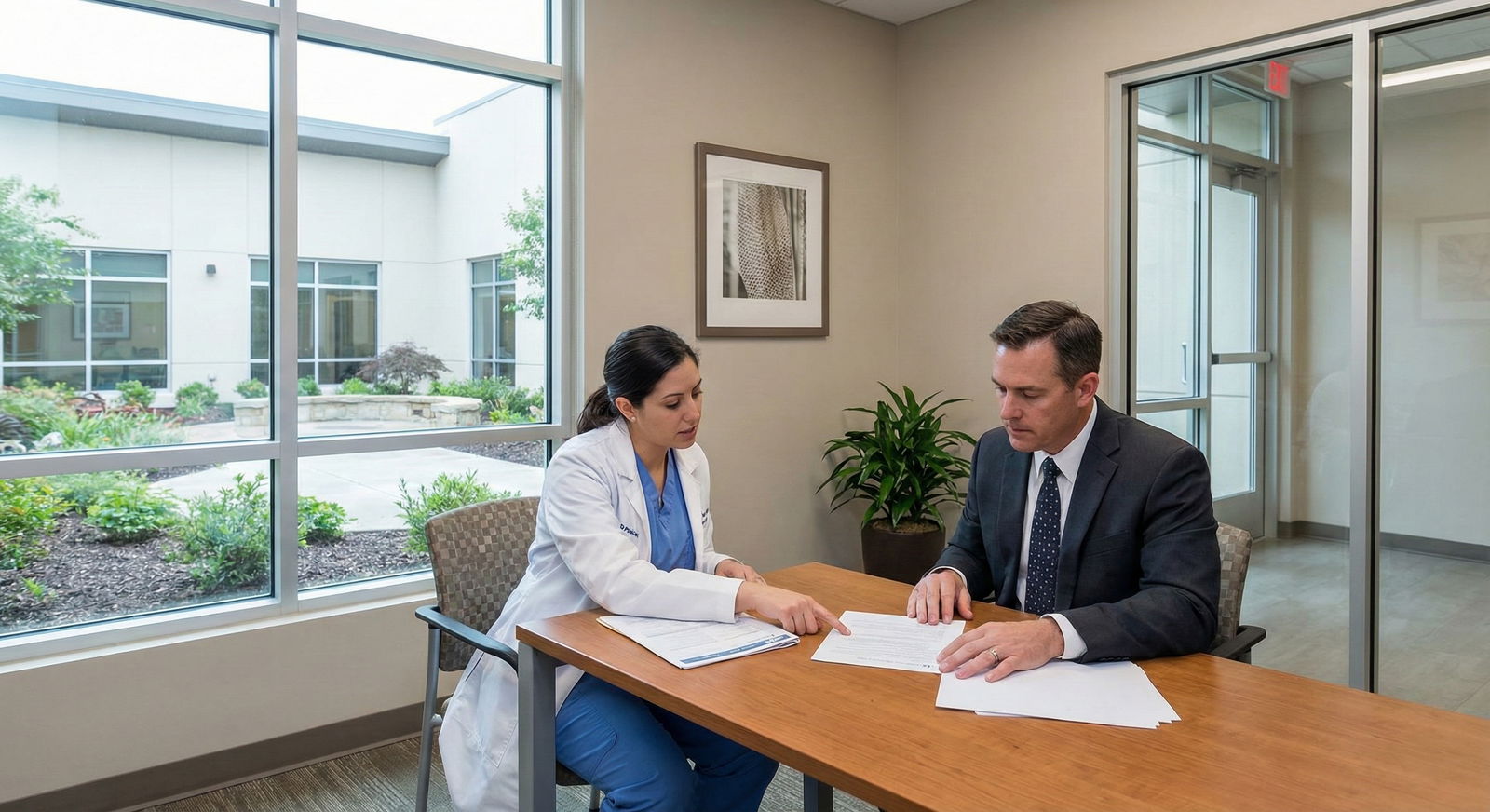
Reaction 1: “We all have it hard / residency is tough for everyone”
Translation: They are minimizing your disability by normalizing suffering.
Response:
“I agree that residency is demanding for everyone. What I am describing is not ordinary fatigue or stress. It is a documented medical condition that significantly impairs specific functions when the schedule exceeds certain limits. That is why I am going through the formal accommodation process rather than just asking for informal favors.”
If they continue:
“I want to make sure we are aligned that this is a legal accommodations conversation, not just a wellness discussion. That is why I have involved [disability/employee health/GME].”
You are gently but firmly pushing it back into the formal lane.
Reaction 2: “If you cannot do X, maybe this specialty/program is not a good fit”
This is the veiled threat version.
First, do not panic out loud. Answer like this:
“My goal is to continue in this program and specialty, and with appropriate accommodations I am confident I can meet the essential functions. Many physicians in [specialty] practice successfully with accommodations.
If you have concerns about what you consider ‘essential functions’ and how these proposed adjustments intersect with them, I would appreciate having that conversation with [disability office/GME] involved so we can align with institutional and legal standards.”
You are not debating your fitness in a vacuum. You are re-routing the conversation into a multi-party arena where unilateral threats look bad.
Reaction 3: “We will have to see if that is fair to others”
They will bring up “fairness” to colleagues.
Response:
“I understand the concern about equity across residents. At the same time, disability accommodations are not about giving me an advantage; they are about leveling the playing field so I can meet the same expectations safely.
The fairness question is actually exactly why institutions have formal processes, so accommodations are evaluated against clear criteria rather than personal impressions.”
If they say, “But everyone wants fewer calls,” you can add:
“I would not be requesting this if it were not medically necessary and directly related to my disability. That is why I am comfortable having the request and documentation reviewed through the formal channels.”
Reaction 4: “Let us just see how it goes” / vague delay
This is the classic stall.
Reply with:
“I am concerned that continuing under the current structure, even temporarily, is already causing significant functional impairment and risk. I would like to avoid situations where we are reacting to problems that could have been prevented.
My preference is to put interim accommodations in place while the formal review is completed. For example, we could start with [X and Y] as temporary measures. Can we agree on a clear plan and timeline today?”
If they refuse to set any plan:
“Given the impact on patient safety and my ability to meet expectations, I am going to follow up with [disability office/GME] in writing so there is a documented request on record while we work this out.”
Say it calmly. They will hear the word “documented.”
Step 6: Document Everything (Quietly but Thoroughly)
You cannot rely on memory or “good vibes.”
Immediately after the meeting
Within 24 hours, send a brief summary email.
Subject: Summary of Accommodation Discussion – [Date]
Dear Dr. [Last Name],
Thank you again for meeting with me on [date] to discuss updates to my disability accommodations. I want to confirm my understanding of what we discussed:
- I described the recent progression/change in my health condition and its impact on [key functions].
- I requested the following accommodations: [brief bullet list].
- You indicated that [summary of their response – supportive, need to review, concerns, etc.].
- Next steps: [who will contact whom, any interim measures, timeline if given].
Please let me know if I have misunderstood any part of our discussion. I will also continue my communication with [disability office/employee health/GME] so we can align the formal accommodations with program needs.
Sincerely,
[Name], PGY-[X]
This does three things:
- Locks in a written record of the request.
- Prevents later “I do not remember you asking for that” claims.
- Gives them a chance to correct, which they usually will not do if your summary is accurate.
Maintain a simple log
One page. Date, event, who, what was said, and any concrete outcomes. Not a diary. A record.
You will need this if:
- Things deteriorate
- You have to go to GME, ombuds, or legal
- You need to show a pattern of requests vs responses
Step 7: Coordinate With Disability / Employee Health Properly
Parallel to the PD conversation, you should be doing this:
Send a “change in condition” email
Subject: Request to Update Accommodation Plan – [Your Name]
Dear [Office / Coordinator Name],
I am a [PGY-X] resident in [Program]. I currently have (or previously had) disability accommodations on file. Since [approximate date], there has been a significant change in my health condition that is affecting my ability to function under the existing setup.
I would like to formally request a review and update of my accommodation plan. I am prepared to provide updated medical documentation from my treating clinician.
Could we schedule a time to discuss this and outline next steps?
Thank you,
[Name]
[Program]
Bring:
- Updated medical letter (focus on functional limitations, not narrative drama)
- Your own list of requested accommodations
- Concrete examples from recent rotations
Ask the disability office directly:
- “What is the timeline from documentation to formal written accommodations?”
- “How are these communicated to the program?”
- “Can interim accommodations be put in place while this is processed?”
Step 8: Know the Difference Between Reasonable Pushback and Red Flags
Not every “no” is illegal or hostile. Some are logistics. You need to distinguish.
| Scenario | Likely Category |
|---|---|
| Suggests alternative schedule that still meets your needs | Reasonable |
| Requests documentation through formal channels | Reasonable |
| Says your condition is just “residency stress” | Problematic |
| Suggests you might not belong in medicine if you need help | Problematic |
| Delays but offers interim modifications | Reasonable |
| Refuses to discuss accommodations at all | Problematic |
Reasonable responses
- “We cannot fully remove all nights, but we can restructure to shorter shifts and fewer back-to-back overnights. Would that meet the same goal?”
- “We will need disability/employee health to weigh in before confirming, but we can make some temporary adjustments now.”
These are engagement. Work with them.
Red flag responses
- “If you need that, maybe you are not cut out for this.”
- “We cannot do anything special just for you.”
- “Do not bring this up again; it will reflect badly on your evaluations.”
At that point, your move is not arguing medical facts with your PD. It is escalation.
Step 9: Escalate Strategically If Needed
If the PD is obstructive or dismissive, you do not fight that alone.
Use this hierarchy:
- Disability/Employee Health – First line. Documented, policy-focused.
- GME Office / DIO – If program-level solutions fail or you see retaliation.
- Institutional Ombuds / Title IX / Equity Office – If you suspect discrimination.
- Outside counsel or professional organizations – If internal mechanisms fail completely.
You do not need to lead with threats. You simply say:
“I am concerned that my formal request for disability accommodations is not being adequately addressed at the program level. I would appreciate guidance on next steps to ensure we are aligned with institutional policy and legal requirements.”
You are not the first person to say this. You will not be the last.
Step 10: Script Variations For Common Situations
Let me give you a few plug-and-play lines tailored to real scenarios.
A. You already had accommodations, and they stopped working
“As you know, I have existing accommodations in place related to [condition]. Over the past [X months], my symptoms have progressed in ways that those accommodations no longer adequately address.
Specifically, despite [current accommodation], I am now [concrete impact]. That is why I am requesting an updated plan that includes [new requests].”
B. You were previously undiagnosed and “just pushed through”
“I want to be transparent about something I have been managing quietly. I was recently formally diagnosed with [condition], which explains a set of symptoms I have been experiencing for some time. Until now, I tried to manage by working around it informally, but it has reached a point where that is not sustainable or safe.
I am now engaging the formal accommodations process and would like to discuss what that means for my schedule and responsibilities.”
C. You are temporarily decompensated and need a short-term change
“I see this as a time-limited but significant flare/change. My goal is to stabilize with appropriate treatment and return to my baseline functioning.
To get there safely, I am requesting temporary accommodations such as [X, Y] for the next [time frame], with a planned re-evaluation by [date] with you and [disability office].”
Process Map: How This All Fits Together

| Step | Description |
|---|---|
| Step 1 | Notice change in condition |
| Step 2 | Define impact and needs |
| Step 3 | Contact disability or employee health |
| Step 4 | Request meeting with PD |
| Step 5 | Provide documentation |
| Step 6 | Hold structured PD meeting |
| Step 7 | Formal accommodation plan draft |
| Step 8 | Program feedback and logistics |
| Step 9 | Finalize written accommodations |
| Step 10 | Implement and monitor |
| Step 11 | Reassess and adjust if needed |
Quick Reality Check
No script makes this comfortable. But a good structure:
- Reduces your risk of being brushed off
- Forces the conversation into the right legal and institutional lanes
- Protects you from the subtle “you never asked clearly” gaslighting later
You are not asking for special treatment. You are demanding the minimum conditions required to practice medicine safely with a disability. There is a big difference.
Use the structure. Use the documentation. And do not do this alone—loop in the systems designed (however imperfectly) to back you up.
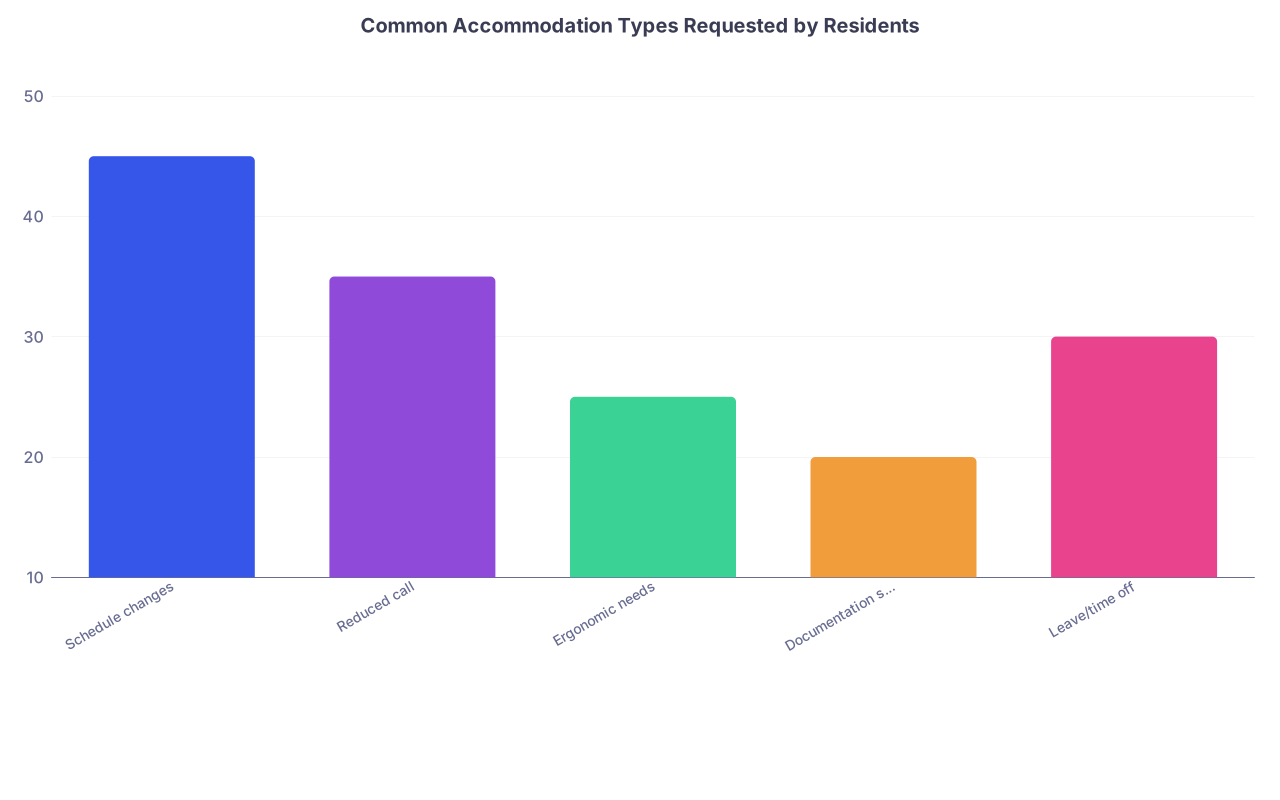
| Category | Value |
|---|---|
| Schedule changes | 45 |
| Reduced call | 35 |
| Ergonomic needs | 25 |
| Documentation support | 20 |
| Leave/time off | 30 |

FAQ (Exactly 4 Questions)
1. Do I have to disclose my specific diagnosis to my PD?
No. You are required to communicate functional limitations and needed accommodations, not your full medical history. Often, the diagnosis is shared with disability/employee health and what the PD receives is a functional summary: what you can and cannot safely do, and what accommodations are recommended. If you choose to share the name of your condition with your PD, that is your choice, not a legal requirement.
2. What if the PD says accommodations will hurt my evaluations or fellowship chances?
That is a red flag. Evaluations must be based on performance, not the fact that you requested or used accommodations. You can respond with: “I want to be clear that I am requesting legally protected disability accommodations to support safe and consistent performance. I am concerned about any implication that requesting these could negatively affect my evaluations. I would like to involve [GME/disability office] to ensure we handle this appropriately.” Then document this in writing and escalate.
3. Can a program refuse accommodations because of staffing or coverage issues?
Programs can argue that specific proposed accommodations are not reasonable if they fundamentally alter essential program functions or create undue hardship. But they cannot just say “we are short-staffed” and end the conversation. They must engage in an interactive process and explore alternative accommodations that meet your functional needs while preserving core requirements. This is where disability/GME offices become critical; do not let this be decided by verbal hand-waving alone.
4. How early should I ask for new accommodations before a demanding rotation?
As early as possible—ideally 4–8 weeks before a known high-intensity rotation (ICU, nights, heavy call blocks). That gives time for documentation, formal review, and schedule adjustments. If your condition worsens more acutely, you still ask immediately. You can say: “I realize this is short notice, but there has been a significant change in my health, and continuing under the current structure poses safety concerns. I am requesting interim accommodations while the formal process is completed.” Early, documented communication protects you more than silent suffering.