
The biggest risk in disability statements is not asking for help. It is asking for it in a way that terrifies licensing boards.
If you think your disability documentation is “nobody’s business” and you can just paste anything into your state board forms, you are one poorly worded paragraph away from a delayed license, invasive monitoring agreement, or outright denial. I have seen people with completely manageable conditions dig themselves into multi‑year remediation plans because of how they described their disability history. Not because of the disability itself.
This is not about hiding your condition. It is about not drafting your own red flags.
Below are the patterns that worry licensing boards, why they set off alarms, and how to avoid making yourself look unstable, unsafe, or dishonest when you really are none of those things.
1. Treating “Disability Statement” Like a Therapy Journal
Licensing boards read your disability disclosures as risk documents, not personal essays. The most common mistake is oversharing in all the wrong ways.
What worries boards
They get nervous when your narrative looks like this:
- Long, emotional descriptions of suffering:
“I have been completely overwhelmed, constantly in crisis, and unable to function for years…” - Catastrophic language without context:
“My anxiety destroys my ability to think clearly under pressure.” - Vague, dramatic claims:
“Medical training broke me and I will never be the same.” - Confessions without framing:
“I have had multiple breakdowns and sometimes I cannot get out of bed.”
This kind of language sets off one central question in a reviewer’s mind:
“Is this person safe to practice independently on an average Tuesday at 3 a.m. in the ICU?”
If your answer appears to be “maybe not,” you just bought yourself scrutiny.
How to avoid this mistake
You must shift from venting to documenting.
Bad version:
“I am constantly depressed and sometimes I just shut down and cannot function, especially when things get stressful.”
Better version:
“I was diagnosed with Major Depressive Disorder in 2021, during a period of personal and professional stress. I engaged in regular treatment, have been stable for over two years, and functioned fully during my clinical rotations with standard accommodations (extended test time and quiet testing space).”
You are still honest. But now you look like someone with a treated, managed condition, not an ongoing uncontrolled crisis.
The red flag is not “I have depression.”
The red flag is “My depression is disabling me right now and I am not showing you any evidence that I am safe or stable.”
2. Confusing “Accommodation Justification” with “Proving Impairment”
Another recurring problem: applicants over‑prove their disability to justify past accommodations and accidentally over‑prove their current impairment.
Licensing boards are not the testing agency. They care far less about whether you “deserved” your Step or shelf exam accommodations and far more about your present functional capacity.
Red flags boards see
- Emphasizing permanent, severe impairment without discussing how it is mitigated:
“I cannot maintain attention for more than 5–10 minutes without losing track of what I am doing.” - Stating extreme dependency:
“I cannot function in any structured environment unless I have these accommodations.” - Repeating language from psychological reports that sounds catastrophic out of context:
“She exhibits severe executive functioning deficits that significantly interfere with daily functioning.”
This makes a reviewer ask:
“If this is accurate, how will this person safely manage medication orders, emergencies, or complex decision-making in real time?”
The safer approach
You still acknowledge limitations. But you tie them directly to strategies and history of success, not helplessness.
Instead of:
“Because of my ADHD, I cannot stay organized or manage tasks without constant external support.”
Try:
“I was diagnosed with ADHD in college. With structured routines, electronic task management tools, and occasional coaching, I have successfully completed medical school and clinical rotations. For standardized testing, I use extended time to account for slower reading speed, but I perform clinical tasks in real time without restriction.”
You are signaling:
- Yes, I needed accommodations for exams.
- No, I am not functionally unsafe in clinical practice.
Do not write yourself into a box you do not belong in.
3. Ignoring How “Professionalism” and “Insight” Are Being Assessed
A lot of disability statements accidentally raise professionalism concerns instead of addressing disability itself. Boards are quietly scoring you on:
- Insight into your condition
- Ability to accept responsibility
- Attitude toward colleagues, institutions, and patients
Red‑flag patterns
Here is what gets people in trouble:
- Blaming everyone else:
“The school refused to support me.”
“My program director discriminated against me and ruined my training.” - Painting yourself as a perpetual victim with no agency:
“I had no choice; they destroyed my career opportunities.” - Displaying hostility or contempt:
“The administration was toxic and retaliatory. They targeted me because of my disability.” - Zero self‑reflection:
Long descriptions of what others did wrong, with nothing about what you learned or changed.
Boards read this and think:
“If something goes wrong with a patient or team, will this person handle it constructively, or will they escalate conflict and externalize blame?”
How to avoid this trap
You can describe real problems without sounding unprofessional.
Instead of:
“My dean discriminated against me and refused reasonable accommodations, which caused me to fail.”
Use:
“There were disagreements with the institution about the timing and scope of accommodations. I subsequently sought guidance from disability services and an external disability rights attorney. The matter was resolved, and I completed my requirements successfully. I have since developed better strategies for early communication and documentation when requesting support.”
You do not have to pretend everything was fair. But you must sound like someone who can work within systems, handle conflict, and maintain professionalism under stress.
4. Being Vague, Inconsistent, or Evasive
The opposite of oversharing is just as dangerous: fuzzy, evasive answers that raise questions about honesty.
Licensing boards are allergic to feeling like information is being withheld. That is when they start digging.
Statements that worry them
- “I had some personal issues that affected my performance.”
- “I took a leave of absence for health reasons, which are now resolved.”
- “I had an episodic mental health concern that has since improved.”
All of these scream: “There is a story here, and you are not telling it.”
If your disability is already documented in your school file, leaves of absence, or past evaluations, assume the board will see it. Minimalism that looks like intentional concealment is a red flag for dishonesty, which boards fear more than almost anything else.
A more precise approach
You do not need every detail of every therapy session. You do need clear, factual anchors:
- Diagnosis (if relevant and established)
- Approximate timeline
- Current treatment and stability
- Concrete evidence of functioning
Instead of:
“I had health problems during second year but have recovered.”
Use:
“During second year, I was diagnosed with Generalized Anxiety Disorder. I took a four‑month leave, engaged in therapy, and started medication. I have been stable for three years, completed all clinical rotations without any fitness‑for‑duty concerns, and I remain in follow‑up care.”
That sounds like someone who understands what happened and is no longer hiding from it.
5. Suggesting Current Uncontrolled Risk Without a Plan
This is where otherwise strong candidates get torpedoed: they admit current symptoms but offer no management plan.
Boards are not shocked that physicians and trainees have disabilities. They are shocked when those disabilities appear unmanaged, especially in mental health and substance use.
Red‑flag phrases
- “I still have panic attacks occasionally and sometimes leave work early.”
- “I struggle with suicidal thoughts when stressed, but I keep going.”
- “I stopped my meds because I do not like the side effects.”
- “I used alcohol more heavily during residency; I have cut back on my own.”
Statements like these, unaccompanied by treatment, monitoring, or professional support, trigger fear of imminent risk. That is how you end up in formal fitness‑for‑duty evaluations or strict monitoring programs.
How to write about ongoing conditions safely
You can acknowledge that your condition is chronic. Boards do not expect perfection. They expect a structure of safety.
Weak:
“I still deal with significant anxiety during busy rotations.”
Stronger:
“My anxiety is a chronic condition that I manage with ongoing therapy, medication, and structured coping strategies. I monitor for early signs of escalation, and I have not had any episodes that interfered with patient care or professional responsibilities since 2022.”
If you mention past suicidal ideation, substance misuse, or other high‑risk behavior, you must also mention:
- What treatment you received
- How long you have been stable / abstinent
- Whether you are in any monitoring programs
- How you safeguard patient safety now
You cannot dangle risk without showing the net underneath.
6. Misunderstanding How Boards Actually Look at Disability
One huge misconception: many applicants think any disability disclosure automatically harms them. That is not accurate. Boards are mostly worried about untreated, unstable, or concealed problems that affect safe practice.
What they actually look for is:
- Stability over time
- Adherence to treatment
- Insight and honesty
- Track record of safe function (rotations, residency, work)
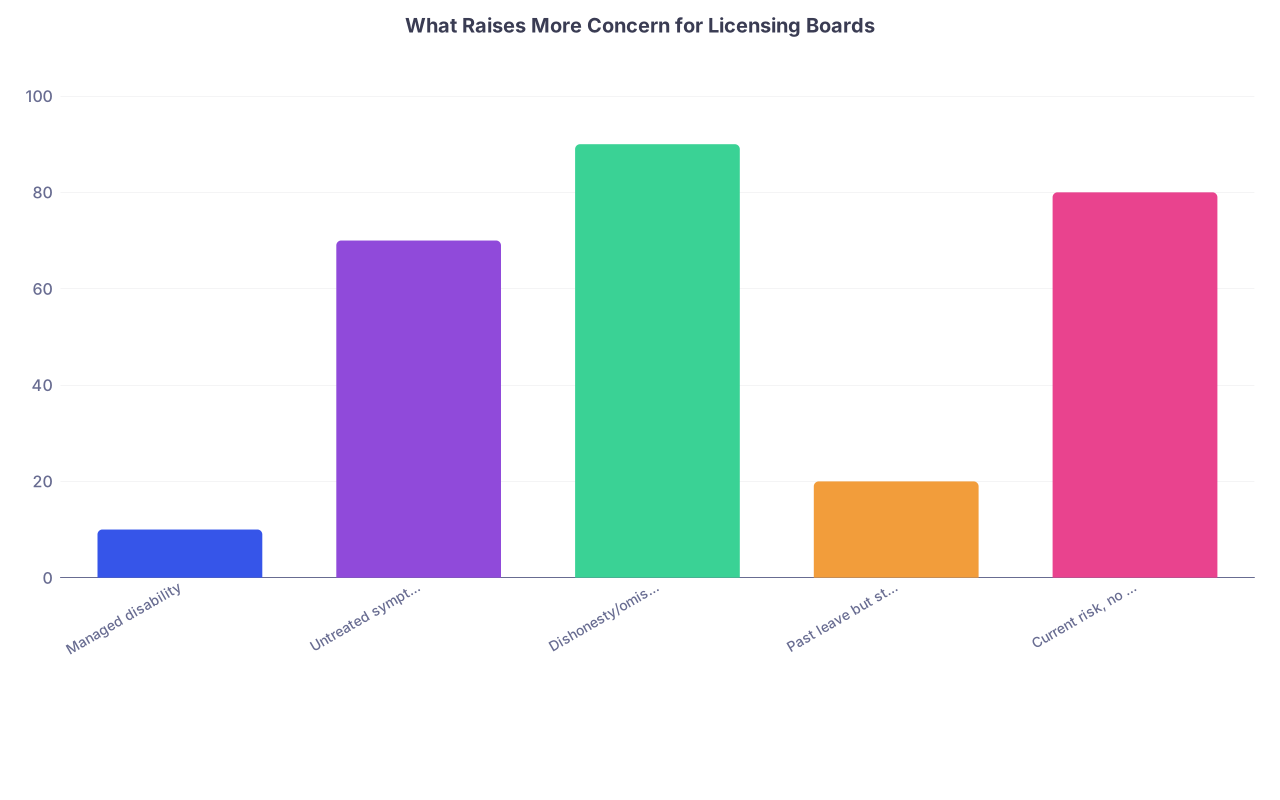
| Category | Value |
|---|---|
| Managed disability | 10 |
| Untreated symptoms | 70 |
| Dishonesty/omission | 90 |
| Past leave but stable | 20 |
| Current risk, no plan | 80 |
Your disability, by itself, is rarely the problem. Your story about it can be.
Big mistake: assuming boards think like exam accommodations offices
They do not.
Testing agencies:
“Prove to us you are impaired enough to need accommodations.”
Licensing boards:
“Prove to us you are stable and safe enough to practice.”
If you reuse language or documentation designed for accommodations—loaded with “functional impairment,” “severe limitations,” “significant deficits”—without recontextualizing it for clinical safety and stability, you are talking to the wrong audience in the wrong language.
7. Sloppy, DIY Documentation That Looks Amateur
Another preventable red flag: disability explanations that look unprofessional, inconsistent with other materials, or obviously “home‑written” without any clinician input.
This is where small mistakes add up:
- You describe a diagnosis your clinician never actually documented.
- Your personal statement says you took a leave for “family reasons,” but your disability statement says it was for severe depression.
- You reference a recent psychiatric hospitalization that is nowhere in your medical school file.
Boards see this and think: “What else are we not being told?”
Use your clinicians strategically
You do not want a 20‑page psychoeducational report thrown at the board without translation. But you also do not want a completely free‑form personal narrative with no external support.
What works best is a combination:
Clinician letter focused on:
- Diagnosis and course
- Current treatment
- Duration of stability
- Fitness to practice
Your statement focused on:
- How it affected training
- How you sought help
- What changed
- How you function now
| Element | Low‑Risk Version | High‑Risk Version |
|---|---|---|
| Diagnosis description | Specific, consistent, time‑bounded | Vague, shifting labels |
| Treatment history | Clear, ongoing or appropriately completed | Minimal, “I handled it myself” |
| Function in training | Concrete examples of safe performance | General claims with no evidence |
| Tone | Factual, reflective, professional | Emotional, angry, or defensive |
If your treating clinician is clueless about what licensing boards need, ask specifically for a “fitness to practice” style summary, not a therapy note printout.
8. Over‑or Under‑Disclosing: Picking the Wrong Battles
Some applicants dump every diagnosis they have ever collected into one disclosure. Others leave out serious conditions because they are scared. Both are mistakes.
Over‑disclosure risk
Listing every minor or historical diagnosis (e.g., “adjustment disorder in high school,” “provisional ADHD that was later ruled out”) clutters your story, raises unnecessary questions, and distracts from what matters.
If you present a chaotic diagnostic history—five different labels, multiple “rule out” comments, no clear resolution—boards worry about instability and lack of insight.
Under‑disclosure risk
On the flip side, failing to mention:
- A recent inpatient psychiatric admission
- A documented substance use disorder
- A formal fitness‑for‑duty evaluation
- A leave explicitly coded for mental health
when asked directly about “conditions affecting your ability to practice” is playing with fire. When they inevitably find it—through school reports, NPDB, or references—you are now in the category boards hate most: dishonest applicant.

| Step | Description |
|---|---|
| Step 1 | Condition or event |
| Step 2 | Disclose with context |
| Step 3 | Usually no disclosure needed |
| Step 4 | Documented in school or official records |
| Step 5 | Past 5 years or still active |
| Step 6 | Currently affects ability to practice |
The general rule:
If it is documented in official records and reasonably recent or still relevant, you are safer acknowledging it with a strong story of recovery and stability than pretending it does not exist.
9. Forgetting That Timing Matters
Licensing boards are much more concerned about recent, destabilizing events than remote, resolved ones.
A panic attack in college 10 years ago that led to one urgent care visit? Low concern.
A suicide attempt 8 months ago during residency? High concern—even if you feel “fine now.”
What many people do wrong is flattening the timeline, presenting everything as one undifferentiated “I have always struggled” narrative. That erases the recovery arc and makes instability look continuous.
Show the arc clearly
Better structure:
- When the problem emerged
- When it was worst
- What interventions you used
- How long improvement has been sustained
- Concrete markers of stability (successful rotations, residency years, evaluations)
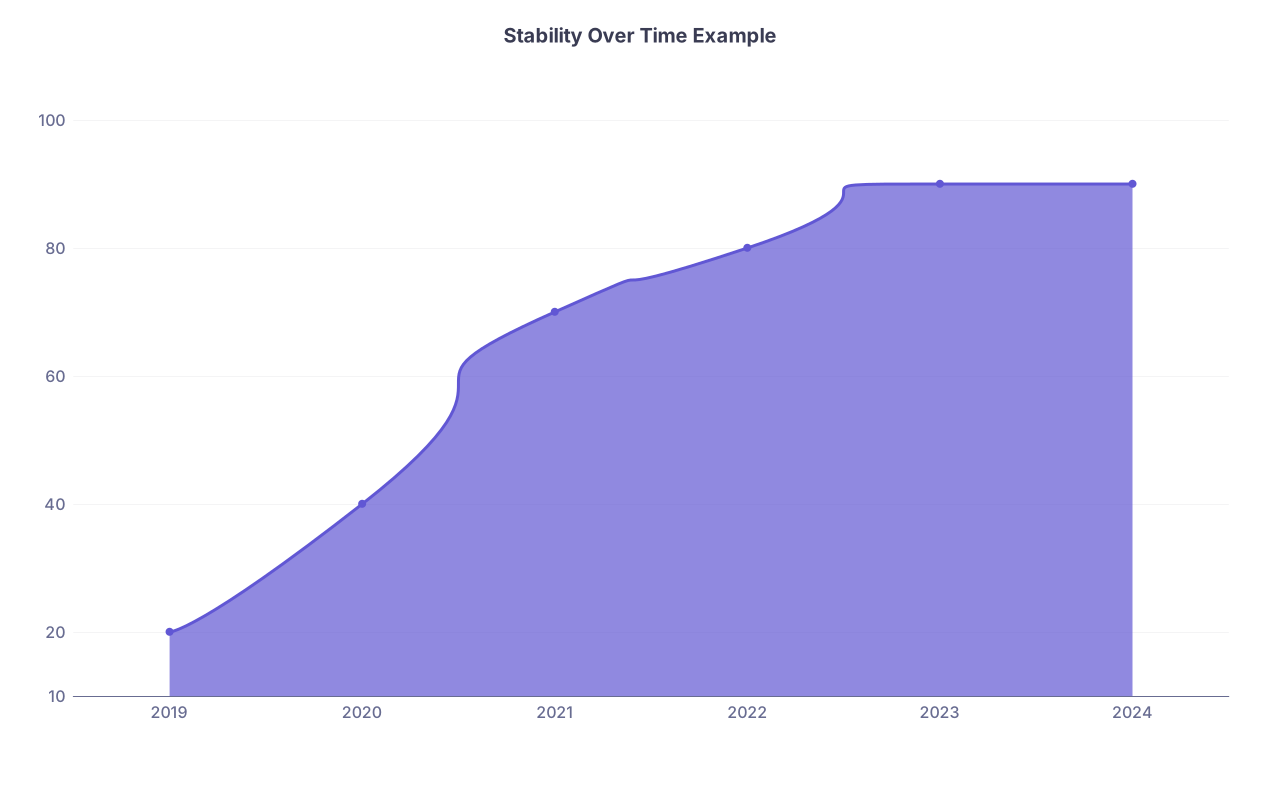
| Category | Value |
|---|---|
| 2019 | 20 |
| 2020 | 40 |
| 2021 | 70 |
| 2022 | 80 |
| 2023 | 90 |
| 2024 | 90 |
You want your narrative to look like that: a clear upward trend, not a flat line of chaos with no resolution.
10. Writing It Alone, Late, and in Panic Mode
Here is the hard truth: the night before your licensing application is due is the worst possible time to invent your disability narrative.
People in that situation:
- Copy‑paste language from old neuropsych reports that make them sound dangerously impaired.
- Ramble, overshare, and contradict themselves.
- Forget to run it by anyone who understands both disability law and medical culture.
Do not do that to yourself.
Get this right early:

| Step | Description |
|---|---|
| Step 1 | Identify what must be disclosed |
| Step 2 | Review school records |
| Step 3 | Consult disability lawyer or advisor |
| Step 4 | Get focused clinician letter |
| Step 5 | Draft your statement |
| Step 6 | Have trusted mentor review |
| Step 7 | Finalize language for applications |
This is not overkill. Your wording here can control how many extra months—or years—of hoops you must jump through.
FAQs
1. Should I ever avoid mentioning my disability to a licensing board?
You should never lie or omit in response to a direct, clearly applicable question. The nuance is in how much you say and which conditions are meaningfully related to your current ability to practice. Remote, minor, fully resolved issues that were never in official records and do not affect you now usually do not belong in your licensing narrative. Significant conditions that led to leaves, hospitalizations, or formal evaluations almost always do—paired with a strong account of treatment and stability.
2. Do I need a lawyer to handle my disability disclosure?
You do not always need a lawyer, but it is dangerously common to regret not at least getting a brief consultation, especially if you have: a formal psychiatric hospitalization, a substance‑related incident, a fitness‑for‑duty evaluation, or an adversarial history with your school or program. At minimum, someone who understands both disability law and medical board expectations should look at your draft. Blindly sending an emotional, DIY statement is how you walk into avoidable monitoring.
3. How specific should I be about my diagnosis?
Specific enough that it is medically meaningful and consistent with your record, but not so detailed that you relive your entire psychiatric history. “Major Depressive Disorder,” “Generalized Anxiety Disorder,” “ADHD, combined type,” or “Type 1 Diabetes” are appropriately specific. Long lists of comorbidities, provisional diagnoses, and speculative labels are not helpful. The board wants to understand the main condition, how it affected you, and how it is now controlled—not every ICD code you have ever been near.
4. What is one concrete step I can take right now to reduce risk?
Pull up your last formal disability documentation—neuropsych report, psychiatrist letter, or accommodation approval—and read it as if you were a board member asking, “Is this person safe to practice independently?” Highlight any sentences that make you look dangerously impaired without mentioning treatment, stability, or success in clinical work. Those are the exact phrases you must not copy into your licensing forms. They need to be reframed, updated, or balanced with clear evidence of current function before you ever hit “submit.”
Open that document today and start highlighting.