
It’s July 5th. Your new academic year calendar just dropped into your inbox. Buried in the excitement and dread is a quiet, annoying reality: your disability accommodation letter expires soon, and you have no idea when to start the renewal circus.
If you get this wrong, you lose accommodations—at least temporarily. Miss a deadline, and suddenly you’re sitting in an exam without extra time, or you’re on a clinical rotation without the modified schedule you rely on.
Let’s not do that.
Here’s your annual renewal timeline for accommodation letters and documentation—month by month, then week by week as you get close, and down to specific day-by-day moves right before things expire.
Big Picture: Your Year-at-a-Glance Accommodation Timeline
Before we zoom in, you need a mental map. Most schools and hospitals run on one main cycle:
- Accommodation letters usually:
- Expire end of academic year (often May–June), or
- Need re-activation each new term (semester/quarter), even if documentation is “good for several years.”
- Documentation (like psychoeducational testing or medical letters):
- Has a validity window (often 3–5 years for ADHD/LD testing, 1–2 years for some medical conditions, 6–12 months for temporary conditions).
At this point, you should find out two key dates:
- Letter renewal date – When your current accommodation letter stops being honored.
- Documentation expiration date – When your underlying documentation is considered “too old.”
If you cannot answer those in 30 seconds, you’re flying blind.
Month-by-Month: The Annual Renewal Cycle
Assume your new academic year starts in August and your current accommodations were approved for this past year.
Adjust months if your calendar is shifted, but keep the sequence.
JANUARY–FEBRUARY: Quiet Prep and Documentation Check
This is where most people screw up by doing nothing. You’re halfway through the year; future-you needs help.
At this point, you should:
- Pull up:
- Your last formal documentation (psych testing, physician letter, audiology, etc.).
- Your most recent accommodation determination letter from Disability Services (DS/Accessibility Office).
- Check three things:
- Date of evaluation/letter.
- Any phrases like:
- “Valid for X years”
- “Must be updated by [date]”
- Your institution’s documentation policy on their website.
If your documentation will be older than their limit by next August, you’re on the clock.
If documentation will still be valid next year:
- Make a note:
- “Accom renewal – contact DS by [date 3–4 months before classes].”
If documentation will be too old by next year:
At this point, you should:
- Book:
- Psychologist/psychiatrist for ADHD/LD or mental health conditions (these fill up fast).
- Specialist (neurology, rheumatology, ophthalmology, etc.) if your condition is under their care.
- Primary care if they coordinate your letter.
Give yourself 2–3 months from appointment to having written documentation in your hands. Clinics are slow. People go on vacation. Your chart note is not the same as an accommodation letter.
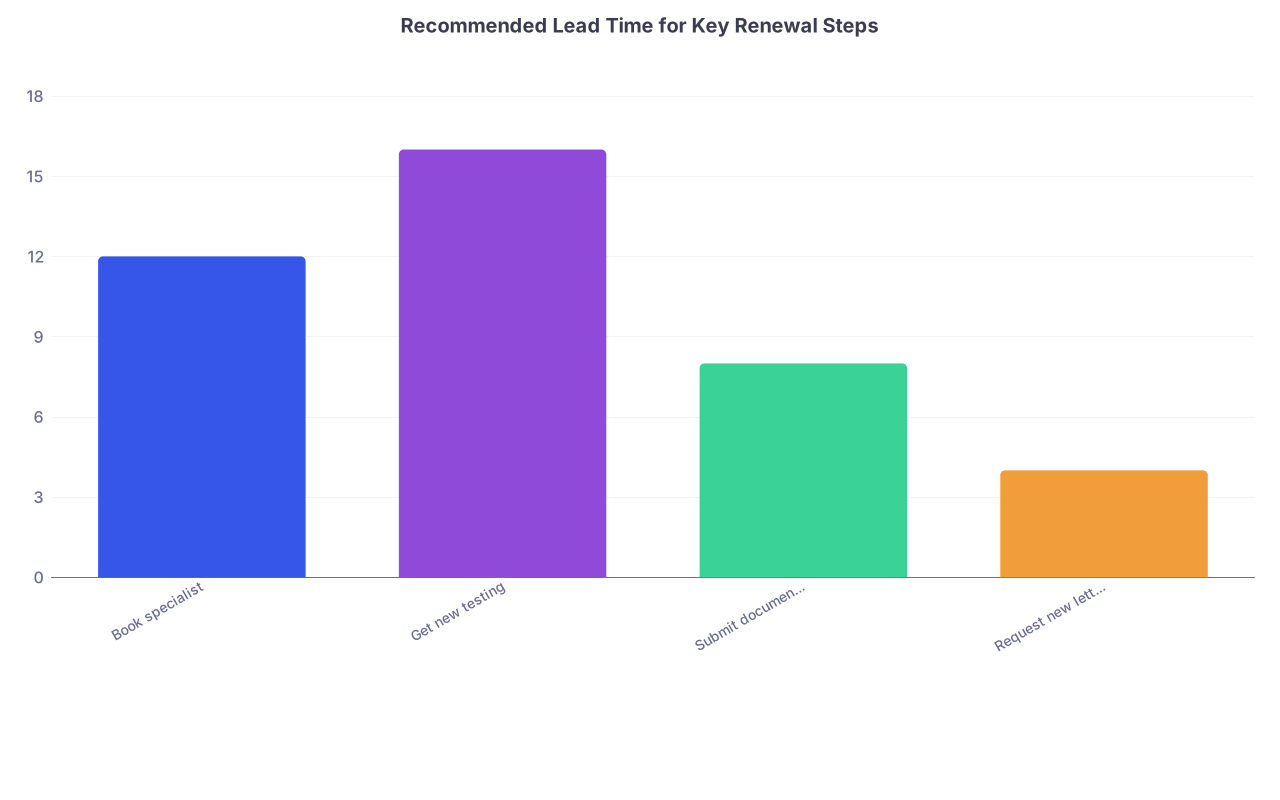
| Category | Value |
|---|---|
| Book specialist | 12 |
| Get new testing | 16 |
| Submit documentation | 8 |
| Request new letters | 4 |
(Values in weeks before the new academic year.)
MARCH–APRIL: Documentation in Motion
By now, you either:
- Have appointments scheduled, or
- You’re staring at full calendars and waitlists. Which is why you start this early.
At this point, you should:
- Attend your evaluation/appointments.
- Tell each provider explicitly:
- “I use accommodations at [school/hospital]. I need a letter that states diagnosis, functional limitations, and recommended accommodations, following [institution] guidelines.”
- Send them your school’s provider documentation form if one exists. Many disability offices have PDFs like “Provider Form for ADHD Documentation.”
Clarify timing:
- “I need this letter by [date], to submit for accommodations for next academic year.”
Do not assume “oh, they know.” They don’t. You will not be their only priority.
MAY: Closing Out Current Year and Locking in Next
This is transition month. Finals. Rotations ending. Everyone is distracted. Disability offices too.
At this point, you should:
Confirm documentation status:
- Do you have updated letters/testing in your possession or on file?
- If not, email the provider: “Just checking on the status of my documentation letter for [condition]. I need to submit it by [date].”
Check your institution’s renewal rules:
- Do they:
- Require a fresh request every year?
- Auto-renew if documentation is still valid?
- Have an online portal where you “re-activate”?
- Do they:
Ask DS directly (email or portal message):
- “My current accommodations are approved through [current year]. What is the earliest date I can submit renewal/continuation for the next academic year, and what do you need from me?”
Get it in writing. Policies get “interpreted” loosely sometimes.
JUNE: The Actual Renewal Request
This is where your proactive work pays off.
At this point, you should:
- Submit:
- Updated documentation (if required).
- Formal request to continue or adjust accommodations.
If there’s a portal:
- Upload documentation.
- Select each accommodation you’re requesting again (extended time, reduced distraction room, note-taker, modified clinical schedule, etc.).
- Add a brief note if you’re asking for any changes (e.g., “Requesting to add breaks during long OSCEs due to worsening symptoms”).
If there’s an email-only system:
- Subject line like: “Accommodation Renewal Request – [Your Name, Program, Grad Year]”
- In the body, include:
- That you are requesting continuation for the upcoming academic year.
- Any changes in your condition.
- Any new accommodations you’re asking for and why.
This is also a good time to decide: Do you need different accommodations for clinical vs didactic phases? If you’re moving into clerkships, say it now, not three days before ICU.
JULY: Meetings, Clarifications, and Letter Generation
Disability offices tend to triage in July. Lots of incoming students. You blend into the noise if you wait too long.
At this point, you should:
Respond quickly to any DS emails:
- Requests for clarification.
- Requests for release forms.
- Requests for more specific documentation.
Schedule a follow-up meeting (virtual or in person) if:
- You’re starting a new type of curriculum (pre-clinical → clinical, clinical → residency).
- Your health has changed significantly.
- You’re requesting new accommodations (scribe, reduced call, flexible attendance, etc.).
Goal by end of July:
- You have:
- A formal approval email for next year accommodations, and
- A way to generate or request new accommodation letters for each relevant person (course directors, clerkship coordinators, GME office, exam proctors).
AUGUST: New Term Activation and Letter Distribution
This is where a lot of people drop the ball. They think “approved” = “everyone magically knows.” They don’t. Faculty are not telepathic and often not looped in.
At this point, you should:
Log into the DS portal (or email) and send accommodation letters to:
- All current course directors.
- Exam coordinators.
- Clerkship directors/rotation coordinators.
- Simulation center if OSCE/skills labs are covered separately.
Do this before classes start or at least:
- 2–3 weeks before your first exam.
- 4–6 weeks before a major national exam (NBME subject, OSCE, in-house boards).
For clinical rotations:
- Send letters at least 2–4 weeks before the start of each rotation to:
- Clerkship director.
- Clerkship coordinator.
- Sometimes the site director if they’re different.
Then, crucial step most people skip:
- Ask each faculty/coordinator directly:
- “Can you confirm you’ve received my accommodation letter and that we can implement [key accommodation] on this rotation/course?”
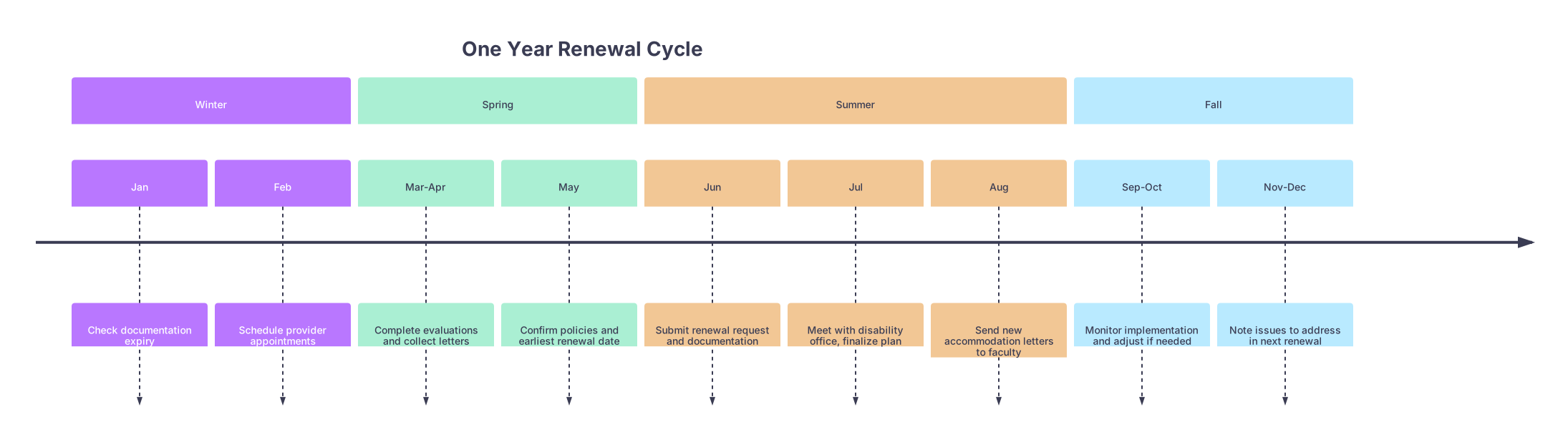
| Period | Event |
|---|---|
| Winter - Jan | Check documentation expiry |
| Winter - Feb | Schedule provider appointments |
| Spring - Mar-Apr | Complete evaluations and collect letters |
| Spring - May | Confirm policies and earliest renewal date |
| Summer - Jun | Submit renewal request and documentation |
| Summer - Jul | Meet with disability office, finalize plan |
| Summer - Aug | Send new accommodation letters to faculty |
| Fall - Sep-Oct | Monitor implementation and adjust if needed |
| Fall - Nov-Dec | Note issues to address in next renewal |
SEPTEMBER–DECEMBER: Mid-Year Adjustments and Future-Proofing
Now you’re living with the accommodations. This is where you collect evidence and patterns for next year’s renewal.
At this point, you should:
Keep a running note (phone or simple doc) with:
- Courses/rotations where accommodations:
- Worked smoothly.
- Were ignored, delayed, or problematic.
- Specific incidents (dates, emails, who said what).
Example: “Neuro clerkship, Week 2 – preceptor refused extra time for mid-rotation quiz despite letter. Email sent to clerkship director on [date].”
- Courses/rotations where accommodations:
If things are not being honored:
- Email DS:
- “Here is what is happening. Here are my approved accommodations. Please advise on next steps.”
- Email DS:
Why this matters for renewal:
- DS will absolutely look at:
- Your documented patterns.
- Whether accommodations remain appropriate.
- Whether additional supports or modifications are warranted.
You’re building your case throughout the year—not in a panicked week next May.
When Documentation Itself Expires: Extra Timeline Layer
Accommodation letters are one thing. The underlying documentation is a separate clock.
Here’s how the timing usually plays out for common categories:
| Condition Type | Typical Validity | Action Lead Time |
|---|---|---|
| ADHD / Learning Disorder | 3–5 years | 4–6 months |
| Mood / Anxiety Disorders | 1–2 years | 3–4 months |
| Chronic Medical (e.g. MS, RA) | 1–3 years | 3–4 months |
| Sensory (vision/hearing) | 2–3 years | 3–4 months |
| Temporary conditions (injury, surgery) | 3–12 months | 2–4 weeks |
At this point (if your documentation is expiring this cycle), you should:
Work backwards from:
- First high-stakes event next year (e.g., Step exam, OSCE, in-person board).
- Your institution’s documentation age limit.
Example:
- You want accommodations for Step 2 CK in June next year.
- Testing must be <5 years old.
- Your last full eval was May 5, five years ago → you are at the edge.
- You schedule new testing by January, so you’ll have updated documentation well before you apply to NBME/USMLE for accommodations.
Week-by-Week: The 6-Week Crunch Before Renewal
Now zooming into the danger zone: about six weeks before your accommodation letter expires or before your next academic year begins.
Assume your new term starts August 15. Adjust dates, keep sequence.
6 Weeks Before (early July)
At this point, you should:
- Confirm:
- Your request for renewal has been submitted to DS.
- All required documentation is uploaded.
- Email DS if you’ve heard nothing:
- “I submitted my renewal request on [date]. Can you confirm it’s in queue and let me know if anything else is needed?”
5 Weeks Before
At this point, you should:
- Request (if your office uses them) draft accommodation letters for:
- Didactic courses.
- Clinical rotations.
- Exam proctors.
- If your renewal isn’t approved yet:
- Ask for a timeline explicitly:
- “Given that my coursework/rotations start on [date], will a decision be made before then?”
- Ask for a timeline explicitly:
4 Weeks Before
At this point, you should:
Start building your distribution list:
- List every person who needs a letter:
- Course directors for Block 1, 2, 3.
- Clerkship directors for the first 2–3 rotations.
- Exam office contact for major tests.
- List every person who needs a letter:
Prepare template emails to send with your letters. Short and neutral:
- “Dear Dr. X,
I’ve attached my approved accommodation letter for the upcoming [course/rotation]. I’d appreciate confirming how we can best implement [key accommodation] for assessments and daily activities. Thank you.”
- “Dear Dr. X,
You can drop in the letter as a PDF or send through the portal—whatever your institution uses.
3 Weeks Before
At this point, you should:
- Send first wave of letters to:
- Any courses/rotations starting within 4–6 weeks.
- Ask for written confirmation:
- Not just “got it,” but how they’ll operationalize it.
If your renewal is still pending:
- Escalate politely:
- “Since my term begins on [date] and my first assessment is on [date], I’m concerned about having accommodations in place. Is there any missing information I can provide, or can my current accommodations be extended temporarily?”
2 Weeks Before
At this point, you should:
Double-check:
- Every person who replied.
- Every person who did not reply.
For non-responders:
- Send a short follow-up:
- “Just following up on my accommodation letter for [course/rotation] starting [date]. I want to ensure we’re aligned on implementing [key accommodation] before the first [exam/shift].”
- Send a short follow-up:
If DS has not finalized renewal by now and your start date is near, it’s time to:
- Call or walk in if possible.
- Be clear: “My coursework/rotation begins in two weeks. I need to know if accommodations will be active or if I need to plan for contingency.”
1 Week Before
At this point, you should:
- Lock in details:
- Exact exam room and check-in procedure if you get a separate location.
- How breaks, stop-the-clock time, or assistive tech will be handled.
- For clinical:
- Clarify schedule expectations, call duties, any modified tasks.
This is not the time to “hope it works out.” You want zero ambiguity by this week.
48–72 Hours Before Start
At this point, you should:
- Reconfirm logistics for any day 1–3 assessments.
- Have:
- Printed or easily accessible digital copies of your accommodation letter.
- Names of who to contact if something goes wrong (DS contact, course coordinator, clerkship director).
If you walk into an exam or rotation and your accommodations are not set:
- Use a calm script:
- “My accommodations are approved for this course. Here is my letter. I’m not comfortable proceeding without the agreed accommodations. Can we contact [DS contact] right now?”
You do not have to “accept” a bare-minimum, on-the-fly solution that violates your letter—though in the moment, you might choose a compromise and then follow up formally after.

Special Timelines: Board Exams and External Testing
If you’re in medicine, pharmacy, PT, nursing, or any health profession, your licensing and board exams have their own accommodation timelines. Often brutal.
At this point (6–12 months before the exam), you should:
- Check:
- The exam board’s accommodation requirements.
- Documentation age limits.
- Whether they require more detailed testing than your school.
Common pattern:
- NBME/USMLE-type exams:
- Want full psychoeducational testing for ADHD/LD within 3–5 years.
- Want documentation that explicitly ties:
- Diagnosis → Functional impairment → Requested accommodations.
- They may require:
- Your school’s accommodation history (letters, policy, duration of use).
So your school’s annual renewal is not just for them—it’s evidence for external boards.
Timeline rule of thumb:
- For a big licensing exam:
- Submit your accommodations request 4–6 months before your intended test date.
- Work backwards so your documentation and school letters are updated well before that.
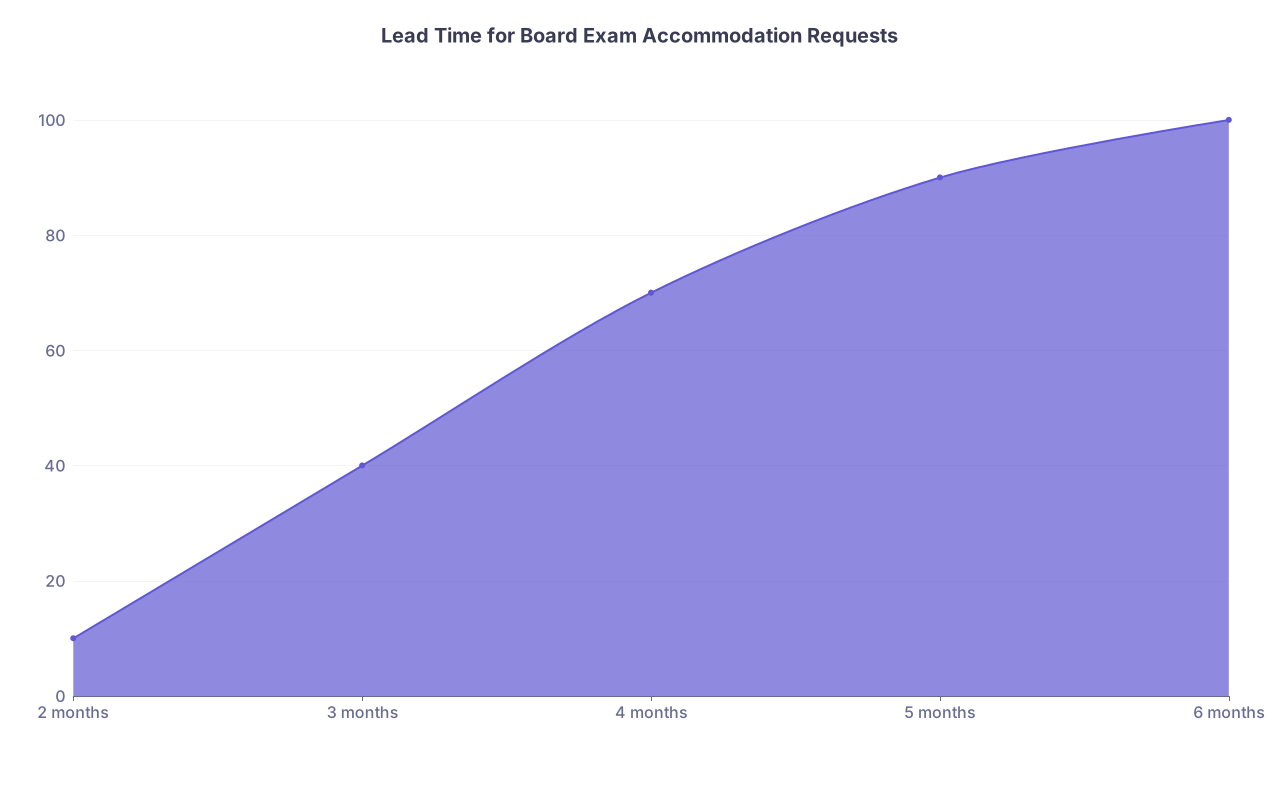
| Category | Value |
|---|---|
| 2 months | 10 |
| 3 months | 40 |
| 4 months | 70 |
| 5 months | 90 |
| 6 months | 100 |
(Percent chance you avoid last-minute crises as lead time increases.)

Common Renewal Pitfalls and How to Time-Avoid Them
I’ve watched the same problems repeat every year. They’re all timing issues disguised as “bad luck.”
At this point (right now), you should be aware of:
Pitfall 1: Waiting for symptoms to ‘get bad again’ before renewing.
- Fix: Renew on schedule regardless of how you feel this month. You don’t earn accommodations by suffering more first.
Pitfall 2: Assuming once-in-a-lifetime documentation is enough.
- Fix: Check the age limit policy yearly. Put the expiration into your calendar like an actual deadline.
Pitfall 3: Not updating DS on clinical-phase demands.
- Fix: Schedule a specific “pre-clinical-to-clinical” meeting 3–6 months before rotations start.
Pitfall 4: Only thinking about accommodations when something goes wrong.
- Fix: Use the month-by-month approach. Renewal is a predictable cycle—treat it like immunizations, not emergencies.

A Simple, Repeatable Annual Checklist
Here’s the cycle boiled down:
January–February
- Check when your documentation and current accommodations expire.
- Book any needed evaluations 4–6 months ahead.
March–April
- Complete evaluations.
- Request letters that follow your school/board criteria.
May
- Confirm your school’s renewal requirements and earliest submission date.
- Clarify if you need separate processes for didactic, clinical, and board exams.
June
- Submit renewal request + updated documentation to DS.
July
- Meet with DS if needed.
- Finalize decision and access to new accommodation letters.
August
- Send letters to faculty/clinical coordinators.
- Confirm implementation details before first assessments/rotations.
September–December
- Track what works/doesn’t.
- Note anything you’ll want changed at the next renewal.
Your Next Move Today
Do one concrete thing now:
Open your disability office’s last email or portal message and write down two dates:
- When your current accommodations expire.
- When your documentation will be too old under their policy.
Then add a calendar event 3–4 months before each date with the title:
“Accommodations – START RENEWAL PROCESS.”
That tiny step flips you from reactive to ahead of schedule.