
It is July 1. Your ID badge still smells like fresh laminate. You just started third-year clinical rotations with a brand‑new limitation: maybe long‑COVID fatigue, a recent mobility change, new hearing loss, a flare of Crohn’s that now needs a bathroom nearby. Whatever the diagnosis, the key fact is this:
Last time you were in a hospital as a student, your body and brain worked differently.
Now you are expected to function in 10‑ to 12‑hour clinical days, in a system that barely adapts to anyone.
Here is the timeline I would use—month by month, then rotation by rotation—with very explicit “at this point you should…” checkpoints. This is written assuming a traditional 12‑month third year with 4‑ to 8‑week core rotations, but you can adapt the logic to whatever calendar your school uses.
Overview Timeline: Year At A Glance
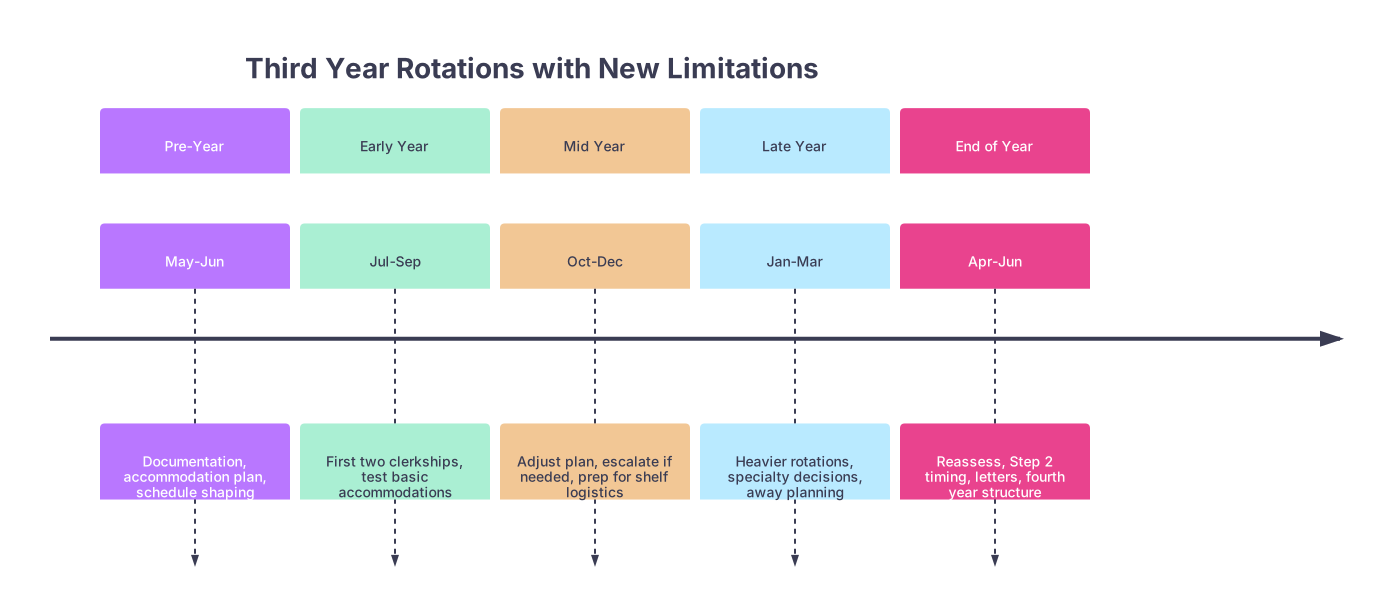
| Period | Event |
|---|---|
| Pre-Year - May-Jun | Documentation, accommodation plan, schedule shaping |
| Early Year - Jul-Sep | First two clerkships, test basic accommodations |
| Mid Year - Oct-Dec | Adjust plan, escalate if needed, prep for shelf logistics |
| Late Year - Jan-Mar | Heavier rotations, specialty decisions, away planning |
| End of Year - Apr-Jun | Reassess, Step 2 timing, letters, fourth year structure |
At each phase, your goals are different:
- Early: Prove what actually works for your body, not what looks good on paper.
- Mid‑year: Fix what is breaking, escalate formally if needed.
- Late: Protect your shelf exams, your Step 2 window, and your letters of recommendation.
1–2 Months Before Third Year Starts
You are not on the wards yet. Emails about “clinical orientation” are piling up. This is the last calm stretch.
At this point you should:
-
- Get updated notes from:
- Specialist (neurology, rheumatology, psychiatry, etc.).
- PT/OT if mobility or stamina is affected.
- Audiology/ophthalmology if sensory.
- Documentation must spell out:
- Functional limitations (cannot stand > X hours, needs bathroom access within Y minutes, cannot lift > Z lbs, needs speech‑to‑text, etc.).
- Duration (permanent, 6 months, “expected to fluctuate,” etc.).
- Impact on cognition, stamina, and overnight work if relevant.
- Get updated notes from:
Meet disability services with a clinical-year lens Do not accept an “extended test time only” template. That is pre‑clinical thinking.
Ask explicitly:
- How have you accommodated:
- Mobility devices on surgery or OB?
- Students who cannot do overnight calls?
- Students with restricted lifting for IM/peds floor months?
- Students who need frequent breaks away from fluorescent lighting or noise?
- Who talks to:
- Clerkship directors?
- GME (if there are shared policies)?
- Exam proctors for shelves/OSCEs?
- How have you accommodated:
Shape your rotation order intentionally
You are not a passive victim of the scheduling algorithm. Push.
Aim for:
- Front‑loading “flexible” rotations (family med, psych, outpatient IM) while you learn your real limits.
- Avoiding surgery + OB/GYN back‑to‑back if stamina and standing are issues.
- Avoiding ICU/overnights first rotation if fatigue, seizures, or med adjustments are in play.
| Priority | Better Early | Better Later |
|---|---|---|
| Fatigue | Psych, FM | Surgery, OB |
| Mobility limits | Outpatient IM, Neuro clinic | Trauma, ICU |
| GI/Bladder issues | Psych, Derm | OR-heavy blocks |
| Sensory (hearing/vision) | Outpatient subspecialties | High-noise ED, OR |
- Define your non‑negotiables in writing
One page. Plain language. This is your script for everyone you will meet.
Example:
- “I use a rollator for distances and cannot stand in one place for prolonged periods.”
- “I need predictable access to a restroom every 2–3 hours.”
- “I have documented cognitive fatigue; I perform best with short task lists rather than rapid‑fire multi‑step instructions.”
This is not for ERAS. This is for:
- Clerkship directors
- Site coordinators
- Chief residents
Month 1: Orientation + First Rotation (Weeks 1–4)
You are on the wards. Suddenly, all the glossy talk about “wellness” collides with 5 a.m. pre‑rounds.
Week 1: Controlled introduction
At this point you should:
Confirm your accommodations in writing for this specific clerkship
- Email the clerkship director and coordinator:
- 3–5 bullet points from your non‑negotiable list.
- Ask: “How do you recommend I share this with my residents and attending team?”
- Do not rely on “the system communicated it.” Often, it did not.
- Email the clerkship director and coordinator:
Do a “day 1–3 reality check” Track:
- Hours in hospital
- Standing/sitting ratios
- Breaks (actual vs needed)
- Pain/fatigue level at midday and end of day (0–10 scale)
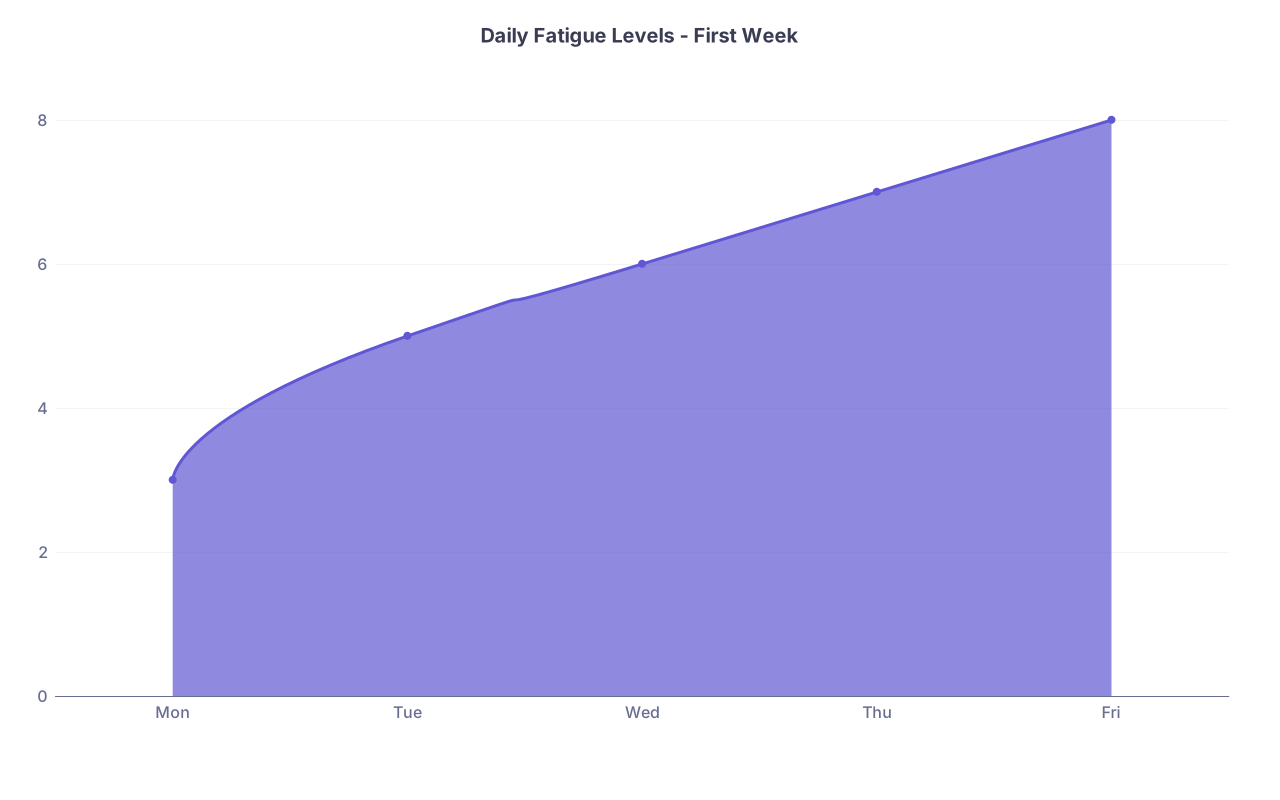
| Category | Value |
|---|---|
| Mon | 3 |
| Tue | 5 |
| Wed | 6 |
| Thu | 7 |
| Fri | 8 |
If you are ending every day at 8–9/10 fatigue, you are redlining. That will not be sustainable for 8 weeks.
- Decide how you introduce your limitation to the team
Short, neutral, functional. Example:
- “I have a condition that limits how long I can stand in one place. I will move to a stool or sit when possible, but I am able to participate fully in patient care.”
- “I use a hearing aid; if you are giving me complex instructions, please face me and speak clearly.”
Week 2: First adjustment cycle
At this point you should:
Identify one or two concrete problems:
- “Rounds routinely go 3+ hours without a bathroom break.”
- “I am being assigned every single heavy chart pull / transport task.”
- “I cannot hear attendings during OR cases; this is impacting my learning and evaluations.”
Decide your escalation route:
- Try the resident/attending:
- “Could we build in a 5‑minute bathroom break midway through rounds? I have a medical condition that requires regular access.”
- If that fails or feels unsafe, go to the clerkship coordinator/director with specifics:
- “On this service, I am consistently unable to use the accommodations already approved. Here are three concrete examples from this week…”
- Try the resident/attending:
Test your energy management routine:
- Pre‑round checklist the night before.
- Small snacks every 2–3 hours.
- Rigid bedtime, even if you study less. Protect your ability to show up functional.
Weeks 3–4: Shelf prep + documentation
At this point you should:
Confirm shelf exam accommodations are actually implemented
- Room location, break policy, extra time, assistive tech.
- Get it all in writing. “We’ll figure it out that week” is code for: “We will forget.”
Log what worked and what failed on this rotation One page, rotation‑specific:
- What helped:
- “Sitting during sign‑out.”
- “Being stationed in clinic rather than wards on flare days.”
- What broke:
- “No wheelchair‑accessible staff restroom near OR.”
- “Pagers only; text‑based backup needed for hearing issues.”
- What helped:
You will not remember the details six months from now when you are re‑fighting the same battles. Write it down now.
Months 2–3: Second and Third Rotations – Pattern Building
You are out of “maybe this will get better” territory. Patterns are appearing.
At this point you should:
- Do a monthly status review with yourself (and ideally disability services)
- Ask three blunt questions:
- Am I staying within my medical limits, or am I quietly harming myself to pass?
- Are my accommodations being honored at least 70–80% of the time?
- Are my evaluations hinting at bias? (Comments about “less enthusiastic,” “not always present,” “less time in OR,” when that is directly tied to accommodations.)
If the answer to any of these is “no” or “maybe,” you need a mid‑course correction, not wishful thinking.
- Refine your accommodation package for specific rotations
By now you know that “one size fits all” is nonsense. Tailor:
- Surgery / OB‑GYN
- Maximum hours scrubbed per day.
- Guaranteed stool or ability to sit during long cases.
- No requirement to run to distant locations with pages.
- Internal Medicine / Pediatrics wards
- Clear cap on daily hours.
- Protected 10‑minute sitting break every X hours.
- Exemption from lifting/transport tasks if mobility limits exist.
- Tighten your communication script
You should have a standard 60‑second script for:
- New attending
- New resident team
- Clinic staff
Example:
- “I have a medically documented limitation that affects my stamina and ability to stand for long periods. My school has approved the following accommodations: I may sit during rounds when able, take brief breaks every few hours, and avoid lifting patients or equipment. I am happy to help in other ways—notes, calls, counseling—but I need to stay within those limits.”
Say it early. Day 1 or 2. Not week 4.
- Monitor for “soft retaliation”
I have seen this too many times:
- Fewer teaching opportunities
- Being left off procedures
- “We just forgot to page you” for interesting cases
Document dates and examples. If a pattern emerges, involve:
- Clerkship director
- Disability services
- Sometimes the dean of students
Bias tied to disability is not “just how this attending is.” It is a legal problem.
Months 4–6: Mid‑Year – Adjust, Escalate, Protect Your Exams
You are now mid‑third year. For many schools, this overlaps with surgery and OB, or other high‑intensity rotations. This is where students with new limitations either burn out or finally push for appropriate change.
Month 4: Stress‑test rotation (often surgery/OB)
At this point you should:
Pre‑negotiate the worst days
- Ask the clerkship:
- Which days routinely go 12+ hours?
- Which call days are mandatory vs optional?
- Propose:
- “I can do one long day per week, but the other days need to stay around X hours, as documented with disability services.”
- Ask the clerkship:
Be explicit about unsafe tasks
- “I cannot safely run with stretchers.”
- “I cannot be on my feet more than X consecutive hours without a seated break.”
- “I cannot function safely past midnight due to seizure risk / medication side effects / etc.”
If you are vague, the system will always default to “but everyone does this.”
Month 5: Shelf exam heavy period
You may have two shelves close together. For students with fatigue, attention, or pain issues, this is where scores can nosedive.
At this point you should:
Plan dedicated recovery time before shelves
- If your school allows, push for:
- A rest day or at least a light clinic day before big exams.
- If not, self‑impose:
- Minimal extra studying the evening before; prioritize sleep and symptom control.
- If your school allows, push for:
Score‑track with disability context
If your shelves are consistently lower than your practice tests, ask:
- Are exam accommodations actually enough?
- Were you in a flare, high pain, or post‑call during multiple exams?
You may need:
- Additional breaks
- Reduced noise testing area
- A modified schedule (not taking an 8‑hour exam the day after a 14‑hour shift)
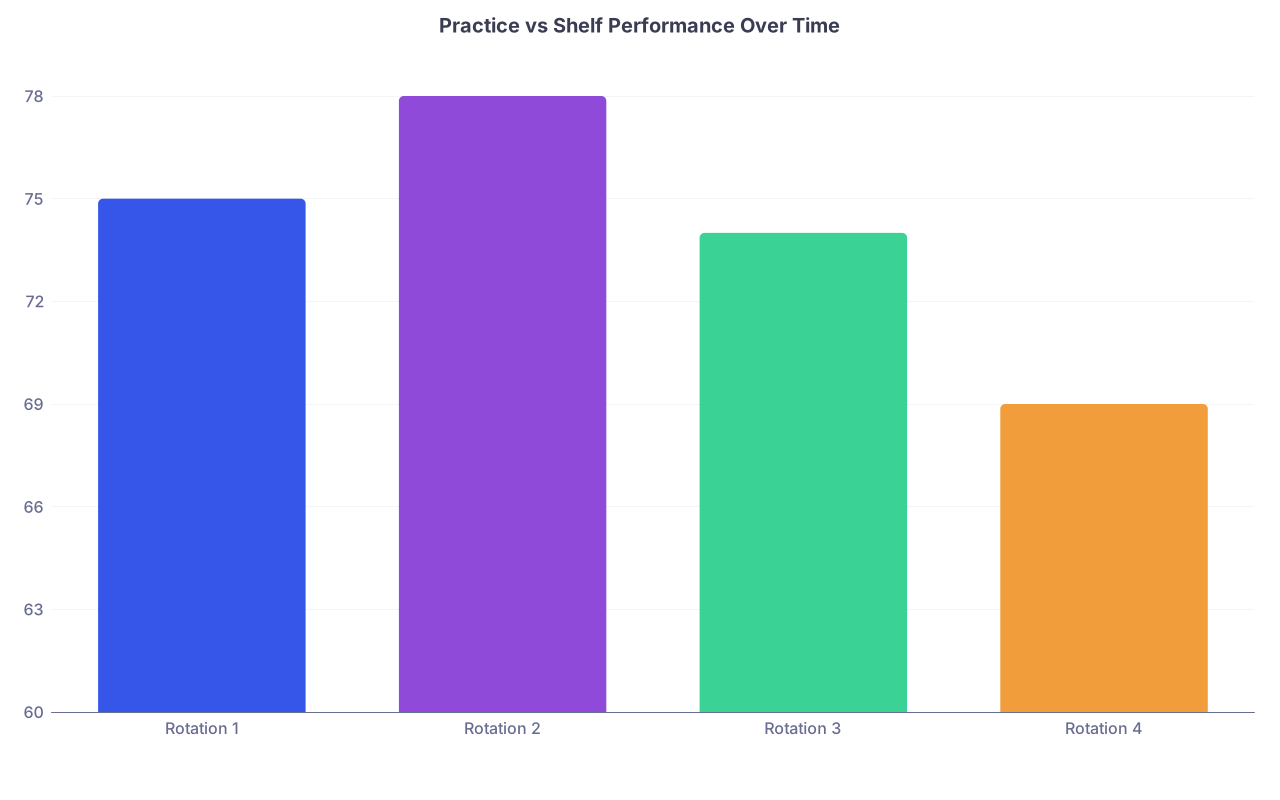
| Category | Value |
|---|---|
| Rotation 1 | 75 |
| Rotation 2 | 78 |
| Rotation 3 | 74 |
| Rotation 4 | 69 |
If you see a downward trend as rotations become more physically demanding, that is data. Use it.
Month 6: Formal reassessment
Mid‑year is the ideal time for a structured reset.
At this point you should:
Meet with disability services + student affairs
- Bring:
- Your documented logs (hours, symptoms, problem days).
- Evaluations where disability clearly intersected with feedback.
- Ask directly:
- “If I continue on this path, can I finish third year safely?”
- “What would a modified schedule or extended graduation look like here?”
- Bring:
Consider schedule restructuring Options I have seen work:
- Spreading a heavy rotation over more weeks at fewer hours / week.
- Doing ICU/overnight‑heavy months in fourth year when you have more control.
- Deferring Step 2 to a lower‑intensity block or a gap between rotations.
Months 7–9: Late Third Year – Future Planning With Limits in Mind
You are now thinking about specialty choice, letters, and Step 2. Your limitations are not hypothetical anymore; you have lived them.
At this point you should:
- Audit which specialties fit your body, not your ego
Be ruthless. If you have a severe standing intolerance, you do not need to grind yourself into the ground proving you “can push through” a surgical career.
Ask:
- On which rotations did I:
- Finish the day with symptoms ≤ 5/10 most of the time?
- Actually enjoy the work enough to forget my body sometimes?
- Receive evaluations that felt fair and not disability‑tinged?
Those are your realistic zones.
- Choose letter writers intentionally
You want attendings who:
- Saw you using accommodations.
- Still respected your work and explicitly commented on adaptability and professionalism.
When you ask for a letter:
- Remind them of your constraints and how you handled them:
- “You may recall I needed to sit during long rounds due to a mobility limitation, but I remained engaged and present. If you are comfortable commenting on my ability to contribute effectively despite accommodations, that would be very helpful.”
- Lock Step 2 timing around your health
Do not drop Step 2 into:
- A flare season you know your condition worsens.
- The middle of two heavy call months.
Instead:
- Identify a 6–8 week window where you can:
- Reduce clinical hours (lighter rotation, vacation, or study elective).
- Stick to a predictable study and sleep schedule.
- Access your usual medical team in case of a flare.
Months 10–12: Final Rotations and Transition to Fourth Year
At this point you are tired, more experienced, and probably less patient with nonsense. Use that.
Month 10: Prep for sub‑internships and acting internships
Sub‑Is are essentially “resident lite.” Brutal for many students with new limitations if not planned right.
At this point you should:
Decide if a traditional sub‑I structure is actually safe
- If your school demands overnight call, define:
- Maximum number of night shifts you can safely do.
- Required recovery time between them.
- If that is not possible, ask for:
- A modified sub‑I with more days, fewer nights.
- Or a different capstone that still satisfies graduation.
- If your school demands overnight call, define:
Re‑confirm with disability services:
- That your accommodations apply to sub‑Is and away rotations.
- How they handle hospitals that are technically separate institutions.
Month 11: Away rotations or specialty‑focused months
If you do aways, accommodation logistics get ugly fast if you do not prepare.
At this point you should:
Contact the visiting student office early
- Send your documentation well in advance.
- Ask:
- “Who is your equivalent of disability services for visiting medical students?”
- “How do you handle clinical accommodations like reduced standing time or no overnight call?”
Clarify evaluation standards
- Some programs still equate hours on site with “work ethic.”
- Ask your home school:
- “If the away site refuses certain accommodations, will you back my decision to withdraw or modify the rotation?”
Month 12: End‑of‑year debrief and fourth‑year structure
You are through the gauntlet. This is where you turn experience into a sustainable plan.
At this point you should:
Write a “year in review” document (2–3 pages) Sections:
- Rotations where accommodations worked well (and why).
- Rotations where they failed (and specific barriers).
- How your health changed across the year.
- Concrete limits you now know:
- Maximum safe weekly hours.
- Number of consecutive days you can handle on service.
- Minimum recovery time after calls, flares, or invasive treatments.
Design fourth year around your body Suggestions:
- Alternating heavy and light months.
- Study or research blocks inserted after demanding rotations.
- Strategic timing of any procedures, med changes, or rehab.
Decide what you will share in residency applications You do not owe programs your diagnostic label. You do need to know:
- That you can fulfill the essential functions of that specialty.
- That you understand how to request and use accommodations without self‑destructing.
Daily and Weekly Micro‑Checkpoints (Any Month)
The big timeline matters, but people actually crack on the micro‑level. So a quick framework.
Daily: 3 questions
At the end of each day, mentally run:
- Did I exceed any of my medical limits today?
- Was that a one‑off or part of a pattern on this service?
- What one boundary can I enforce tomorrow to avoid repeating it?
If you exceed limits more than 2–3 days in a week, it is not “just a bad week.” It is a system problem.
Weekly: Time and symptom log
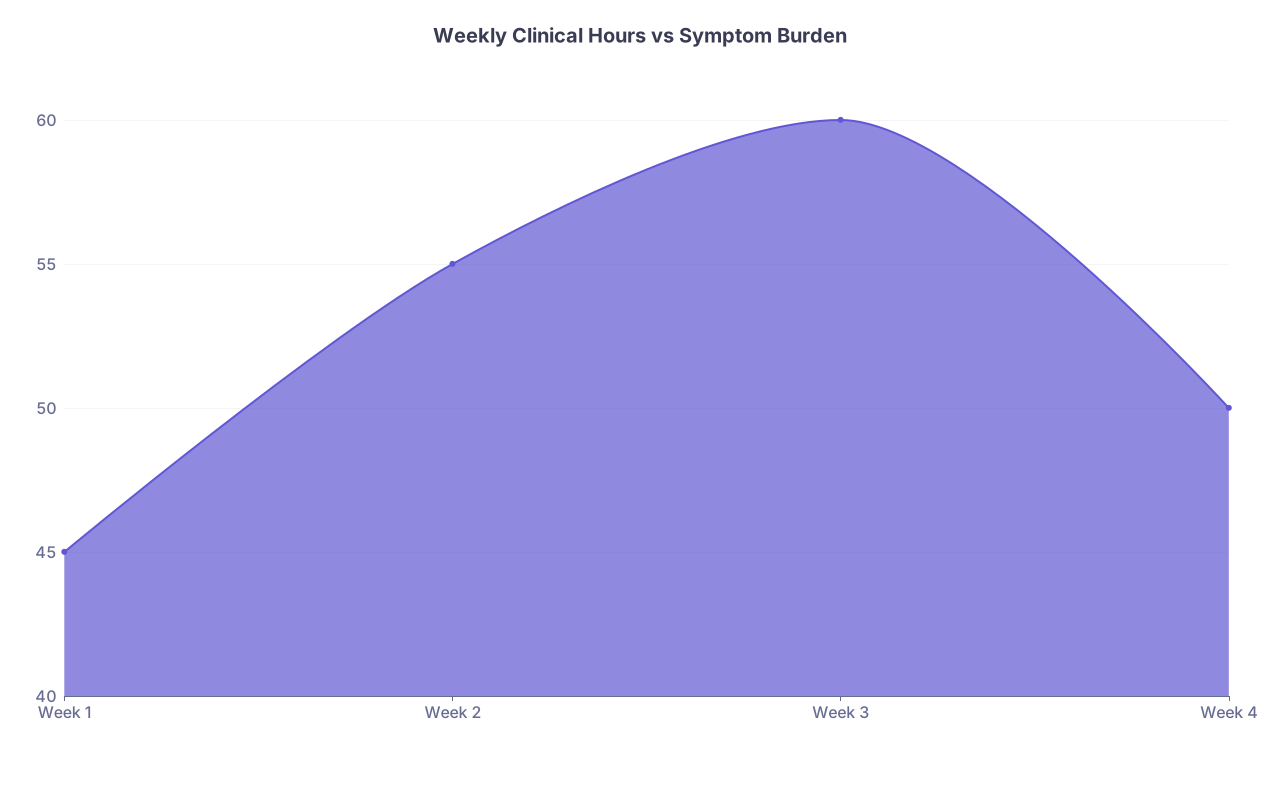
| Category | Value |
|---|---|
| Week 1 | 45 |
| Week 2 | 55 |
| Week 3 | 60 |
| Week 4 | 50 |
Keep a simple note:
- Weekly total hours on site
- Number of nights / calls
- Average symptom score for the week
- Any major flares or safety events
Patterns here will support any request to adjust your schedule.
Visual: Accommodation Escalation Flow
When something is not working, you need a clear route. Use this mental flowchart.

| Step | Description |
|---|---|
| Step 1 | Accommodation not honored |
| Step 2 | Clarify with resident or attending |
| Step 3 | Document resolution |
| Step 4 | Contact clerkship coordinator |
| Step 5 | Email clerkship director and disability office |
| Step 6 | Involve dean or ombuds |
| Step 7 | Adjust rotation or site |
| Step 8 | Problem resolved |
| Step 9 | Coordinator helps |
| Step 10 | Safety or legal concern |
Closing: Three Anchors To Keep You Oriented
Third year is not a test of how completely you can ignore your limitations. It is a year‑long experiment in how to practice medicine without destroying your body or brain.
At each month‑level checkpoint, ask: “Can I sustain this schedule and symptom level for another three months?” If the answer is no, you change the schedule, not your pain tolerance.
Document everything—what helps, what harms, who supports you, who obstructs you. That record is your leverage for better accommodations now, and your blueprint for a residency that actually fits the physician you are becoming, not the one pre‑illness you used to imagine.