The biggest mistake disabled med students make is waiting until they’re in crisis to build a paper trail. By the time you “really need” accommodations, you’re already behind.
Here’s the fix: you treat disability documentation like you treat Step prep—long game, structured, and proactive. Year by year, semester by semester.
This is your MS1–MS4 timeline for when to start building (and updating) your disability paper trail—so when you say, “I need X accommodation,” you’ve got clean, dated, specific proof ready to go.
Big Picture: What Your Disability Paper Trail Should Look Like by Graduation
By the time you graduate, you want a folder—physical and digital—that could survive a hostile review by:
- Your med school’s disability office
- NBME / USMLE
- Your residency program
- A hospital’s employee health / GME office
At that point, you should have:
- A clear diagnosis (or at least a well-documented clinical picture if formal diagnosis is tricky)
- Longitudinal notes showing stability, progression, flares, or functional impact
- Testing / evaluations (neuropsych, audiology, ophthalmology, PT/OT, etc.) when relevant
- Documentation of accommodations granted and how they helped
- Updated notes that tie your condition to exam settings, clinical duties, and fatigue / time / sensory / physical demands
You build this slowly, not in a panic two weeks before Step 1.
MS1: Foundation Year – Quietly Start the Trail
At this point you should stop pretending “I’ll just push through” is a long-term plan.
Month 1–2: Establish your core documentation
If you have any chronic condition (physical, mental health, neurodivergent, sensory), in the first 4–8 weeks of MS1 you should:
Identify your primary documenting clinician
- For ADHD/learning issues: psychiatrist, psychologist, or neuropsychologist
- For depression/anxiety/PTSD: psychiatrist, therapist + PCP
- For chronic pain / autoimmune: rheumatologist, neurologist, PM&R, or relevant specialist
- For sensory issues: audiologist, ophthalmologist, low-vision clinic
Do not rely on a one-time urgent care note or a random counselor. You want someone who’ll still be around in 3–4 years.
Book a “baseline” visit
- Goal: get a dated, formal note in your chart as early in med school as possible.
- Ask them to:
- List diagnoses with ICD codes
- Describe functional impact in academic and clinical settings
- Note predicted long-term or lifelong nature if applicable
- Mention meds, therapies, assistive devices
Start your folder system
- One digital folder (encrypted, cloud-backed) + one physical binder.
- Subfolders:
01_Diagnoses_and_Clinical_Notes02_Testing_and_Evaluations03_Accommodation_Letters_Received04_Forms_Submitted05_Email_Correspondence
Month 2–4: Decide whether to disclose to the school
By this point you’ve seen exams, anatomy lab, long days. If symptoms are affecting performance or endurance, at this point you should:
Contact your disability office (not your dean first—go to the experts):
- Ask:
- What documentation is required?
- How recent must testing be (e.g., ADHD eval within 3–5 years)?
- What’s their timeline for processing accommodation requests?
- Get these answers in writing (email). Save in
05_Email_Correspondence.
- Ask:
If you’ve ever had IEP/504/college accommodations:
- Gather those records now. Don’t wait. School districts lose records, offices close, old emails vanish.
- Scan and store. Even if med school “doesn’t accept” them as primary evidence, they prove history and continuity.
At this stage, you’re not obligated to request accommodations yet. But you should at least know the requirements and have your baseline documents in order.
Month 4–8: If you need accommodations for MS1 exams
If you’re struggling with:
- Speed on exams
- Focus in long testing blocks
- Sitting/standing tolerance
- Visual/reading load
- Fine motor tasks (anatomy, lab, OSCE)
Then by mid–first year you should:
Request accommodations formally (if needed)
- Aim to apply at least 4–6 weeks before the next exam block.
- Request examples:
- Extra time (1.5x or 2x)
- Reduced-distraction environment
- Breaks for medication / blood sugar / pain management
- Ergonomic seating, adjustable table, or permission to stand
- Screen-reader or enlarged font
- Keep copies of:
- Your application forms
- All clinician letters used
- The official accommodation decision letter (approved or denied)
Ask your clinician for a med-school-specific letter
- Should connect your condition to:
- Long exam duration
- High-stakes nature
- Cognitive load / fatigue
- Ask them to spell out: “These accommodations are reasonable and necessary in similar standardized testing environments such as NBME or USMLE exams.”
- Should connect your condition to:
That last sentence matters later.
MS2: Reinforce and Point Everything Toward Board Exams
MS2 is where the paper trail matures. You start shifting the documentation language from “class test” to “standardized board exam.”
Early MS2 (Month 1–3): Tune up your docs
At this point you should:
Have at least 1–2 detailed notes in your medical record from your primary clinician during med school, not just from college or earlier.
Schedule a follow-up visit to:
- Update symptoms, flares, functional limits
- Document how MS1 went with or without accommodations
- If you had accommodations:
- Ask them to explicitly say:
“Student has received extended time / breaks / etc. on medical school examinations with clear benefit and continued need.”
- Ask them to explicitly say:
If you’ll need neuropsych testing or updated evals:
- Book now. Waitlists can be 2–6 months.
- Especially crucial for:
- ADHD / LD
- TBI / cognitive impairment
- Memory / processing speed concerns
Mid MS2 (Month 4–8): Positioning for Step 1 (or Step 2 if your school shifted timelines)
NBME/USMLE accommodations are a different beast. They’re picky, slow, and will deny you for sloppy or incomplete documentation. You build towards them months in advance.
At this point you should:
Study NBME/USMLE accommodation requirements
- Print or download their current PDFs. Highlight:
- Required types of documentation
- Time limits on testing (e.g., ADHD eval within 3–5 years)
- Need for objective test results vs. self-report
- Print or download their current PDFs. Highlight:
Reverse-engineer your documentation
- Show:
- History of the condition (not “newly discovered right before the exam”)
- Functional impact specifically in testing conditions
- Consistency of accommodations (college → med school → boards) if applicable
- Show:
Have your clinician write a Step-focused letter
- Include:
- Exact diagnosis + codes
- Duration and course of condition
- Objective data (test scores, rating scales, performance data)
- Specific link to exam demands:
- 7–8 hour exam days
- Sustained attention, reading speed, visual tracking, sitting tolerance
- Explicit recommended accommodations:
- “100% extended time”
- “Testing over multiple days”
- “Permission for breaks for blood sugar/pain management”
- Statement that “without these accommodations, the exam does not accurately reflect the student’s knowledge and skills.”
- Include:
Save a clean PDF copy. This letter type is gold for future NBME/USMLE requests.
MS3: Clinical Reality Check – Expand Beyond Exams
MS3 is where your disability interacts with patient care: standing for long hours, nights, call, sensory overload, unpredictable breaks.
At this point you should stop thinking your paper trail is “just for tests.”
Start of MS3: Reassess your needs in clinical settings
At the start of third year, you should:
Schedule a check-in with your documenting clinician:
- Describe typical day: pre-rounding, rounding, OR time, clinics, call
- Be specific about:
- Standing/walking tolerance
- Needle handling, fine motor tasks
- Sensory triggers (alarms, lights, noise)
- Sleep schedule and impact on symptoms/meds
Ask them to:
- Document clinical functional limits, not just exam issues:
- e.g., “Cannot safely work more than X continuous hours without a break because…”
- “Requires ability to briefly step away for glucose checks / medication / sensory decompression.”
- Document clinical functional limits, not just exam issues:
This sets you up for:
- Rotation-specific adjustments
- Clerkship accommodations
- Later, residency accommodation discussions
Mid MS3: Document real-world impact
During clerkships, you’re going to hit walls. Fatigue spikes, pain during long cases, attention drop-off post-call. When it happens:
Don’t just “tough it out” in silence
- When something is clearly unsafe or unsustainable, schedule a medical visit while it’s happening or immediately after.
- That visit note should say:
- Which rotation you’re on
- Typical hours
- How those conditions triggered or worsened symptoms
- Dates matter. Rotations are time-bound, and it shows pattern and context.
Email your disability office when issues arise
- Not to complain. To document.
- Example:
- “I’m on surgery now with 16+ hour days. My [condition] is flaring as documented in Dr. X’s note from [date]. I want to discuss whether an adjustment in call schedule, breaks, or assignment is possible without impacting my evaluation.”
- Save responses. They show you tried to find reasonable, early solutions.
Collect evidence of accommodations in clinical settings (when they happen)
- Example:
- Modified call schedule
- Exemption from certain physically impossible tasks
- Permission to sit during rounds
- If clerkship director agrees by email—save it.
- Example:
MS4: Tighten Documentation for Residency and Licensing
MS4 is when the paper trail either makes your next steps smoother—or you’re frantically trying to reconstruct a history that doesn’t exist.
At this point you should have:
- A stable diagnosing clinician who knows your history over at least 1–3 years
- Written documentation of both:
- Testing accommodations
- Clinical/rotation-related functional needs
Early MS4 (before ERAS submission): Align your record with your future specialty
If you’re going into a physically demanding field (surgery, EM, anesthesia, OB/GYN) or one with brutal calls (IM, peds), you need your documentation to reflect realistic constraints.
You do not need to tell programs every detail. But you do want records that:
- Show your condition is stable / managed
- Specify what adjustments make things safe and sustainable
- Don’t make it sound like you cannot function in any clinical environment
So, early MS4:
Book a comprehensive “summary” visit with your primary clinician
- Ask them to create a detailed letter that:
- Summarizes the diagnosis and course across med school years
- Describes what you’ve successfully managed with supports
- Outlines any:
- Work-hour limitations
- Physical limitations
- Sensory limitations
- Required breaks or scheduling patterns
- Ask them to create a detailed letter that:
Prepare for Step 2/3 accommodations (if applicable)
- If you needed Step 1 accommodations, keep your documentation up-to-date.
- If Step 2 is your first time requesting, backfill:
- At least 1–2 years of records
- Proof of similar accommodations at med school level
Late MS4: Prep for GME / employee health conversations
Near graduation, as you start onboarding for residency:
Know what you might need from a program
- Example accommodations:
- Later start time after night float
- Slightly reduced call frequency
- Avoiding specific triggers (e.g., no heavy lifting, no driving post-call if seizure risk)
- Structured breaks during long cases or ED shifts
- Example accommodations:
Have a clean, residency-facing letter ready
- Separate from Step letters.
- Shorter, practical, and focused on:
- What’s necessary for safe patient care
- That these are reasonable and do not fundamentally alter core training
- That you’ve successfully functioned in similar settings during MS3–MS4
Quick View: What You Should Have By Each Year
| Stage | Minimum You Should Have |
|---|---|
| End of MS1 | Baseline diagnosis note, initial clinician letter, med-school-focused documentation, folder system started |
| End of MS2 | Updated notes showing course, any neuropsych or specialty testing completed, Step-focused clinician letter ready, history of med school accommodations (if used) |
| End of MS3 | Documentation of clinical impact, notes tied to rotations, emails about attempted accommodations in clerkships, stable long-term treatment relationship |
| Mid MS4 | Comprehensive summary letter, specialty-relevant functional description, updated records for Step 2/3 if needed |
| Graduation | Full longitudinal paper trail: diagnoses, testing, accommodations history, and residency-facing letter for future use |
Visualizing Your Four-Year Plan
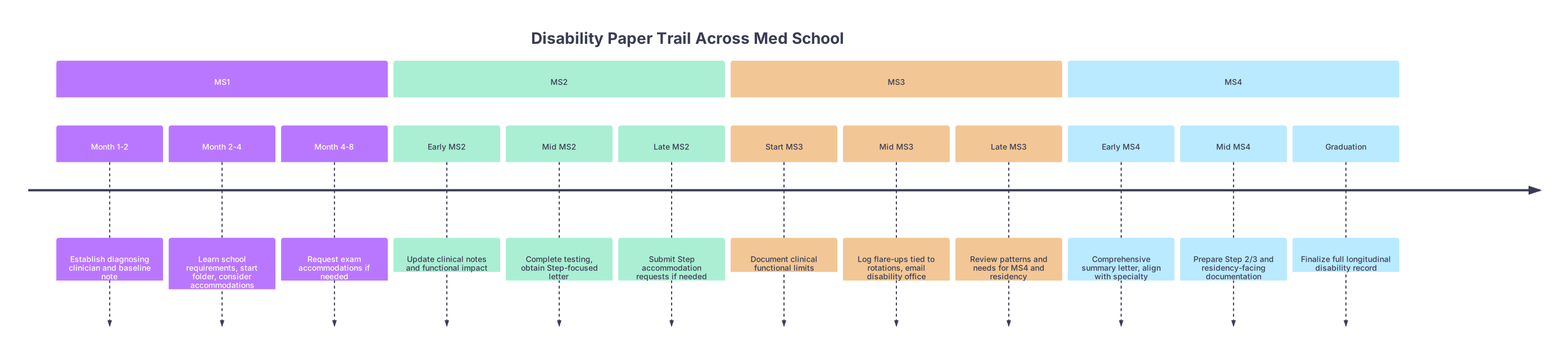
| Period | Event |
|---|---|
| MS1 - Month 1-2 | Establish diagnosing clinician and baseline note |
| MS1 - Month 2-4 | Learn school requirements, start folder, consider accommodations |
| MS1 - Month 4-8 | Request exam accommodations if needed |
| MS2 - Early MS2 | Update clinical notes and functional impact |
| MS2 - Mid MS2 | Complete testing, obtain Step-focused letter |
| MS2 - Late MS2 | Submit Step accommodation requests if needed |
| MS3 - Start MS3 | Document clinical functional limits |
| MS3 - Mid MS3 | Log flare-ups tied to rotations, email disability office |
| MS3 - Late MS3 | Review patterns and needs for MS4 and residency |
| MS4 - Early MS4 | Comprehensive summary letter, align with specialty |
| MS4 - Mid MS4 | Prepare Step 2/3 and residency-facing documentation |
| MS4 - Graduation | Finalize full longitudinal disability record |
Common Timing Mistakes—and When to Fix Them
You’re going to see classmates do these things. Try not to copy them.
Mistake 1: “I’ll only document if I fail something”
By the time you fail, it’s late. Committees suddenly want to know: “Why now? Where is your prior record?”
Fix: By MS1 mid-year, even if you’re passing, you should have at least a baseline note and a clear diagnosis on file.
Mistake 2: Last‑minute Step accommodation scramble
I’ve watched students panic four weeks before Step 1, calling neuropsych offices begging for an eval. Most boards want months of lead time, not days.
Fix: By early–mid MS2, you should already have any updated testing scheduled and a Step-focused letter drafted.
Mistake 3: No documentation that ties symptoms to clinical work
Programs and hospitals care about patient safety. “I get tired” is vague. “I cannot safely perform continuous 28-hour call without risk of [X] as documented on [date]” is specific.
Fix: During MS3, whenever symptoms clearly worsen on a demanding rotation, at that point you should get it documented in a visit note—while you’re on that rotation, not 6 months later.
Simple Year-By-Year Checklist
Print this. Or at least screenshot it.
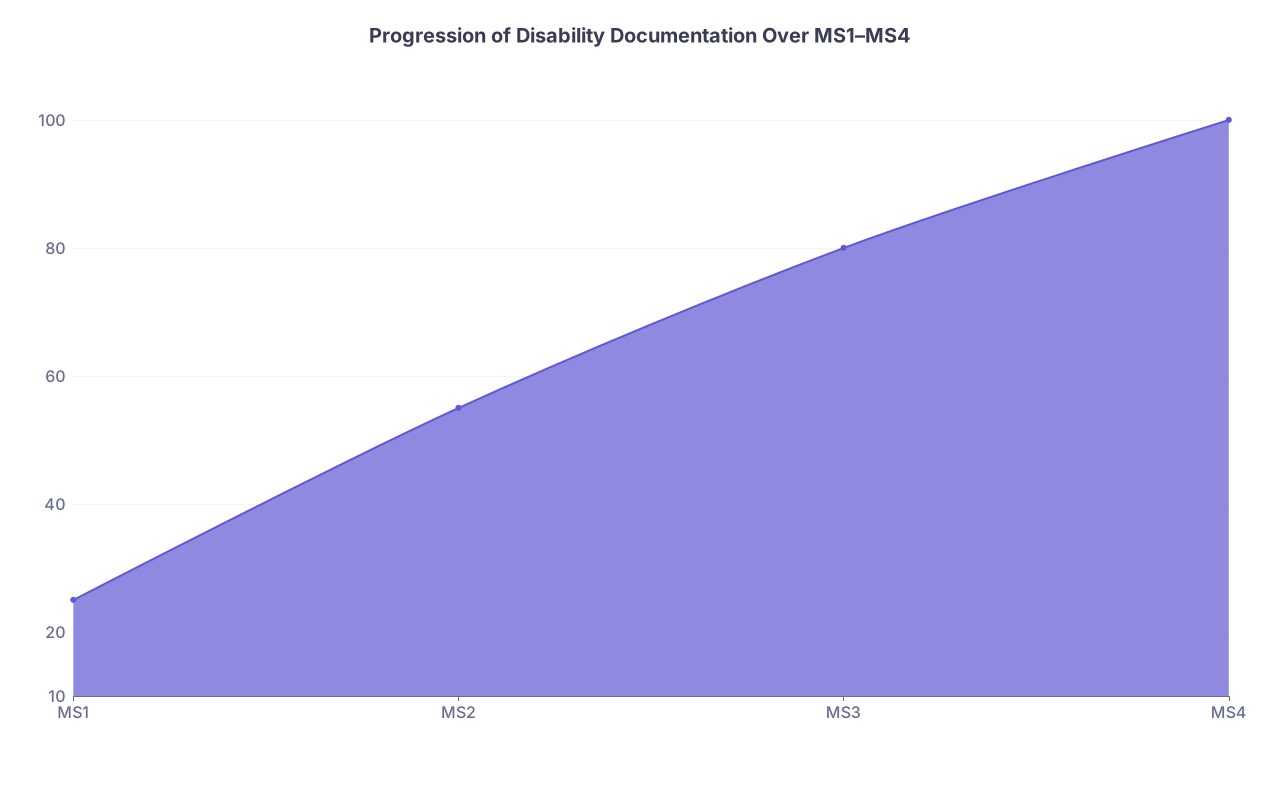
| Category | Value |
|---|---|
| MS1 | 25 |
| MS2 | 55 |
| MS3 | 80 |
| MS4 | 100 |
By End of MS1, you should:
- Have:
- Diagnosing clinician established
- At least 1 formal note during med school
- Folder system with baseline documents
- Know:
- Your school’s documentation and process requirements
- (If needed) Have:
- Initial exam accommodations approved and documented
By End of MS2, you should:
- Have:
- Longitudinal notes describing functional limitations
- Updated testing (ADHD/LD, etc.) if required
- Step-focused clinician letter ready
- If you’re requesting board accommodations:
- Submitted your request with all supporting documents
By End of MS3, you should:
- Have:
- Notes that connect your disability to specific clinical demands
- Documentation of flare-ups or safety concerns during rotations
- Emails showing attempts to adjust rotations or get support when needed
By Mid MS4, you should:
- Have:
- A comprehensive summary letter covering your entire med school course
- A residency-facing letter describing functional needs for training
- Updated records for any remaining board exams

Final Thoughts: What Actually Matters
Three things:
- Start early. A thin paper trail built across four years beats a perfect one built in four weeks.
- Be specific. Link your condition to real tasks—90‑question blocks, 28‑hour calls, 6‑hour OR cases—not vague “struggles.”
- Keep everything. Every letter, email, eval, and decision goes in your folder. Future you will need it—boards, residency, licensing, HR.