
The biggest scheduling mistakes disabled residents make are not about grit or time management. They’re about silence, vagueness, and trying to “be low maintenance” in a system that will absolutely exploit that.
If you’re a disabled resident, the call schedule can quietly ruin your health, your training, and your future if you handle it the way most people are pressured to.
Let’s fix that.
Mistake #1: Waiting Until After the Schedule Drops to Ask for Changes
This is the classic disaster.
You know nights will flare your migraine, your autoimmune disease, your POTS, your mobility issues. You mean to talk to someone. Then orientation hits. You’re drowning in new passwords and pager numbers. Suddenly the call schedule goes live and you’re on every third night with a stretch of 7 straight days.
Then what happens?
- You email your chief in a panic.
- They say, “We already published it to GME and the attendings, but we’ll try to make tweaks.”
- Other residents grumble because now they’re being asked to swap.
- You feel like you’re asking for “special favors” instead of using your rights.
- The message—subtle or not—is: why didn’t you say something earlier?
This isn’t your fault. The system’s built on “figure it out later.” But that pattern will crush you if you copy it.
How to avoid this
You need to front-load the hard conversation before the first schedule is ever built.
Talk to GME / Disability office early
- Ideally: months before residency starts.
- Realistically: as soon as you match and know your program.
- Goal: get formal documentation and an accommodations letter that explicitly addresses call and scheduling parameters (frequency, nights, shifts length, commute factors).
Tell your program director and chiefs before they start constructing schedules
- Phrase it clearly, not apologetically:
- “I have documented accommodations through GME for call scheduling. Before you build the block, I want to review what’s needed so we aren’t scrambling later.”
- Do NOT wait for them to ask “Any issues?” in a rushed meeting. Lead with it.
- Phrase it clearly, not apologetically:
Ask: When do you build the call schedule and what’s the lead time?
- You want to know:
- Do they schedule 1 month at a time, or 3–6 months?
- When is their “lock date” when changes become hard?
- Your requests have to land before that lock date.
- You want to know:
If you hear yourself thinking, “I don’t want to bother anyone until I see if I can handle it”… stop. That thought is how people end up in the ED with a flare after a brutal night float block.
Mistake #2: Being Vague About Your Actual Limits
“I can’t do too many nights.”
“I just need a more balanced schedule.”
“I prefer shorter calls.”
This is how you get destroyed by “reasonable” schedules that still break you.
Vague language leaves all the interpretation to:
- a well-meaning but clueless chief
- a pressured scheduler trying to fill holes
- or a program that’s never worked with a disabled resident before
They’ll “balance” you the same way they balance everyone else. Just with extra guilt and eye contact.
What you actually need: hard, concrete, boring specifics
You must translate your disability needs into schedule rules. Things like:
- Maximum number of consecutive work days:
- “I cannot safely work more than 5 consecutive days; I require at least 1 full day off after.”
- Night/overnight frequency:
- “No more than 2 consecutive night shifts; max 4 total nights per 4-week block.”
- Shift length:
- “No 28-hour calls; max shift length 16 hours with protected rest.”
- Commute/access issues:
- “I cannot safely drive after overnight shifts; I need closer parking or non-driving post-call expectations.”
- Recovery after specific rotations:
- “After ICU weeks, I require at least 2 days without clinical duty.”
Put this in writing, tied directly to your medical provider’s documentation. It feels extreme. It’s not. It’s the only way the scheduler can work with something concrete.
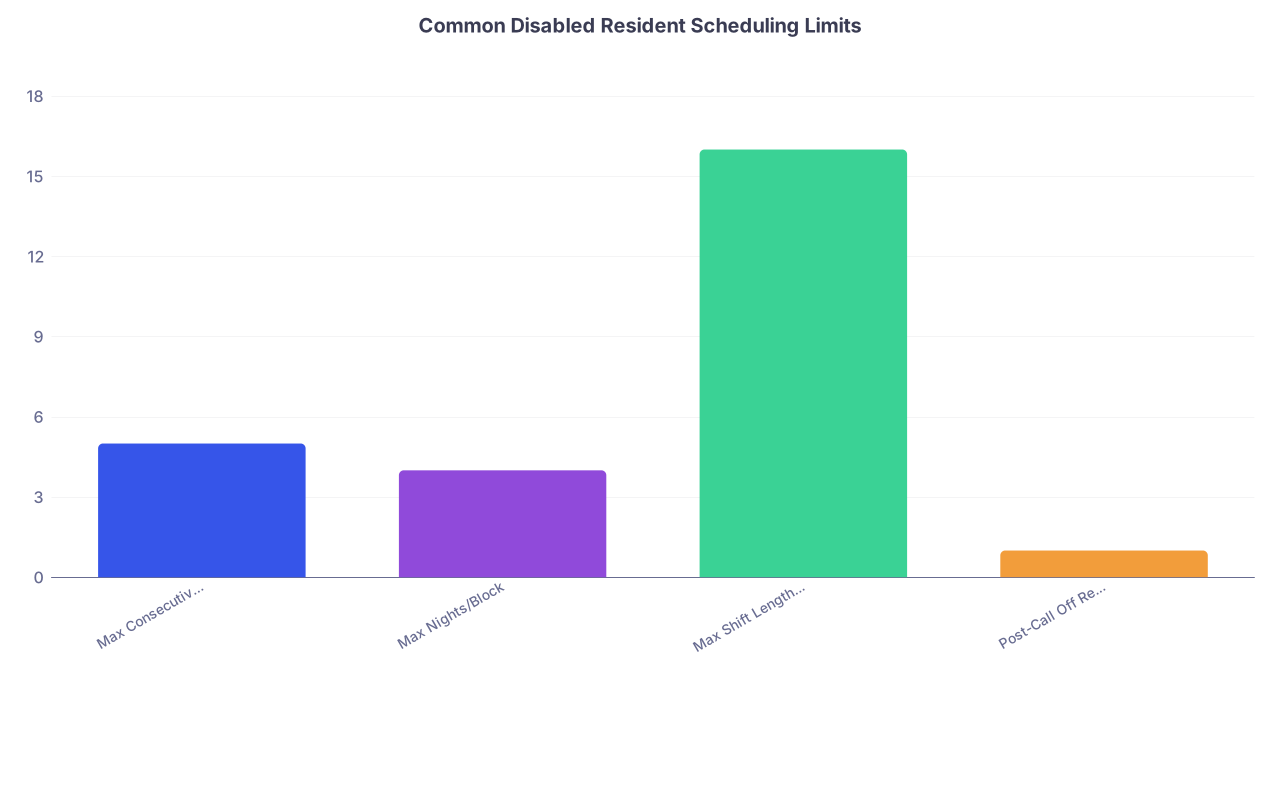
| Category | Value |
|---|---|
| Max Consecutive Days | 5 |
| Max Nights/Block | 4 |
| Max Shift Length (hrs) | 16 |
| Post-Call Off Required | 1 |
Don’t make this mistake:
- Don’t say: “I’ll let you know if it becomes a problem.”
- Do say: “Here are the specific limits my physician and GME have documented. Can we plug these into your scheduling template now so we’re not fixing it later?”
Vague = you get crushed first, accommodated second. If at all.
Mistake #3: Keeping Your Disability Completely Secret from the People Who Schedule You
This one is understandable. Medicine trains you to:
- minimize your needs
- hide anything that looks like “weakness”
- fear retaliation or being labeled “difficult”
So residents hide their conditions from chiefs and schedulers and hope they can “push through.” I’ve seen this with:
- a resident with severe ulcerative colitis trying to survive night float
- a deaf resident not disclosing until an entire ICU month was built around phone calls and overhead pages
- a resident with cardiac issues doing back-to-back 28-hour calls “to prove I can handle it”
They land in:
- the ED
- remediation
- or on someone’s radar as “struggling” before anyone knows what’s really going on
What you actually need:
You don’t have to give your entire medical history to your peers. But you do need a small circle that knows enough to schedule you safely.
That usually means:
- Program Director
- GME / Disability or HR representative
- Chief residents (at least the scheduling chief)
- Sometimes your advisor or a trusted attending
You can say things like:
- “I have a documented disability with GME that affects call scheduling. I’m happy to share the formal accommodation letter and take any questions about logistics, but not about medical details.”
- “Here’s what you need to know from a scheduling perspective. The rest is private and already documented through the proper channels.”
Why secrecy backfires
When chiefs don’t know:
- They interpret your limits as attitude, not medical need.
- They assume you’re “less committed” when you say no.
- They redistribute work grudgingly instead of intentionally.
When chiefs do know:
- They’re more likely to defend your schedule when other residents complain.
- They can preemptively design rotations around your limits.
- They’re less likely to tag you as “performance issue” when you hit a bad flare.
Your privacy matters. But total secrecy around the functional impact of your disability is a high-risk move.
Mistake #4: Accepting “We’ll Just See How It Goes” as a Plan
This line should be a red flag in your head.
“We’ll see how it goes.”
“We’ll start you on the regular schedule and adjust if needed.”
“Let’s try this first and you tell us if it’s too much.”
No. That’s not a plan. That’s gambling with your health and career.
Here’s how that usually plays out:
- You start regular call or night float.
- You push yourself too hard because you don’t want to be the “problem resident.”
- Your performance slips. Notes late, orders delayed, you look exhausted in front of attendings.
- Someone documents “concerns.” Often without context.
- Then they discuss accommodations, now framed as “remediation vs support.”
By the time “how it goes” is clearly bad, there’s already paper in your file.
Replace “We’ll see” with “Let’s define triggers and contingency”
Push for something more structured:
- “Let’s define in advance what ‘it’s not going well’ looks like and what the automatic next step will be.”
For example:
- If you have more than 2 health-related call-ins during a block → automatic meeting with PD to review schedule and reduce nights.
- If you hit certain symptom thresholds → temporary shift to day-only coverage.
- If fatigue is affecting safety (med errors, near-misses) → built-in rest days and reassignment of heavy call.
You’re not asking them to predict the future. You’re asking them to agree now what happens when, not if, things go sideways.
If they really push “We’ll see,” you put it in email:
- “Per our conversation, we’ll begin with X schedule, and if I experience Y issues or health decline, we’ll reconvene to adjust call expectations. I’ll also keep GME looped in.”
Paper trail. Every time.
Mistake #5: Ignoring the Ripple Effects Across Rotations
Here’s a sneakily dangerous pattern: your call schedule is barely “okay” on an easier ward month. Then they copy-paste that same call pattern onto ICU or night float or ED.
Suddenly you’re in trouble.
Residents often forget that:
- not all months have the same physical/cognitive load
- not all rotations have the same flexibility for swapping or stepping back
- some blocks absolutely cannot handle you crashing mid-month
Where people get burned
- ICU months: Heavy overnight volume, constant pages, zero downtime. A “normal” call schedule on a unit like this can be catastrophic if your disability affects stamina, cognition under sleep deprivation, or mobility.
- Night float: Repeated circadian disruption wrecks many chronic illnesses after week 1–2, not day 1.
- ED blocks: Cramped spaces, constant standing, unpredictable pacing—brutal for mobility issues, POTS, severe anxiety, or sensory disabilities.
You can’t just negotiate “generic” call accommodations. You need to layer them over the reality of each rotation.
| Rotation | Risk Factor for Disabilities | Scheduling Red Flag |
|---|---|---|
| MICU/SICU | High acuity, nonstop pages | 24–28 hr calls |
| Night Float | Circadian disruption | >4 nights/week |
| ED | Constant standing, noise | Back-to-back 12s |
| Cards Consults | Heavy travel between units | Long walking distances |
| OB Night Call | Unpredictable surges | No protected rest |
How to avoid this
Ask rotation-specific questions:
- “How is call structured on ICU here? 24s? Night float? Home call?”
- “Do any rotations have mandatory 28s or Q3 call?”
- “Which rotations historically burn people out the most here?”
Then:
- Pair your hardest rotations with the lightest call pattern you can negotiate.
- Avoid stacking brutal months back-to-back (e.g., ICU → night float → cards).
- Request protected recovery time after known high-risk blocks.
If you hear, “Everyone survives it,” translate that in your head to, “No one has thought seriously about how this interacts with disability.”
Mistake #6: Not Anticipating Colleague Resentment and Handling It Strategically
Let me be blunt. Even in “nice” programs, some co-residents will resent your accommodations. Especially when it comes to call.
Typical comments you’ll never hear directly but will absolutely happen:
- “Why do they get fewer nights?”
- “I’m not disabled but I’m exhausted too.”
- “Must be nice to just ‘not be able’ to do X.”
If you pretend this doesn’t happen, you’ll be blindsided later when the social atmosphere shifts.
Your biggest mistake here:
Trying to fix resentment by volunteering to “take on extra” in ways that directly undermine your accommodations.
Examples I’ve actually seen:
- Disabled resident with back issues agreeing to stay late to admit “just one more patient” because a co-resident is irritated.
- Resident with a no-night restriction agreeing to “just cover one night” so no one is mad.
- Someone on protected lighter call quietly doing extra weekends “off the record.”
This is how your carefully negotiated accommodations get shredded by guilt.
How to handle this like an adult professional, not a martyr
Have a stock phrase ready
- “I’m on a GME-approved accommodation schedule. I know it means others pick up more nights, and I’m grateful. I’m doing X, Y, Z to contribute in other ways.”
- Keep it boring. Calm. Not apologizing, but acknowledging reality.
Over-contribute where it does NOT cost your health
- Teach interns.
- Take complex discharges on your lighter days.
- Help with tedious but lower-impact tasks (med rec, paperwork, follow-up logistics).
- Volunteer for committees or QI work you can do in daylight hours.
Do NOT negotiate your health against other people’s feelings
- Their resentment is not evidence you’re wrong.
- It’s evidence the system is under-resourcing everyone and shifting blame sideways.
If things get openly hostile, that’s not a “you need to work harder” issue. That’s a hostile work environment / disability discrimination problem, and you loop in PD + GME immediately.
Mistake #7: Not Using the System’s Own Rules and Documentation
Disabled residents often think accommodations live in verbal favors from “supportive” individuals. Then that chief graduates. New leadership arrives. Or someone higher up decides “we treat everyone the same here.”
Without documentation, your accommodations evaporate.
The specific errors here:
- Keeping everything “off the books” because you want to be easy.
- Trusting handshake agreements instead of written plans.
- Not knowing your own institution’s policies on disability and call.
You’re in a rule-heavy environment. Use that to your advantage.
What to do instead
Go through the formal disability accommodation process
- Yes, even if your PD “totally gets it.”
- You want:
- A written accommodation letter.
- Clear language about call frequency, nights, and shift limits.
Email-confirm every major scheduling decision
- “Per our conversation today, my call schedule for the next block will not include night float and will be limited to Q5 16-hour calls as per GME accommodation letter. Please let me know if anything I’ve written here is inaccurate.”
- This locks in memories. And intentions.
Get familiar with ACGME duty hour rules and how they intersect with your needs They are not disability accommodations, but they are a floor. Don’t let anyone treat them as a ceiling:

| Step | Description |
|---|---|
| Step 1 | Document Disability with GME |
| Step 2 | Receive Accommodation Letter |
| Step 3 | Meet with Program Director |
| Step 4 | Discuss Call Limits and Rotations |
| Step 5 | Schedule Built with Limits |
| Step 6 | Monitor Health and Performance |
| Step 7 | Trigger Review with PD and GME |
| Step 8 | Continue Current Plan |
- Know your right to revisit accommodations
- If your health changes, you’re not locked into the first version.
- And if leadership changes, you still have institutional backing.
The resident who “keeps it casual” is the resident who ends up fighting from a weaker position later.
Mistake #8: Forgetting About the Long Game (Fellowship, Licensing, References)
Call scheduling isn’t just about surviving this month. It affects:
- how attendings perceive you
- the letters you get
- whether someone casually labels you as “a problem” or “a strong clinician with accommodations”
- how much documentation lives in your file about “struggles”
The dangerous move is sacrificing health to look “normal” now, and generating a trail of:
- sick calls
- fatigue-related mistakes
- evaluations that mention “concerns about reliability” or “struggles with demanding schedules”
That paper trail can haunt:
- fellowship applications
- hospital credentialing committees
- state licensing boards (if things escalate badly)
Better strategy
- Use accommodations early to prevent crisis.
- Protect your performance on the hours you do work.
- Let attendings see you functioning at your best, not barely surviving.
You’d rather be “the resident with adjusted call who is rock-solid on days” than “the resident who melted down on nights but never said why.”
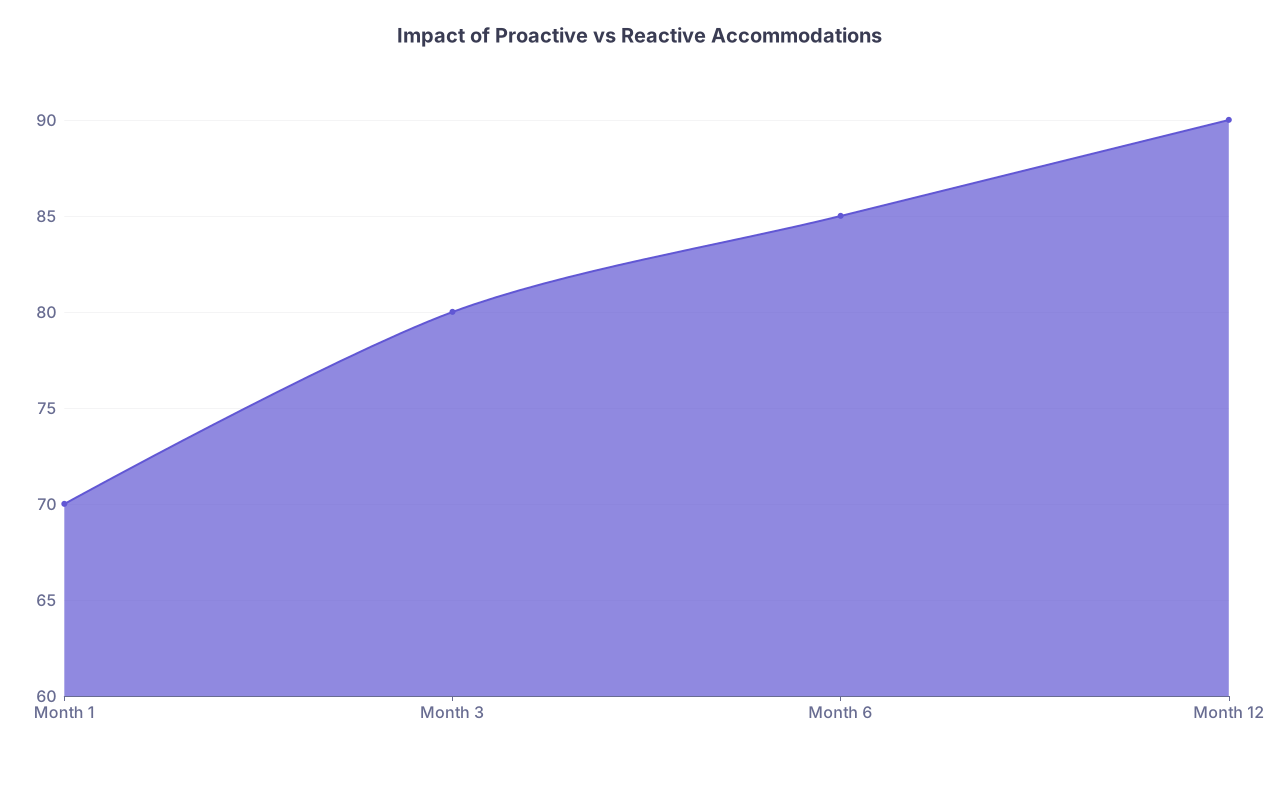
| Category | Value |
|---|---|
| Month 1 | 70 |
| Month 3 | 80 |
| Month 6 | 85 |
| Month 12 | 90 |
(Think of that curve as performance and stability when you set boundaries early instead of after repeated crashes.)
Mistake #9: Not Planning for Flares and Worst-Case Scenarios
Here’s the final landmine: acting like your disability will behave perfectly all year if you just “push hard enough.”
It will not.
I’ve watched:
- a lupus resident hit a flare mid-ICU and suddenly need steroids and time off
- an epileptic resident have a breakthrough seizure after repeated overnight calls
- a resident with severe depression slide into suicidal ideation after three brutal blocks in a row
None of that was in the tidy mental PowerPoint they used when they said, “I think I can manage the regular schedule and just ask for help if needed.”
You need a flare plan. Before the flare.
That plan should answer:
- Who do I call first if I know I cannot safely work this call?
- What is the backup coverage system in my program? How is this documented?
- Who is my point person to advocate if someone pushes back?
- How will temporary modifications be handled (e.g., no nights for 2 blocks, switch to clinic)?
Spell this out with:
- PD
- GME / disability office
- Chief residents
And then you write it down. Email it. Keep a copy.
So when you’re exhausted, in pain, or barely holding it together, you’re not inventing a process from scratch.
FAQ: Call Scheduling for Disabled Residents
1. Do I have to disclose my exact diagnosis to my program to get call accommodations?
No. You typically do not have to share your specific diagnosis with your program director or chiefs. You do need to document it with your institution’s disability or GME office. What your program needs is the functional impact:
- “Cannot safely do overnight call.”
- “Requires limits on consecutive work days.”
- “Needs proximity to accessible facilities.”
You can say: “My condition is documented with GME, and here is the official accommodation letter describing what’s required for scheduling.” That’s enough.
2. What if my program says they “can’t” accommodate my call needs because of fairness or coverage?
This is where people get intimidated and back down. “Fairness” doesn’t override disability law or institutional policy. They can say:
- “We need to explore what’s reasonable within the program requirements and coverage constraints.”
They can’t simply say:
- “We don’t do individualized scheduling.”
- “Everyone has to do full call or they can’t be here.”
Loop in GME and the disability office. Put the issue in writing. Ask: “What alternative structures have you tried for other residents, and how can we adapt those to my documented needs?” Make them actually engage with solutions, not slogans.
3. How early should I start the accommodations process for residency call schedules?
As early as you realistically can, ideally:
- Right after Match: contact GME/disability services.
- Before orientation: meet with PD and send them your accommodation letter.
- Before the first schedule is built: talk to the chiefs and clarify specific limits.
If you’re already in residency and struggling, start now. Don’t wait for the next crisis month or the next ICU block. Tell GME you need formal review and accommodation, and treat this like you would a serious patient safety issue—because it is.
4. Will call accommodations hurt my chances at fellowship or future jobs?
What hurts you is unaccommodated burnout that leads to bad evaluations, documented “concerns,” or extended leaves with no context. Properly handled accommodations, done early and transparently through the right channels, are far less damaging than a quiet meltdown mid-residency.
Most fellowship directors care about:
- clinical strength
- reliability within your agreed-upon role
- letters that say “This resident is excellent” without caveats
If you need a slightly modified call structure to maintain that level, that’s not a moral failure. That’s good risk management.
5. What if my co-residents are clearly angry that I have fewer calls?
You don’t fix systemic under-staffing by sacrificing your health. Acknowledge the reality:
- “I know this means others are carrying more nights. I’m grateful, and I’m contributing in X, Y, Z ways that fit within my accommodations.”
Then hold your line.
If resentment turns into exclusion, hostility, or harassment, that’s not a “personality clash.” That’s a professionalism and possibly disability discrimination issue. Document it. Bring it to your PD, then GME if needed. You are not required to trade away safety so other people feel better about a broken system.
Keep three things in your head:
- Do not wait until the schedule drops. Get formal accommodations nailed down before anyone opens the call template.
- Skip the vague language. Turn your needs into explicit, written scheduling rules and get them into the system.
- Protect the long game. Use accommodations to stay consistently strong, not to patch over repeated collapses.
You’re not asking for favors. You’re building a residency you can survive—and actually learn from—without burning your body to ashes.