The disability office saying “we can’t do that” is not the end of the conversation. It’s the opening move.
You’re likely reading this right after a meeting or email that left you pissed off, scared, or both. You asked for extended testing time, a reduced call schedule, remote lectures, adjusted OSCE timing—something that actually lets you function—and got hit with some version of:
- “We don’t do that here.”
- “That would fundamentally alter the program.”
- “Other students would think it’s unfair.”
- “We can only offer X, not Y.”
Let me walk you through what to do next, step by step, without sugarcoating.
Step 1: Freeze the Emotion, Capture the Facts
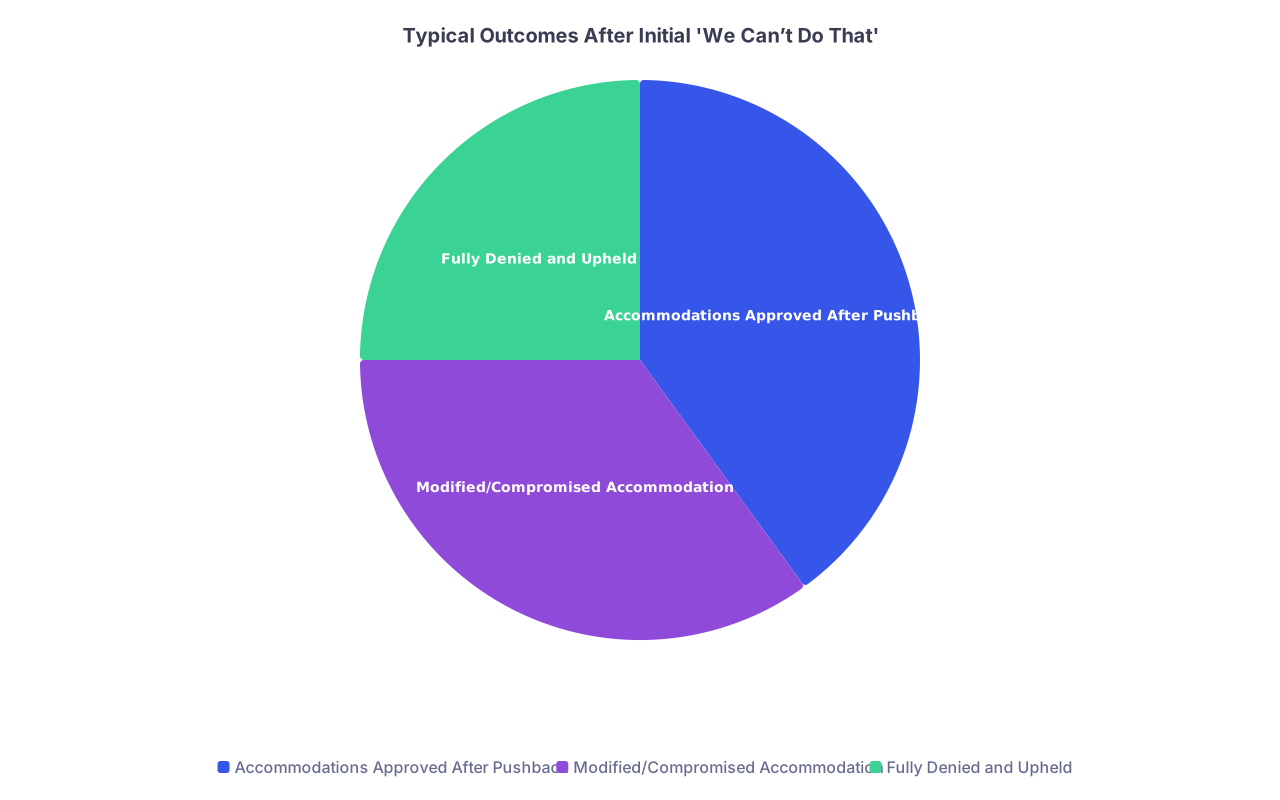
| Category | Value |
|---|---|
| Accommodations Approved After Pushback | 40 |
| Modified/Compromised Accommodation | 35 |
| Fully Denied and Upheld | 25 |
The worst thing you can do right after a denial is vanish for three months and then resurface in crisis. You need a paper trail and a clear record of what happened.
Right after that “we can’t do that”:
Write down exactly what was said.
Not the vibe. The words.
“We don’t allow extended time on OSCEs.”
“We cannot adjust your call schedule; that would violate program requirements.”
“We don’t provide note-takers in clinical years.”Send a same‑day summary email.
Something like:Dear [Name],
Thank you for meeting with me today. I want to summarize my understanding of our conversation to ensure I captured it accurately.
On [date], I requested accommodations including [list what you asked for]. My understanding is that you stated [quote or paraphrase the denial], and that the office can offer [list what they did offer, if anything].
Please let me know if I have misunderstood anything.
Best,
[Your name]Short. Calm. Precise. You’re not arguing yet—you’re nailing down the record.
Collect your documentation into one place.
Psych evals, neuropsych testing, physician letters, prior IEP/504, Step/MCAT accommodations approvals, previous college/university accommodations. Have all of it in a single folder (digital and physical).
You’re building an evidence file. Not because you’re suing tomorrow, but because legal rights without documentation are useless.
Step 2: Figure Out What Kind of “We Can’t Do That” You Got
Not all “no”s are created equal. Some are soft. Some are lazy. Some are illegal.

Usually, the refusal falls into one of these buckets:
“We don’t do that here” (policy myth)
Translation: “This would be inconvenient, and we’ve never been forced to figure it out.”
Example: “We don’t give extra time on quizzes,” even though quizzes are timed, graded assessments.
This is negotiable. Often very negotiable.“That would fundamentally alter the program” (magic words)
They heard somewhere that saying this phrase makes something legal. It does not automatically.
They now have a legal obligation to be able to back up that claim with specifics.“We’re concerned about patient safety/professionalism” (fear defense)
Classic in clinical years. Translates to: “We’re scared of liability and other students complaining.”
Has to be tied to actual standards, not vague anxieties.“We don’t have the resources” (budget excuse)
ADA/504 are not “as long as it’s cheap” laws. Resource constraints matter, but they don’t end the discussion.“We’ll only give you this, not that” (half-accommodation)
Example: You request 50% extra time; they offer 25%. Or you ask for reduced overnight call; they offer one less night per month.
Many students accept this without pushing. Do not assume their first offer is the maximum.
Your response depends on which kind you’re dealing with. And you usually won’t know for sure until you see it in writing.
So your next move:
“Can you please send me a written explanation of which aspects of my requested accommodations were denied and the reasons for the denial?”
Calm. Direct. No apologies.
Step 3: Force Them Into Their Process (Most Students Skip This)
A lot of med school disability offices behave as if they’re doing vibes-based accommodations. They aren’t allowed to. They must have a process.
You want them in that process, on the record.
Here’s what to look for or explicitly ask:
- “Could you walk me through your formal process for reviewing accommodation requests?”
- “Who is involved in the decision besides you? Is there a committee?”
- “What information do you need from my providers to reconsider?”
- “How do you determine when something is a ‘fundamental alteration’?”
If they can’t answer, or they wave you off with “we just don’t do that,” you’ve now spotted a weakness. Because under ADA/504, they’re supposed to:
- Engage in an interactive process
- Consider individualized circumstances
- Base decisions on evidence, not tradition or vibes
You’re not going to lecture them on the law. You’re just going to keep nudging them back to: “Explain your process. Explain this denial. In writing.”
Step 4: Clean Up Your Own Ask (Many Requests Are Vague or Easy to Dismiss)
Before you go back at them, tighten your request so it’s precise and hard to hand‑wave away.

| Step | Description |
|---|---|
| Step 1 | Initial request vague |
| Step 2 | Specify setting |
| Step 3 | Specify exact change |
| Step 4 | Link to impairment |
| Step 5 | Show precedent or necessity |
You need:
Exact setting
Not "exams," but “all written, timed exams including block exams, NBME subject exams, and OSCE written components.”Exact adjustment
“50% additional time (time-and-a-half) on all timed exams”
“Option to take exams in a low-distraction room with reduced test taker capacity (≤5 students)”
“Exemption from 24-hour call and night float; maximum shift length 16 hours.”Link to functional limitation
Use language straight from your documentation:
“Due to documented deficits in processing speed and working memory…”
“Due to episodic symptom flares that impair concentration and stamina…”Evidence or precedent if you’ve got it
- Prior accommodations in undergrad/other grad school
- MCAT/USMLE/COMLEX accommodations approvals
- National exam standards
You’re turning your ask from “this would be nice” into “this is a logical, necessary modification directly tied to my impairment.”
Then you restate it clearly in an email:
I’d like to clarify my formal accommodation request:
- [Specific accommodation, in specific setting, with rationale]
- [Next one]
These requests are based on [diagnosis/functional limitation], as documented in [date] evaluation by [provider]. I’m attaching that documentation again here for convenience.
You’re not begging. You’re specifying.
Step 5: Use Your Allies Strategically (Not Emotionally)
This is where people either underuse support or blow up their own case.
| Role / Person | When To Involve Them |
|---|---|
| Treating clinician (MD/psych) | Before formal request and before appeal |
| Therapist | For coping + drafting communication |
| Trusted faculty mentor | After written denial, before escalation |
| Student affairs dean | When disability office is stonewalling |
| University ADA/504 coordinator | When you need formal appeal or oversight |
Your clinician
Stop asking for “a letter saying I need extra time.” Too vague.Ask them to write:
- Your diagnoses (if you’re comfortable disclosing)
- Specific functional limitations (processing speed, stamina, executive function, vision, mobility, etc.)
- Direct link to the requested accommodations
- If possible: “Without these accommodations, I believe the student will be substantially limited in the major life activity of [learning, concentrating, walking, etc.].”
Faculty mentor who actually gets it
Not the “just push through, everyone’s tired” attending. Someone who has already helped a struggling student before.You’re not asking them to be your lawyer. You’re asking:
- “Is this denial consistent with how other students are treated?”
- “Is there department-specific flexibility they are not admitting?”
- “Would you be willing to support that [X] is feasible in the clerkship context?”
Student affairs / dean level
When your conversations with disability services go in circles, you say:I appreciate your time. Since this decision significantly affects my ability to continue in the program, I’d like to understand the appeal or review process. Is that handled through your office, student affairs, or the institutional ADA/504 coordinator?
You’re not “going above their head” in a dramatic way. You’re calmly entering the escalation channel that already exists.
Step 6: Push Back, But With Receipts
This is where you respond to the actual denial.
Let’s take a common one:
“We cannot provide additional time on clerkship shelf exams because these are NBME exams, and we must follow NBME timing.”
This is false or at least incomplete in many schools. Some do provide extended time on NBME exams; others provide institutional timing adjustments.
Your reply should:
- Quote their reason back.
- Attach or reference evidence (if you have it).
- Ask for a specific reconsideration or alternative.
Example:
Dear [Name],
Thank you for your response and for outlining the decision. You wrote that additional time on clerkship shelf exams cannot be provided because these are NBME exams and the school must follow NBME timing.
My understanding is that some institutions do provide extended time on NBME subject exams, and even where that is not implemented, schools sometimes administer institutional exams with adjusted timing for students with documented disabilities.
Given my documented [processing speed/attention/etc.] limitations, I’m requesting that the school reconsider whether either:
- Extended time can be provided on shelf exams, or
- An alternative assessment approach with adjusted timing can be used that still meets clerkship requirements.
I would appreciate a detailed explanation of how this request was evaluated in light of my documentation and what alternatives, if any, were considered.
Best,
[You]
You’re not screaming. You’re not saying “this is illegal.” You’re forcing them to think, document, and reconsider.
If the denial is based on “fundamental alteration,” demand specifics:
Could you please identify which essential program requirement(s) you believe would be altered by [accommodation], and whether any alternative accommodations were considered?
Make them name the supposed conflict. Most of the time, the “requirement” is either flexible or tradition dressed up as law.
Step 7: Know the Line Between “Hard” and “Stop” (And Plan Your Moves)
There are absolutely times when the program has a legitimate hard line.
There are also times they bluff.
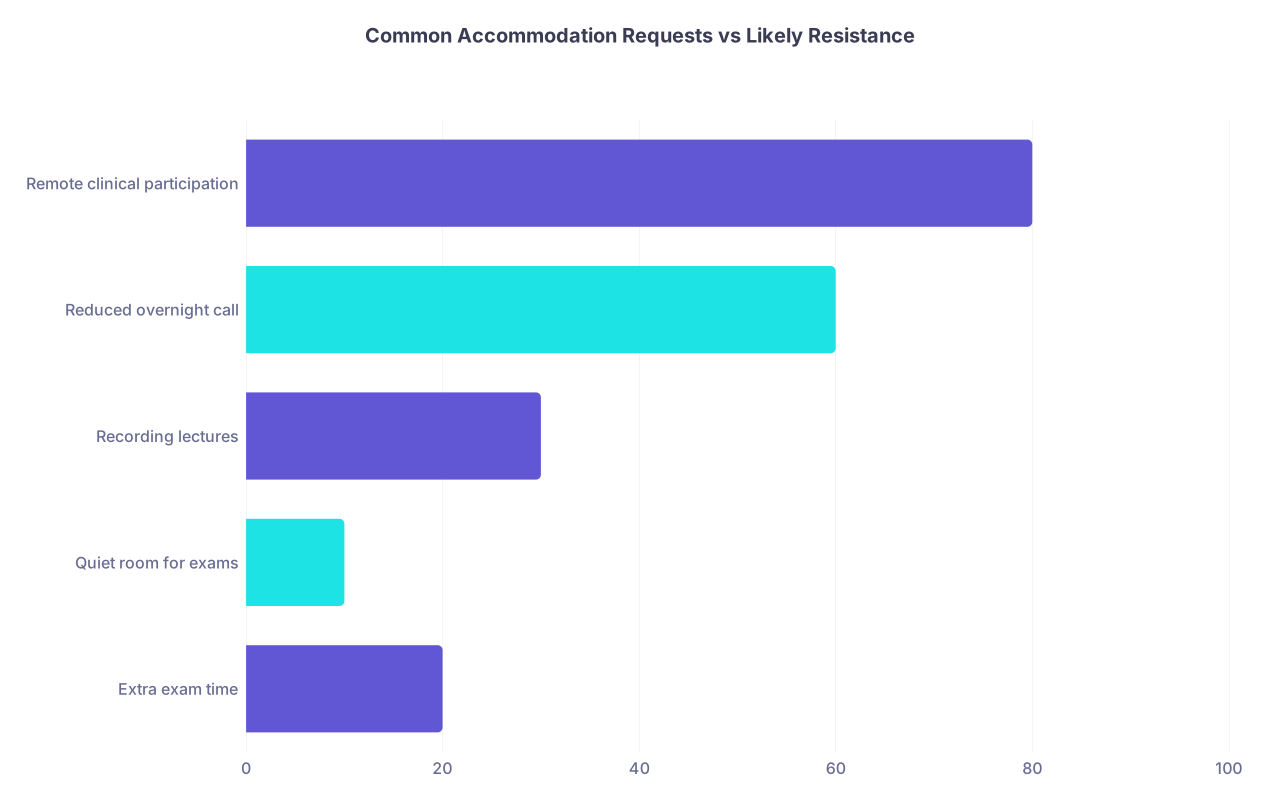
| Category | Value |
|---|---|
| Extra exam time | 20 |
| Quiet room for exams | 10 |
| Recording lectures | 30 |
| Reduced overnight call | 60 |
| Remote clinical participation | 80 |
Rough reality:
- Extended time on written exams? Often obtainable, unless you’re late in the game or asking for something huge (like double time without strong documentation).
- Quiet testing environment / separate room? Usually easy.
- Flexibility in attendance policies for chronic illness? Variable but possible with good planning.
- Reduced overnight call / no 24-hour shifts? Harder, but not impossible, depends on specialty and program creativity.
- Remote clinical participation? Usually a brick wall except in very narrow circumstances (immunosuppression during outbreaks, etc.).
So you do two things at once:
Keep pushing reasonably on what’s genuinely necessary for you.
Not what would be “nice,” what keeps you afloat.Start building contingency plans in parallel:
- What happens if you don’t get night float adjusted?
- Can you front-load lighter rotations when your health is more stable?
- Can you stack more outpatient rotations?
- Worst case: Would a LOA or change of program be necessary?
You don’t announce these thoughts to the school. You just don’t let your entire future hang on a single policy decision from one administrator.
Step 8: Use the Real Appeal/ADA/504 System If Needed
If you’ve:
- Clarified your request,
- Gotten a written denial with reasoning,
- Tried to engage in a rational back‑and‑forth,
- Looped in at least one higher-level person,
and you’re still stuck, it’s time to formalize.

| Step | Description |
|---|---|
| Step 1 | Initial denial |
| Step 2 | Clarify request and reasons |
| Step 3 | Written follow up |
| Step 4 | Meet with student affairs |
| Step 5 | Contact ADA or 504 coordinator |
| Step 6 | Formal institutional appeal |
| Step 7 | External advice - lawyer or advocacy org |
Most universities (including med schools embedded in them) have:
- An ADA/504 coordinator at the institutional level
- A formal grievance/appeal process
You find them by searching “[Your University] ADA coordinator” or “disability grievance procedure.” Not the med school site. The whole institution.
Your outreach email is direct:
Dear [Coordinator Name],
I am a medical student at [School] with documented disabilities. I have been working with the medical school’s disability office regarding accommodations and recently received a denial for [brief description].
I’m concerned that the process used and the outcome may not fully align with the university’s obligations under ADA/Section 504. I would like information on the appropriate way to request a review or file a grievance.
I have documentation and email correspondence I can share.
Thank you for your time,
[You]
You’re not filing a lawsuit. You’re using the internal compliance system they already told the federal government they’d have.
If things are truly severe—risk of dismissal, forced LOA, or you suspect discrimination—you may also quietly talk to:
- A disability rights attorney
- A medical trainee legal advice clinic (some exist via bar associations or med student orgs)
- National advocacy groups (e.g., Disability Rights [your state], ACLU in some contexts)
You don’t threaten. You gather information and options.
Step 9: Protect Yourself Day-to-Day While the Big Stuff Plays Out
All of this can take time. Meanwhile, you still have exams, patients, attendings with opinions, and a nervous system that doesn’t care about policy timelines.

Some practical moves you can make immediately:
Use your own “micro-accommodations” where you can:
Noise-cancelling headphones, text-to-speech, speech-to-text, calendar automation, scheduled rest blocks between tasks. These are not a substitute for institutional duty, but they keep you functional.For clinical rotations, communicate early with chief residents/attendings about what helps you function, without waiting for disability paperwork to filter down.
Example: “I tend to think more slowly under pressure but I’m thorough. It helps if I can pre-chart or know my patients the night before.”Keep your own log of incidents:
Flare-ups, near-misses, days where you literally couldn’t complete a task without what you requested. This becomes powerful narrative and evidence if you need to escalate further.Guard your energy for key battles.
Don’t die on the hill of “I want to use a specific brand of note-taking app approved by nobody.” Save your advocacy for the accommodations that make or break your ability to continue.
Step 10: Reality Check—When to Stay, When to Pivot
Sometimes, despite doing everything right, a school just won’t move. Or they move so slowly and grudgingly that you’re burning out anyway.
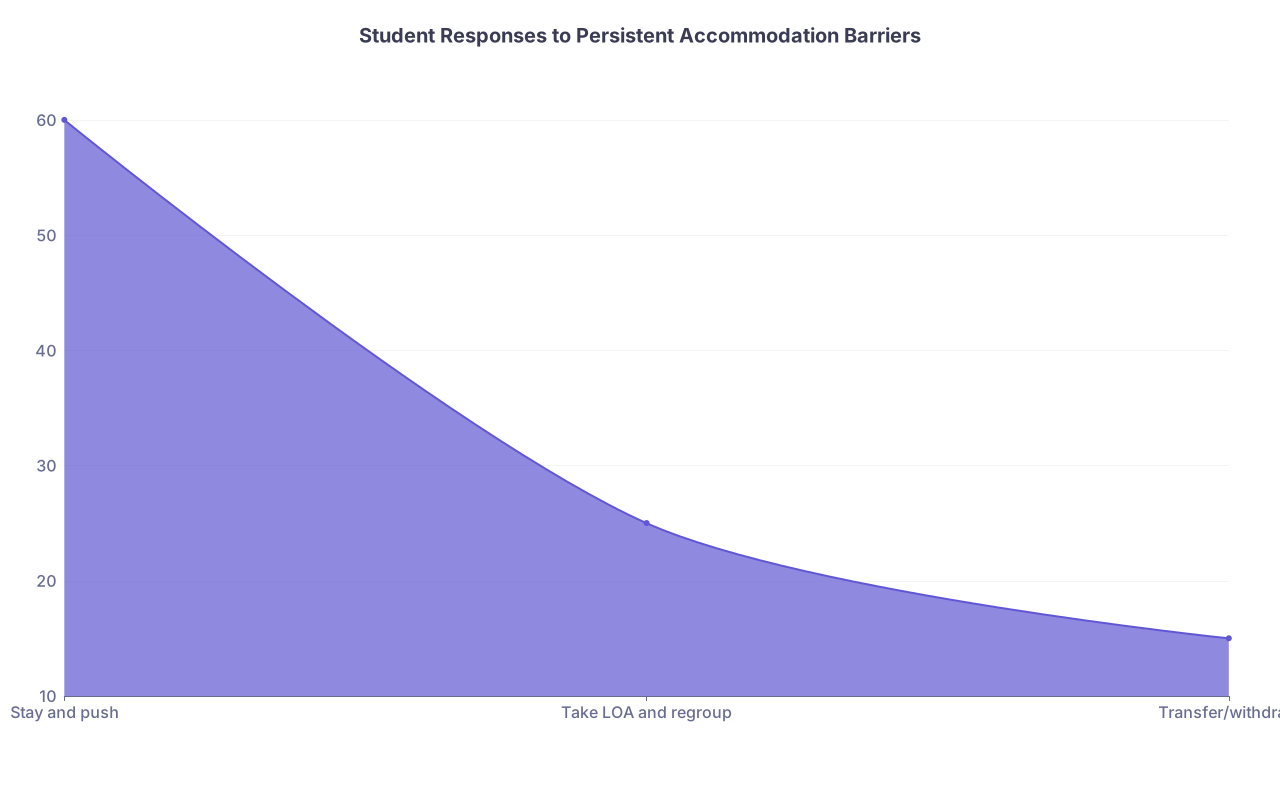
| Category | Value |
|---|---|
| Stay and push | 60 |
| Take LOA and regroup | 25 |
| Transfer/withdraw | 15 |
Here’s the part nobody says out loud: not every med school deserves to keep every disabled student. Some programs are simply not safe or sustainable environments, no matter how talented you are.
Hard questions to ask yourself (preferably with a therapist or trusted mentor):
- If they never grant this key accommodation, can I realistically complete this program without destroying my health?
- Is this a temporary rough patch in an otherwise decent culture, or a pattern of contempt/hostility toward disabled trainees?
- What’s my Plan B if I need to step away—timeline, finances, alternative careers, reapplication strategy?
You’re not a failure if your body or brain does not fit the rigid structure of a specific institution. That’s partly why disability law exists—to force institutions to face that reality.
But I won’t lie: sometimes the decision is not “win vs lose the accommodation.” It’s “win and stay in a hostile place” vs “walk and protect yourself.” Both are valid. Both are hard.
Final Thoughts: How to Play This Without Losing Yourself
You’re in a system that’s been built around an able-bodied, neurotypical ideal student. When you ask for something outside that template, people get uncomfortable.
Your job is not to make them comfortable. Your job is to:
- Get everything in writing and force them into their own documented process.
- Make clear, specific, medically grounded requests—and push back calmly when reasoning is vague, outdated, or lazy.
- Protect your long-term health and career options, even if that means appealing, escalating, or eventually leaving.
If your disability office just told you “we can’t do that,” the conversation is not over. It’s barely started.