The way most programs handle chronic illness in residency is broken. You’re expected to function like a machine during ICU or night float, and then everyone acts surprised when you crash.
You cannot afford that.
If you have a chronic illness, autoimmune disease, mental health condition, migraines, POTS, long COVID, or anything else that “flares,” your ICU or night float months are where things usually go off the rails. Not because you are weak. Because the system is built for healthy 26‑year‑olds with unlimited reserves.
Let’s talk about what you actually do, on a Tuesday at 3:17 a.m., when you feel your body tanking and you’re covering 40 patients.
This is not theory. This is what I’ve seen residents survive with—and without.
Step 1: Design Your ICU/Night Float Month Before It Starts
If you walk into ICU or night float with no plan and no accommodations, you’re gambling your health and possibly patient safety. Do not do that.
You want three things locked in before the rotation starts:
- A clear personal flare plan
- Program‑level accommodations
- A communication script for co‑residents and nurses
1. Build a written flare plan (for yourself first)
You should have a one‑page, brutally practical document that answers:
- What does a mild vs moderate vs severe flare look like for you?
- What can you still safely do in each state?
- What tasks become unsafe (e.g., central line, driving home, cross-covering 30 patients solo)?
- What meds or interventions help and how quickly?
- When do you escalate (call chief / attending / go to ED)?
Make it specific, not vague.

Example of useful detail:
- Mild flare: joint pain 4/10, mild brain fog, able to walk quickly, can climb stairs with mild discomfort.
- Moderate: pain 6–7/10, brain fog interfering with calculations, light sensitivity, near‑syncope if standing >10 minutes.
- Severe: cannot ambulate safely without support, blurry vision, vomiting, near‑constant tachycardia >120 even when sitting.
Attach clear actions:
- Mild: hydrate aggressively, scheduled NSAID if allowed, micro‑breaks every hour, offload tasks that require rapid calculation to co‑resident if possible.
- Moderate: inform co‑resident or senior, shift off procedures, request to stay in pod close to workroom, consider calling chief.
- Severe: stop clinical work, hand off immediately, activate formal coverage (chief, attending), present to ED or employee health.
You’re not being dramatic. You’re building a safety protocol.
2. Get specific accommodations on record
If your disability office or GME just writes “avoid excessive fatigue,” that’s useless at 2 a.m. in the unit.
You want operational language. Things like:
| Category | Example Accommodation |
|---|---|
| Scheduling | Max 3 consecutive nights; no 28-hour calls |
| Workload | Cap on cross-cover census; no solo cross-cover >25 |
| Environment | Access to dark, quiet on-call room for lie-down breaks |
| Duties | Avoid non-urgent procedures during active flares |
| Backup | Formal back-up system if flare impairs safe function |
You do this before the rotation. With:
- Documentation from your treating clinician
- A meeting (not just email) with: program director + GME / disability office
- Example language for what you need (do not expect them to know how to translate your diagnosis into logistics)
You want it in writing that:
- You are allowed to step away for brief symptom management breaks (e.g., 10–15 min lie‑down, rescue meds, glucose checks, etc.).
- There is a defined chain for calling in backup at night if you become acutely impaired.
- You may require avoidance of extended standing, prolonged NPO, or missed medication windows.
If this conversation feels overwhelming, that’s normal. But this is the foundation that lets you protect both your patients and your own body later.
3. Script how you’ll talk to co‑residents and nurses
You do not have to give your whole medical history. But you can’t expect people to read your mind either.
Have a short, practiced script for day one:
To your co‑resident:
“I have a chronic medical condition that can occasionally flare. It’s stable most of the time. If I suddenly look like I need to sit or lie down, I may need a short 10‑minute break to take meds / reset so I can keep working safely. I have a formal plan with the PD and chiefs. If I ever tell you I’m at a ‘red’ level, that means I shouldn’t be doing procedures or running codes solo. I’ll always make sure you’re not blindsided.”To a charge nurse you trust (modified):
“Just so you’re aware, I have a chronic condition that sometimes flares. If you notice I suddenly seem really off—pale, dizzy, slow to respond—please tell me or page the other resident. I’m not being dramatic; there’s a plan in place.”
This feels awkward the first time. By the third rotation, you’ll be glad you did it.
Step 2: Build a “Flare-Resistant” Night / ICU Routine
You cannot eliminate flares. You can reduce how often you tip yourself into one.
Night float and ICU are brutal because they attack every stabilizing factor for chronic illness:
- Sleep rhythm
- Hydration
- Food timing and quality
- Medication schedule
- Stress load
- Physical strain
You need a rotation‑specific operating system.
Anchor your meds and non‑negotiables
Your baseline meds cannot become “optional” on nights. That’s how you end up crashing in week two.
Create a rotation schedule like a treatment plan:
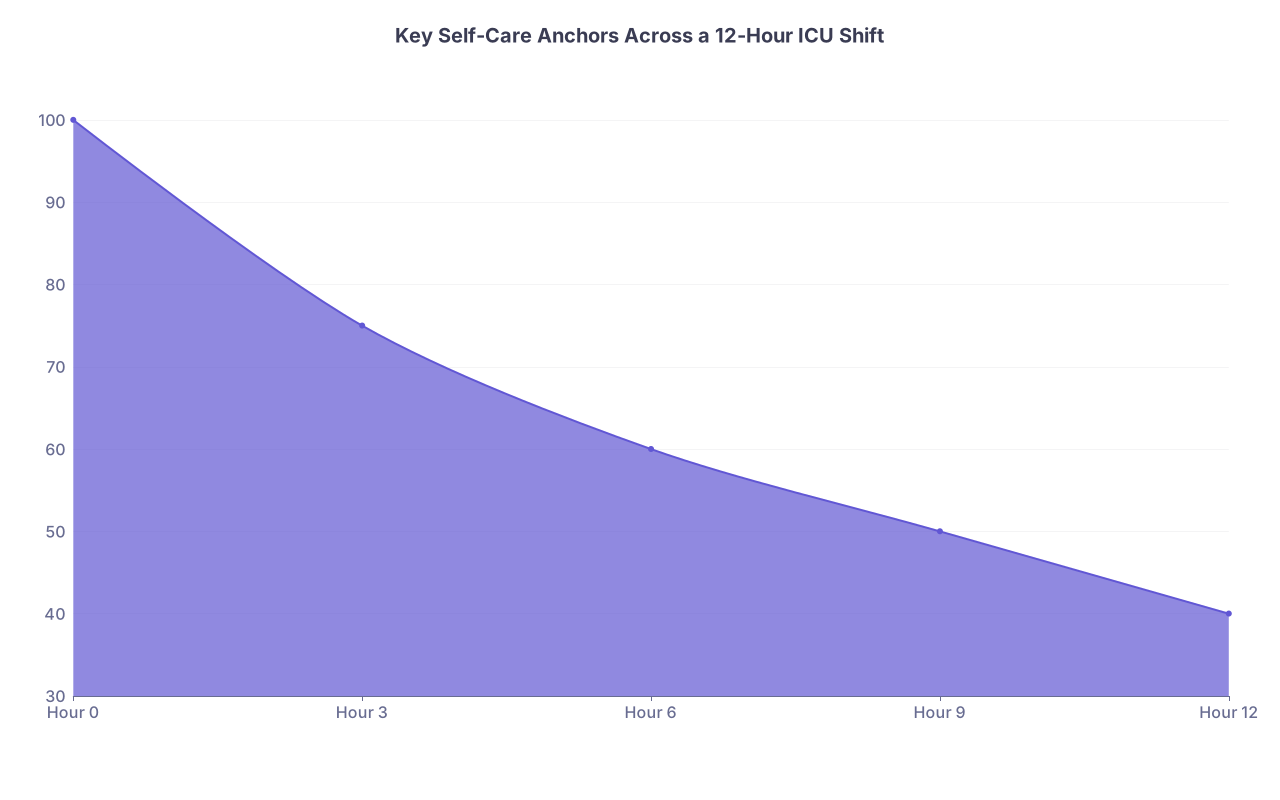
| Category | Value |
|---|---|
| Hour 0 | 100 |
| Hour 3 | 75 |
| Hour 6 | 60 |
| Hour 9 | 50 |
| Hour 12 | 40 |
Treat the critical ones (disease-modifying meds, steroids, beta‑blockers, anti‑seizure, etc.) the way you treat heparin drips on the unit: timed, tracked, double‑checked.
Practical moves:
- Put timed alarms on your watch/phone labeled with what the med is.
- Carry a rotation pill kit: 24–48 hours of key meds in proper containers (follow hospital policy), plus PRN flare meds.
- Build a simple check before sign‑out: “Did I take X/Y/Z today?” Write it on your sign‑out template if you must.
Control what you can: hydration, glucose, movement
You already know this matters. The issue is execution at 3 a.m. with three pressors titrating.
Work with reality:
- Always have a 1–2 L bottle at the workstation. Empty by mid‑shift; refill and empty again by end of shift (adjust if you’re on fluid restriction, obviously).
- Pack “failsafe” snacks that don’t rely on the cafeteria: nuts, jerky, protein bars, low‑prep carbs if tolerated.
- Every time you walk from workroom to a patient room, do a micro‑body check: Are you dizzy? Tachy? Short of breath more than expected? That’s early warning.
And no, this is not “self-care.” This is basic maintenance so you don’t collapse during a code.
Step 3: Real-Time Flare Management During a Shift
This is the core: what you do in the moment without compromising care.
Think in three levels: yellow, orange, red.
Yellow: Early signs, still safe to work
You notice:
- Brain fog creeping in
- Mild joint pain climbing
- Subtle POTS symptoms
- Classic migraine aura just starting
- Rising anxiety / panic sensations
At yellow, your job is to prevent escalation while keeping patients safe.
What you do in the next 30–60 minutes:
Triage your own tasks
- Move cognitively heavy tasks earlier: order sets, complex notes, vancomycin dosing.
- Delay non‑urgent things that can be safely done later: social calls, non‑critical note perfection, teaching pearls.
Quietly optimize your environment
- Adjust lighting if migraines / sensory issues are a trigger.
- Sit whenever you can—even for 60‑second intervals during charting.
- Put on compression socks / supportive footwear if orthostasis is a factor.
Use your pre‑planned micro‑break
- Take a timed 5‑ to 10‑minute break to medicate, hydrate, stretch, or lie down if part of your accommodation.
- Tell your co‑resident: “I need a 10‑minute quick break to deal with a medical issue; page me for any stat changes, I’ll be right back.”
Yellow is the time to be proactive. Ignoring yellow is how you end up in red at 4 a.m.
Orange: Symptoms affecting your performance
Now you’re at:
- Trouble tracking multiple issues at once
- Vertigo or near‑syncope when standing
- Pain high enough that you’re distracting yourself from details
- Panic level where you can’t process what the nurse just said the first time
- Visual symptoms or migraine that slow chart review
The mistake residents make here is pride. They pretend this is still “fine.” It is not.
Orange is where patient safety is at risk if you keep pretending.
Your playbook at orange:
- Loop in your co‑resident or senior, clearly and quickly
You need a sentence like:
- “I’m having a flare that’s affecting my attention. I’m safe to stay in the workroom and manage pages, but I should not be doing procedures, running codes, or cross-covering alone. I’ve already talked to PD/GME about this.”
Or:
- “My POTS is flaring—I’m getting near‑syncopal when I stand. I need to sit while I work and may need you to handle bedside evaluations that require prolonged standing for the next hour.”
You give specific limits, not vague “I don’t feel good.”
- Shift tasks strategically
Safer things you can often still handle at orange:
- Phone calls with families (if you can think clearly)
- Non‑urgent orders
- Writing notes while seated
- Following up labs / imaging from workroom
- Helping with checklist items for morning sign‑out
Tasks you should hand off if at all possible:
- Procedures
- Running codes / rapid response
- Running to multiple bedside evals at once
- Driving home afterward (seriously)
- Decide on escalation timing
Orange should trigger a mental timer: “If I’m not improving within 30–60 minutes after meds/hydration/rest, I escalate to chief/attending.”
Not “wait until I collapse.” You’re a physician; treat yourself like a high‑risk patient.
Red: You’re clinically unsafe to continue
This is not negotiable. If you hit red, you stop being “the doctor on duty” and become “a sick person in a hospital.”
Red looks like:
- You’re about to pass out or actually syncopal.
- You can’t walk safely unassisted.
- You’re vomiting, can’t keep meds down, or are in severe pain.
- Your vision is too blurred to read the monitor/name bands.
- You’re dissociating, having panic so strong you can’t speak in full sentences, or experiencing active suicidal thoughts.
- You realize you just made or nearly made a dangerous error because of your symptoms.
At red, the only safe response is:
Immediate handoff to a human
- Tell your co‑resident or the nurse next to you: “I am having a severe medical problem and I am not safe to continue right now. I need you to call the chief / attending.”
- If nobody is nearby, tell the operator or call the code line and say “physician medical emergency in X location” if that’s the only way to get rapid help.
Activate the backup system you set up before the rotation
This is why you did the paperwork. You’re not asking for a favor at 3 a.m.; you’re triggering a pre‑approved backup plan.
- Transition from clinician to patient
Yes, your brain will scream about abandoning the team. Ignore it.
- Sit or lie down.
- Let someone check your vitals.
- Go to ED / employee health if indicated.
- Document incident afterward with GME/PD—this protects you legally and improves future planning.
I’ve seen residents push through red. They looked heroic and wrecked their health for months, sometimes years. It’s not bravery; it’s self-destruction.
Step 4: Protecting Patient Safety Without Becoming “The Problem Resident”
There’s a fear sitting under all of this: “If I speak up, they’ll see me as unreliable. If I don’t, I might hurt someone.”
You’re not wrong. But there are ways to structure this so you look like a responsible physician managing a known risk, not a chaos grenade.
Be predictable, not dramatic
Programs and attendings can work with predictable limitations. What they hate is unpredictability.
Predictable looks like:
- You disclosed your condition and accommodations early.
- You warned chiefs before ICU month: “Sometimes on night 3 or 4 I flare. If that happens, here’s the plan we discussed with GME.”
- When a flare happens, you follow the script you agreed on. You don’t vanish. You don’t make the intern guess what’s going on.
Unpredictable looks like:
- You never said anything, then suddenly call out at 6:45 p.m. with “I can’t come in” three nights in a row.
- You disappear to lie down for an hour with no handoff.
- Nurses are the ones first telling attending, “Doc seems really off tonight.”
Guess which one makes them label you a “problem resident.”
Document, briefly but consistently
After any orange/red episode that affects coverage:
- Send a short email to yourself, PD, and (if appropriate) GME:
“On [date], during [rotation], I experienced an acute flare of [condition] around [time]. I informed [co‑resident / chief], and coverage was provided by [name]. I was evaluated [location, if ED/employee health] and symptoms improved/resolved by [time]. I’m working with my physician to optimize prevention going forward.”
This creates a paper trail that:
- Shows you acted responsibly.
- Protects you against “they’re always sick with no explanation” narratives.
- Helps if you need to adjust accommodations or schedules later.
Step 5: After the Shift: Recovery and Pattern Recognition
What you do in the 12–24 hours after a flare night matters almost as much as what you did in the unit.
You have two jobs: recover and learn.
Recovery isn’t optional
You’re not going to fully undo what a 12‑hour ICU night did to you. You can stop yourself from compounding the damage.
Non‑negotiables in the recovery window:
- Sleep block that’s protected like a religious ritual. Phone off, blackout curtains, eye mask, earplugs. Everyone in your life gets told: this is off‑limits.
- Baseline meds back on schedule as quickly as possible. If your schedule flipped days/nights, ask your treating physician how to adapt dosing so you aren’t yo‑yoing every 24–72 hours.
- Gentle movement (if your condition allows) to reset orthostasis/muscles—short walks, stretching, nothing heroic.
Skip the “I should go to the gym and be normal” fantasy. You are recovering from both work and a medical event.
Pattern recognition so the next month is better
Keep a tiny, rotation‑specific log. Not a diary. Data.
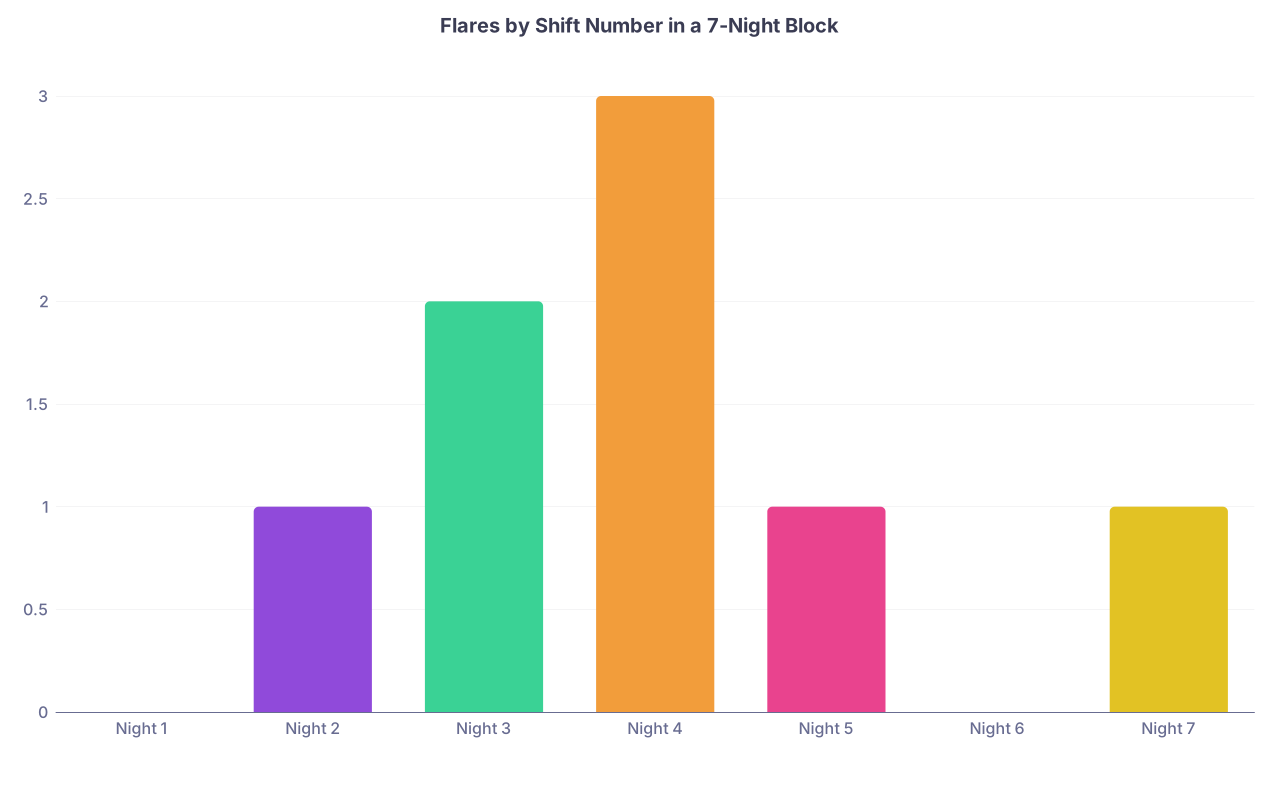
| Category | Value |
|---|---|
| Night 1 | 0 |
| Night 2 | 1 |
| Night 3 | 2 |
| Night 4 | 3 |
| Night 5 | 1 |
| Night 6 | 0 |
| Night 7 | 1 |
After the block, look for:
- Which night in a run gave you the worst flares? (Often night 3–4.)
- Were there specific tasks that always preceded a flare? (Skipping dinner, multiple procedures back to back, certain attendings.)
- Did certain adjustments help more than others?
Then you go back to your treating clinician and PD/GME with specifics:
- “I reliably flare after more than 3 consecutive nights. Here’s my log. We need to cap at 3 in a row.”
- “If I skip my 2 a.m. snack, I crash by 4. I need to be able to take 10 minutes to eat even on heavy nights.”
Concrete patterns = stronger case for focused accommodations.
Step 6: When the System Fails You (And How to Protect Yourself)
Let’s not pretend every program is enlightened about disability. Some are hostile. Some are just lazy.
If you hit resistance like:
- “Everyone is tired; you’re no different.”
- “We can’t change the schedule just for you.”
- “Medicine might not be the right field for you if you can’t hack ICU.”
You need to stop arguing at the hallway level and start protecting yourself at the institutional level.
Steps:
Loop in GME / Disability Office formally
- Ask for a sit‑down. Bring documentation from your physician. Bring a written description of how your condition interacts with ICU/night work and which accommodations are reasonable vs would fundamentally alter the program.
- Get copies of everything. Keep your own file.
Know when to bring in outside help
- If you’re in the US, you have ADA protections. Some residents eventually involve an external disability rights advocate or lawyer—not to sue immediately, but to get clarity on what’s reasonable.
- National organizations for your condition (MS Society, Lupus Foundation, etc.) often have resources specifically for workers in safety‑sensitive jobs.
Worst case: plan for the long game
- For some, the answer is eventually: different specialty, part‑time, or a non‑clinical role. That’s not failure. That’s staying alive and useful.
- But you don’t jump to that at the first sign of conflict. You start by structuring ICU and nights so they’re survivable, then reassess.

Step 7: Specific Scenario Playthroughs
Let’s run a few concrete “if you’re here, do this” vignettes.
Scenario 1: Autoimmune disease + 3 a.m. decompensation
You’re the night float resident covering floors and step‑down. You’ve been fine the first half of the shift. At 2:45 a.m., your joints are on fire, you’re freezing, and your brain feels like cotton.
What you do:
- Recognize this is at least orange.
- Hand off the most acute tasks first: “Hey, can you take any new rapid response or ED admit for the next hour? I’m having a medical flare and need to stay at the desk and handle pages/charting.”
- Take your rescue meds and a 10‑minute break (yes, really).
- Set a timer for 45 minutes; if not improving, page the chief: “I’m having a significant flare of my autoimmune disease. I’ve offloaded procedures/rapids to my co‑resident, but if this doesn’t improve soon I might not be safe to finish the shift. I wanted you aware early.”
You’ve protected patients, kept your co‑resident in the loop, and set up a path to backup if needed.
Scenario 2: POTS/orthostatic intolerance + ICU rounds
Day 6 in the unit. You stand at the bedside for the third 45‑minute family meeting of the day. You feel your heart jackhammer, vision narrowing.
You:
- Sit. Right there if you must. “I’m going to sit while we keep talking so I don’t pass out.”
- After the meeting, tell your attending: “My POTS is acting up. I need to sit during prolonged discussions and would do better running the rest of rounds from the workroom where I can sit and monitor.”
- Re-distribute roles: let the fellow/senior stand bedside while you manage orders/docs from a chair, still present on all decisions.
That’s not unprofessional. That’s functional adaptation.
Scenario 3: Migraine + cross-cover night
Midnight. Aura hits. You know what’s coming.
You:
- Downgrade nonessential sensory input: screen brightness down, dark room when charting, avoid standing under fluorescents when possible.
- Tell your co‑resident: “I’m developing a migraine with aura. I can still work but might be slower and need to avoid driving at the end of shift. If I cross into severe, I’ll tell you and step out of procedures/codes.”
- Take meds early, hydrate, small snack.
- At 4 a.m., if vision is blurred and pain is 9/10, move to red: you cannot safely run a code with compromised visual fields and attention. Call chief, get swapped out or brought to ED.
Again: planned, not panicked.
The Future: You’re Not the Only One Anymore
Here’s the hidden truth: more residents with chronic illness, long COVID, and mental health conditions are coming. Not fewer.
Programs that refuse to adapt will lose good people. Slowly, painfully, sometimes publicly.
You, right now, are part of the awkward middle phase—where you have to both survive and push the system an inch forward. That’s unfair. And real.
The only way this works is if you treat your flare management plan with the same seriousness you treat a sepsis protocol:
- Clear triggers
- Pre‑defined steps
- Early escalation
- Protected backup
You are not choosing between your health and patient safety. Protecting your health is protecting patient safety. An impaired resident pretending to be invincible is a liability for everyone.
Your next step today:
Open your calendar and find your next ICU or night float block. Then block 30 minutes in the next week to write a one‑page flare plan and email your PD/GME requesting a brief meeting to review ICU/night accommodations before that block starts.