
What do you do when occupational health says you’re “cleared with no restrictions,” but the disability office (or HR) insists you need accommodations—or the opposite?
This is where people get crushed between systems. You are “too disabled” for one office and “not disabled enough” for the other. Meanwhile you’re just trying to keep your job or your training spot and not blow up your health.
Let’s walk through what to do, step by step, when occupational health and the disability/accommodations office are giving you conflicting answers.
First: Understand Who Does What (So You Know Where the Power Actually Is)
If you do not understand the roles, you will argue with the wrong person and lose months.
In most hospitals, schools, and big employers, there are three main players:
- Occupational Health (Occ Health / Employee Health)
- Disability / ADA Office (or HR accommodations)
- Your Department / Program (your actual boss, PD, chair, manager)
Here’s the short version:
Occupational Health
Medical-ish. They:- Clear you to work or not work.
- Set safety-related restrictions (e.g., no night call for seizure risk, no lifting >20 lbs after back surgery, N95 fit test fails → cannot work in certain environments).
- Think in terms of fitness for duty and risk to you or patients.
Disability / ADA Office
Legal-ish. They:- Decide if you’re covered under disability laws.
- Coordinate “reasonable accommodations.”
- Look at essential job functions and whether they can be modified.
Your Department / Program Operational. They:
- Decide if they can run the service/clinic/rotation with those restrictions.
- Decide on schedule, call, coverage, rotations, assignments.
- Often say “we can’t accommodate that” even if disability office says it’s reasonable.
When you say “they disagree,” it usually means one of these:
- Occ Health says you’re fine; disability office says you qualify for accommodations.
- Occ Health restricts you; disability office won’t recognize it as a disability or won’t put it into accommodations language.
- Both agree you have limits, but your program/department refuses to implement what they’re saying.
You need to know which problem you have, because the strategy changes.
Scenario 1: Occupational Health Says “Cleared,” Disability Office Says “Yes, You Need Accommodations”
This is very common with “invisible” conditions: ADHD, chronic pain, POTS, migraines, depression, anxiety, autoimmune disease, long COVID.
Occ Health visit is 7 minutes: vitals, “any restrictions?” You say, “I get dizzy with prolonged standing, but I can manage.” They check a box: medically cleared, no restrictions.
Disability office looks at your detailed documentation and says, “You clearly qualify for accommodations: extra breaks, flexible scheduling, reduced call,” etc.
Now your department says: “Occupational health cleared you; why do you need accommodations?”
Here’s what to do.
Step 1: Separate “fitness for duty” vs “performance accommodations”
You need to put this into language administrators understand.
Fitness for duty = Can you physically/mentally be at work without posing a direct threat to yourself or others?
Accommodations = Can we adjust how/when you work so you can perform essential functions successfully and sustainably?
You say (in writing, not just verbally):
“Occupational Health assessed my fitness for duty; they determined I can be at work.
The Disability Office assessed my chronic condition’s impact on how I work and determined I qualify for accommodations under ADA/504. These are different questions and can have different answers.”
You are educating them, but you’re also drawing a line: Occ Health did not nullify the disability office.
Step 2: Get the disability office to put it in clean, operational language
A lot of disability offices are too vague. You need concrete, schedulable items.
Ask them—directly:
“Can you please issue a written accommodation letter that lists specific functional accommodations—e.g., ‘no more than X consecutive hours,’ ‘one protected break every X hours,’ ‘no more than Y night shifts per month’—that my department can operationalize?”
If they push back with “We only do general language,” respond:
“My department is denying accommodations unless they have clear, concrete terms. Broad wording is being interpreted as optional. I need functional, specific descriptions.”
You’re not asking for medical detail, just job-function language.
Step 3: Use documentation, not debate, with your department
When your program director or manager says, “Occ Health cleared you,” you don’t argue verbally. You send an email.
Subject: Clarification on Occupational Health vs ADA Accommodations
Then something like:
Dear Dr. X,
Following our conversation, I wanted to clarify that Occupational Health determined I am fit to be at work.
Separately, the Disability Office has determined that I qualify for accommodations under ADA/504. Attached is their letter specifying the recommended accommodations.
I would like to work with you on implementing these in a way that maintains patient care while still meeting my documented needs.
Thank you,
[Name]
This creates a written record that:
- You’re not refusing to work.
- You’re asking to implement what the disability office already supported.
If they still deny? We’ll get to escalation later.
Scenario 2: Occupational Health Restricts You, Disability Office Won’t Support You
Different problem. Here it’s usually:
- Occ Health: “No night shifts; avoid >12-hour shifts; no heavy lifting; no OR for now.”
- Disability office: “This doesn’t qualify as a disability,” or “We don’t do ‘no call’ accommodations,” or “We only do testing accommodations, not schedule changes.”
So your department says: “Occ Health won’t clear you for these duties. We can’t run the service with those restrictions. Maybe you should take leave.”
You’re stuck: medically restricted, but administratively unsupported.
Here’s how you approach this.
Step 1: Get exact written restrictions from Occ Health
No vague “light duty” garbage. You need explicit, functional restrictions.
Ask Occupational Health (in writing if you can):
“Can you please list my work restrictions in specific functional terms: maximum shift length, types of tasks to avoid, frequency of breaks, and whether these are temporary or permanent?”
You want something that reads like:
- No lifting over 20 lbs.
- No more than 10-hour shifts.
- Must have seated breaks after 3 hours of continuous standing.
- Avoid night shifts due to seizure risk.
Not “consider shorter shifts if possible.”
This gives you leverage.
Step 2: Push disability office to reconsider using the Occ Health note
Send an email to the disability office:
“Occupational Health has placed these formal restrictions on my work (see attached). These clearly affect my ability to perform essential job functions without modification.
Can we reopen my ADA/504 evaluation using these documented restrictions, and determine what reasonable accommodations might allow me to continue working safely?”
They may have been treating your issue as “temporary” and trying to dodge. Once Occ Health says “ongoing restrictions,” that looks a lot more like disability territory.
If they say “We don’t handle this; it’s a staffing issue,” then:
“I understand staffing is separate. However, ADA/504 covers modifications to how essential functions are performed, and occupational health is confirming I cannot perform them under usual conditions. I’m asking for a formal determination on accommodations to address these restrictions.”
You are forcing them to decide on the record.
Step 3: If disability still refuses, you lean into fitness for duty versus leave
If no one will accommodate and Occ Health says you cannot safely perform major parts of the job, then the honest options are:
- A temporary medical leave to recover.
- A reduced schedule / part-time status, if that’s allowed.
- Transition to a different role that fits your restrictions.
You may not like that answer, but pretending you can do 28-hour calls with uncontrolled POTS is how people end up intubated in their own ICU.
If you want to push, you can bring in:
- Your own specialist’s letter supporting specific, realistic accommodations.
- Documentation showing colleagues with similar accommodations (if you know about them carefully, without breaching privacy).
But sometimes the cleanest path is: “I am medically unable to meet these demands without accommodations you’re refusing to provide, so I need leave/alternative placement.”
Scenario 3: Both Offices Agree On Limits, Department Refuses To Implement
This is probably the most infuriating scenario.
- Occ Health: “No more than 2 consecutive night shifts; no lifting >30 lbs.”
- Disability office: “Reasonable to limit nights; schedule-based accommodation approved.”
- Department: “We can’t schedule that. Everyone has to take equal call. If you can’t, maybe this job/program isn’t for you.”
You do not fix this by more “talking it out.” You fix it with documentation and escalation.
Step 1: Force specifics: what exactly is “not possible”?
Reply in writing:
“I understand call coverage is challenging. So I can better understand, could you clarify which specific aspects of the accommodation are not feasible in our schedule—for example, limiting to 2 consecutive nights, or avoiding post-call clinic?
Knowing exactly where the barrier is will help me discuss options with the disability office as well.”
You’re doing two things:
- Getting them to say on paper that they’re refusing.
- Turning vague “can’t” into specific, discussable points.
Step 2: Pull the disability office into the conversation directly
Do not play go-between forever. Loop them in.
You send:
“Per the attached accommodation letter, I’ve requested implementation with my department. They’ve expressed concerns about feasibility.
Could we schedule a joint meeting with [Disability Office], [Department], and me to discuss alternative ways to implement these accommodations while maintaining patient care?”
Then in the meeting, your message is simple:
- “I’m trying to work within my restrictions.”
- “I want specific solutions, not general ‘we can’t.’”
- “If some aspects are unreasonable, let’s modify them with disability office input, not unilaterally ignore them.”
Take notes. Send a recap email after:
“Thank you for meeting. To summarize, we discussed X, Y, Z. My understanding is:
- [Department] believes [Accommodation A] is not feasible because [reason].
- [Disability Office] suggested [Alternative B].
- Next step: [who does what].”
Paper trail. Always.
When They Truly Disagree on Restrictions: You Need a Comparison
Sometimes the disagreement isn’t about implementation. It’s about reality.
- Occ Health: “You can work 12s, no problem.”
- Your treating physician: “You should not do shifts longer than 8 hours.”
- Disability office: “We need objective guidance.”
This is where you line up the opinions.
| Source | Focus | Typical Output | Who They Answer To |
|---|---|---|---|
| Occupational Health | Fitness for duty | Work/No work, safety limits | Employer |
| Treating Physician | Your medical best interest | Detailed medical restrictions | You (patient) |
| Disability Office | Legal accommodations | Accommodation letter | Institution compliance |
Step 1: Get your own doctor to write a clear work-capacity letter
Occ Health often gives generic “cleared for duty” notes. You need something sharper.
Ask your own physician:
“Can you please write a letter describing:
- My diagnoses (or at least functional effects if you prefer not to name them)
- Specific work restrictions (max shift length, need for breaks, limits on nights, lifting, etc.)
- Whether these are temporary or long term
- What could realistically be accommodated versus what truly isn’t safe?”
This is often more nuanced than Occ Health’s one-liner.
Step 2: Submit that to both Occ Health and the disability office
You’re basically saying: this is my best medical evidence. Now reconcile it.
To Occupational Health:
“My treating physician has provided more detailed information about my work capacity (attached). Could you please review and let me know if this changes your assessment of my fitness for duty or restrictions?”
To Disability Office:
“I’m submitting this updated medical documentation from my treating physician. Occupational Health’s initial assessment was less detailed, and this letter more accurately reflects my functional limitations.
I’m requesting accommodations aligned with these restrictions.”
You’re setting up a situation where if Occ Health ignores your specialist’s letter and something goes wrong, that’s on them.
Step 3: If Occ Health still refuses restrictions you clearly need, protect yourself
I’ve seen residents push through 24-hour calls after cardiology explicitly told them not to, because Occ Health didn’t “recognize” the restriction yet.
That’s how you end up with catastrophic events.
If your own physician says “no more than 8–10 hours at a time” and Occ Health keeps you at 16–24s, do three things:
- Get your doctor to explicitly state: “Working longer than X hours places [patient] at significant risk of [worsening condition, syncope, seizure, etc.].”
- Send that to HR/Occ Health and say:
“Given this clear risk, I’m not comfortable working beyond these limits while we sort this out. Can we temporarily adjust my schedule or consider leave until there is a clear plan that doesn’t contradict my medical safety?”
- If they push you to work beyond that, you’re in territory where legal advice is appropriate. Because now it’s not about “preference”; it’s about ignoring documented medical risk.
Mapping Out Your Moves: Don’t Flail, Use a Sequence
Here’s what the typical flow looks like when there’s conflict.

| Step | Description |
|---|---|
| Step 1 | Conflicting opinions |
| Step 2 | Identify the exact conflict |
| Step 3 | Collect documentation from all sides |
| Step 4 | Clarify roles - fitness vs accommodations |
| Step 5 | Ask disability office for specific functional terms |
| Step 6 | Request joint meeting with department |
| Step 7 | Implement and monitor |
| Step 8 | Escalate - HR, ombud, legal advice |
| Step 9 | Resolved? |
The worst thing you can do is keep having hallway conversations with five different people and never put anything in writing.
Every step above should generate at least one email and one document you save.
The Quiet Reality: Sometimes the “Solution” Is Leaving, But Don’t Jump Too Fast
Let me be blunt: some departments and programs will not accommodate anything meaningful, no matter what the disability office says. They will weaponize “essential functions” language to mean “we won’t change anything.”
If you are in a malignant culture, long-term survival might mean transferring programs, changing employers, or even rethinking your specialty. That’s reality.
But do not jump straight to quitting without:
- At least attempting formal accommodations.
- Documenting refusals and non-responses.
- Exploring alternatives: LOA, part-time, role change, non-clinical periods.
Why? Because:
- Documentation protects you if you do need to explain gaps to future programs/employers.
- Sometimes, once HR or compliance gets looped in, things suddenly “become possible.”
You want your story to be: “I engaged the process in good faith; they blocked every reasonable attempt,” not “I got upset and vanished.”
A Quick Visual: How All These Offices Interact
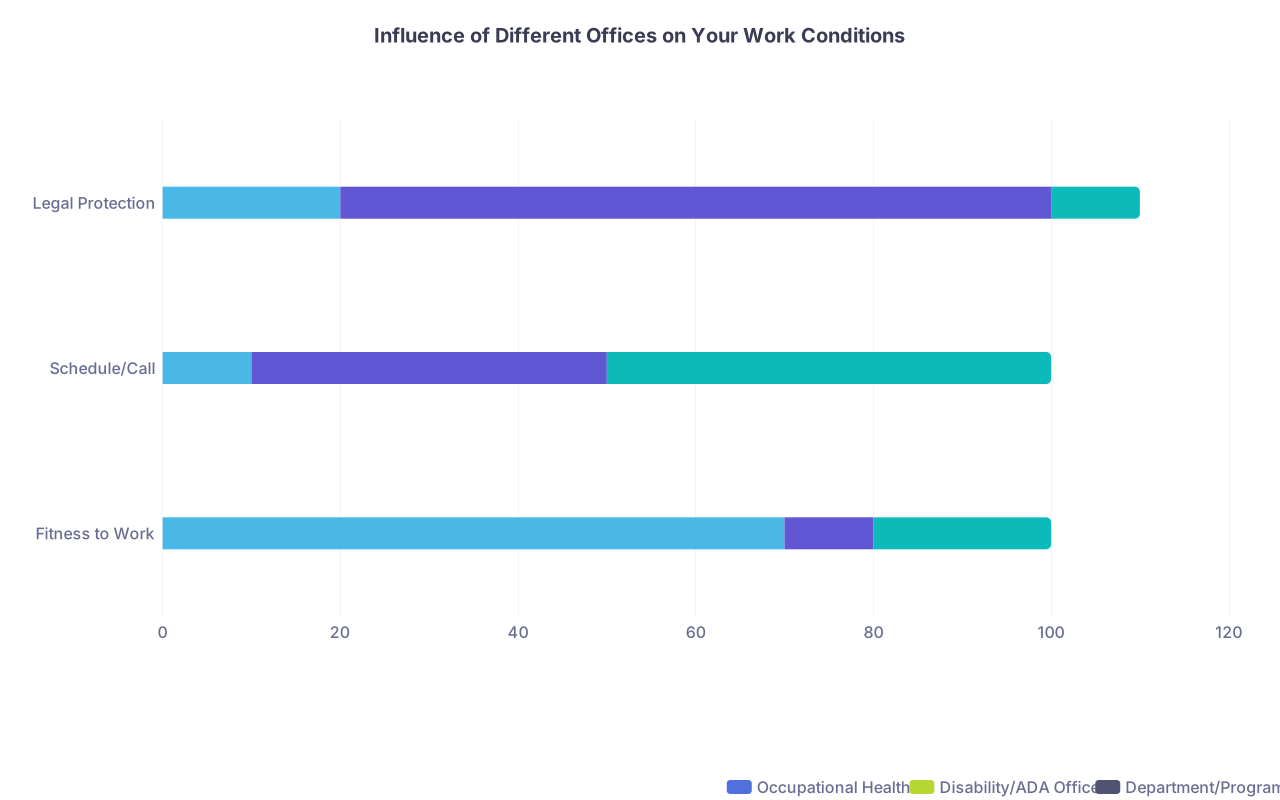
| Category | Occupational Health | Disability/ADA Office | Department/Program |
|---|---|---|---|
| Fitness to Work | 70 | 10 | 20 |
| Schedule/Call | 10 | 40 | 50 |
| Legal Protection | 20 | 80 | 10 |
The point of that chart: no single office controls everything. You have to move information between them deliberately.
How To Write Emails That Don’t Get Ignored
You’re often tired, sick, and angry when dealing with this. That’s when emails get messy. Here’s a simple structure that tends to work.
Subject: Request to Clarify Work Restrictions and Accommodations
Body:
One sentence of context:
“I’m writing to clarify my current work restrictions and accommodations, as there seems to be some disagreement between offices.”
Bullet (yes, just here) your understanding:
- Occ Health says: [copy exact phrase if you have it].
- Disability Office says: [summarize or attach letter].
- Department says: [what they told you].
Ask for a clear next step:
“Could we please clarify how these should be reconciled, and what my actual working limits and accommodations are as of now?”
Close with openness but firmness:
“I’m committed to working within safe and legally appropriate boundaries and want to avoid misunderstandings. Thank you for your help clarifying this.”
Send it. Save their responses.
When To Bring In Outside Help
You escalate when:
- You’ve got documented denials or contradictions.
- Safety is at risk.
- Your job/position is being threatened because of the conflict.
Options:
- Institutional ombudsperson or trainee advocate (med schools and residencies often have one).
- Employee relations / HR at a higher level than your department.
- Union if you’re unionized.
- External lawyer specializing in employment/ADA, if things get ugly.
Do not open with legal threats. But do not be afraid to quietly get a consultation if you’re being backed into a corner. Sometimes a one-page letter from a lawyer asking, “Why is the institution ignoring its own disability office?” changes the tone fast.
Bottom Line: If You’re Stuck Between Offices
You’re not crazy. The system is fragmented, and the right hand often has no idea what the left hand just signed.
Three core moves:
Force clarity on roles and language.
Fitness for duty vs accommodations. Vague “you’re fine” vs specific, written restrictions.Use documentation, not emotion, to align the players.
Email summaries, letters from your own doctors, formal requests for joint meetings.Protect your health first, then your paper trail.
Do not work beyond what’s medically safe just because one office is lagging. Get your physician’s limits in writing, share them, and if necessary, step back on leave rather than gamble your long-term health on someone else’s confusion.