It’s Wednesday at 4:30 a.m. You’re halfway through your surgery rotation. Yesterday you fell, tore something in your knee, or broke your wrist. The ED doc shrugged and said, “You’re going to need a brace and probably surgery… and you should not be on your feet all day.”
Your phone is buzzing with group texts: “Don’t be late for rounds.” Your chief expects you at 5. You can barely walk to the bathroom.
You’re stuck between two fears:
- “If I tap out now, I’ll look weak and unreliable.”
- “If I push through, I’ll wreck my body and maybe my career.”
Here’s how to pause safely, protect yourself legally and medically, and still keep relationships intact.
Step 1: Stabilize Your Health First (Even If It Inconveniences People)
You can’t “power through” some injuries. Not without consequences.
If you’re acutely hurt (fracture, significant tear, concussion, serious back spasm, etc.), your first obligation is to get medically stabilized. Not to your team. Not to your eval. To you.
Do this immediately:
Get clear documentation
If you’re in the ED or urgent care, ask for:- A work status note (fitness for duty note) that clearly states:
- Your diagnosis or suspected diagnosis
- Specific restrictions (no prolonged standing, no lifting >10 lbs, no driving, no call, etc.)
- Duration of restrictions (“for at least 2 weeks, reassess with ortho”)
- Any imaging reports, consult notes, discharge summary
Do not leave with a vague “follow up with PCP” slip. Tell them:
“I’m a medical student on clinical rotations. My school will need clear activity restrictions and an estimated timeframe to decide if I can continue or need a leave.”- A work status note (fitness for duty note) that clearly states:
Be honest about pain and function
This is not the time to downplay your limitations to look “tough.” If you tell ortho, “It’s not that bad, I think I can walk all day,” guess what they write? “Activity as tolerated.” That’s useless when you try to get accommodations.Instead:
“I can walk a few steps but can’t tolerate prolonged standing or walking. My job usually requires 10–12 hours on my feet, pushing beds, running around. That’s not doable right now.”Ask explicitly about work/rotation feasibility
“Given my role as a medical student, do you recommend I continue hospital rotations or pause temporarily?”
If they say you should pause, ask them to write that down.
You need this paper trail. Not because you’re litigious. Because medicine loves documentation, and everyone up the chain will want “proof” you weren’t just “tired and stressed.”
Step 2: Same Day Triage – Who You Tell, and How
You don’t ghost your team. You also don’t over-explain your life story at 4:45 a.m. while high on pain meds.
Here’s a clean order of operations for that first 24 hours:
Immediately (same morning) – Notify your chief or resident
Short, factual, and early.Example text/email (use whatever channel they actually check):
“Hi Dr. Patel, this is [Your Name], MS3 on your team. I had an acute injury last night and was evaluated in the ED. I’ve been advised not to work clinically until I’m cleared. I won’t be at rounds this morning. I’ve already contacted the clerkship coordinator. I’m sorry for the short notice and will keep you updated once I know more.”
That’s it. No drama. No essay. They’re starting rounds in 15–30 minutes. They don’t have time for your whole saga right now.
Same morning – Email the clerkship coordinator and course director
Slightly more detail, still professional.Subject: Urgent – Medical Issue Affecting Clinical Participation
Dear [Coordinator Name] and Dr. [Clerkship Director],
I’m currently on the [Service] team at [Hospital]. Yesterday I sustained an acute injury and was evaluated in the ED. I’ve been given restrictions that likely prevent me from safely completing my current clinical duties (no prolonged standing, limited walking, no lifting, and possible need for further intervention).
I’ve notified my team that I will be out today. I have documentation from the ED and will obtain any additional notes you need. I’d like guidance on next steps, including whether I should pause this rotation and how to proceed with formal accommodations or a short-term leave if needed.
Thank you for your help,
[Name], [MS3/MS4], [ID#]Same day – Contact student affairs / dean of students
This is where many people mess up. They talk only to the rotation and never to the school’s central office. Then policies get weaponized later.Send:
“I’ve had an acute injury that affects my ability to safely participate in clinical rotations (per ED note / specialist recommendation). I’m requesting a meeting as soon as possible to discuss options: temporary leave, adjusted schedule, and disability accommodations. I have documentation ready to share.”
Your goal on Day 1 is not to negotiate the entire solution. It’s to:
- Alert key people.
- Establish that this is a legitimate medical issue.
- Get on student affairs’ radar before rumors or assumptions take over.
Step 3: Understand Your Realistic Options (Not the Ones People Guilt You Into)
Once the initial dust settles, you’re looking at a few possible paths. The right answer depends on how long you’ll be limited, how close you are to graduation, and how rigid your curriculum is.
Here’s the practical breakdown.
| Option | Best When | Typical Time Impact |
|---|---|---|
| Short pause within rotation | Out 3–10 days | Minimal, may still complete on time |
| Withdraw and repeat later | Out >2–3 weeks | Adds 2–4 weeks later |
| Formal leave of absence | Prolonged recovery/surgery | Adds 3+ months, may delay graduation |
| Accommodated continuation | Partial mobility limits | May extend by 0–2 weeks |
1. Short pause but finish the same rotation
Good if:
- Your injury is minor/moderate.
- You’ll be functional again in 3–10 days.
- You’re not on a hyper-competitive rotation where every day matters for a letter.
This works when the clerkship director agrees to:
- Excuse your absence as medical.
- Allow you to make up a bit of time or accept partial completion.
- Not tank your evaluation because “you weren’t there enough.”
You’ll need:
- Clear return-to-work restrictions (from your clinician).
- Written confirmation from the clerkship that this approach is acceptable.
2. Withdraw and repeat the rotation later
This is underused but often the cleanest option.
You basically say:
“I was unable to complete this rotation due to medical reasons. I will withdraw now and repeat the full block when medically cleared.”
Pros:
- You’re evaluated on a full, clean performance, not a half-broken one.
- You avoid that “they were out a lot and kind of impaired” subtext on evaluations.
Cons:
- Time. Your schedule shifts. Maybe graduation moves, maybe not.
- You’ll need the registrar and student affairs to sign off.
This is very often the right choice for:
- Surgery with non-weight-bearing leg.
- Ortho with upper extremity in a cast.
- Rotations with a heavy procedural or call burden you literally can’t do.
3. Formal leave of absence (LOA)
You go this route when:
- You’re facing surgery with real downtime (e.g., ACL reconstruction, spinal surgery).
- Recovery is measured in months, not days.
- You’re dealing with pain, rehab, maybe mental health fallout.
Do not let anyone pressure you into “just see how it goes” if three different clinicians are telling you you’ll be quite limited for months. That’s nonsense. You’re not a superhero. You’re a human with one body.
You’ll want:
- Strong documentation from your treating physician.
- A clear written LOA agreement: when it starts, what happens to your current rotation, how/when you’ll return, financial aid impact, graduation impact.
Step 4: Use Disability Services Properly (Not as a Last Resort)
Most med students only discover disability services when they’re desperate. That’s backwards.
You want disability/ADA or equivalent office involved early if:
- Your limitations will last more than a couple of weeks.
- You’ll have ongoing restrictions (no call, limited standing, no night shifts, etc.).
- You need structural changes (extra time on exams due to meds, ergonomic workstation, etc.).
What disability services can do that your clerkship director can’t:
- Translate your medical restrictions into formal accommodations the school must consider.
- Standardize expectations across rotations so you’re not renegotiating your legitimacy every 6 weeks.
- Protect you from the worst “Just push through, we all did” toxic nonsense.
Sample email:
“I’ve had an acute injury that’s expected to significantly limit my mobility and stamina for at least [X] weeks/months. My current clinical duties exceed the restrictions set by my treating physician. I’m requesting to begin the process for disability accommodations so that my clinical training can continue in a safe and feasible way.”
Bring:
- All relevant medical notes.
- A clear description of your typical clinical day (so they understand what “no standing >2 hours” actually means in medicine).
- A list (draft) of potential accommodations you think might help (it shows you’re thoughtful and realistic).
Possible accommodations:
- Reduced call or no overnight shifts for a period of time.
- No heavy lifting, bed-moving, or transporting patients.
- Limited continuous standing/walking time with built-in breaks.
- Permission to sit during rounds, clinic, or OR observing.
- Temporary shift to more outpatient-heavy or lighter-physical-demand rotations.
Non-negotiable: accommodations cannot be purely “vibes.” They need to be documented and official. That protects you when you meet the inevitable attending who thinks “In my day, we scrubbed with a 102°F fever.”
Step 5: Preserve Relationships While Still Drawing Boundaries
You’re not just managing logistics. You’re also managing people’s impressions of you.
The trick is to be:
- Proactive.
- Respectful.
- Firm.
How to talk to your clerkship director
Once you have some idea of your medical course, schedule a meeting. In person or video is best.
Your script, roughly:
Acknowledge the disruption.
“I know this puts the schedule and service in a bind, and I’m sorry for that.”State the medical facts, briefly.
“I had [brief description] and my specialist recommends [no prolonged standing, no call, etc.] for at least [time].”Tie it to safety and competence.
“Given these restrictions, I don’t think I can safely or meaningfully complete this rotation in its current form.”Propose a path.
- “I’d like to withdraw from this block and repeat the full rotation when I’m cleared.”
- Or: “If possible, I’d like to continue with accommodations: shorter days, more clinic, no call.”
Show commitment.
“I care about this specialty and I want to be evaluated at my best, not while half-immobilized and distracted by pain.”
You’re framing this as responsibility, not avoidance.
How to handle the “suck it up” crowd
You’ll hear things like:
- “I broke my wrist as an intern and still rounded.”
- “If you want surgery, you just deal with it.”
- “Residency will be worse.”
The blunt truth: some of them are proud of their own bad boundaries and poor self-care. That’s not your model.
Lines you can use:
- “I respect that you pushed through a lot. My physician and disability office have been clear about what’s safe for me right now, and I’m following that guidance.”
- “This is about making sure I can have a long career, not just survive this month.”
- “I’m committed to the work. I’m just not going to ignore medical advice about my own body.”
If someone becomes truly inappropriate or retaliatory, document it. Times, dates, what was said. Then talk to student affairs. You’re not snitching. You’re protecting yourself.
Step 6: Strategically Protect Your Evaluations and Future Apps
You’re not just trying to survive the next week. You’re trying to avoid nasty surprises when MSPEs and letters go out.
What to prevent on your record
Red flags you don’t want:
- “Student missed substantial time due to personal issues” with no context.
- Vague negative professional comments like “less reliable” when half your absence was medical.
- A random “withdrawal” appearing as if you just bailed, with no note that it was for health reasons.
You can’t micromanage what’s written, but you can strongly influence the setup.
Actions:
Ask what will appear on your transcript/MSPE
Straightforward:
“How will this medically-related withdrawal/absence be documented on my transcript and in my MSPE?”Ask for neutral language
“Since this was due to documented medical reasons and not a professionalism issue, I’d appreciate if the wording reflects that.”For future letter writers
When you’re back and healthy on another rotation, you might say:
“I had to withdraw from a prior rotation due to an acute injury, but I’m now fully cleared. I want to make sure my record reflects my performance when I’m at full capacity.”
You’re not hiding anything. You’re giving future readers the real story: “There was a medical interruption. It was handled professionally. Performance otherwise is strong.”
Step 7: Plan Your Return So You Don’t Crash Again
The biggest trap: coming back too early, overcompensating, and setting yourself back.
Think in phases:

| Step | Description |
|---|---|
| Step 1 | Injury and ED Visit |
| Step 2 | Notify Team and School |
| Step 3 | Medical Evaluation and Restrictions |
| Step 4 | Pause Few Days Finish Rotation |
| Step 5 | Withdraw Repeat Rotation Later |
| Step 6 | Formal Leave of Absence |
| Step 7 | Gradual Return With Accommodations |
| Step 8 | Full Clinical Duties When Cleared |
| Step 9 | Expected Recovery Time |
When negotiating a return date and structure, ask yourself:
- Can I safely get through an 8–10 hour day without significantly worsening my injury?
- What’s my actual pain level by the end of the day? Am I wiped or functional?
- Do I have PT/rehab appointments that need protected time?
Reasonable return model:
- Week 1 back: lighter rotation, outpatient if possible, no call.
- Week 2–3: incremental increase in hours and complexity.
- Full duty only when your treating clinician signs off.
Put this clearly to student affairs:
- “My physician recommends a graded return: initially no call and limited standing, with re-evaluation in 2 weeks. Is there a rotation structure that can accommodate that?”
Practical Communication Templates You Can Steal
To your team when you realize you can’t continue
“Dr. [Resident/Attending],
I wanted to update you now that I’ve had a chance to speak with my treating physician and student affairs. My injury requires [brief description: e.g., non-weight-bearing status and likely surgery] and I won’t be able to complete this rotation safely. The plan is for me to withdraw from this block and repeat it once I’m medically cleared.
I’ve really appreciated the teaching and the time with your team. I’m disappointed to step away mid-rotation, but I think this is the safest and most responsible plan. Thank you again for your understanding.
[Name]”
To disability services asking for specific accommodations
“Following my [injury/surgery], I have the following medically documented limitations: [list key ones]. My typical clinical day involves prolonged standing and walking, sometimes for 8–12 hours, plus call.
To continue training safely, I think I may need accommodations such as reduced or no overnight call for [time period], permission to sit during rounds when needed, and limits on continuous standing and walking. I’d appreciate your guidance on what’s reasonable and how to formalize this.”
Visual Snapshot: Time Impact vs. Injury Severity
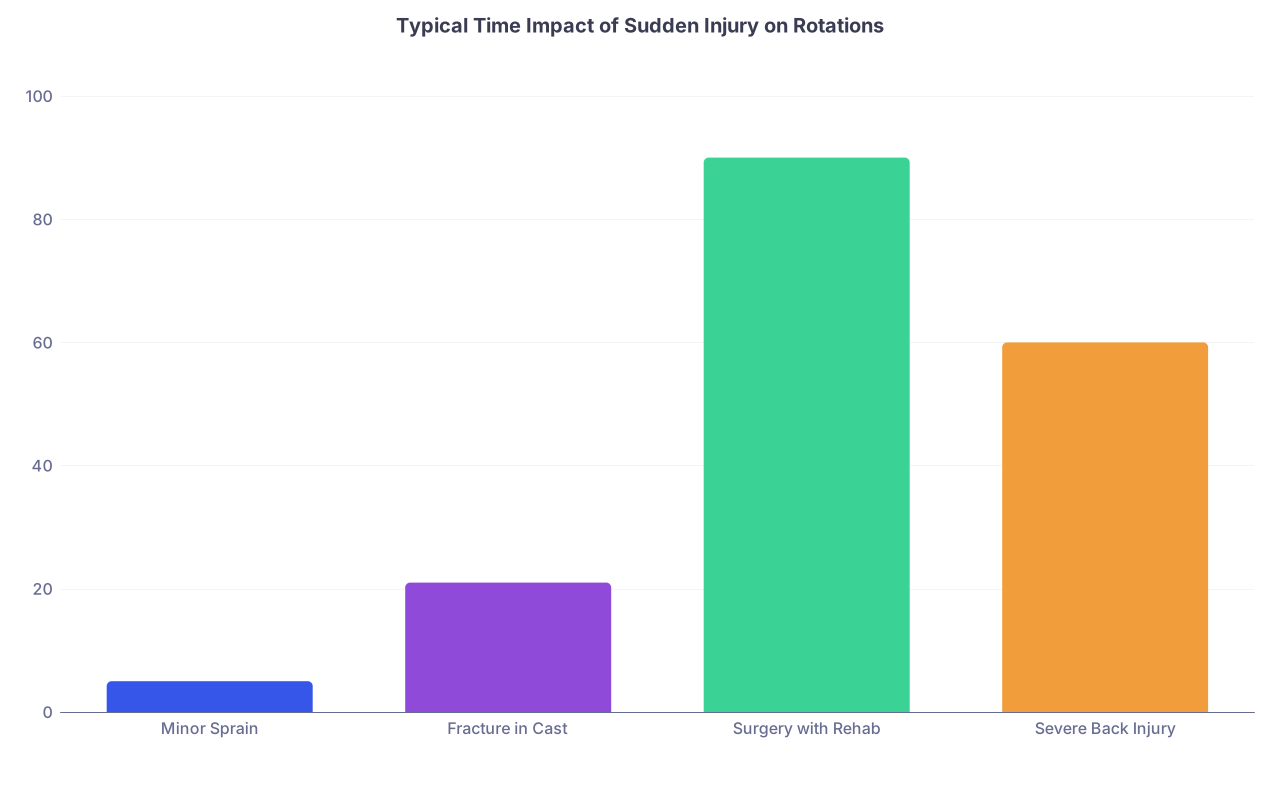
| Category | Value |
|---|---|
| Minor Sprain | 5 |
| Fracture in Cast | 21 |
| Surgery with Rehab | 90 |
| Severe Back Injury | 60 |
Days approximate: this is how long students often end up partially or fully out, not exact prescriptions. The point is: you’re not weird if your situation is measured in weeks or months. It’s common.
Don’t Ignore the Mental Side
This part no one tells you.
You’ll feel:
- Guilty for “abandoning” your team.
- Scared about looking weak.
- Angry that your body failed you at a terrible time.
- Isolated while your classmates keep posting OR selfies.
None of that means you’re making the wrong call.
Get support:
- Another upperclass student who’s taken a leave or had an injury.
- A therapist (especially if pain, sleep, or meds are wrecking your mood).
- A trusted faculty member not directly involved in your evals.
Phrase you might need to hear:
Protecting your body is not a character flaw. It’s a professional obligation if you want a 30–40 year career instead of a 5-year crash.
One More Thing: Document Everything
Pain fades. So do details. Admin disputes do not.
Keep a simple folder (digital or physical) with:
- All medical notes and work restrictions.
- Emails to/from clerkship directors, student affairs, disability services.
- Any evaluations mentioning your leave or injury.
- A brief log of key conversations (date, who, what was said).
You hope you never need it. But if there’s ever a dispute about professionalism, progression, or whether your absence was “justified,” that archive protects you.

FAQs
1. Will this hurt my residency chances?
It can, if it’s mishandled. If you disappear unpredictably, don’t communicate, or collect vague negative comments about reliability, that’s a problem. But a clearly documented, medically-explained interruption that’s handled professionally and followed by strong, full-capacity performances on later rotations? Programs see that all the time. When needed, you or your dean can mention it briefly in your MSPE or personal statement as a challenge you navigated responsibly, not as a dramatic saga.
2. Should I disclose this injury in my personal statement or ERAS?
Usually not as a central story. It’s not your main identity. If the injury caused a formal leave or delay that’s visible on your record, a brief mention in a secondary essay or dean’s letter is often enough: “I took a medically necessary leave during third year due to an acute injury and returned fully cleared; subsequent rotations were completed without limitation.” If it truly shaped your career goals (e.g., you pivoted to PM&R after a major rehab journey), you can integrate it, but keep the tone focused and mature, not self-pitying.
3. What if my school or clerkship director is unsupportive?
This happens. When it does, you escalate in a controlled way. Start with student affairs or the associate dean for clinical education. Bring documentation and a clear description of how your duties conflict with medical restrictions. If that fails, involve disability services—they’re often the ones who actually understand legal obligations. In extreme cases, you may need to involve an ombudsperson or even an external disability rights organization for advice. You’re not asking for special favors. You’re asking for your school to follow its own policies and the law.
Key points to walk away with:
- Get real medical documentation and involve student affairs/disability services early. Verbal sympathy from an attending isn’t enough.
- Choose a path—short pause, withdraw-and-repeat, or LOA—that protects your body and your evaluations instead of clinging to a broken version of “toughness.”
- Communicate like a professional: clear, early, documented. That’s how you pause without burning bridges and return on your own terms.