The biggest mistake disabled trainees make is trying to convince attendings they “deserve” accommodations instead of calmly enforcing the boundaries they already have a legal right to.
If you’re reading this, you’ve probably already had some version of this conversation:
“So… do you really need that?”
“Other students manage without that.”
“We’ll see how it goes first before we change anything.”
“We’re all tired. That’s part of medicine.”
You feel your stomach drop. You start explaining. Over-explaining. You walk away doubting yourself.
Let’s fix that.
This is how to respond, in the moment and afterwards, when attendings question your need for adjustments.
1. Understand What Game You’re Actually Playing
You are not in a clinical reasoning exercise. You are in a power, liability, and policy situation.
There are three layers here:
Your legal/ institutional rights
You’re not asking for a favor; you’re implementing an approved adjustment (if it’s already through Disability Services / GME).The attending’s mindset
They may be:- Ignorant of policy
- Worried about “fairness” or “precedent”
- Afraid of lowered standards / liability
- Just annoyed their normal workflow has to change
Your personal stakes
- Evaluation
- Reputation
- Future letters
- Your physical/mental health and safety
Your job is not to fix their beliefs about disability. Your job is to:
- Keep your accommodation
- Protect your evaluation and safety
- Document what matters
- Escalate strategically if needed
Once you accept that, your responses get sharper and calmer.
2. Scripts for Common Pushback (Use These Word-for-Word)
You need language ready before someone corners you on rounds. When you’re stressed, your brain will default to apologizing and over-sharing unless you’ve rehearsed something else.
Scenario A: “Do you really need that adjustment?”
Comment variations:
- “Do you actually need to sit during procedures?”
- “Is the extra day off for real, or just a preference?”
- “Do you really need extended time for exams?”
Your response structure:
- Confirm
- Anchor to policy
- Close the topic
Example:
“Yes, I do. This is an approved accommodation through [Disability Services/GME]. I’m happy to focus on how to make it work on this rotation.”
If they push again:
“I understand it may be different from what you’re used to. The accommodation has already been reviewed and approved by the school/hospital. I’d really like to focus on meeting your expectations for the rotation within that framework.”
That line “within that framework” is key. You’re not negotiating the existence of the adjustment. You’re negotiating how to implement it.
Scenario B: “Other students manage without this.”
Classic shaming line.
You do not need to compare yourself to other people. Ever.
Response:
“I get that this isn’t typical. My situation is different, which is why the formal accommodation is in place. I’m committed to meeting the rotation objectives while using the supports I need.”
If they say, “But how will you be a doctor if you need this?”
“I’ve discussed that with my institution’s disability team. They’ve confirmed these are reasonable within the essential functions of training. My focus here is to learn and contribute on this team while using the accommodations I have.”
You kick that question back to the institution that approved your adjustment. Smart and safe.
Scenario C: “Let’s see how you do without it first.”
Huge red flag. This is them trying to delay or de facto deny an accommodation.
Response:
“I need to use my accommodations consistently, not only after there’s a problem. They were approved to prevent issues, not react to them. I’ll be using them starting now.”
If they insist:
“I’m not comfortable deviating from what’s been formally approved. If there’s a concern, I can loop in [Disability Services / GME / course director] so we’re all on the same page.”
You’re drawing a line and immediately signaling you’ll escalate if needed.
Scenario D: “Can you tell me what your condition is?”
Sometimes they ask out of curiosity. Sometimes out of skepticism.
You are not required to disclose diagnosis to an attending. The institution that approved your accommodation has that information. The attending only needs to know what to implement.
Response options:
Polite boundary:
“I keep my specific diagnosis private. What’s relevant here is the accommodation, which has been approved. I’m happy to talk about how to integrate it into the workflow.”
If they push:
“I’m not able to share medical details, but I can forward you the official accommodation letter if you’d like to see it again.”
You’re not defensive. You’re just closed.
3. Know Your Rights Before You Walk Onto the Floor
You don’t want to be googling ADA at 1 a.m. after being humiliated on rounds.
Broad strokes (US context; local rules differ, but the logic is similar elsewhere):
- You’re entitled to reasonable accommodations if you’re otherwise qualified to meet essential requirements with those adjustments.
- You don’t have to tell supervisors your diagnosis. The interactive process is between you and the institutional disability office / GME / HR.
- Attendings are supposed to implement, not reinterpret, accommodations that have already been vetted.
What attendings can legitimately say:
- “We need to adjust how this is implemented in the OR/clinic.”
- “Help me understand the logistics so we can plan the schedule.”
What they cannot appropriately say:
- “I don’t think you need this.”
- “Prove to me you need it.”
- “I’ll give it to you if you perform well.”
If you don’t have formal accommodations yet and are just “informally asking” for adjustments, you’re more exposed. On some rotations, an informal arrangement is enough. On others, you will get steamrolled.
If you’re relying on “everyone’s been chill about it so far,” that will eventually fail. Plan for that.
4. How to Respond in Real Time Without Melting Down
You won’t always have the luxury of long, thoughtful responses. People will hit you with this in doorways, in the OR, on rounds in front of others.
Use a three-part mental script: Pause – Anchor – Redirect.
Pause (2–3 seconds)
Breathe. Do not immediately justify. Silence actually shifts power back to you for a moment.Anchor to something external
- “My formal accommodations…”
- “The school’s disability office…”
- “The program approved…”
This moves the conversation away from your worth as a trainee and toward policy.
Redirect to clinical/learning goals
- “I’d like to focus on how I can best contribute today.”
- “Can we talk through expectations for the rotation?”
Example combo in the moment:
Attending: “Do you really need to sit during long cases? Everyone stands.”
You: (pause)
“Yes, that’s part of my formal accommodation. I want to be sure I’m still doing everything expected of me in the OR. Are there specific parts of the case where you’d prefer I be at the field vs charting?”
You answered. You anchored. You redirected to workflow and expectations.
5. When It Gets Hostile or Punitive
Let’s be honest. Sometimes this isn’t just an awkward question. It’s retaliation dressed up as “feedback.”
Patterns to watch:
- Suddenly “unprofessional,” “not a team player,” “not committed” after you assert an accommodation
- Comments like “Medicine may not be the right field for you”
- Being excluded from key learning experiences explicitly because of your adjustment (“If you can’t take call, you can’t scrub cases”)
This is where documentation and calm escalation matter.
Step 1: Document immediately
Same day. While the wording is fresh.
Email to yourself or a notes app (that you can export):
- Date, time, location
- Who was present
- Exact phrases you remember (“We’re all tired,” “Other students don’t need this,” etc.)
- What you said back
- Any impact (you were removed from a case, told not to use your break, etc.)
Do not wait until the end of the rotation and then write a novella from memory.
Step 2: Short, neutral follow-up email when needed
Sometimes, sending a brief summary email creates a paper trail and forces some professionalism.
Example:
Subject: Clarification on accommodations during this rotation
Dear Dr. [Name],
Thanks for discussing my schedule today. I just want to confirm that I will be using my approved accommodation for [brief description, e.g., “one afternoon weekly for medical appointments”] throughout the rotation, as arranged with [Disability Services / Student Affairs].
If there are any concerns about how this affects workflow, I’m happy to involve [Disability Services contact/course director] so we can align on expectations.
Best,
[Your name]
That looks polite. But it also signals: “I am not going away quietly, and external eyes may read this.”
Step 3: Escalate strategically, not impulsively
You’re not tattling. You’re protecting yourself.
Who to involve, in roughly this order:
| Situation Severity | First Contact | Next Level | Formal Path |
|---|---|---|---|
| Mild pushback | Disability office | Clerkship/program director | None yet |
| Repeated questioning | Disability office | Student affairs/GME | Written concern |
| Hostile comments | Disability office | Title IX/EEO office | Formal complaint |
| Retaliation in evals | Disability office | Dean/GME leadership | Grade appeal/grievance |
You do not have to open with “I want to file a formal complaint.” You can start with:
“I’m experiencing some pushback implementing my already-approved accommodations on [service]. Can you advise on how to handle this?”
Behind the scenes, they know what that really means.
6. Pre-Emptive Moves Before Each Rotation or Service
You can make a lot of this easier by not waiting for the first confrontation.
A. Use a structured intro email
Before the rotation starts (or at least Day 1), send a short email to the attending/team lead or coordinator:
Subject: Accommodations on [Rotation Name]
Dear Dr. [Name],
I’m looking forward to working with your team on [dates]. I do have approved accommodations through [Disability Services/GME], including [brief functional description, e.g., “periodic sitting during prolonged standing tasks” or “protected time for medical appointments on Wednesday afternoons”].
I’ve attached/They have on file the official letter, but I wanted to proactively offer to discuss any logistical questions so things run smoothly.
My goal is to fully meet the rotation requirements while implementing these supports.
Best,
[Your name]
This does several things:
- Sets tone: you’re proactive and professional
- Reduces “surprise” annoyance
- Creates a record that they were informed
B. Have a one-liner ready for in-person intros
When you meet the attending:
“Just as a heads up, I have a couple of approved accommodations on this rotation, mainly [1–2 functional points]. If you have any concerns, [Disability Services/Student Affairs] is happy to discuss details with you.”
Short. Clean. No drama.
7. Don’t Over-Explain Your Disability (You’ll Regret It Later)
Here’s a pattern I’ve seen dozens of times:
Student feels guilty. Opens up about trauma/diagnosis in detail. Attending seems sympathetic in the moment. Later, that same info shows up weaponized in an evaluation.
You control the dial on disclosure. Right now you may feel like you’re “hiding something.” You’re not. You’re maintaining professional boundaries.
Good rule of thumb:
- Talk in terms of functional impact, not diagnosis.
- “I need intermittent sitting during prolonged standing tasks.”
- “I need protected time for weekly medical care.”
- “I need extra time for written assessments.”
Not:
- “I have POTS and chronic pain and sometimes I almost faint…”
- “I have bipolar and when I don’t sleep it spirals and then…”
The more detail you give, the more they’ll feel (incorrectly) entitled to second-guess your care plan and accommodations.
8. Managing Your Own Headspace So This Doesn’t Break You
You can do everything right and still feel gutted after someone questions your needs. Because it is personal, whether they mean it that way or not.
A few practical things that actually help:
Debrief with someone who gets disability in medicine
This is not a “talk to your friends” situation if your friends are all “I just push through” types.
Better options:
- A disabled trainee/faculty group (many schools now have affinity groups)
- National groups (e.g., Disabled and Chronically Ill Physicians/Trainees communities)
- A therapist who actually understands medical training culture
Script to start the conversation:
“I had an attending question my accommodations today and I’m stuck between wanting to appease them and knowing I need to hold the line. I need help figuring out what’s reasonable.”
Separate performance anxiety from accommodation validity
Two different questions:
- “Am I performing well?”
- “Do I deserve/need this accommodation?”
Attendings will try to blend them: “If you want a good evaluation, you need to do XYZ like everyone else.”
You unblend them in your own head:
- “I will meet the clinical expectations.”
- “I will not jeopardize my health or violate policy to soothe someone’s bias.”
That’s not easy. But you have to practice.
9. The Future-of-Medicine Reality: You Are Not the Problem
You’re hearing a lot about “diversity,” “wellness,” and “belonging” in shiny brochures. Then you hit the wards and get:
- “Back in my day we just sucked it up.”
- “Patients won’t care about your accommodations.”
- “If you can’t do 28-hour calls maybe this isn’t for you.”
Here’s the truth: the future of medicine will not look like your attending’s nostalgia. It will be shaped by people like you who refuse to vanish or break themselves to fit bad systems.
Your job right now is not to fix all of that. Your job is to:
- Survive
- Get trained
- Keep your integrity
- Leave a legal and cultural paper trail that makes it slightly harder for them to mistreat the next disabled trainee
That’s not small. That’s system-change work, one “No, I will be using my approved accommodations” at a time.
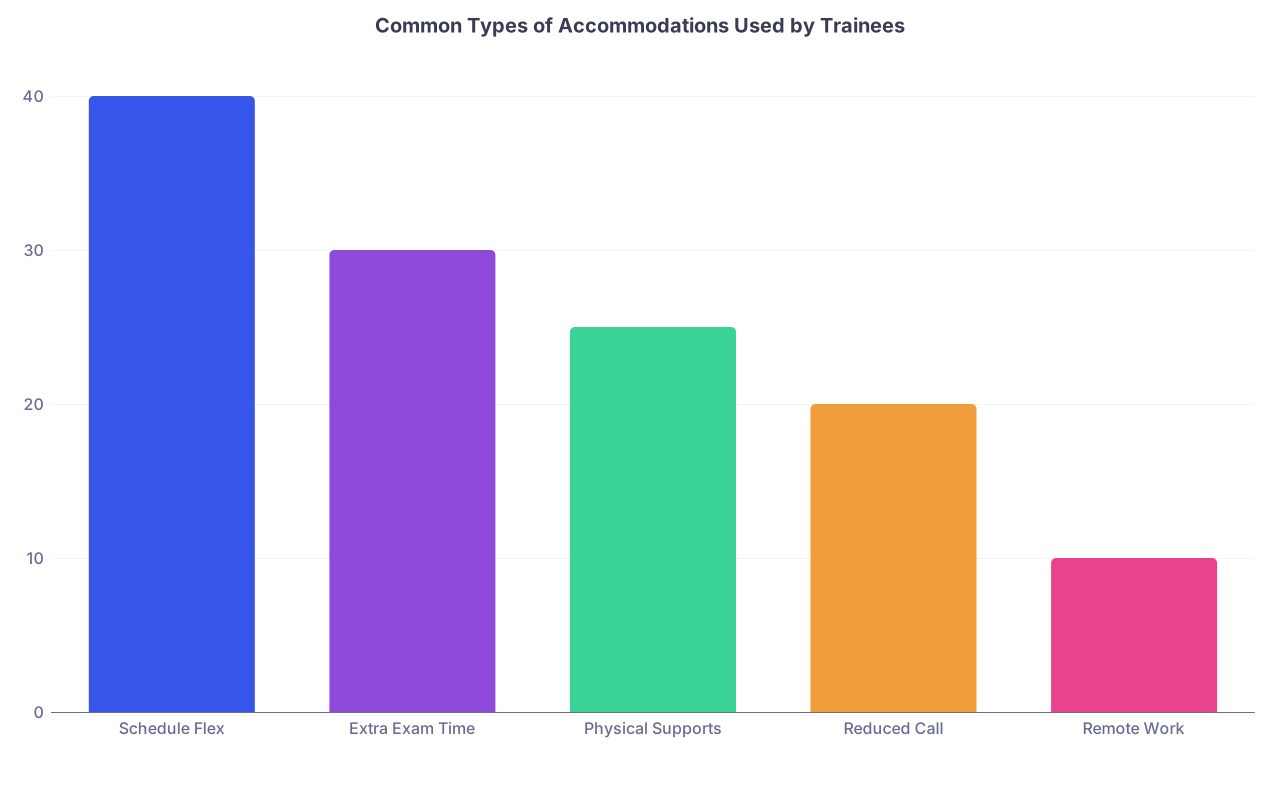
| Category | Value |
|---|---|
| Schedule Flex | 40 |
| Extra Exam Time | 30 |
| Physical Supports | 25 |
| Reduced Call | 20 |
| Remote Work | 10 |

| Step | Description |
|---|---|
| Step 1 | Attending questions need |
| Step 2 | Pause and breathe |
| Step 3 | Use prepared script |
| Step 4 | Return focus to patient care |
| Step 5 | Document interaction |
| Step 6 | Email disability office |
| Step 7 | Monitor for pattern |
| Step 8 | Escalate to leadership |
| Step 9 | Pushback continues |
| Step 10 | Hostile or retaliatory? |

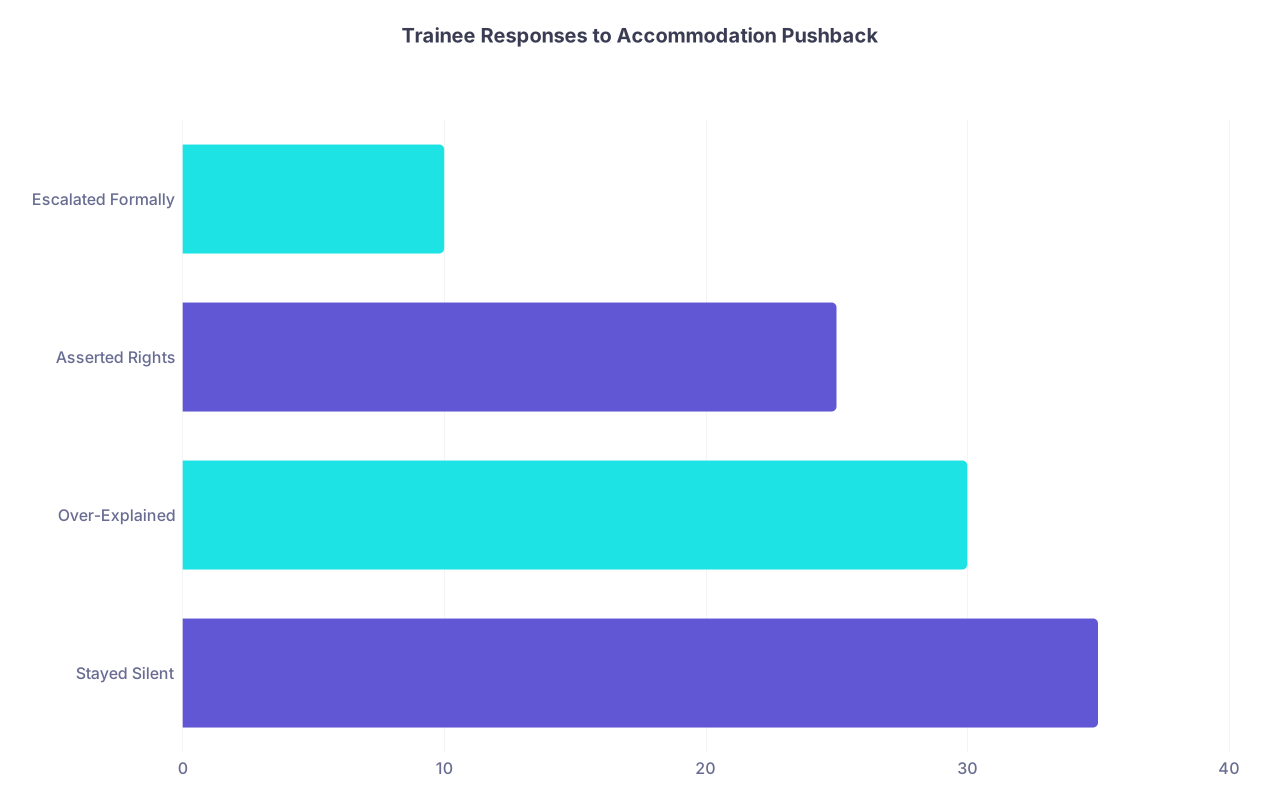
| Category | Value |
|---|---|
| Stayed Silent | 35 |
| Over-Explained | 30 |
| Asserted Rights | 25 |
| Escalated Formally | 10 |

FAQ (4 Questions)
1. Should I confront an attending directly if I think they’re discriminating against me because of my disability?
Sometimes, but not always. If it feels safe and the relationship isn’t completely toxic, a brief, calm conversation can help: “I’ve felt some hesitation about my accommodations and I want to make sure we’re aligned on expectations. Can we talk about how I can best contribute while still using them?”
If they’ve already made hostile comments, tied your accommodations to negative personality traits (“lazy,” “not committed”), or you rely on them for grades/letters, it’s often smarter to loop in Disability Services or Student Affairs first, get advice, and decide a plan together. Direct confrontation when the power imbalance is huge can backfire if you go in alone and unprepared.
2. What if I don’t have formal accommodations yet and an attending is already pushing me beyond what’s safe?
Then your priority is to get formalized support fast. You can say, “I’ve been managing a health condition that impacts [X function]. I need to speak with Disability Services/Student Affairs about formal accommodations so I can participate safely.” Stop relying on informal “understandings” once they’re being ignored. While that process starts, you can request short-term, very concrete adjustments (“I need to step out to sit for 5 minutes every hour”) but recognize that without documentation, you’re vulnerable. Treat the attending’s pushback as your signal that it’s time to get this on paper.
3. How worried should I be about retaliation in my evaluations if I insist on my accommodations?
Worried enough to document everything, not so worried that you silently comply with unsafe expectations. Retaliation does happen. I’ve seen evals where “professionalism” took a mysterious hit right after a student enforced an accommodation. That’s exactly why you keep contemporaneous notes and copy Disability Services or course leadership on key emails. If there’s a pattern, you have a basis to contest a grade or ask for a second reviewer. Quietly sacrificing your health to keep one attending happy is not a long-term strategy; building a paper trail is.
4. How much do I need to disclose to residency programs about my disability and accommodations?
Far less than people think. You don’t need to write essays about it in your personal statement unless it’s central to your story and you want to. You don’t need to list accommodations in ERAS. What matters is knowing what you’ll need in residency and confirming—often through back channels and direct questions to GME—that programs can support those needs. Many residents apply, match, and then work with GME to formalize accommodations after they arrive. The key is: understand your non-negotiables, pick programs that can realistically meet them, and remember you’re entering a system that legally has to engage in a reasonable accommodation process with you.
You’re not overreacting. You’re not “too sensitive.” You’re running medicine on hard mode in a culture that’s still catching up to reality.
You do not have to justify your existence every time someone raises an eyebrow at your chair, your schedule, your exam timing. You need a few firm sentences, a clear sense of your rights, and the willingness to bring in backup when an attending pushes too far.
With that foundation, you’re not just surviving rotations—you’re quietly reshaping what “being a good doctor” looks like. And once you’re on the other side of training, you’ll be the attending who doesn’t ask, “Do you really need that?” but instead asks, “What do you need to thrive here?”
But that’s your future attending self. For now, your job is to get through tomorrow’s rounds with your accommodations intact.