
The brutal truth: if your clinical accommodations aren’t respected, your grade, your reputation, and sometimes your career are on the line. Pretending it’s “just a misunderstanding” is how students get burned.
You’re not crazy. And you’re not overreacting. This is a high‑stakes situation, and you need a plan.
Here’s how to handle it like someone who intends to graduate, match, and still have a spine.
Step 1: Get Absolutely Clear on What Was Approved
You cannot enforce what you cannot quote.
Before you confront anyone, sit down and pull every document related to your accommodations:
- Official letter from Disability Services / Accessibility Office
- Any emails clarifying how accommodations apply on clinical rotations
- The rotation syllabus or handbook for that clerkship
- Your school’s technical standards and professionalism policies
Now, do three concrete things.
Isolate the exact accommodation language.
Highlight the lines that matter: “Student is approved for X,” “Preceptors must provide Y,” “Clinical assignments must be adapted by Z.”Match each unmet accommodation to a specific example.
Write a short list in a separate document. Example:Approved: “Extended time for documentation when direct patient care is completed.”
Reality: “Preceptor repeatedly demands all notes completed within same timeline as peers; deducted points for ‘efficiency.’”Approved: “Use of stool during standing procedures.”
Reality: “Resident said, ‘Everyone stands. This is surgery, not a desk job,’ and blocked the stool from the room.”
Check if it’s a misunderstanding or direct resistance.
Some attendings genuinely never saw your accommodation letter. Others saw it and chose to ignore it. Those are very different problems.
If you don’t have a written accommodation letter that explicitly applies to clinical rotations, you’re in a grey zone. In that case, step 2 includes going back to Disability Services to tighten that up.
Step 2: Start Documenting Like a Lawyer, Not a Student
Once you realize accommodations aren’t being respected, you start documenting. Immediately. Not “later tonight,” not “this weekend.”
Open a running log (Word, Google Doc, whatever) and every time something happens, you add:
- Date and time
- Who was involved (attending, resident, nurse, coordinator)
- Location (clinic, OR, rounds, call room)
- What happened, in neutral but specific language
- Any exact phrases that matter (“We don’t do special treatment here.” “I don’t care what your letter says.”)
- Impact on your performance (missed encounter, lost evaluation points, couldn’t complete task, physical flare, safety concern)
Keep this factual, not emotional. You’re building an evidentiary record, not a diary.
Here’s how detailed I mean:
11/14/2025 – 7:10 AM – Pre-rounds
Resident Dr. X told me no extra time for prerounding despite approved accommodation for modified patient load/time. Quote: “That’s not how this team works. If you can’t keep up, maybe you’re not ready.”
Impact: Only able to see 1 patient fully instead of 2; later criticized on evaluation for “limited initiative and patient load.”
You also save:
- Copies/screenshots of relevant emails
- Photos (if appropriate) of inaccessible spaces or missing equipment
- Grade sheets / evaluations that reference behaviors tied to your disability (e.g., “not enthusiastic” because you sit, “not efficient” because of processing time)
You’re not doing this because you want drama. You’re doing it because when you eventually talk to the clerkship director or dean, “I felt unsupported” won’t move anything. “Here are eight dated examples tied to an approved accommodation” might.
Step 3: Quietly Test the Softest Fix First
Before you escalate to the school, sometimes you can get what you need with one clean, professional conversation.
This works best when:
- The attending/resident doesn’t seem malicious, just oblivious or hurried
- You suspect they never saw your accommodation letter
- The problem is specific (e.g., one rule, one behavior), not everything
Script for a one‑on‑one:
“Dr. Smith, I wanted to check in about something that’s affecting my performance. I have a documented accommodation through the school for [briefly describe – mobility, processing, chronic condition]. The formal letter says [one sentence of what it requires].
On this rotation, I’ve noticed [brief example]. I’m worried this is impacting my ability to meet expectations fairly. I wanted to make sure you’ve seen the letter and ask how we can adjust so I can meet the same learning goals within those parameters.”
Keep it short. Calm. You’re not asking permission to have a disability. You’re asking how to execute an already‑approved plan.
Three likely responses:
Receptive: “I’m so sorry, I didn’t see the letter. Let’s figure this out.”
Great. Immediately follow up with an email: “Thank you for talking earlier; as discussed, I’ll be [accommodation detail].” This makes it real.Defensive but movable: “Well, everyone is busy… I’m not sure how that will work.”
Here, you anchor to the letter: “The school has approved it and advised I work directly with you to implement it. I’m open to different ways of doing it, as long as these core elements are met.” Still professional. Still firm.Hostile / dismissive: “We don’t do that here.” “Medicine is hard; maybe this isn’t for you.”
That’s your signal: stop trying to fix this at the individual level. You’ve gathered evidence. Now you move up.
If your gut says, “If I bring this up, they’ll tank my eval,” skip this step and go directly to Step 4. Self‑protection is not paranoia in clinical training. It’s survival.
Step 4: Pull in Disability Services Early, Not After You Fail
Most students wait too long to involve Disability Services during clinicals. They show up after the shelf, after the bad evaluation, after the remediation letter.
Do the opposite.
Email your disability/accessibility office:
- Subject line: “Urgent: Clinical accommodations not being implemented – [Clerkship, Site, Dates]”
- Attach: your official accommodation letter, your log (even if it’s short), any relevant emails
- Request: a meeting within the week
In the meeting, be direct:
- “Here are my approved accommodations.”
- “Here are specific examples of non‑implementation or pushback.”
- “I’m worried this is already affecting (or will affect) my grade and my standing.”
- “I need you to intervene with the clerkship leadership and document that I raised this now, not after the rotation ends.”
Ask blunt questions:
- “Does my accommodation letter explicitly cover clinical rotations at this site?”
- “What is the school’s process if a preceptor refuses to comply?”
- “Will you contact the clerkship director and site coordinator directly, or leave that to me?”
- “How will this be documented in case my evaluation is negatively affected?”
You want three outcomes from this:
- A confirming email summarizing what you discussed and what they’ll do
- Clear written clarification that your accommodations do apply in this setting
- Someone with institutional power backing you before grades are final
If your Disability Services office is passive or unhelpful, that’s not the end. It just means your escalation path is longer (Step 6).
Step 5: Protect Your Grade While the System Catches Up
You still have patients to see. Notes to write. Attitudes to manage. You cannot put the rotation on hold while the bureaucracy processes your email.
Here’s how to survive the rotation in the meantime without completely sacrificing your health or your principles.
Identify the non‑negotiables vs stretch points.
Non‑negotiable: things that impact safety, cause you serious physical harm, or directly contradict approved accommodations. Those you hold your ground on.
Stretch: annoying but survivable things, especially while your case is being addressed. Sometimes you tolerate some friction to avoid escalation fatigue.Quietly adapt where you can.
Examples:- Ask peers to trade certain tasks (you take extra patient calls, they take physical task X)
- Use assistive tech even without explicit permission (voice dictation on your phone for notes, if HIPAA‑compliant)
- Pre‑write parts of your notes at home to reduce time pressure on rounds
Control what shows up in your evaluation.
Mid‑rotation check‑ins are where subtle retaliation often surfaces. An attending says, “You’re not as fast,” “You seem less engaged,” “You leave early” (even if you’re leaving for medical reasons).When that happens, calmly link back to accommodations, on the record:
“I appreciate that feedback. I do want to clarify that my schedule/pace is adjusted based on a documented accommodation approved by the school. If there are concerns about my performance within that framework, I’d like to address them specifically.”
That way, when you later challenge an evaluation, there’s a history that you raised this in real time.
Ask for a second preceptor if needed.
For longer rotations (8–12 weeks), sometimes the clerkship director can assign you to a different attending mid‑course, “for additional exposure.” That change can quietly save your grade without an open war.
Step 6: Escalate Above the Rotation When Needed
If the attending or site culture is toxic or openly refusing to honor your accommodations, you go higher. Not in a dramatic, email‑everyone way. Strategically.
The typical escalation ladder (exact titles vary by school) looks like this:
| Level | Who to Contact | When to Use |
|---|---|---|
| 1 | Clerkship Coordinator | Logistics, schedule, site switches |
| 2 | Clerkship Director | Pattern of non‑compliance, grade risk |
| 3 | Disability/Accessibility Office | Legal rights, implementation support |
| 4 | Associate Dean for Student Affairs | Systemic issues, retaliation, major grade disputes |
| 5 | Dean of Medical Education / Legal | Extreme cases, repeated violations |
You don’t always go in order. If the problem is clearly discrimination (“Maybe medicine isn’t for people like you”), skip straight to Disability Services and Student Affairs.
When you email the clerkship director, your tone matters. You’re not ranting. You’re documenting.
Sample structure:
Dear Dr. [Name],
I’m writing regarding my [Internal Medicine, Surgery, etc.] rotation at [Site]. I have approved clinical accommodations through the school (letter attached).
Despite this, I’ve experienced difficulty implementing these accommodations on this rotation. Examples include:
– [One‑sentence example, with date/week]
– [Another one‑sentence example]I’m concerned this is affecting my ability to meet the rotation’s learning objectives fairly. I’ve already discussed this with [Disability Services contact], and they recommended I reach out to you to help ensure my accommodations are implemented appropriately.
Could we meet briefly or discuss how to address this going forward so that I can complete the rotation successfully?
Sincerely,
[Your Name]
Attach the accommodation letter. CC Disability Services if appropriate. You’ve now pulled this into the official record.
If retaliation shows up—sudden comments about “professionalism,” “not being a team player,” or “complaining”—that is exactly when you involve the Associate Dean for Student Affairs. With the same calm, documented approach.
Step 7: When the Evaluation Is Already Damaged
Sometimes you don’t realize how bad it was until you see the final evaluation. Now “inefficiency,” “limited participation,” or “difficulty with physical tasks” are written into your record in permanent ink.
Do not just swallow this.
You have a narrow window—often 1–2 weeks—to contest a clinical evaluation. You need three things ready:
- Your documentation log (dates, quotes, examples)
- Your accommodation letter
- Any emails with Disability Services / clerkship leadership from that period
Then you request a grade review or evaluation appeal. This could be with the clerkship director, an evaluation committee, or Student Affairs, depending on your school.
Your argument should be:
- These comments/grades directly reflect my disability and unimplemented accommodations
- I raised concerns (or tried to) during the rotation
- The school had a responsibility to ensure implementation
- The evaluation, as written, does not reflect my performance within the agreed accommodation framework
You can propose remedies:
- Remove or edit subjective comments that punish disability‑related behavior
- Convert a “Pass with Concern” to a standard Pass
- Repeat parts of the rotation at a different site with proper support
- Add a note to your internal file acknowledging the accommodation dispute
You’re not asking them to pretend you were perfect. You’re demanding they separate disability and lack of accommodation from genuine performance.
Step 8: Handling the Emotional and Political Fallout
Let’s be honest: pushing for your rights in medicine carries a social cost. Some people will label you “difficult.” Some residents will whisper. A few attendings will quietly blackball you.
You cannot avoid that entirely. You can blunt it.
Things that help:
- Secure at least one strong ally on each rotation. A resident or attending who’s seen your actual work. They can write you a fair letter and vouch for you later.
- Be boringly professional in every official interaction. Your emails read like a future colleague, not a furious student. You can be angry with your friends. Not in the cc line.
- Choose your battles. You don’t fight every minor annoyance. You fight the ones that affect safety, grades, or your ability to function long‑term.
And yes, you may need support outside of medicine: therapy, disability peer groups, legal consultation if things go very wrong. You are not weak for needing backup in a system built for non‑disabled bodies and brains.
Step 9: Think Long Game – Letters, Specialty Choice, and Future Training
You’re not just trying to survive this rotation. You’re trying to protect your chances to match and to be a sustainable physician.
A few strategic moves:
Identify departments that “get it.” Some specialties or institutions are simply more mature about disability. If your Internal Medicine department handled your accommodations well while Surgery fought you at every turn, that’s a data point for both letters and specialty choice.
Be deliberate about who writes your letters. Avoid asking for LORs from anyone who pushed back on your accommodations, even if they are “big names.” A slightly less famous but actually supportive attending is safer.
Document successful rotations with accommodations implemented. Those are your proof that “with correct accommodations, I perform at or above expectations.” That narrative is gold for residency programs that care about function, not appearance.
Here’s the real shift: you’re training not just to be a doctor, but to be a disabled doctor in a system that still doesn’t fully know what to do with you. The way you handle this now is practice for what you’ll eventually do for yourself—and your patients—over a career.
Step 10: When the System Is Flat‑Out Failing You
Sometimes the school is the problem. Disability Services is weak or obstructive. Clerkship directors ignore them. Deans shrug off clear discrimination. You’re not misreading it. It happens.
If you’re in that level of dysfunction, you have to consider:
- External legal advice. Quietly. From someone who understands disability rights in education (ADA, Section 504).
- Transferring programs if you’re early enough in training and the pattern is entrenched.
- Strategic compliance + external documentation if you’re close to graduation and just need to get out with minimal additional damage.
External support doesn’t always mean lawsuit. Sometimes a letter from an attorney to the institution wakes everyone up and suddenly your “impossible” accommodation becomes “we’d be happy to help.”
You’re allowed to play hardball when your career and health are on the line.
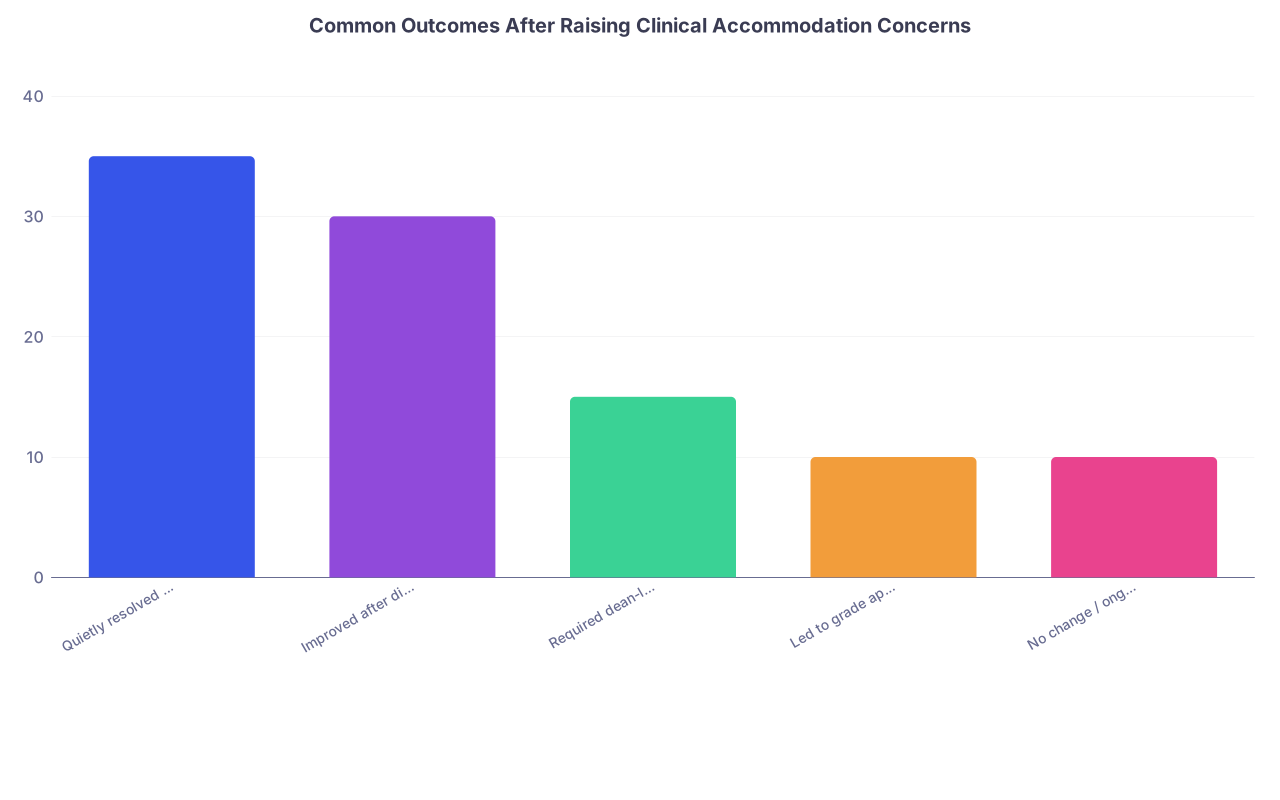
| Category | Value |
|---|---|
| Quietly resolved on site | 35 |
| Improved after disability office involvement | 30 |
| Required dean-level escalation | 15 |
| Led to grade appeal | 10 |
| No change / ongoing issues | 10 |

| Step | Description |
|---|---|
| Step 1 | Accommodations not respected |
| Step 2 | Document incidents |
| Step 3 | Contact Disability Office immediately |
| Step 4 | Attempt direct convo with preceptor |
| Step 5 | Email summary to confirm |
| Step 6 | Involve Clerkship Director |
| Step 7 | File grade review or appeal |
| Step 8 | Complete rotation, monitor |
| Step 9 | If unresolved, escalate to Dean or legal |
| Step 10 | Safety or severe impact? |
| Step 11 | Improves? |
| Step 12 | Evaluation harmed? |
The Bottom Line
Three things to walk away with:
- You enforce accommodations with documentation and escalation, not just hope. Keep records, loop in Disability Services early, and put things in writing.
- Protect your grade and your future while you fight. Be strategic about what you push on, who you involve, and who evaluates you.
- You’re not asking for a favor. You’re demanding equal access to the same education your peers get by default. That’s not optional. That’s the job of the institution.