What actually happens when a disabled resident can do the job safely and effectively—but a program waves a magic phrase, “essential functions,” and calls it impossible?
Let’s tear this apart.
Most people in academic medicine talk about “essential functions” like they’re the Ten Commandments: fixed, sacred, and untouchable. They are not. They’re policy documents written by committees—often years ago—based on assumptions from an era when “doctor” meant able-bodied, no limits, and no questions asked.
The myth is simple:
“If you can’t personally perform every physical or cognitive task in the ‘essential functions’ list exactly like a non-disabled resident, you cannot be a resident.”
That’s not the law. That’s not what the data on patient care says. And it’s definitely not the future of medicine.
Let me walk through what’s actually going on.
What “Essential Functions” Really Are (Legally vs How Programs Use Them)
Programs love to point to their “Technical Standards” or “Essential Functions” PDF like it’s handed down from God. Usually it includes things like:
- “Must have sufficient hearing to auscultate heart and lung sounds without assistive devices.”
- “Must be able to perform all procedures independently.”
- “Must respond rapidly to emergencies in any environment.”
- “Must have full range of motion and fine motor skills.”
Sounds authoritative. Looks official. Often completely overbroad and outdated.
Legally, under the ADA and Section 504:
- An essential function is a fundamental duty of the job, not every task that’s ever been done by a resident.
- The question is: Can this function be performed with reasonable accommodation or with the help of others, without fundamentally altering the program or compromising safety?
- If the answer is yes, the person is qualified even if they do it differently.
Here’s the key legal distinction programs routinely ignore:
- Essential functions = outcomes (what must get done)
- Nonessential = specific methods (exact way it must be done, who must do which sub-task, speed, posture, etc.)
“Interpret chest X-rays” may be essential for an internal medicine resident.
“Personally hang the film on a lightbox using two good hands and perfect vision” is not.
Yet many programs write their essential functions as if the method and the outcome are the same thing. They are not. That’s where disabled residents get crushed.
What the Data Actually Shows About Disabled Physicians
Let’s go to evidence, not vibes.
We now have growing data on disabled medical students and physicians:
- Studies show that disabled physicians are more likely to practice primary care, rural care, and treat patients with disabilities and chronic conditions. That’s exactly where the system has shortages.
- Multiple surveys report that disabled clinicians report similar or higher levels of empathy, patient satisfaction, and understanding of barriers.
- There’s no good evidence that disabled physicians who are properly accommodated provide worse care. What you see instead is institutional discomfort, not unsafe care.
Programs fear “liability” and “safety” while ignoring facts:
- Many clinical tasks are already distributed. Interns don’t do the same things as seniors. Residents ask nurses, respiratory therapists, consultants to assist constantly. No one calls that unsafe—until a disabled doctor needs the same kind of distribution.
- Modern medicine is team-based, tech-heavy, and specialized. The idea that each resident must be a one-person fully self-contained care unit is fantasy. It hasn’t matched reality for years.
So the claim “if we accommodate this resident, patient care will suffer” is usually not backed by data. It’s backed by tradition and discomfort.
The Biggest Myths About Essential Functions and Disabled Residents
Let’s take on the sacred cows one by one.
Myth 1: “If you can’t do every procedure 100% independently, you can’t be a resident.”
Reality: Independence has always been relative and staged.
A first-month intern in surgery doesn’t independently manage a crashing trauma patient. They are part of a team. They learn, with supervision, with help. A junior neurology resident might never independently run a code stroke without backup.
The law does not say you must personally perform every single physical step of every procedure:
- A blind resident might place central lines with ultrasound guidance and tactile feedback, assisted by a nurse or another resident for certain steps.
- A wheelchair user might not run down the hallway to a code but can be the code leader at the bedside once the team arrives, directing care, interpreting labs, and making decisions.
The essential function is “participate in emergency care at an appropriate level,” not “sprint down hallways and personally do chest compressions at 120 bpm.”
Programs quietly accept that some residents are too short, too tall, too pregnant, too injured to do certain maneuvers, and work around it. But if you have a disability label? Suddenly it’s “essential” that you do everything, all the time, alone.
That’s not principled. That’s selective enforcement.
Myth 2: “Essential functions cannot be changed.”
Reality: Programs revise essential functions all the time—just usually not to include disabled trainees.
When ACGME changes requirements, when specialties evolve (e.g., more ultrasound, fewer open procedures), when technology enters practice, programs adapt. Essential functions quietly shift.
Examples I’ve seen:
- Anesthesia programs rewriting expectations once ultrasound-guided regional anesthesia became standard.
- Internal medicine programs changing call structures with night float and cross-coverage; suddenly “30-hour continuous call” wasn’t essential anymore.
- Radiology embracing PACS and teleradiology; “reading film on physical lightboxes” stopped existing as an “essential” anything.
So when a program says, “We would love to help, but these essential functions are fixed”? No. They’re choosing not to revise them in light of disability law and tech changes, while revising them for pretty much everything else.
Myth 3: “If we accommodate one disabled resident, we’ll have to pass anyone who asks.”
Reality: That’s not how the ADA works, and everybody knows it.
The legal standard is “reasonable accommodation” for a qualified individual with a disability. Programs do not have to:
- Waive core competencies.
- Graduate someone who truly can’t perform essential functions even with accommodation.
- Accept accommodations that compromise patient safety or fundamentally alter the core training.
But here’s what they also can’t legally do (even though many still try):
- Declare entire categories of disability “incompatible with residency.”
- Define “essential functions” so narrowly and specifically that they intentionally exclude people who could do the job with different methods or assistive tech.
- Refuse to even experiment with accommodations, then claim they “know” it won’t work.
The slippery slope argument is just that: argument. Not law. Not data.
Myth 4: “Accommodations in residency are impossible because of patient safety.”
Let’s be blunt. Safety is often a shield for, “We do not want to figure this out.”
Look at what hospitals already safely accommodate:
- Residents with temporary injuries: broken legs, back injuries, post-surgery limitations.
- Pregnant residents with lifting restrictions, call modifications, and no overnight shifts late in pregnancy.
- Religious accommodations: schedule shifts around religious holidays, fasting, or head coverings in the OR.
- COVID-era precautions: residents pulled from high-risk areas, remote sign-outs, telemedicine.
All those were “impossible” until institutions decided they were not.
The real question usually isn’t “Is it safe?” but “Is it new and administratively annoying?” Safety is easier to say out loud.
What Reasonable Accommodation in Residency Actually Looks Like
Let’s move from theory to practice. These are not hypotheticals; versions of all of these have existed in real programs.
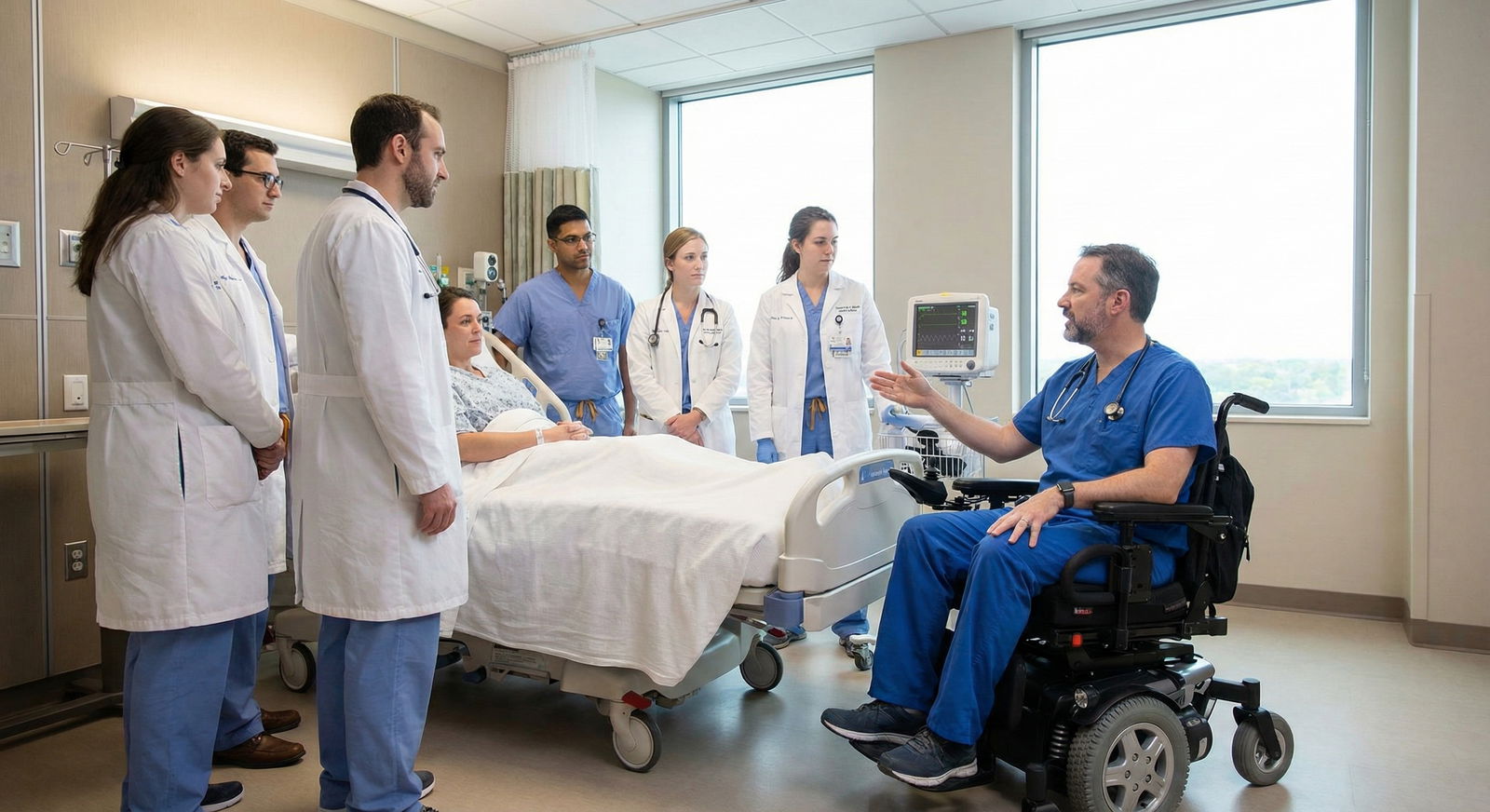
Examples of accommodations that often do work:
Mobility impairments
- Using sit-stand options in clinic; adjusting OR assignments to procedures compatible with mobility.
- Assigning closer parking, more predictable schedules, telehealth visits for some clinic days.
- Role in codes: lead and manage rather than physically compressing chests.
Hearing impairment
- Visual alert systems, vibrating pagers, and team codes through secure messaging in addition to overhead pages.
- Amplified or digital stethoscopes streaming to hearing aids or cochlear implants.
- CART captioning or real-time transcription for didactics and virtual handoffs.
Visual impairment
- Screen readers, magnification software, high-contrast EHR configurations.
- Adjusting some rotations (e.g., heavy procedural fields) while maintaining required competencies through alternative experiences.
- Assistance with specific visually demanding sub-steps in procedures while still meeting procedural competency standards.
Chronic illness / mental health conditions
- Shift modifications (no 24+ hour calls; use night float; capping consecutive nights).
- Protected time for medical appointments and therapy.
- Reduced sensory overload environments when possible, or structured breaks.
Are these annoying to implement? Sometimes. Do they “fundamentally alter” residency? No. They tweak the way work gets done in a system that is already constantly tweaked for non-disabled people.
Here’s how the basic logic should work, but often doesn’t:

| Step | Description |
|---|---|
| Step 1 | Resident requests accommodation |
| Step 2 | Interactive process with GME and disability office |
| Step 3 | Explain decision and rights |
| Step 4 | Identify essential functions by outcome |
| Step 5 | Brainstorm possible accommodations |
| Step 6 | Modify or reject specific accommodation |
| Step 7 | Implement trial period |
| Step 8 | Evaluate impact on performance and safety |
| Step 9 | Adjust and continue or reconsider |
| Step 10 | Is the resident qualified? |
| Step 11 | Causes undue hardship or safety risk? |
Reality: Many programs jump straight from A → “No, can’t be done” without ever doing the middle steps.
How Programs Misuse “Essential Functions” to Block or Push Out Residents
Here’s how I’ve seen this play out in real life:
- Resident develops a new disability or discloses an existing one that now needs accommodation (migraine, MS, hearing loss, major depression, chronic pain, etc.).
- Program leadership gets “concerned” about whether the resident can “meet essential functions.”
- Instead of an actual interactive process, they:
- Point to a clause like “must be able to respond rapidly to all codes anywhere in the hospital”
- Declare that any modification to call, codes, or shifts is impossible
- Suggest the resident “consider a non-clinical path” or leave medicine entirely
- GME and disability services are either sidelined or treated as rubber stamps for whatever the PD wants.
This is backwards. The law expects case-by-case analysis, not pre-baked exclusion.
Also, watch the language. The moment you hear:
- “We’re worried you’ll be a burden to your colleagues.”
- “Other residents will have to pick up your slack.”
- “We don’t have the resources for this.”
You’re not hearing a neutral safety assessment. You’re hearing bias, workload anxiety, and a complete misunderstanding of what “undue hardship” actually means in a hospital-level operation.
The Future: Essential Functions Will Have to Grow Up
The “one body, one brain, no limits” model of who gets to be a physician is already cracking.
Three trends are accelerating this:
Demographics and disability prevalence
More med students and residents with chronic illness, mental health conditions, neurodivergence, and physical disabilities are coming through. Not because they’re suddenly appearing, but because they’re finally disclosing.Technology Adaptive tech is getting better, cheaper, and more integrated: voice-to-text charting, digital stethoscopes, AI-assisted imaging, telemedicine, remote monitoring. The idea that you must have perfect hearing, perfect vision, perfect mobility to be safe is increasingly ridiculous.
Regulatory and legal pressure OCR, the courts, and advocacy orgs are slowly—too slowly—pushing back on obviously discriminatory standards. Programs are starting to lose when they use cartoonishly narrow essential functions to exclude disabled trainees.
Let me show you how expectations are already shifting:
| Area | Old Standard (Implicit) | Evolving Reality |
|---|---|---|
| Emergencies | Run to every code, do compressions | Team roles split; code leaders, documenters |
| Documentation | Type fast, no aids | Voice dictation, scribes, templates |
| Procedures | Solo execution, full strength | Team assistance, device-guided procedures |
| Communication | In-person, unaided speech/hearing | Interpreters, captioning, secure messaging |
| Work hours | 24–30 hour in-house | Night float, duty hour caps, remote work |
None of this is hypothetical. This is happening right now.
The question is whether disabled residents will be openly included in this evolution or quietly pushed out while everyone pretends essential functions are fixed in stone.
If You’re a Disabled Resident (or Future Resident), Here’s the Uncomfortable Truth
You are not fighting “nature.” You are fighting:
- Old documents written for a fantasy version of medicine.
- Program leaders who are terrified of extra work, scrutiny, or being the first.
- Colleagues who have been trained to equate suffering and physical grind with competence.
So:
- Do not take “the essential functions say no” as a final answer. Ask who wrote them, when, and whether they’ve been reviewed for ADA compliance.
- Pull in the institutional disability office early, not as an afterthought when the PD already has a narrative about you.
- Document everything. Every conversation. Every email. Every comment about “burden” or “fit.”
- Understand that asking for accommodation is not asking for charity. It’s exercising a legal right in a system that already makes accommodations—just mostly for the non-disabled.
And for program directors reading this: if your “essential functions” list hasn’t been seriously rewritten in the last 5–10 years, with disability law and modern tech in mind, it’s probably not describing what’s truly essential anymore. It’s just describing what you’re used to.

FAQs
1. Can a residency program legally say, “Your disability means you can’t meet essential functions, so we won’t accommodate you”?
They can say you’re not qualified only if they’ve actually:
- Identified the true essential functions (by outcomes, not methods)
- Seriously considered reasonable accommodations
- Shown that even with accommodations, you still can’t perform those core functions without safety or fundamental alteration problems
Most programs skip steps and use a blanket “you can’t meet essential functions” line. That’s not how the law is written, and that’s where programs get into trouble when challenged.
2. Are there specialties that disabled residents just can’t realistically do?
There are specific tasks or sub-roles that some disabled residents may not be able to perform safely, even with accommodation. That’s reality. But whole specialties being “off-limits” is usually an overstatement rooted in tradition, not data.
Interventional cardiology, trauma surgery, or EM with constant rapid response will be tougher for some disabilities. But people said the same about OB, surgery, and ICU for pregnant residents and they were wrong. Case-by-case, outcome-based analysis matters more than sweeping bans.
3. What should programs actually do to make their essential functions legitimate?
Three basic steps:
- Rewrite essential functions based on competencies and outcomes, not physical checklists or historical habits.
- Run those standards through legal, disability services, and at least one disabled clinician who actually understands the job.
- Build a real interactive accommodation process with trial periods, monitoring, and adjustment—rather than pre-emptive rejection.
If a program is unwilling to do those three things, the problem is not the disabled resident. It’s the program.
Key points to carry out of this:
- “Essential functions” are supposed to describe what must get done, not how an able-bodied person has always done it.
- Disabled residents can and do safely meet those functions when programs stop using outdated standards and start using real accommodations.
- The future of medicine is team-based and tech-driven; pretending only non-disabled bodies can be doctors is not just wrong—it’s obsolete.