Confidentiality Myths About Disability Offices in Medical Schools
What actually happens to your disability paperwork after you hit “submit”—and how much of it lands in your dean’s inbox?
Let me be blunt: most medical students dramatically overestimate how private disability offices are in theory… and underestimate how private they are in practice.
You’ve probably heard all of these:
- “If you register, the administration will know you’re ‘problematic’.”
- “Your diagnosis will end up in your dean’s letter.”
- “Preceptors will get your full psych history.”
- “Residency programs will know you had accommodations and won’t rank you.”
Some of that is total fiction. Some of it is technically wrong but practically half-true. And some of it is just students filling in gaps with fear because schools are terrible at explaining how this actually works.
Let’s dismantle the myths, using what the law requires, what schools actually do, and what I’ve seen go wrong behind the scenes.
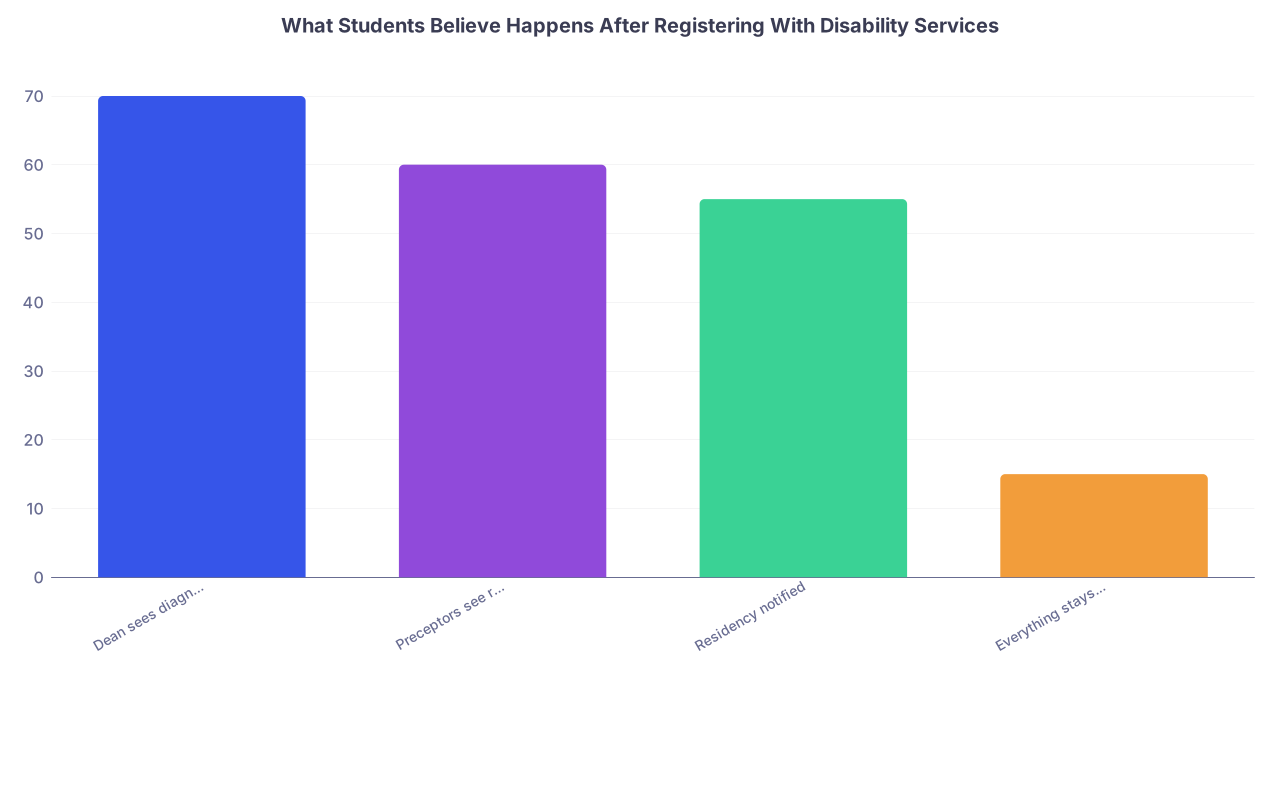
| Category | Value |
|---|---|
| Dean sees diagnosis | 70 |
| Preceptors see records | 60 |
| Residency notified | 55 |
| Everything stays private | 15 |
Myth #1: “If I Register, Everyone Will Know I Have a Disability”
This is the foundational fear: that telling the disability office is basically telling the entire institution.
Wrong—but there’s a nuance that matters.
Legally, in the US, disability offices live under ADA/Section 504 rules. That means:
- They are supposed to keep diagnostic information separate from your educational record.
- They can share functional limitations and approved accommodations with “need-to-know” people to implement those accommodations.
- They do not have carte blanche to blast your diagnosis to your dean, your clerkship director, or your attendings.
So the mental model should be:
- Your diagnosis and documentation → stays in disability services.
- Your accommodations (e.g., extended time, quiet room, modified call) → shared only with limited faculty/staff who need that info to make it happen.
But here’s where students get burned: schools are wildly inconsistent in how cleanly they separate these.
I’ve seen places where:
- The disability office sits under Student Affairs, and the same dean who writes your MSPE also “supervises” disability services. Legally they’re supposed to firewall roles; practically, it gets blurry.
- Longitudinal course directors get CC’d on “implementation emails” that say way too much: “Student registered with psychological disability requiring reduced load…” instead of just “Student has an approved reduced course load accommodation.”
That is not how it’s supposed to work. But it happens.
If you’re smart, you treat “confidential” as a legal standard, not a magical shield. Ask very specific questions before you register:
- Who exactly will be told that I have accommodations?
- Will my dean be told? In what form?
- Will course/clerkship directors see diagnosis or just accommodations?
- Where is my documentation stored and who has system access?
If they can’t answer that clearly or they dodge, that tells you more than any glossy handbook.

Myth #2: “Your Diagnosis Will End Up in Your Dean’s Letter (MSPE)”
This one is especially sticky. I’ve heard third-years swear, “If you get test accommodations, your MSPE will be flagged.”
The reality: for most US MD and DO schools, putting your diagnosis or the fact that you used disability accommodations into your MSPE is legally radioactive.
Two reasons:
- ADA and Section 504: Schools cannot discriminate based on disability and should not be forcing disclosure that has nothing to do with performance.
- The AAMC’s own MSPE guidelines do not tell schools to report accommodations. They focus on performance, professionalism, and narrative comments.
If your dean is writing: “This student has ADHD and required extended testing time”—that’s not just bad form. That’s flirting with discrimination.
Now, here’s the uncomfortable part.
Sometimes the effects of accommodations show up anyway—because they’re structural:
- If you had a reduced course load or took a leave for health reasons, your academic timeline changes. That may be described in the MSPE.
- If you requested specific clinical site restrictions that affected rotation selection, that may indirectly appear as “scheduling complexity” or non-standard sequence.
The tricky piece is this: the MSPE is supposed to be an “objective” academic history. Leaves, delays, off-cycle graduation—those are part of that history. Schools often mention them in neutral language like “The student took a personal leave from X to Y” without mentioning disability. Technically “confidential.” Practically? Some PDs can read between the lines.
But: documenting that your timeline changed is not the same as disclosing that you are disabled or listing diagnoses.
The myth that “registering with disability services automatically out you in your dean’s letter” is simply false at most institutions. When I’ve seen lines crossed, they were usually:
- A clueless assistant dean oversharing in private emails to PDs.
- An old-school faculty member dropping “overcame learning difficulties” language that no one edited out.
Fixable problems. But not automatic or inevitable.
Myth #3: “Attendings Will See Your Full File If You Use Clinical Accommodations”
Another big one: “If I ask for a lighter call schedule or not to do night float, my attending will get my psych eval, neuropsych report, everything.”
No. That’s not how it’s set up.
Disability offices work on a need-to-know accommodation model in clinical settings. A supervising physician generally sees one of two things:
- A short notice like:
“Student X has an approved accommodation for modified call schedule: no more than X continuous hours, maximum Y shifts per week.” - Or they’re just given a schedule that quietly accommodates you, without any explicit disability label.
What they do not get:
- Your neuropsych testing.
- Psychiatric notes.
- DSM codes.
- Detailed medical history.
If an attending ever pulls you aside and quotes from your evaluation? That’s a red flag that your school’s process is broken or that someone violated confidentiality.
However—and here’s where the myth has a grain of truth—small clinical teams are gossip factories. What often happens is this:
- The clerkship office sends an email: “Please adjust call schedule for Student X per accommodations.”
- Someone on the admin side speculates out loud: “Oh, is this another anxiety case?”
- The line attending never sees a diagnosis. But suspicion gets built out of thin air.
Legally still “confidential.” Practically, culture leaks.
So you protect yourself with clarity:
- Ask disability services: What exactly will my preceptors be told? Word for word.
- Ask whether implementation emails use only accommodation language or hint at diagnosis (“psychological,” “learning,” “medical,” etc).
- If they say, “We just say you have a documented need”—that’s closer to best practice.
Can attendings infer that something is going on when you have unusual scheduling constraints? Of course. But inferring that you might have a health issue is not the same as receiving your confidential record.
There’s a huge difference between “they might suspect something” and “they’ve been given your disability file.” Students conflate those constantly.
| Role | Diagnosis? | Accommodation Details? | Documentation? |
|---|---|---|---|
| Disability Office | Yes | Yes | Yes |
| Dean (Student Affairs) | Rarely | Possibly (summary) | Usually No |
| Clerkship Director | No | Yes (limited) | No |
| Individual Attendings | No | Sometimes (logistics) | No |
Myth #4: “Residency Programs Will Know You Had Accommodations”
This one is a classic scare tactic from older residents and sometimes from poorly informed faculty: “If you ever take extra time or a reduced load, programs will know and blacklist you.”
Evidence does not support that.
What residency programs concretely see:
- Your ERAS application.
- Your MSPE.
- Your transcript.
- Your letters of recommendation.
- Your board scores (If you release them).
They do not get:
- A secret flag that says “registered with disability office.”
- A report of “accommodations used on USMLE” (USMLE explicitly does not tell score users that an accommodation was used).
- Your disability documentation.
Could they possibly infer something if your training was significantly modified or extended? Yes.
For example:
- You repeated multiple clerkships due to “health reasons.”
- You had a long unexplained leave without a decent narrative.
- You graduated substantially off-cycle and it’s clearly described in the MSPE.
Even then, most program directors are not sitting there playing detective: “Was it cancer? Depression? Learning disability?” They’re asking: “Are you competent? Are you going to show up? Can you pass boards?”
And there’s exactly zero good data that simply having registered with disability services—without massive performance issues—hurts match outcomes. What does hurt you is underperforming because you refused accommodations you actually needed, then racking up failures, professionalism concerns, or incomplete rotations.
So the choice is often misframed. It’s not:
- “Use accommodations and be marked forever,”
versus - “Stay clean and invisible.”
It’s more like:
- “Use accommodations quietly and perform well,”
versus - “Struggle visibly, deteriorate, maybe fail, but hey at least your disability office file is empty.”
Programs see performance. If accommodations are what keep your performance solid, you’re better off using them.
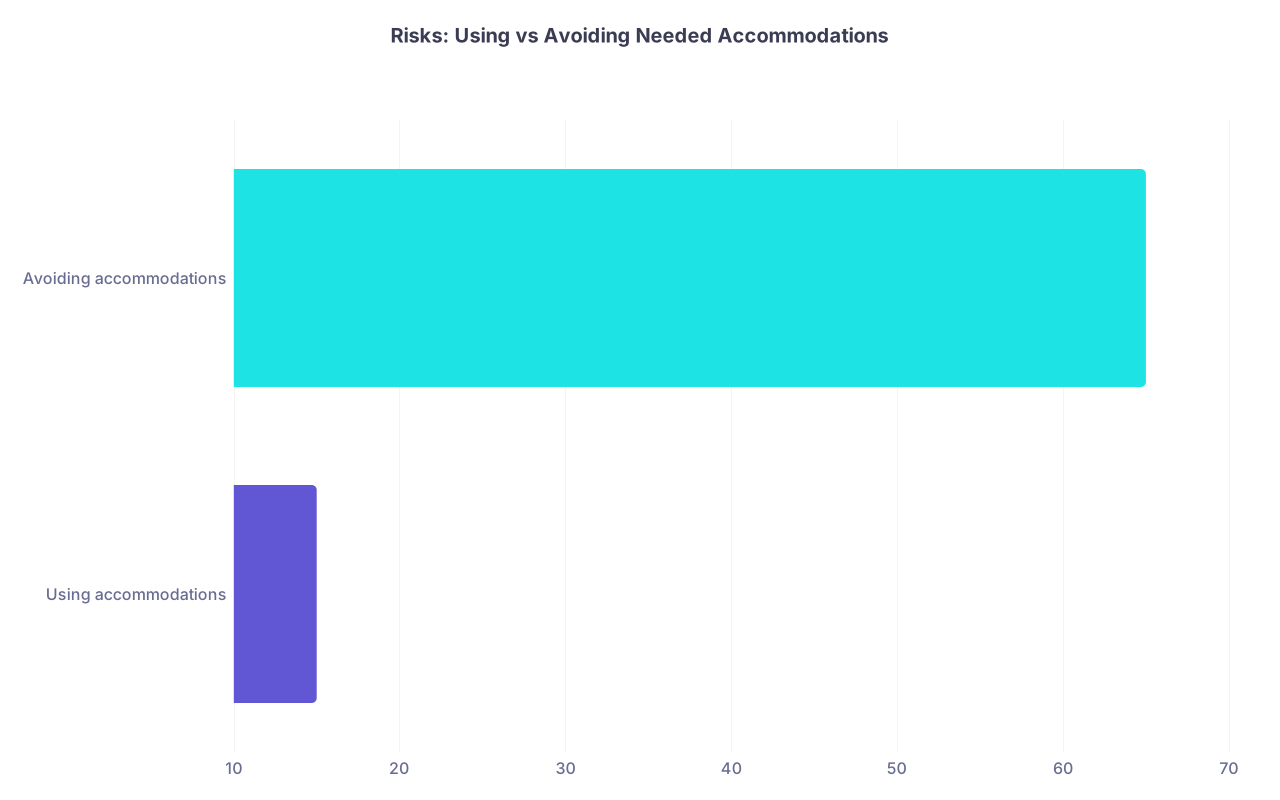
| Category | Value |
|---|---|
| Using accommodations | 15 |
| Avoiding accommodations | 65 |
Myth #5: “Disability Offices Are Either Perfectly Safe or Completely Untrustworthy”
The binary thinking here is part of the problem.
You’ll hear two extremes in the same class:
- “Never tell them anything; they’ll screw you.”
- “They’re totally safe; it’s all confidential; don’t worry about it.”
Both are lazy takes.
Here’s what the data and patterns actually show:
- Policies on paper almost always look restrictive and compliant.
- Actual practice varies wildly by:
- Where the disability office reports (Student Affairs vs central university).
- How well-trained staff are on health-profession-specific issues (clinical rotations, patient safety, boards).
- How tight their email and record systems are (FERPA/ADA aware or chaos).
I’ve seen three broad archetypes:
Central University Disability Office, Strong Firewalls
Your med school sends you to the same office that handles undergrads and grad students. Records are separate from med school academic affairs. Deans get at most a generic note saying a student in X cohort has accommodations. This is often the most protective model.Embedded Office Inside Medical School, Well-Run
Technically part of Student Affairs, but they have clear role separation, training, and documented procedures. Diagnosis stays siloed; deans only see what’s needed to address academic planning. Works if the culture is mature and legally cautious.Embedded and Sloppy
Disability info casually discussed in promotions committee, deans mention “learning issues” in offhand comments, clinical folks gossip about “this student with anxiety accommodations.” Written policy says all the right things; behavior doesn’t. These are the places where students get burned.
You can’t assume you’re in category 1. You have to probe.
Ask questions like a lawyer, not like a supplicant:
- “Who exactly has read/write access to my disability file?”
- “Under what circumstances would my dean be told my diagnosis, if ever?”
- “If I appeal a dismissal or remediation, is my disability info ever introduced without my consent?”
- “Do you ever discuss specific students by name in promotions or academic standing committees?”
The answers—and the body language—will tell you a lot.

| Step | Description |
|---|---|
| Step 1 | Student |
| Step 2 | Disability Office |
| Step 3 | Registrar or Testing |
| Step 4 | Clerkship Office |
| Step 5 | Exam Logistics |
| Step 6 | Clinical Schedules |
The Future: Where Confidentiality Actually Needs to Go
If you want a useful contrarian angle, it’s this: the problem isn’t that disability offices know too much. It’s that the broader medical education system still treats disability like a character defect that must be hidden at all costs.
That cultural rot is what makes secrecy feel necessary. And it’s why students whisper about “never registering” instead of asking how to use accommodations strategically and safely.
Three things need to change:
Standardized, enforced firewalls in health professions programs
Not just “we follow the ADA,” but specific, auditable requirements about:- Who can access disability data.
- How and when it can be referenced in academic decisions.
- Explicit bans on including accommodation status in MSPEs or unofficial communications with residencies.
Transparent, written explanations to students—in plain language
Not a vague sentence like “All information is kept confidential per law.” A real explanation:- Who sees what.
- Under what circumstances.
- How errors or breaches are handled.
Culture shift away from “red flag” thinking
Faculty and administrators need to stop treating disability as a sign of fragility and instead as a fact of the workforce. Physicians get sick. They have ADHD. They develop mobility limitations, depression, autoimmune disease. If the system cannot handle that truth in training, it absolutely cannot handle it in practice.
FAQs
1. Can my school use my disability information in dismissal or remediation decisions?
They’re not supposed to use your disability against you. But your performance, leaves, and remediation history can absolutely be discussed, and you may choose to introduce disability documentation yourself if you’re arguing that failure was linked to unaccommodated needs. The danger is when schools quietly factor in “concerns” about your health or disability without ever putting it on record. That’s not legal, but it happens. You want a paper trail when you ask for accommodations, so “you never told us” doesn’t become their excuse.
2. Should I tell my dean directly about my diagnosis, or keep everything through disability services?
If you can keep diagnosis strictly within disability services, that’s usually safer. Deans should know effects: schedule changes, leaves, remediation plans. They don’t often need causes in diagnostic detail. Sometimes strategic disclosure to a trusted dean makes sense, especially if you need complex schedule restructuring. But you should never assume a dean’s office has the same confidentiality obligations or training as disability services.
3. Can I request that my attendings not be told I have accommodations?
You can request it, but it depends on the nature of the accommodation. For pure logistics (like a specific exam room), often yes—they can implement quietly. For schedule or duty-hour modifications, hiding it completely is usually impossible. The key ask is not invisibility; it’s minimal necessary disclosure: no diagnosis, no labels, only the operational change they must implement.
4. What if my school already leaked more than they should have—do I have any recourse?
Potentially, yes. You can document what was said, by whom, and to whom, then raise it with disability services leadership, the dean, or the university’s ADA/504 coordinator. Serious breaches can justify formal complaints to the institution and, in some cases, to external agencies. Realistically, your goal is often prospective: tighten how your info is handled going forward and prevent retaliation. Sometimes that means getting an outside advocate (lawyer or disability rights group) involved to remind the school that “confidential” is not optional marketing language; it’s a legal duty.
Key points, stripped of the drama:
- Your diagnosis should almost always stay inside disability services; what leaks out are accommodations and logistics, not your psych eval.
- Residency programs are not secretly notified about your accommodations; they care about performance, not your paperwork.
- The real risk is not registering—it’s struggling unaccommodated in a system that quietly punishes visible failure far more than invisible disability.