
Programs are not secretly running a “do they have accommodations?” filter on your file and dropping you 30 spots. That myth survives because people whisper it in call rooms, not because data backs it up.
Let me be blunt: the fear of asking for disability accommodations is causing more harm to trainees than any realistic risk of being “punished” in the Match. I’ve watched people hide serious conditions, skip meds, and work themselves into near collapse because an attending once said, “You know, programs get nervous about residents who need special treatment.”
That attending was wrong. And reckless.
Let’s pull this out of the rumor mill and into reality.
What Programs Actually See (And What They Don’t)
The first big misconception: “If I disclose to get accommodations, every PD will see I’m disabled.”
False. There are three different universes here, and people mash them together:
- Application / Selection (ERAS, SF Match, etc.)
- Employment / Onboarding (HR, occupational health, GME)
- Post-match accommodation process (ADA/Section 504 world)
You are mixing #1 and #3 in your head. Programs legally and structurally cannot treat them as the same thing.
Here’s how it actually breaks down most of the time:
- Disability disclosures for accommodations go through HR/Disability/Occ Health, not through the PD’s inbox.
- Program directors typically do not see your documentation, diagnosis, or physician letters. They may only see:
- “Employee is approved for XYZ reasonable accommodation”
- Or even less: “Employee must not exceed X hours / no overnight call / needs flexible scheduling”
- ERAS and NRMP do not have a “disability flag” that programs can filter by. PDs are looking at scores, letters, MSPE, personal statement, and interview impressions. Not your accommodation paperwork.
Could something leak informally? Yes, medicine is a gossip machine. But that’s not the same as a formal, systemic rank-list penalty for requesting help.
Where people get burned is when they blur the boundary and:
- Overshare detailed medical history in interviews.
- Frame tasks they can do as if they’re permanent hard limitations.
- Or try to negotiate accommodations in a way that directly contradicts essential job functions.
That gets attention. Not the fact that you went through the legit ADA process.
The Law Is Not a Vibe. It’s a Real Constraint.
The other lazy myth is: “Sure, ADA exists, but programs do whatever they want.”
Again, no.
Residency and fellowship programs are employers. That matters. They’re under:
- ADA (Title I) – employment protections for people with disabilities
- Section 504 of the Rehabilitation Act – applies to federally funded entities (read: almost all academic hospitals)
Quick translation:
- They cannot outright refuse to rank you because you need reasonable accommodations.
- They can require that you meet the program’s essential job functions, with or without accommodations.
- They must engage in an interactive process to figure out if accommodations are feasible and not an undue hardship or safety risk.
Does discrimination still happen? Of course. But it’s usually:
- Subtle.
- Indirect.
- Wrapped in language about “fit,” “concerns about meeting requirements,” or “clinical performance.”
What it’s usually not is: “They asked for accommodations, so we dropped them 50 spots on the list.”
Programs know emails are discoverable. They know lawsuits happen. GME offices have sat through enough mandatory training to understand: ranking someone lower explicitly because they requested accommodations is a legal landmine.
What the Data and Patterns Actually Show
We do not have a neat “here’s the R-squared between accommodation requests and rank position” study. That research basically doesn’t exist.
But we do have:
- Data on disabled medical students and residents completing training.
- Case law and OCR (Office for Civil Rights) findings.
- Surveys where program directors admit what actually drives their decisions.
- And a very glaring pattern: the biggest barrier is not the act of requesting accommodations. It’s poorly planned, late, or nonspecific requests that collide with scheduling and staffing realities.
Let me put it more plainly:
- Residents who request clear, reasonable, job-related accommodations early generally stay on track.
- Residents who hide disability until they’re failing, then demand sweeping changes mid-rotation often get labeled “unreliable” or “disorganized,” and yes, that affects how people talk about them.
That second group then tells the next cohort: “Don’t ever say anything. It’ll tank you.”
No. Their timing and framing hurt them. Not the mere fact that they needed support.
Where the Real Risk Is (Spoiler: It’s Not the Rank List)
The obsession with “my rank list will tank” distracts you from a much more boring, but very real, risk:
- You match somewhere that genuinely cannot support what you need – and you have no paper trail.
I’ve seen this play out:
You power through interviews with zero mention of any limitation. You rank a high-intensity surgical program #1 because “I don’t want them to think I’m weak.” You match there.
Then week three of intern year:
- Post-call seizures.
- Uncontrolled Crohn’s flare from chronic sleep deprivation.
- Worsening depression with suicidal ideation after 6 straight 80-hour weeks.
Now you’re not an applicant. You’re an employee on a PIP (performance improvement plan) or on leave, trying to retroactively convince a skeptical PD and a stressed-out chief that you “always knew” you needed accommodations.
That’s where careers derail. Not at the rank-list.
Programs plan coverage like a Jenga tower. Pulling out central blocks mid-year is hard on everyone. So yes, they are more resistant when accommodations are:
- Last-minute
- Vague (“I just need less stress”)
- Or perceived as you asking to fundamentally change the job you were hired to do
The solution is not “never ask.” It’s “ask earlier and smarter.”
Timing: When to Talk and When to Shut Up
The fear is often framed as: “If I mention disability or accommodations at all before Match Day, I’m screwed.”
Reality is more nuanced.
There are three time points you should think about.
1. Application Season (ERAS, personal statement, etc.)
You do not have to disclose a diagnosis in your application. You do not have to write a disability trauma narrative to “explain” anything.
Smart moves here look like:
- If there’s a major gap or drop in performance (failed Step, LOA, remediation) that was disability-related:
- You can briefly contextualize it without oversharing medical detail.
- Focus on: what changed, what’s stable now, how you function today.
- Don’t spontaneously add: “I’ll need accommodations” without actually knowing what, specifically, you’ll need in residency.
At this stage, programs are screening for “Can this person probably complete training?” not “What ergonomic chair do they use?”
2. Interview Season
This is where people panic the most.
You have options:
- No discussion at all if your condition is stable and will not significantly change how you meet essential functions.
- Light functional framing if something is visible or obviously relevant:
- “I use a mobility aid; I’ve completed all required rotations successfully with some scheduling flexibility for PT.”
- Targeted questions about program capacity without a full disclosure:
- “How does your program handle residents who need temporary or long-term schedule adjustments due to health issues?”
- “Who manages the interactive process for accommodations here – GME or hospital HR?”
Notice what you’re not doing: walking through your entire medical file or leading with “I have X; will you rank me lower?”
3. Post-Match / Pre-Start
This is usually the safest and most powerful window to formalize accommodations.
- You are now an employee with legal protections.
- The program has already ranked and matched you.
- The conversation shifts from “Should we pick this person?” to “How do we comply with the law and make this work?”
If you know you will need ongoing accommodations (not just “we’ll see”), this is when you:
- Contact GME / HR / disability services.
- Get the required documentation from your treating provider.
- Define concrete functional needs:
- No 28-hour shifts
- Limits to night float blocks
- Need for specific assistive technology or workspace changes
Again: you’re not begging for a favor. You’re engaging in a structured, protected process.
What Actually Raises Red Flags for Programs
Let’s not pretend programs never get wary. They do. But it’s usually because of behaviors, not a line in your file that says “approved for an ergonomic stool.”
Patterns that really worry them:
Unclear boundaries
You say, “I can’t work nights, weekends, or more than 40 hours for health reasons,” in a field where nights/weekends are core functions. That’s not an accommodation issue; that’s a misalignment with the job.Volatile availability
Frequent last-minute call-outs with vague explanations, no prior documentation, and no consistent follow-up plan. That looks like unreliability, not disability.Retrofitting the narrative
After multiple professionalism or performance concerns, suddenly everything is re-framed as “because of my disability,” with no prior trail of requests or treatment. Programs get defensive here.Non-collaborative attitude
“I need X, and if you can’t give it to me, you’re violating my rights,” is very different from, “Here’s what helps me function best; what options fit within your scheduling and duty hour structure?”
Notice the theme: it’s about trust, predictability, and honesty, not about the presence of an accommodation per se.
Concrete Examples: What Reasonable Often Looks Like
To make this less abstract, here’s what I’ve seen that works versus what routinely blows up.
| Scenario | More Successful Approach | Higher-Risk Approach |
|---|---|---|
| Chronic migraine | Request predictable post-call day, reduced consecutive nights | Demand zero nights in EM or ICU |
| Mobility limitation | Request placement on services with less stair-heavy coverage, accessible workspaces | Refuse all inpatient rotations entirely |
| ADHD | Request quiet workspace for notes, permission to use noise-cancelling headphones, short protected admin blocks | Ask to cap at 40 hours/week in an 80-hour specialty |
| Depression/anxiety | Request regular outpatient appointments, ability to schedule therapy during business hours with coverage | Repeated last-minute call-outs with “not feeling well” and no documentation |
Line between “reasonable” and “essential job modification” is not always clean, but most programs are much more flexible than the horror stories suggest—if you’re specific and realistic.
The Future: This Will Look Laughable in 10–15 Years
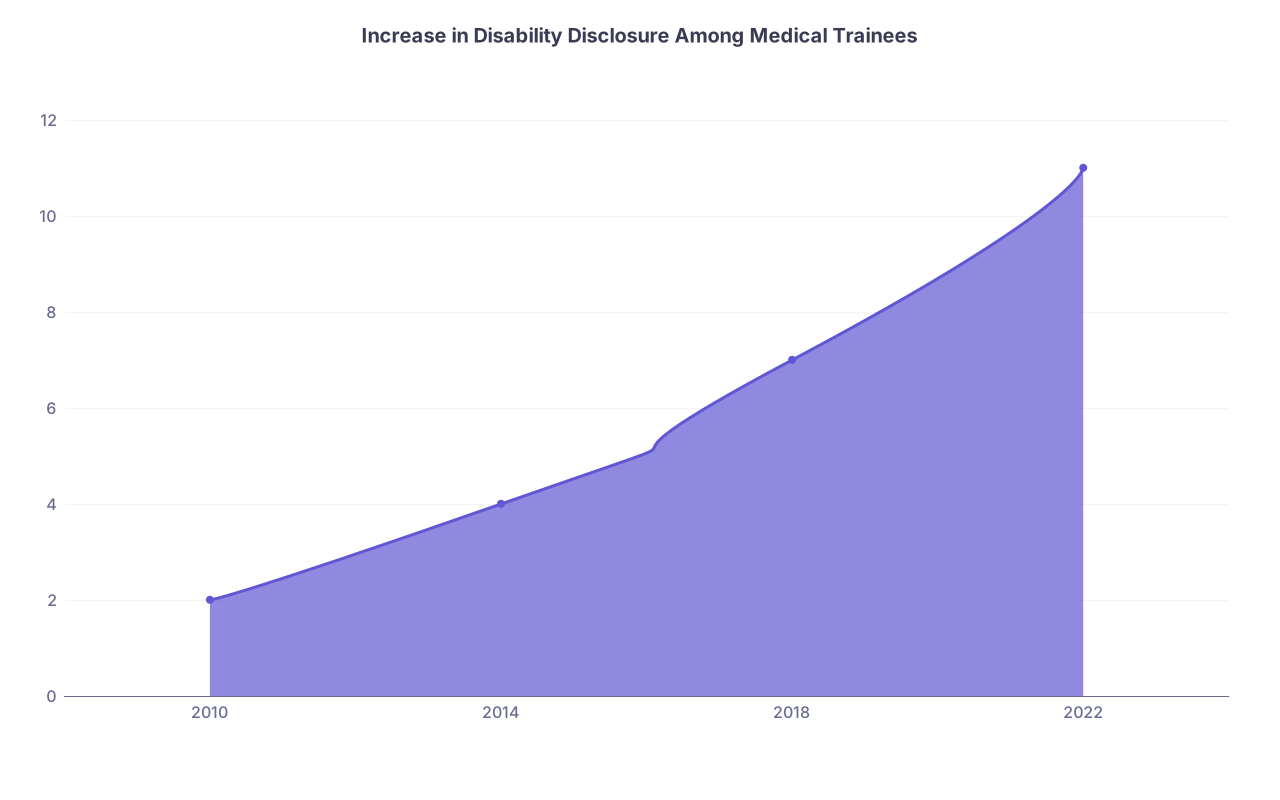
One more unpopular opinion: the culture that tells you to hide your disability is already dying. Slowly, but it is.
- More trainees are openly disabled.
- More academic centers have formal disability offices.
- Telemedicine, remote charting, AI tools, and flexible coverage models are making rigid 1980s-style residency structures look less “essential” and more “historical artifact.”
| Category | Value |
|---|---|
| 2010 | 2 |
| 2014 | 4 |
| 2018 | 7 |
| 2022 | 11 |
That’s not fantasy; those percentages are in the ballpark of published data on self-identified disabled med students over the past decade.
Is bias gone? Not even close. But the assumption that “accommodations = unemployable” is losing ground.
If anything, the programs thinking strategically about workforce, retention, and burnout are starting to view proactive accommodation use as a marker of maturity and self-advocacy, not weakness. The resident who says, “Here’s what I need to stay functional and safe for patients,” is frankly safer than the one white-knuckling through panic attacks and micro-sleeps on the highway.
How to Request Accommodations Without Sabotaging Yourself
Let me make this practical.
Here’s a high-yield structure that doesn’t rely on magical thinking or naïve trust.

| Step | Description |
|---|---|
| Step 1 | Match or Acceptance |
| Step 2 | Review Essential Functions |
| Step 3 | Clarify Your Functional Limits |
| Step 4 | Consult Treating Clinician |
| Step 5 | Contact HR or GME Disability Office |
| Step 6 | Submit Documentation |
| Step 7 | Interactive Meeting |
| Step 8 | Agree on Specific Accommodations |
| Step 9 | Monitor and Adjust as Needed |
Key habits:
Know your own job description.
Look at the actual “essential functions” language for the residency. Frame your needs around how you’ll meet those.Talk in function, not diagnosis.
Instead of “Because of my autoimmune disease,” say:- “I can safely work 24-hour shifts up to X per month, but not more than that without significant flare risk.”
Loop in your clinician early.
Vague letters like “they may need accommodation” are useless. You want:- Clear, specific functional recommendations.
- A statement that your condition is stable under current management.
Keep a written trail.
Email > hallway conversation. Not to be adversarial, but to avoid “we never heard about this” later.
You’re building a case that you’re both realistic and reliable. That’s what programs care about.
The Myth vs. Reality, Stripped Down
Let me strip this to the studs.
- No, requesting accommodations does not automatically tank your rank list. Programs are more constrained by law, by process, and by documentation reality than the rumor mill acknowledges.
- Yes, disability bias still exists, but it usually shows up as skepticism about performance, not as a direct punishment for having gone through HR.
- The real danger is hiding legitimate needs, matching into a structurally incompatible program, and then trying to fix it in crisis mode.
You are not safer because nobody knows you’re struggling. You’re just more alone if (when) things crack.
If you remember nothing else:
- Programs cannot legally and openly use your accommodation request as a rank-list filter. What they do care about is reliability, clarity, and your ability to meet essential functions.
- Timing and framing matter more than the fact of disclosure. Early, specific, function-focused accommodation requests help you; last-minute vague pleas often backfire.
- The culture is shifting. In the coming decade, hiding disability will look less “professional” and more “reckless.” Start acting like your safety and longevity in medicine count just as much as your Step score.