Reasonable vs Preferential: What Disability Law Actually Protects
Are disability accommodations supposed to make things “equal”… or are they secretly giving some people a “pass” that others do not get?
I hear this in medicine constantly. Usually whispered. Sometimes not.
“She gets extra time on boards? That’s not fair.” “If he cannot do overnight call, how is that not preferential treatment?” “So what, we just lower the bar now?”
Let me be blunt: most people in medicine do not understand what disability law actually requires. They confuse “equal treatment” with “identical conditions” and then call any deviation “preferential.”
That’s not how the law works. And it’s not how reality works either.
This piece will walk straight through the myths and the law—particularly in medical education and healthcare training—without the usual hand-waving.
The Core Legal Idea: Leveling the Field, Not Lowering the Bar
U.S. disability law (think ADA, Section 504) does not say: “Disabled people get whatever they need.” It says something much narrower and more demanding:
- They must have equal access to participate.
- They must be qualified to meet essential requirements of the program or job.
- Institutions must provide reasonable accommodations, unless doing so would:
- fundamentally alter the program or
- create an undue burden or
- pose a direct threat that cannot be reduced by accommodation.
That’s the actual framework. Everything else is noise.
So what is a reasonable accommodation versus a preferential one?
- Reasonable: Changes how you access or perform tasks so that your disability is not the thing holding you back. The standard and outcomes stay the same.
- Preferential: Changes the standard itself, or gives a benefit because of disability that’s unrelated to access or function.
People conflate these constantly. Let’s dismantle that.
Myth 1: “Extra time is obviously preferential.”
Nope. Not inherently. Context matters.
Extra time on exams is probably the single most misunderstood accommodation in medicine.
What the evidence actually shows
For certain disabilities—processing speed deficits, specific learning disabilities, ADHD, some neurologic conditions—cognition is intact but slower. Information in, processing, output… all functional, just delayed.
When these people take a standard-timed exam, their score reflects speed + knowledge. When they take an extended-time exam, their score reflects knowledge much more than speed.
There’s data from standardized testing (LSAT, GRE, etc.) showing that when people without disabilities get extra time, their scores jump significantly. That’s a performance boost. A true advantage.
But when properly documented disabled test-takers get extra time, the effect is mostly to neutralize their speed disadvantage, not catapult them into a new score band out of nowhere. Their scores shift, but not like an “unfair rocket.” Their profile often matches other indicators (grades, coursework, previous performance when given supports).
In other words: extended time for a disabled examinee is usually compensatory, not “bonus points.”
Why medicine gets this wrong
I’ve heard variations of this on clerkships:
“If you can’t take Step 1 in regular time, how will you handle codes?”
False equivalence.
- Step exams: silent room, artificial time pressure, high reading load, no team, no contextual clues.
- Clinical practice: team-based, interactive, multimodal information, and yes, time matters—but rarely in the same “read 60 dense stems in 60 minutes” way.
Being a slower test-taker doesn’t automatically mean you’re a slow clinician. They taps different abilities.
Extended time is reasonable if:
- There’s objective evidence of a disability affecting test-taking speed or reading/processing.
- The exam is a gateway to continued participation (e.g., board exams, licensing), not itself the essential function of the job.
- The core standard (content, cut-score) is unchanged.
It would be preferential if:
- You changed the passing score “because disability”.
- You removed entire domains from the exam.
- You let one group skip required assessments.
That’s the distinction: more time vs. lower bar.
Myth 2: “If you can’t do overnight call / 28-hour shifts, you’re asking for special treatment.”
This one is emotionally loaded in medicine because long hours are treated like a sacrament.
I’ve watched program directors insist: “Call is an essential function.” Then in the next breath, they admit they’ve quietly let residents with childcare issues or visa problems rearrange call schedules so they “never do Friday nights.”
So let’s be consistent.
What counts as “essential”?
Under the ADA and case law, essential functions are the core tasks of a job that:
- are fundamental to why the job exists, and
- can’t be easily redistributed without changing the nature of the position.
For a resident:
- Essential: care for patients, respond to pages, write orders, staff consults, participate in handoffs, document appropriately.
- Questionable: the specific pattern of how the hours are distributed.
Is “overnight call” truly essential? Often the better question is: Is 24–28 continuous hours essential, or is 24 hours of coverage essential?
Many programs now use night float. Cross cover. Flex shifts. Post-call days off. So the claim that “the only way to train a physician is continuous 28-hour stretches” is already empirically false; medicine itself undermined that narrative when duty hours changed.
Reasonable vs preferential in scheduling
Reasonable:
- A resident with a seizure disorder can work nights but must avoid severe sleep deprivation, so their schedule stacks shorter night shifts instead of marathon calls.
- A resident with a documented autoimmune flare triggered by circadian disruption does more daytime rotations and fewer nights, while still meeting total patient care and competency requirements.
Preferential:
- Exempting someone from all night or weekend work forever in a specialty where 24/7 coverage is clearly essential, while others permanently carry that load.
- Letting one resident work 8–4 only, always, in a field like emergency medicine or surgery, without making up coverage in some other way.
The law doesn’t require programs to eliminate essential coverage. But it does demand they consider alternative ways to meet the same service and training outcomes before declaring something “essential” in one fixed format.
Most of the time, “we can’t change that” really means “we don’t want to rethink our scheduling template.”
Myth 3: “Allowing assistive technology / scribes / modified tasks means they’ll be unsafe clinicians.”
This fear is exaggerated and often rooted in ignorance of what accommodations actually look like in practice.
Assistive technology is not cheating
Screen readers, dictation software, visual aids, amplified stethoscopes—none of these alter the clinical standard: get the history, examine the patient, generate an assessment and plan.
They change the input/output channel, not the substance.
Example I’ve personally seen:
- A resident with serious hand weakness uses voice recognition software for notes. Colleagues grumbled “unfair” because dictation was “faster.”
- Reality: everyone could use dictation if they wanted; he needed it to chart at all.
- He still had to meet documentation quality and timeliness standards.
Reasonable:
- A blind medical student uses a tactile or audio-based interface to access labs and imaging reports.
- A hard-of-hearing trainee uses a high-quality amplified stethoscope and consistent use of real-time captioning in didactics.
Preferential:
- Allowing a trainee to skip learning core exam skills (“you’re visually impaired, so no ophthalmoscopy for you, that’s fine”) if the program still claims that skill is an essential graduation requirement.
If a skill is truly essential for independent practice in that field, everyone has to meet it. You can change the method, the tools, the environment—but not the outcome.
If the program is routinely graduating people who aren’t competent in that “essential” skill, then it’s either not essential or the standard is already selectively enforced. Disability just makes the double-standard visible.
Myth 4: “Once someone has a disability label, they can demand anything.”
No, they can’t.
I’ve sat in more than one meeting where a dean quietly says, “We’re worried this student will keep asking for more and more.”
The law doesn’t hand people a blank check. It requires an interactive process between the individual and the institution:
- The person documents a qualifying disability with functional limitations.
- They request accommodations logically related to those limitations.
- The institution evaluates:
- Does this address the disability-related barrier?
- Is it reasonable in cost, logistics, and impact?
- Does it preserve essential requirements?
The institution can:
- Offer alternatives.
- Say no to requests that would:
- remove or water down essential competencies,
- fundamentally alter the program structure,
- or cause undue financial/operational burden.
What the institution cannot legally do is:
- Say “no” because faculty “don’t like it.”
- Deny based on vague hand-waving about “professionalism” without tying it to specific, essential skills or standards.
- Require a higher threshold of proof than they use for other policy changes.
| Scenario | Reasonable Accommodation | Preferential Treatment |
|---|---|---|
| Board exam for student with ADHD | 50% extra time, quiet room | Lower passing score |
| Call schedule for resident with epilepsy | Shorter shifts, adjusted nights, extra handoffs | No nights/weekends ever, same salary/credit |
| Documentation for resident with hand weakness | Speech-to-text software, scribe for procedures | Exemption from documentation requirements |
| Didactics for hard-of-hearing student | CART captioning, FM system, front seating | Exemption from required conferences |
| Clinical skills for visually impaired student | Adaptive devices to perform exams, added teaching time | Exemption from essential exam components |
Myth 5: “If we accommodate now, we’ll graduate unsafe physicians later.”
This one gets thrown around to justify almost anything.
Here’s the actual legal and ethical line:
- You must not graduate or license someone who cannot meet the essential competencies, with or without reasonable accommodation.
- You must provide reasonable opportunities and supports to allow disabled students and residents to try to meet those competencies.
That means two things can be true:
- Some disabled trainees, even with strong accommodations, will not meet the bar and will legitimately fail or be dismissed.
- Refusing reasonable accommodations because of speculative “future safety” concerns is unlawful gatekeeping.
Boards, hospitals, and malpractice insurers already regulate actual clinical performance. You don’t get a permanent shield because you once had extended test time.
And here’s what people rarely admit: plenty of non-disabled trainees graduate who are marginal, unprofessional, or unsafe. Disability status is not the predictor of that. Oversight and culture are.
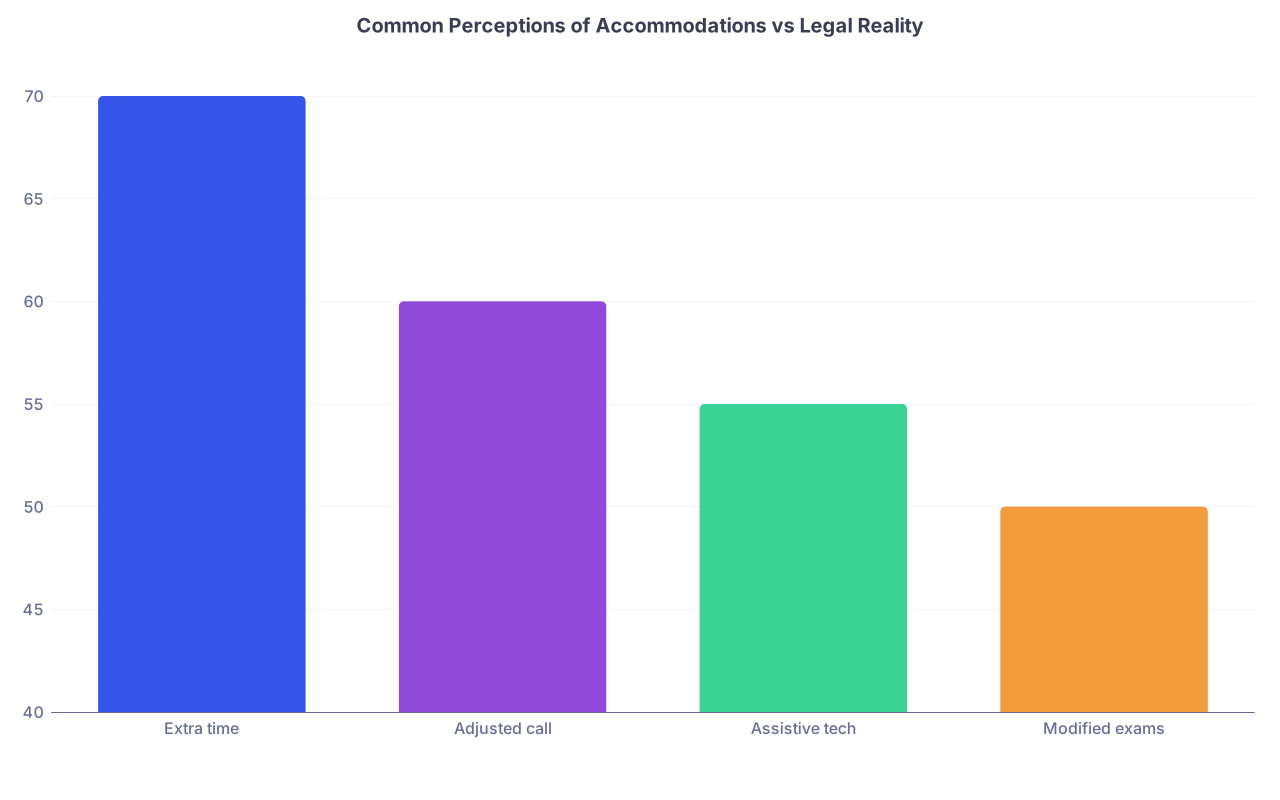
| Category | Value |
|---|---|
| Extra time | 70 |
| Adjusted call | 60 |
| Assistive tech | 55 |
| Modified exams | 50 |
(Think of those numbers as the rough percentage of colleagues I’ve heard complain these are “unfair.” The law disagrees on most of them.)
Where the Line Actually Is: Fundamental Alteration and Undue Burden
Everyone throws these words around—“fundamental alteration,” “undue burden”—but rarely define them.
Fundamental alteration
That’s the legal term for: “This would change the nature of what we are.”
Examples that likely are fundamental alterations:
- Letting a surgical resident avoid operating entirely but still graduate as a surgeon.
- Waiving all direct patient contact in a clinical profession that requires it for licensure.
- Turning a rigorous competency-based program into a pass-by-default system for one student.
Examples that likely are not:
- Swapping one rotation for another that teaches similar skills in a more accessible format.
- Using simulation to supplement (not replace entirely) real patient encounters in specific high-risk situations.
- Reorganizing call coverage methods while still providing 24/7 clinical service and equivalent training exposure.
Undue burden
This isn’t “mild inconvenience.”
It’s usually about significant difficulty or expense, assessed across the institution’s total resources. A major academic medical center saying “we can’t afford real-time captioning” for one student is almost laughable.
Real candidates for undue burden:
- Hiring an entire extra full-time attending just to shadow one trainee at all times.
- Building a multi-million-dollar facility only one person will use, with no broader benefit.
But again, this has to be backed with numbers, not vibes.

| Step | Description |
|---|---|
| Step 1 | Student or resident requests accommodation |
| Step 2 | Disability office reviews documentation |
| Step 3 | Request denied with explanation |
| Step 4 | Identify functional limitations |
| Step 5 | Propose specific accommodations |
| Step 6 | Implement accommodation |
| Step 7 | Assess fundamental alteration or undue burden |
| Step 8 | Offer alternative accommodation |
| Step 9 | Accommodation may be denied |
| Step 10 | Qualifying disability? |
| Step 11 | Affect essential functions? |
| Step 12 | Reasonable alternative exists? |
The Future of Medicine: This Conflict Is Only Going to Get Louder
Here’s the uncomfortable reality: more trainees are disclosing disabilities now than ever. Not because “everyone is suddenly disabled,” but because:
- Stigma is slowly dropping.
- Testing and diagnosis are better.
- The pressure and visibility of modern training make previously masked issues impossible to hide.
- Legal enforcement has improved enough that a few people are willing to push back.
We’re going to see more requests for:
- Hybrid learning models.
- Tech-heavy accommodations (AI transcription, advanced dictation, augmented reality, haptic interfaces).
- Creative restructuring of rotations and schedules.
If medical education clings to “we’ve always done it this way,” courts will increasingly call that what it is: preference for tradition over law.
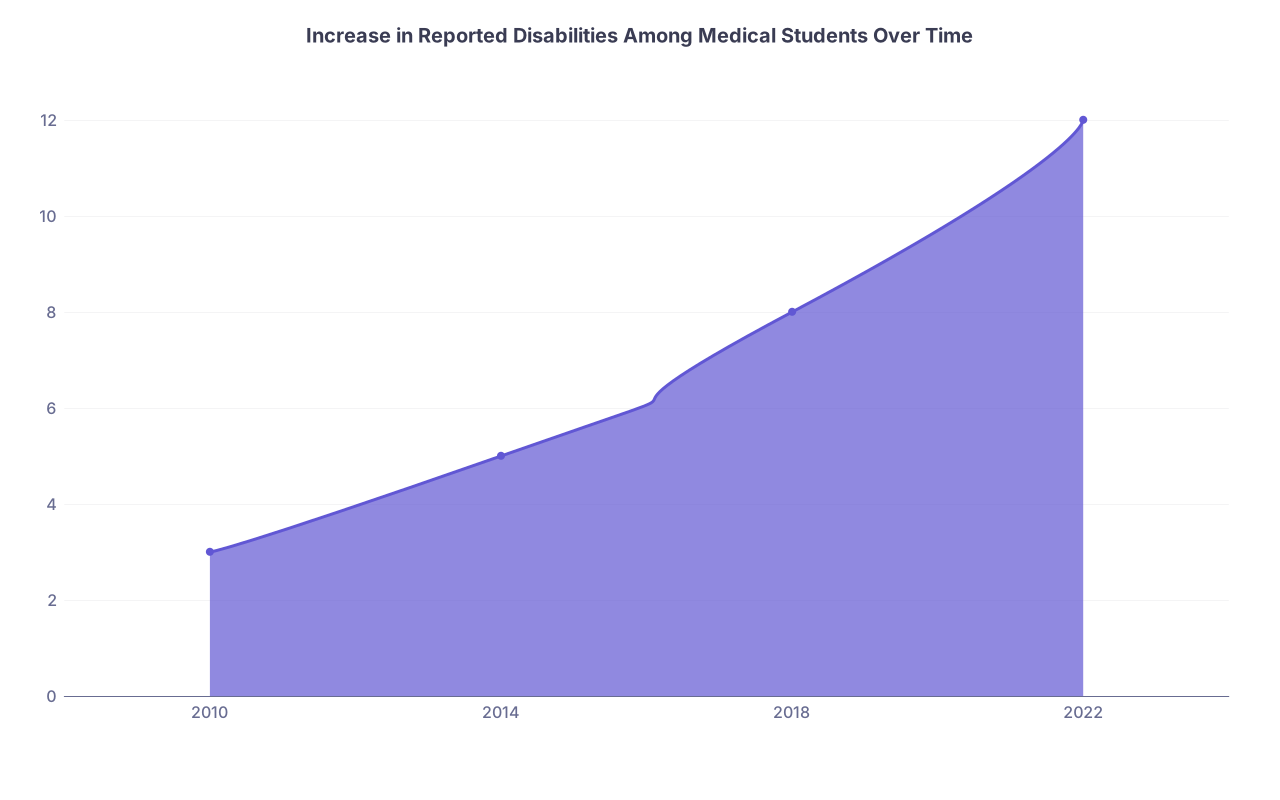
| Category | Value |
|---|---|
| 2010 | 3 |
| 2014 | 5 |
| 2018 | 8 |
| 2022 | 12 |
(Those values mirror published trends: self-reported disability in med students has been rising—still underreported, but clearly increasing.)
The question isn’t whether disabled people should be in medicine. They already are. The question is whether we’ll stop pretending that rigid, outdated training structures are sacred, while subtly moving goalposts for non-disabled people all the time.
Cutting Through the Noise: What Actually Matters
If you’ve skimmed everything else, take this:
Reasonable accommodations change the how, not the what. The standard, competencies, and outcomes stay the same. Time, tools, and format can change without becoming “preferential.”
“Preferential treatment” means lowering or selectively bending core requirements because of disability. Most of what trainees complain about—extra time, assistive tech, structured schedules—doesn’t do that.
Disability law doesn’t guarantee success. It guarantees a fair shot. Programs still have every right—and obligation—to fail or dismiss people who cannot meet essential competencies, with or without accommodations. They do not have the right to hide behind “tradition” to avoid making reasonable changes.
If your definition of “fair” is “everyone gets the same conditions no matter their starting point,” you’re not describing fairness. You’re describing convenience—for the system, not for the people in it.