
The belief that using extra time on exams will quietly cap your career is mostly myth, partly culture, and barely data-driven.
Let me be blunt: extra time exam accommodations are far more career-limiting in people’s heads than in actual outcomes. The bottleneck for most students is not “extended time ruined my chances.” It is stigma, silence, inconsistent policies, and people waiting way too long to seek help because they’re scared of being labeled “less capable.”
You want to know whether extra time will follow you like a scarlet letter into residency and beyond. So let’s walk through what actually happens, exam by exam, gate by gate, and where the real risks actually live.
Myth #1: “If I Take Extra Time, Programs Will Find Out and Judge Me”
They usually will not. And, in most cases, they legally cannot.
There are three different layers people keep mixing up:
- Your diagnosis / disability status
- Your accommodation approval (e.g., 50% extra time)
- Your exam score or pass/fail outcome
Most gatekeepers only see #3.
USMLE / COMLEX and Extra Time
For medical licensing exams, the rules are very explicit.
USMLE (Step 1, Step 2 CK, Step 3)
The National Board of Medical Examiners (NBME) used to annotate scores when someone took an accommodated exam. That practice ended years ago. Now, scores do not indicate whether accommodations were used.
Programs see: your score (or pass/fail). Not your time limit. Not your documentation.COMLEX-USA (Level 1, 2, 3)
The NBOME follows similar practice. Approved accommodations are implemented on their testing side, but your score report to residency programs does not disclose what was provided.
For most residency programs, your “extended time” status is invisible unless:
- You tell them explicitly, or
- Your school flags some general “needs significant accommodations” note in the MSPE (which, at most schools, they do not).
Is there gossip? Sure. I’ve watched clerkship directors speculate, “I wonder if he had extra time on Step,” usually when they are trying to make sense of a high shelf-score/low Step-score combo. But speculation is not policy, and they cannot confirm anything through official score reports.
Medical School and MSPE
In the vast majority of schools I’ve worked with or seen up close:
- The disability office is separate from academic records.
- Faculty do not see your psychoeducational evaluation.
- The MSPE (Dean’s Letter) does not list “Student received extended time on exams” unless something truly unusual is going on (e.g., massive curricular modifications, or leaves tied to disability that the student chose to disclose).
Is it airtight everywhere? No. Small schools with leaky cultures exist. People talk. But at a systems level, the idea that “using extra time will be recorded and automatically shared with programs” is wrong.
So on the “Will they know?” question:
Usually no. And when they do, it’s more often because you disclosed it, not because a score report outed you.
Myth #2: “Using Extra Time Means I’m Less Capable, So I’ll End Up in a Less Competitive Specialty”
This one is more psychological than structural.
Let’s separate:
- What the data suggests about outcomes
- What disability and accommodation actually measure
- What people assume about “capability”
What the Data Actually Shows (Where We Have Any)
Nobody is publishing RCTs of “extended time vs no extended time” for med students’ long-term career success. But we do have pieces of the puzzle.
General education research (K–12 and college)
Studies on extended time for students with documented learning disabilities or ADHD show roughly this:- When the documentation is legitimate and the exam is speeded, extended time brings performance closer to peers’, not above them.
- In other words, it levels the playing field rather than turning people into “super scorers.”
- Importantly: extended time does not reliably help non-disabled students much at all. So it’s not a magic cheat code; it is a corrective tool.
Professional exams (MCAT, LSAT, etc.)
Older LSAT and SAT data used to show annotated scores for accommodated administrations. Those annotations were removed partly because:- There was no consistent evidence that accommodated test takers were misrepresenting ability in a way that harmed downstream performance predictions.
- The annotations were discriminatory in practice.
Medical training outcomes
The Association of American Medical Colleges (AAMC) has reported rising numbers of students with disabilities in medical school. They track graduation and progression rates. Key pattern:- Students with disabilities graduate and match, across a range of specialties.
- Barriers they report most? Stigma, culture, and lack of support. Not “extra time destroyed my career.”
Do we have a perfect chart of “extended time → specialty choice”? No. But everything we do have points to: extra time helps people clear the same objective hurdles everyone else faces. The real determinants of competitive specialty matches remain:
- Board scores (with or without accommodations)
- Clinical performance
- Research
- Letters
- Interview impressions
- Institutional bias (which is not going away regardless of your time limit)
You do not have a “less real” 245 because you used accommodations. You just took the test in a way that allowed you to show what you actually know without your processing speed bottleneck artificially suppressing the score.
Myth #3: “Programs Secretly Blacklist People Who Used Extra Time”
This is the quiet fear nobody wants to say out loud, but you probably thought it: “Sure, they’re not supposed to discriminate, but we all know they do.”
Let’s be precise.
What Programs Actually See When Ranking You
For most residency programs, the inputs are:
- Step/COMLEX scores
- Clerkship grades and narrative comments
- Class rank / quartile
- Research, leadership, activities
- Personal statement
- MSPE
- Interview day performance
Now compare two scenarios:
- You do not use needed accommodations. Your Step scores are marginal, your clerkship exams are a struggle, you fail one exam, you barely pass remediation.
- You do use accommodations. Your Step scores are solid, you pass on first try, your clinical evaluations are strong.
Which file “looks better” to a program director who never sees your extended time status? Obviously #2.
There’s a persistent fantasy that “being stoic and refusing help” will be rewarded down the line. The actual currency is performance and reliability. Not martyrdom.
But What About Disclosure?
Here’s where nuance matters.
There are moments where you might choose to disclose your disability or accommodations:
- In a personal statement (e.g., disability as part of your story)
- In an interview, when explaining non-linear progression, leaves, or exam failures
- When requesting future accommodations in residency
I’ve heard PDs say very different things about this:
- The lazy / biased version: “If someone tells me they needed extended time, I worry about how they’ll handle call.”
- The thoughtful version: “If someone was struggling, got diagnosed, got accommodations, and then performed well, that’s resilience and insight. I’d rather know they have a functioning system than someone melting down silently.”
Legally, programs cannot discriminate based on disability. Reality: implicit bias exists everywhere. But notice the actual logic of the second group: what they care about is future performance and self-management, not whether you were allowed 1.5x time on a standardized test.
If you craft your story as “I needed accommodations and now I function at the level my peers do,” that’s very different from “I am perpetually on the edge and need ever-escalating exceptions.”
Where Extra Time Can Affect Your Trajectory
Here’s where I’ll stop being comforting and be pragmatic.
Extended time in itself usually is not the career-limiter. But the factors around it can be.
1. Delayed Diagnosis and “Too Late” Accommodations
I’ve seen this many times:
- Student powers through undergrad with brute force.
- MCAT is underwhelming but barely good enough.
- First two years of med school: constant grind, mediocre exam performance, always “just passing.”
- Step 1 or Level 1: fails. Collapse. Panic evaluation. ADHD or learning disorder diagnosed at 25.
- Now they apply for accommodations for the re-take.
At that point, your record already has:
- A failed board exam
- Maybe a leave of absence
- Possibly a delayed graduation
Those things can absolutely change your career options, even if your retake with accommodations goes fine. The career-limiting factor is not the accommodations. It’s the delay in getting them.
2. Under-Used or Incomplete Accommodations
Some students are weirdly half-in: they accept extra time for in-house exams but do not apply for it on Step. Or vice versa. Or they don’t request any adjustments in clerkships even when it’s allowed (e.g., extra reading time for notes, assistive tech, minimized paging during dedicated study time).
Result: patchy performance, unexplained inconsistencies.
Programs do not see “brave and unaccommodated.” They just see:
- “Strong student early, Fall-off later”
- Or “Why are shelf scores so much lower than classroom exam scores?”
That inconsistency can hurt more than a quiet, invisible extra-time flag ever would.
3. Burnout and Mental Health Fallout
Untreated ADHD, dyslexia, or processing speed issues in a high-stakes, speed-based environment are perfect recipes for:
- Chronic sleep loss and over-studying
- Anxiety and depression
- Impostor syndrome
- Eventually: leaves of absence, failures, dropouts
Burnout absolutely can be career-limiting. And a lot of it is preventable when people stop moralizing about accommodations and treat them like glasses for myopia: boring, necessary, unremarkable.
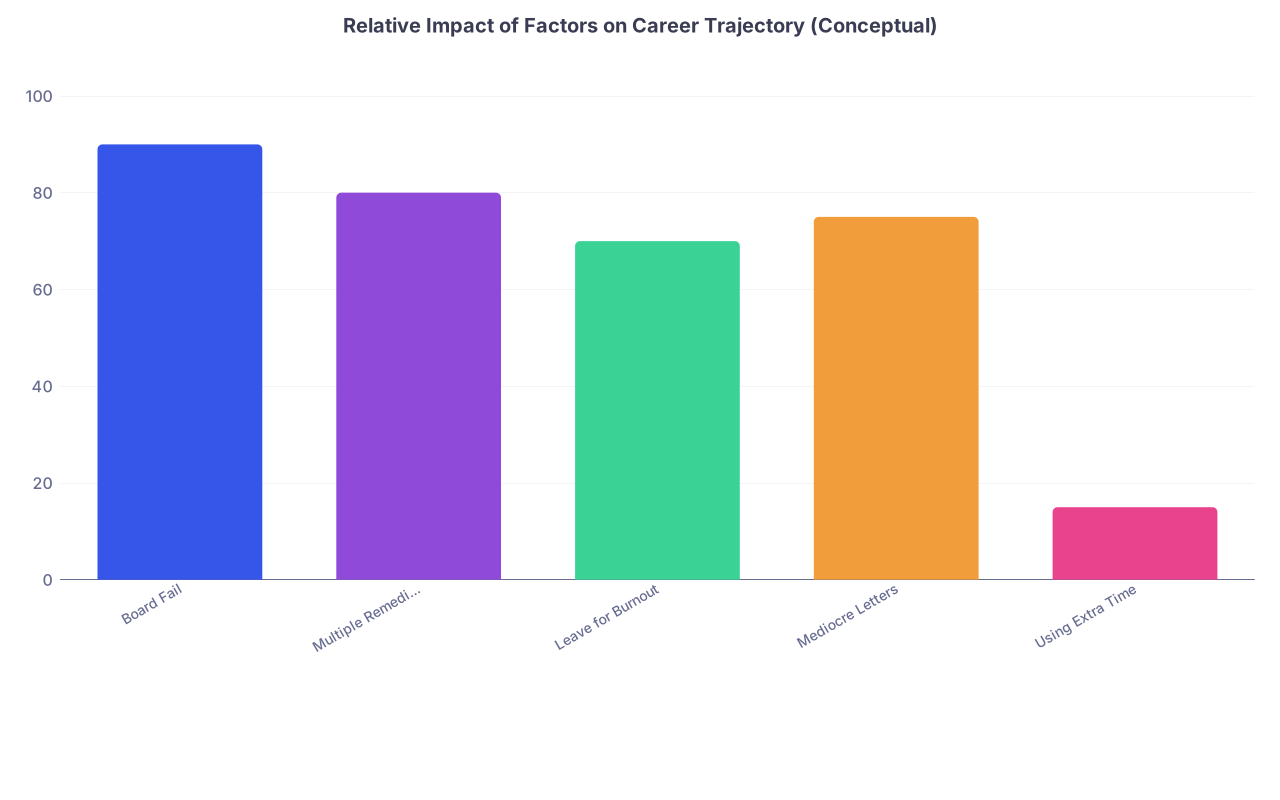
Data Snapshot: What Actually Limits Careers
Let’s put some numbers on this. They’re approximate, but directionally right.
| Factor | How Often It Limits Careers | Usually Visible to Programs? |
|---|---|---|
| Board exam failure (no accomms) | High | Yes |
| Repeated course/clerkship failures | High | Yes |
| Leaves of absence for burnout | Moderate to High | Often |
| Poor clinical evaluations | High | Yes |
| Documented disability with accommodations (no failures) | Low | Rarely |
| Category | Value |
|---|---|
| Board Fail | 90 |
| Multiple Remediations | 80 |
| Leave for Burnout | 70 |
| Mediocre Letters | 75 |
| Using Extra Time | 15 |
Is this a randomized trial? No. It’s the composite of what PDs actually care about layered on top of what gets them in trouble with their own institutional metrics.
Notice what’s at the bottom: “Using Extra Time.” Because in most files, they do not even know.
The Real Question: How Do You Use Extra Time Strategically, Not Fearfully?
If you strip away the noise, the better question is:
“How do I use accommodations in a way that maximizes my long-term career options?”
A few practical, unglamorous truths:
Seek evaluation early, not after a catastrophic failure.
If you’ve always been the “smart but slow test taker” since elementary school, or reading dense text wipes you out five times more than peers, get that documented now. Not after you’ve already failed a gateway exam.Align accommodations with real functional impairments.
Testing agencies hate vague diagnoses like “test anxiety” without robust evidence. What works: detailed neuropsych testing pointing to specific deficits (processing speed, working memory, reading fluency) that actually match the accommodation requested.Use accommodations consistently across settings.
If you need 50% extra time, you need it on:- School exams
- NBME subject exams
- USMLE/COMLEX
- High-stakes written tests later (in-training, specialty boards)
Piecemeal use is what creates weird grade/score patterns that invite speculation.
Focus relentlessly on performance, not purity.
You’re not collecting virtue points for “doing it without help.” No one is handing out a special medal for not using the tools you’re entitled to. This is not a moral test. It’s a competency filter.Plan for the reality that clinical practice is less speed-test-driven.
Residency and attending life have different constraints—fatigue, multitasking, emotional stress—but you are seldom sitting a 7-hour multiple-choice exam under a ticking clock. The main game is:- Judgment
- Teamwork
- Reliability
- Communication
Extra time on a multiple-choice exam does not predict being a slow intern. Those are separate skill sets.
The Future: Disability, Exams, and Medicine’s Slowly Shifting Culture
We’re seeing a slow, uneven shift:
- More med students are disclosing disabilities.
- More schools are establishing real disability services instead of ad hoc “talk to Student Affairs” advice.
- More specialties are being forced to confront the reality that disabled physicians exist—and practice well.

| Step | Description |
|---|---|
| Step 1 | Recognize Longstanding Difficulties |
| Step 2 | Seek Formal Evaluation |
| Step 3 | Get Documented Diagnosis |
| Step 4 | Obtain Exam Accommodations |
| Step 5 | Improved Exam Performance |
| Step 6 | Stronger Application |
| Step 7 | Residency and Career |
There will always be holdouts who believe medicine is only for the perfectly neurotypical, perfectly abled, perfectly fast processor who never needed support. They are wrong on both ethics and data.
One more angle almost nobody talks about: if you don’t normalize appropriate accommodations now, you are quietly helping preserve a system that will later punish your patients who need accommodations in your clinic, your hospital, your health system. The culture you tolerate as a trainee is the culture your patients inherit.

Where the Actual Risk Lies (Spoiler: Not in Extra Time)
The truly career-limiting behaviors I’ve seen linked to disability and testing are not “using extra time.” They are:
- Hiding struggles until something breaks under pressure.
- Refusing help out of shame until the only option is a leave of absence.
- Building a transcript full of remediations and failures instead of a single, quietly accommodated success.
- Treating accommodations like a personal moral failing instead of a tool.
If you want a contrarian take grounded in how this actually plays out:
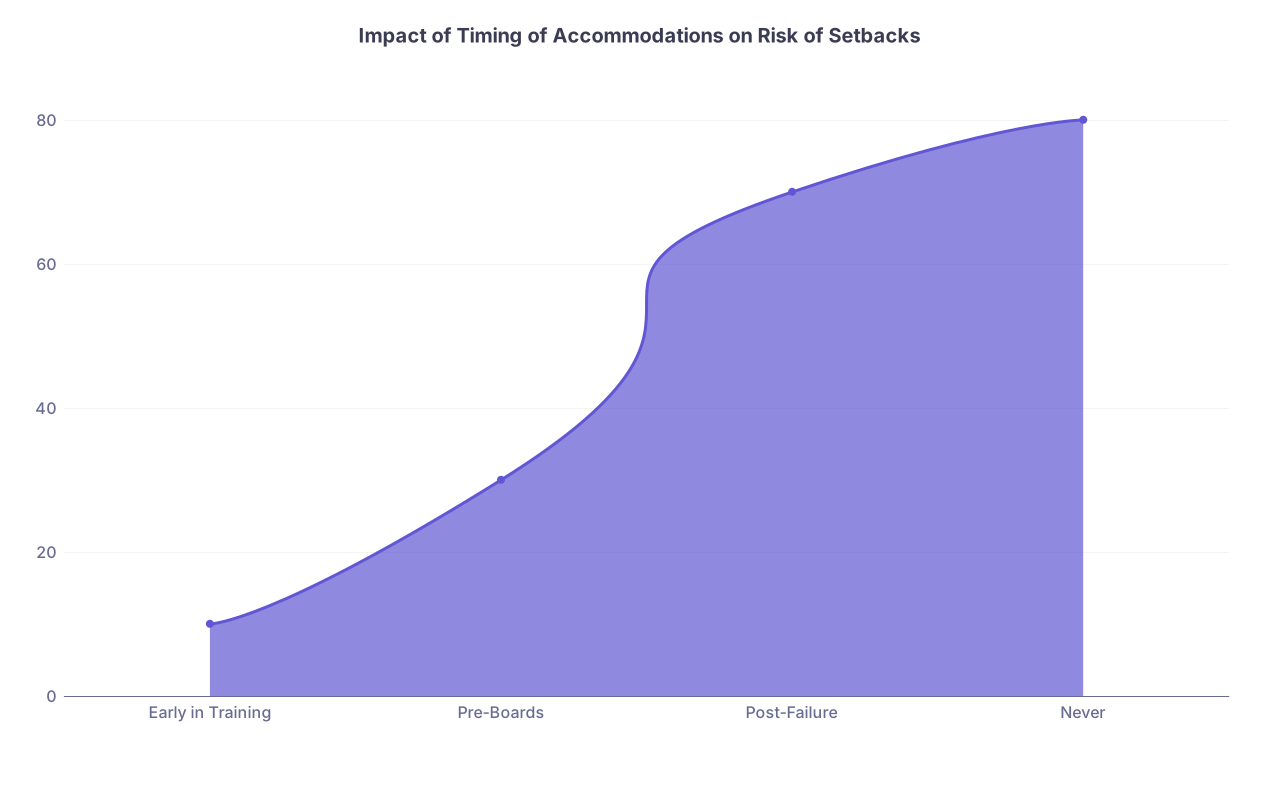
Using extra time early and appropriately is usually career-protective, not career-limiting.
| Category | Value |
|---|---|
| Early in Training | 10 |
| Pre-Boards | 30 |
| Post-Failure | 70 |
| Never | 80 |
Earlier = fewer catastrophic events. Later or never = more.
Bottom Line: What You Should Actually Take Away
Let me condense this to what matters when you make your decision:
- Extra time itself is rarely visible and even more rarely the thing that limits a career. Stigma and delay are the real enemies, not the accommodation.
- Performance, not martyrdom, is the metric that gatekeepers use. A solid track record with accommodations beats a shaky one without them every single time.
- Using needed accommodations early is usually a smart, protective move. Waiting until after you fail a major exam is what truly narrows your options.
If you need extra time, the bravest—and frankly most strategic—move is to use it and then get on with building the career you actually want.