
Only about 1–2% of US medical students and residents ever receive formal testing accommodations on high‑stakes exams, yet a far larger share quietly assume that those accommodations will somehow “carry over” into residency life.
That gap between belief and reality is where people get hurt.
Let me be blunt: securing extra time, a quiet room, or break modifications on the USMLE or COMLEX does not guarantee that you will get—or keep—anything resembling similar flexibility in residency. The legal framework changes, the power dynamics change, and the practical constraints explode.
You are not in the same world once you graduate from exam taker to employee-physician.
How Board Accommodations Actually Work (And Why That World Is Tiny)
Before dismantling the myth, you need the map.
Testing accommodations live in a very specific legal and logistical universe: high‑stakes standardized exams run by private entities (NBME, NBOME, FSMB, etc.), governed by disability law as applied to testing agencies, not employers.
On boards, your interaction looks roughly like this:

| Step | Description |
|---|---|
| Step 1 | Identify functional impairment |
| Step 2 | Collect documentation |
| Step 3 | Submit to NBME or NBOME |
| Step 4 | Approved accommodations |
| Step 5 | Appeal or test standard |
| Step 6 | Meets criteria |
Testing bodies are terrified of two things: lawsuits and invalidating score comparisons. So their default is conservative: they’ll grant accommodations only when the documentation is airtight and the functional limitation clearly intersects with test conditions.
Key features of the testing world:
- There’s one task: sit, read, think, click.
- Time, environment, and computer interface are tightly controlled.
- They can offer “equivalent access” structurally—longer time, quiet room, breaks—without altering the core test.
This is why extra time or alternative formats are feasible and relatively standardized.
Residency is none of that.
Residency Is Not A Test Center: The Legal Shift No One Explains
Here’s the part most students discover too late: once you’re in residency, you’re an employee providing patient care. That moves you under a different part of the Americans with Disabilities Act (ADA) and related state laws—employment protections, not testing protections.
Different section. Different standards. Different fight.
On boards, the question is:
“Does this person have a qualifying disability that interferes with demonstrating their knowledge under standardized conditions, and can we adjust the conditions without changing what’s being measured?”
In residency, the question is harsher:
“Can this person perform the essential functions of this job, with or without reasonable accommodations, without compromising patient safety or fundamentally altering the training program?”
Those last eleven words are where most expectations die.
Programs don’t have to:
- Remove essential job functions
- Lower clinical standards
- Excuse residents from core duties that define the specialty
- Create entirely new positions to “fit” one trainee
They do have to engage in an interactive process and seriously consider reasonable accommodations. But “reasonable” in a busy ICU at 2 a.m. does not look like “reasonable” in a quiet Prometric center at 2 p.m.
And no, your prior approval from NBME or COMLEX does not automatically prove anything about what’s feasible in a hospital. It’s evidence of a disability, not a binding contract about accommodations.
The Big Myth: “If I Get Extra Time On Boards, I’ll Get It For Everything”
I’ve heard versions of this in advising meetings too many times:
- “I get 50% extra time on exams, so I’ll probably get lighter call.”
- “They can’t make me do 28‑hour calls; I have ADHD with documentation.”
- “I have Step 2 CK accommodations, so residency should honor something similar.”
This is fantasy, built on conflating exam access with clinical role design.
Look at the difference:
| Aspect | Boards / Exams | Residency / Employment |
|---|---|---|
| Legal category | Testing agency obligations | Employer obligations |
| Core activity | Sitting and taking a test | Continuous, unpredictable patient care |
| Time control | Fully controllable, fixed window | Variable, emergencies, cross‑coverage |
| Typical remedies | Extra time, quiet room, breaks | Schedule tweaks, assistive tech, task changes |
| Safety constraints | Low (no patients) | High (patient harm, staffing ratios) |
See the problem? “Extra time” on a reading‑based exam can be achieved by literally editing a timer. “Extra time” in the ED means telling someone else to pick up your patients when you’re running behind. That’s not just a software setting; that’s another human being doing your work.
Which raises a very practical question: who is that human, and when are they available?
Most programs are chronically short‑staffed. There is no reserve army of residents to absorb the productivity gap of every trainee who previously got extra time on boards. That doesn’t mean you’re doomed. It does mean you cannot simply port your testing accommodation logic into clinical life.
What The Limited Data (And Real Life) Actually Show
Here’s the uncomfortable truth: there is very little formal research on accommodations in residency compared with med school or board exams. Almost all the hard data we have is on:
- Prevalence of disability disclosure in med school and residency
- Outcomes for learners with accommodations during school
- Legal cases when things go wrong
The pattern is consistent:
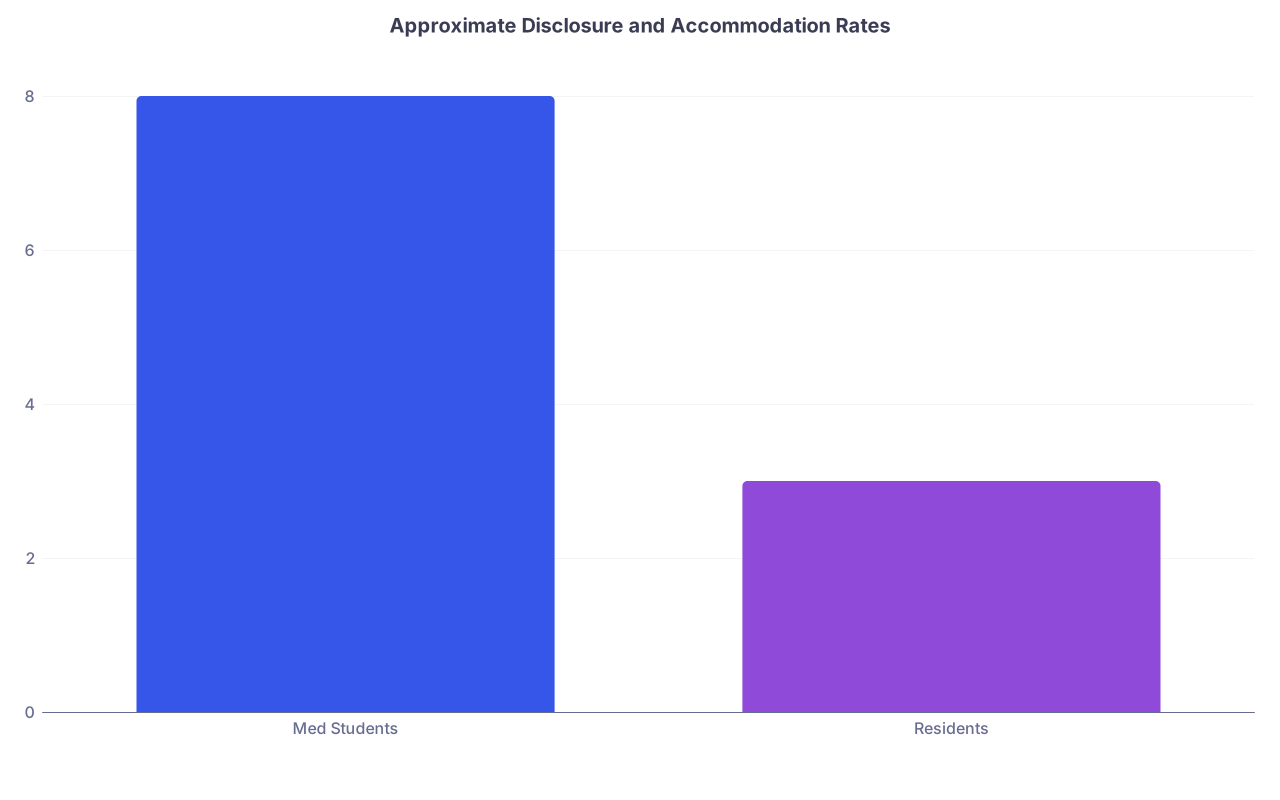
- A growing but still small fraction of med students disclose disabilities (often quoted in the 5–10% ballpark, depending on survey and definitions).
- An even smaller fraction disclose during residency.
- Even fewer pursue formal accommodations once they’re employees.
And the outcomes? Mixed. Some residents do well with targeted accommodations. Others hit a brick wall when they request changes that programs see as incompatible with essential duties.
Here’s a stylized view from multiple surveys and reports (numbers are approximate, not gospel):
| Category | Value |
|---|---|
| Med Students | 8 |
| Residents | 3 |
Rough translation: disclosure and accommodation use drop when stakes and power differentials rise.
I’ve seen cases like this (details changed for anonymity):
- A resident with a documented learning disability who had 100% extended time on Step exams. In residency, they requested reduced patient loads and extra time to write notes. Program granted some documentation templates, a bit of protected time, but not the patient load reduction they wanted. The rationale: service volume and fairness to co‑residents. Outcome: resident struggled, needed remediation, eventually transferred to a less acute setting.
- A resident with narcolepsy who had extra breaks during exams. In residency, they requested no night float and no 24‑hour calls. Program compromised with minimized night float and medication‑aligned scheduling but refused a total exemption, citing essential functions. It was a grind, but doable. A partial yes, partial no.
- A resident with chronic musculoskeletal pain who had ergonomic testing accommodations. In residency, they requested no standing OR cases over 3 hours. For surgery, that was essentially a non‑starter; program proposed non‑operative specialties instead.
Patterns emerge quickly: accommodations that support essential functions are more likely; accommodations that replace essential functions are typically rejected.
Where Programs Actually Have Flexibility (And Where They Do Not)
This is the part you need if you’re planning your career with a disability in the mix.
Residency programs often can flex on:
- Some scheduling patterns (strategic use of vacations, continuity clinic blocks, avoiding back‑to‑back nights when possible)
- Use of assistive technology (dictation software, screen magnification, alternative computer input devices)
- The environment for non‑urgent tasks (quiet room for reading consults, flexible location for certain paperwork)
- Didactic formats (recorded lectures, alternative ways to demonstrate knowledge)
- Clearer task structuring and supervision patterns
Programs usually cannot or will not flex on:
- Core coverage requirements that keep the hospital functioning
- Participation in key rotations that define the specialty (e.g., ICU months in internal medicine, L&D in OB/GYN)
- Fundamental shift of essential duties to other residents so one person does considerably less clinical work
- Changes that meaningfully reduce exposure to core competencies required for board eligibility
This is why the myth of “board accommodations = lifestyle residency” is so dangerous. It encourages people to walk into high‑intensity specialties assuming the system will be bent around them if they can just get the right letter from NBME. That’s not how this works.
The Specialty Choice No One Wants To Talk About
Here’s the contrarian piece: the best “accommodation” for many disabilities is not a schedule tweak. It is choosing a specialty whose essential functions fit your brain and body from the start.
But almost no one says this bluntly because it sounds discriminatory. Let me be clear: I’m not saying “disabled people can’t be surgeons” or “people with ADHD shouldn’t go into EM.” I’m saying the fit between your specific functional limits and the workload pattern of a specialty matters more than any letter from a testing body.
Some realities:
- If your main barrier is sustained night work, shift‑heavy specialties (EM, many hospitalist tracks, ICU‑heavy paths) will be an uphill battle even with accommodations.
- If your main barrier is fine motor control or prolonged standing, operative fields will demand more creative reshaping than most programs are currently willing or able to do.
- If your barrier is reading speed and processing, very note‑heavy or multitasking-intense specialties may challenge you more than ones with slower, relationship‑based workflows.
The point is not “don’t do X.” The point is: do not let the existence of Step accommodations convince you that structural barriers in certain specialties will magically disappear.
What You Should Actually Do If You Have (Or Need) Board Accommodations
Let me translate all this into something practical, because otherwise this is just doom.
First, recognize that your Step/COMLEX accommodations prove two valuable things:
- You have a documented disability that affects you in defined ways.
- You know how your brain/body behaves under high‑stakes cognitive load.
Those are data points, not golden tickets.
Use them to interrogate residency reality:
- During interview season, ask residents (quietly, not on the record) how schedule changes and wellness issues are actually handled. You’ll learn more in a hallway than from any program director slideshow.
- Talk with an institutional disability office before you sign a contract if you can. Some academic centers have robust systems; others still run on “we’ve never done that before.”
- Be radically honest with yourself about your functional limits. Not your diagnosis. Your limits. Can you stay awake and safe on nights? Can you function with constant interruptions? How does pain affect your ability to stand or perform procedures?
Then, if you match:
- Engage in the accommodation process early and in writing. Be specific about tasks, not labels: “I have difficulty with sustained night work beyond X hours without Y mitigation” is better than “I have a sleep disorder.”
- Expect negotiation, not capitulation. Some requests will be modified, some denied, some granted. Programs have to consider patient care and fairness to your colleagues; you have to consider your safety and success.
- Have a Plan B. That may mean a different subspecialty, a different type of practice, or even, if necessary, a different career direction. Not because you “failed,” but because the structure of US residency training is still built around an old‑school, able‑bodied template and changes are slow.
Why This Myth Persists—And Why You Cannot Afford To Believe It
Two big reasons this myth has legs:
- Silence and stigma. Residents with disabilities who make it work often keep quiet about the details. Failures get legal-gagged. You see the success stories and assume “accommodations fixed it.”
- Institutional messaging. Schools push students to apply for board accommodations (correctly) but rarely pair that with a brutally honest conversation about how different residency will be.
So you’re left with a half-truth: “The system accommodated me once; it will accommodate me again.”
Here’s the full version:
“The system accommodated you in a narrow, controlled testing environment. The clinical world can also accommodate you—but only within the much tighter constraints of patient safety, staffing, and essential job functions.”
The earlier you understand that, the more agency you retain. Because then your choices—specialty, program type, disclosure timing—are strategic, not wishful.
Years from now, you will not remember the details of your Step accommodation letter. You will remember whether you built a career around what your mind and body can sustainably do, instead of waiting for a system that was never designed around you to magically reshape itself.