
The belief that you must fully expose every disability, diagnosis, and treatment detail to a medical licensing board is wrong — and it’s keeping a lot of smart, capable people out of care and on the edge of burnout.
Let me be blunt: most physicians and trainees are more afraid of the licensing board than of their own disease. That’s backwards. And it’s fueled by half‑truths, rumor, and outdated horror stories.
You asked: Are you required to disclose disabilities to licensing boards? The real answer is nuanced, and it’s not “yes, always” or “no, never.” But the standard street advice you hear in the call room — “if you ever see a therapist you’ll lose your license” — is flat‑out wrong.
Let’s dismantle this properly.
Myth #1: “Boards Can Ask Anything They Want About Your Health”
They cannot. Not legally.
State licensing boards operate under state law, but they’re still bound by federal law — especially the Americans with Disabilities Act (ADA).
Here’s the key legal principle almost nobody in medicine seems to understand:
Licensing boards are allowed to assess your current fitness to practice, but they are not allowed to run a fishing expedition through your entire medical and psychiatric history just because you’re disabled or have sought treatment.
The ADA and subsequent Department of Justice (DOJ) guidance draw a critical line:
- Questions must be narrowly tailored to whether you currently have a condition that impairs your ability to practice safely.
- Broad questions like “Have you ever been treated for a mental illness?” are on very shaky legal ground.
- Questions about diagnosis alone, without connection to current impairment, are generally problematic.
The DOJ has actually investigated multiple state medical boards over this. Some boards have had to change their forms, pay settlements, and update their policies because they were asking questions that violated the ADA.
Yet many physicians still talk like the year is 1995 and the board can legally ask “Have you ever had depression, anxiety, or any psychiatric diagnosis?” and act on that alone. In many states, they used to ask that. Some still do. But that’s where law and practice are colliding — and not always cleanly.
So no, boards cannot just ask anything. Whether they currently do ask illegal or borderline questions is a separate — and messy — issue.
Myth #2: “You Must Disclose Any Disability to Get or Keep a License”
This is the core misconception.
You are not categorically required to disclose every disability, every diagnosis, or every time you saw a therapist. What you are typically required to disclose is:
- Truthful answers to the specific questions actually asked on the application; and
- Information about current impairment, not simply the existence of a diagnosis or disability.
That’s it.
Licensing is application‑driven. You don’t have a generic, free‑floating duty to tell the board about your private health information. Your responsibility is to answer the questions on the form accurately and completely as they’re written.
This means three uncomfortable but critical truths:
- If a board does not ask about a particular diagnosis or condition, you are not required to volunteer it.
- If a board asks an overbroad question (e.g., “Have you ever had any mental health condition?”), you may still be legally required to answer it truthfully — but that question itself may violate the ADA, and you may have options to challenge or narrow it.
- What boards are supposed to ask, under ADA‑compliant guidance, is whether you currently have a condition that impairs or limits your ability to practice medicine safely and competently, with or without accommodation.
Notice the difference between:
“Do you have bipolar disorder?”
and
“Do you currently have any condition that impairs your ability to practice medicine safely?”
Legally, the second is defensible. The first, standing alone, is not.
What the Guidance Actually Says (Not the Gossip)
Let’s get away from hallway mythology and look at what regulators and courts have actually pushed for.
The DOJ and disability advocacy groups have repeatedly pushed state boards toward three main standards:
- Focus on current functional impairment, not diagnosis history.
- Use a limited time frame, often the past 2–5 years, rather than lifetime “have you ever” questions.
- Treat mental health and physical health equally, rather than singling out psychiatric diagnoses.
Some boards have modernized. Others… less so.
| Question Style | ADA Compliance | What It Really Means |
|---|---|---|
| “Have you ever been treated for any mental illness?” | Weak / often noncompliant | Fishing expedition into lifetime history |
| “In the past 5 years, have you had any condition that impaired your ability to practice safely?” | Stronger | Focuses on recent functional impairment |
| “Do you currently have any condition that affects your ability to practice safely, with or without accommodation?” | Strongest | Present‑focused, ADA-aligned |
Most disability law experts favor that last style. It respects privacy while still protecting patients.
If your board is still using the first style, it’s not because that’s the legal gold standard. It’s because regulation change is slow, political, and often driven by fear and optics, not data.
Disability vs. Impairment: The Distinction Everyone Confuses
Licensing boards care about impairment. The ADA protects disability. Those are not the same thing.
- Disability (under the ADA) = a physical or mental impairment that substantially limits one or more major life activities (or a record of such, or being regarded as such).
- Impairment for licensing purposes = you cannot safely or competently perform the essential functions of being a physician without serious risk to patients.
People routinely conflate the two, which leads to terrible advice.
Example:
A resident with well‑controlled epilepsy on stable meds, seizure‑free for years. They have a disability under the ADA. They do not have current impairment in their ability to practice, assuming they’re not having breakthrough events that put patients at risk.
Same with:
- A physician with ADHD using medication and good systems.
- A surgeon with a prior major depressive episode now in remission.
- An intern with a hearing loss who uses high‑quality aids and an amplified stethoscope.
Disabled? Yes, often. Currently impaired? Not necessarily.
Licensing boards are allowed to keep genuinely impaired physicians from practicing. They’re not allowed to punish people for having a disability, controlled condition, or seeking treatment.
That’s the line. Boards don’t always get it right, but the line exists.
So When Are You Required to Disclose?
You’re required to disclose when:
- The application asks a clear, currently legal question that squarely applies to you; and
- Answering “no” would be a lie about a material fact.
Let’s run through a few concrete scenarios.
Scenario 1: Stable Mental Health Condition, No Current Functional Issues
You’ve had major depression in the past, got treated, you’re currently stable, functioning well, no hospitalizations, no current suicidal ideation.
If your board application asks:
- “Do you currently have any condition that impairs or limits your ability to practice medicine safely?” → Your honest answer is probably No.
- “Have you ever been diagnosed with or treated for depression, anxiety, bipolar disorder, or other mental illness?” → That’s a different beast. If you have, the strictly truthful answer is Yes, even though the question itself may be ADA‑questionable.
Most physicians are stunned to learn that the legally correct format is the first question, not the second.
If your state is still using the second type, that’s when it’s worth talking to your institution’s counsel, disability office, or an outside attorney who knows both health law and disability law. Don’t wing it based on what your co‑resident did.
Scenario 2: Active Condition That Truly Affects Safety
You’re having uncontrolled manic episodes. Or seizures that are not well‑controlled. Or a substance use disorder with recent diversion or impaired performance on duty.
If the board asks about current impairment or recent episodes that compromised patient safety, and that applies to you — then yes, you’re required to disclose. Hiding this crosses from privacy into potential fraud and patient harm.
That’s the line where boards actually do have teeth. And should.
Scenario 3: You Received Accommodations in School or on Exams
This one is chronically misunderstood.
Being granted accommodations — extra time on Step exams, quiet room, screen reader, adjusted scheduling — does not automatically create a duty to disclose to a licensing board. What matters is:
- Does the board specifically ask if you’ve had prior accommodations?
- More importantly: does your underlying condition currently impair your ability to practice safely without reasonable accommodations, and are you asking for accommodations now?
Most boards care about current functional status, not whether you had 50% extra time on Step 2 CK.
However, if you need accommodations for parts of practice (e.g., assistive technology, modified call schedule as a permanent modification, not just a temporary medical leave), you may intersect with both:
- Your employer’s ADA obligations, and
- The board’s concern about your functional capacity.
This still does not equal “automatic disclosure of diagnosis,” but it moves the conversation into a more nuanced, case‑by‑case zone.
What the Data Actually Shows About Mental Health and Licensure
There’s a reason this topic is toxic in medicine: people are afraid that any hint of disability or mental health care will ruin their license prospects.
Here’s what the research actually shows:
- States with more intrusive mental health questions on licensing forms have higher rates of physicians avoiding treatment. Not hypothetically. Documented.
- States that revised their questions to focus on current impairment and limited time frames saw no spike in safety issues, but did report healthier attitudes toward seeking care.
- Most discipline by boards is driven by:
- Substance use with clear practice impact
- Sexual misconduct
- Fraud and criminal issues
Far less frequently is it triggered by someone with a stable, treated psychiatric or physical disability who is practicing safely.
So the fear that “if I see a therapist and take an SSRI I’ll lose my license” is wildly disconnected from actual board actions. The risk is much higher if you avoid care, spiral, and then show up impaired at work.
Yet the myth persists because:
- Applications are badly written.
- Boards communicate poorly.
- Physicians share worst‑case anecdotes, not probabilities.
Practical Strategies: How Not to Screw Yourself Over
You want the bottom line on what to actually do? Here it is.
- Read the exact wording. Not your co‑resident’s summary. The actual question as printed.
- Answer what’s asked — nothing more, nothing less. You’re not obligated to turn a yes/no question into a narrative confessional.
- Separate diagnosis from impairment. Ask yourself: “Does this actually impair my practice now?” That’s the lens boards are supposed to be using.
- If questions look overbroad, get real legal advice. A 30–60 minute consult with someone who does physician licensing/ADA work is worth more than 30 hours of Reddit threads.
- Do not lie. Ever. Boards forgive treated illness far more than provable dishonesty.
And if you’re disabled and functioning well? You’re exactly the type of clinician the ADA intended to protect, not eliminate.
The Future: Where This Is Headed
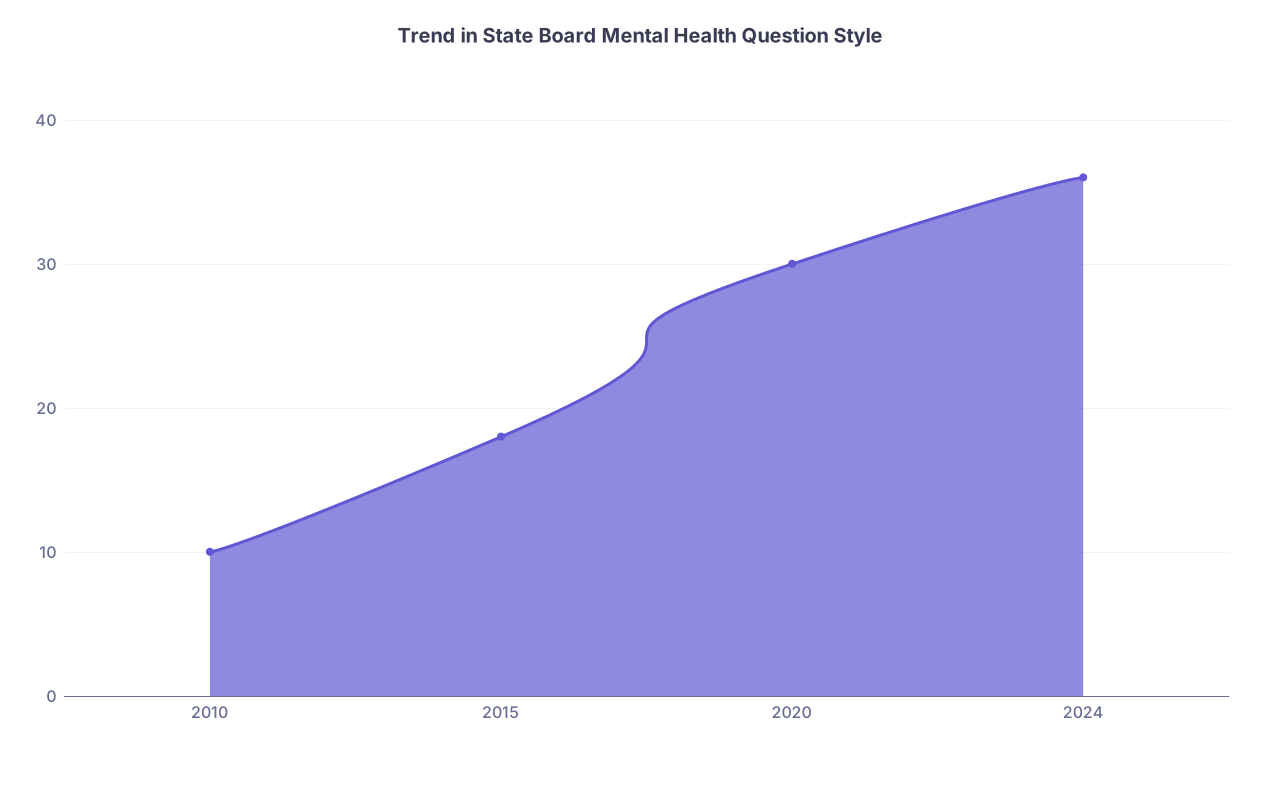
This whole area is in flux. But the trend line is clear: toward less intrusive, more impairment‑focused questions.
| Category | Value |
|---|---|
| 2010 | 10 |
| 2015 | 18 |
| 2020 | 30 |
| 2024 | 36 |
That chart is illustrative of a real pattern: more states have moved from “ever had a mental illness?” to questions about current impairment within a recent time frame.
Add in:
- Growing data on physician suicide
- Increased scrutiny from DOJ and advocacy groups
- And generational shifts in attitudes about mental health and disability
You’re going to see more boards quietly rewriting forms, tweaking wording, and trying to reduce legal risk. Not out of altruism. Out of fear of losing in court.
But until they catch up, you’re practicing in the messy middle — where old forms, new law, and entrenched stigma collide.
One More Thing: Don’t Let Licensing Fear Stop You From Getting Care
The most dangerous myth in this entire space isn’t about question wording. It’s this:
“To protect your license, stay away from mental health care or disability support.”
That’s backwards.
Boards crack down hardest on uncontrolled impairment that shows up in patient care, professionalism issues, or criminal behavior. Getting treatment, using accommodations appropriately, and maintaining stable function are your best defense — morally and practically.
If your strategy is “white‑knuckle everything, never disclose, never seek care,” you’re gambling your career and your patients on the hope that you never hit a breaking point. That’s not brave. It’s reckless.

| Step | Description |
|---|---|
| Step 1 | You have a condition |
| Step 2 | No current impairment |
| Step 3 | Current impairment |
| Step 4 | No disclosure required |
| Step 5 | Consider legal advice but answer truthfully |
| Step 6 | Seek treatment and workplace support |
| Step 7 | Disclosure required |
| Step 8 | Still at legal risk if practice unsafe |
| Step 9 | Does it impair safe practice now? |
| Step 10 | Does application ask about diagnosis history? |
| Step 11 | Application asks about current impairment? |
That’s the real decision tree. Not the folklore version.
The Short Version
Three things to walk away with:
- You’re not automatically required to disclose every disability or diagnosis to a licensing board. You’re required to answer the actual questions, truthfully, with the law (ADA) on your side regarding overbroad fishing expeditions.
- Licensing law is supposed to care about current impairment, not whether you’ve ever been disabled, depressed, or accommodated. Disability and impairment are not the same thing.
- Avoiding care out of licensing fear is a great way to become the exact impaired physician boards are right to act against. Stable, treated, supported clinicians — including disabled ones — are not the problem the law is designed to solve.