Most of what you’ve heard about disabled med students “routinely losing clinical placements” is exaggerated, outdated, or flat-out wrong.
The horror stories circulate on Reddit, in group chats, whispered in lecture halls: “If you disclose, they’ll fail you out.” “If you ask for accommodations on rotations, they’ll pull your placement.” “Programs don’t want liability, so they’ll just get rid of you.”
I hear versions of this every single year. And I also see the data. Those two do not match.
Let’s dismantle this properly.
The Big Myth: “Students Regularly Lose Placements Because of Disability”
Here’s the claim: if you have a disability or chronic illness and you disclose it, you’re at high risk of losing your clinical placement or being kicked out of rotations outright.
Reality: documented, disability-driven removal from clinical placements is uncommon, usually legally risky for schools, and when it does happen, it is almost never solely because of disability status. It’s about one of three things: safety, essential requirements, or performance that’s already tanking.
Is there discrimination? Yes. Is there quiet retaliation sometimes? Also yes. But the picture people paint online—a system gleefully dumping disabled students the second they ask for extra time or adaptive equipment—does not match what we actually see in the literature, court cases, or school policies.
Let’s ground this in what we do know.
What the Data Actually Shows
There’s no single national “lost placement due to disability” registry. So you need to look at several indirect sources: prevalence of disability, accommodation rates, attrition data, legal cases, and qualitative surveys.
How many med students are disabled?
The AAMC has been publishing real numbers for years now. Depending on the year and methodology:
- Around 4–6% of U.S. med students self-identify as having a disability.
- When you include psychological and learning disabilities, some schools report closer to 8–10% internally.
And yet you don’t see 8–10% of students being pulled out of rotations. Somehow all those disabled students quietly make it through, right?
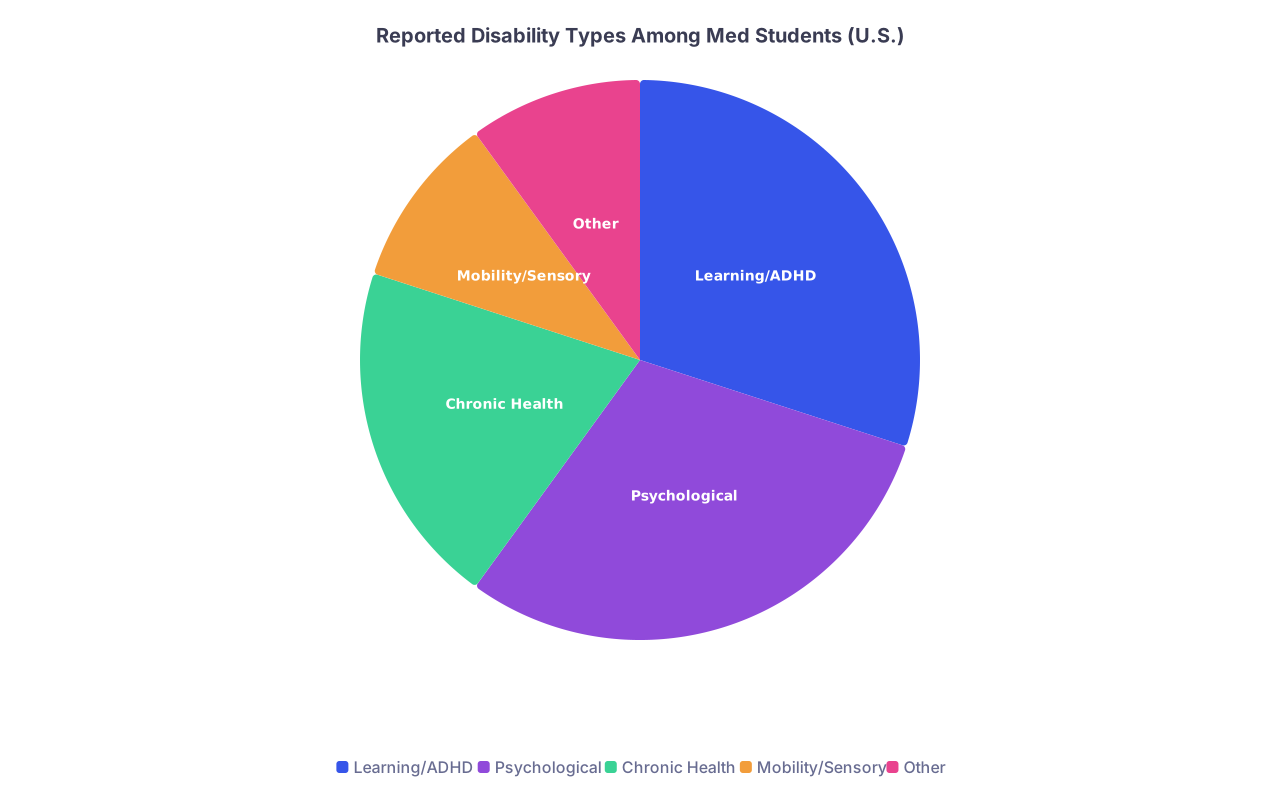
| Category | Value |
|---|---|
| Learning/ADHD | 30 |
| Psychological | 30 |
| Chronic Health | 20 |
| Mobility/Sensory | 10 |
| Other | 10 |
That pie isn’t from one exact study but it’s aligned with multiple institutional reports: the majority of “disabled med students” are not wheelchair users; they’re students with ADHD, depression/anxiety, or learning disabilities. These students are all over your classes and rotations—and most never lose placements.
What about attrition?
Med school attrition in the U.S. hovers around 3–5% total over four years at many schools. Most of that has nothing to do with disability status: academic failure, personal issues, career change, misconduct, etc.
Do disabled students leave at somewhat higher rates in some studies? Yes. But when you read those papers closely, the reasons are usually a nasty mix of:
- late or inadequate accommodations
- stigma and hostile culture
- mental health deterioration
- previously unaddressed learning issues that explode under stress
That’s not “you lost your placement because you’re disabled.” That’s systemic failure to support you.
Legal reality: why schools don’t casually pull placements
Any U.S. med school taking federal money (which is basically all of them) lives under:
- ADA (Americans with Disabilities Act)
- Section 504 of the Rehabilitation Act
Both explicitly prohibit discriminating against qualified students with disabilities and require reasonable accommodations unless they cause “undue burden” or fundamentally alter essential program requirements.
Translating the legalese: if you can meet the essential technical standards with reasonable support, they cannot legally boot you just because they’re uncomfortable.
When cases hit OCR (Office for Civil Rights) or court, schools get hammered for:
- Not engaging in an individualized assessment
- Refusing accommodations without real analysis
- Using stereotypes about disability instead of evidence
Which means administrators are acutely aware: “We withdrew this student from their rotation because of disability” is basically an invitation to a federal complaint.
Does that mean it never happens? No. But it means it’s not remotely common practice.
Where Do Students Actually Lose Placements?
Now we get to the nuance. There are scenarios where placements get pulled, and disability is tangled up in it. But the simplistic story—“they saw my cane, I was out”—usually has a lot more underneath.
1. Safety and essential functions
Hospitals have legitimate safety constraints. That part isn’t a myth.
If your disability means you:
- can’t safely perform essential tasks even with assistive tech or modification,
- or you’d put patients at risk in high-acuity areas,
then yes, certain placements or specific tasks might be limited or substituted.
Example I’ve seen: a student with uncontrolled seizures being restricted from unsupervised OR participation or working on ladders in the OR storeroom. That’s not discrimination; that’s basic risk management. What usually happens: they’re reassigned tasks or locations, not tossed out of clinical training entirely.
The key phrase there: with accommodations. Schools are expected to try reasonable changes first: adaptive tools, modified call schedules, accessible spaces, scribes, ergonomic equipment, assistive listening devices, etc.
2. Poor, already-documented performance
Another very common pattern: the student is already on thin ice academically or professionally. Remediation plans. Multiple professionalism write-ups. Barely passing shelves. Then the disability disclosure appears late, in crisis.
Faculty may frame the situation as “the student’s disability means they can’t do X,” but on paper the cause of withdrawal is performance or professionalism, not disability.
Is that sometimes weaponized? Absolutely. Students with ADHD or psychiatric diagnoses are more likely to be labeled “unprofessional” or “not committed” for the exact same behaviors (lateness, missed deadlines, emotional responses) that get others a quiet warning.
But from a pure numbers standpoint, the trigger documented in the file is usually performance—not “we found out they had a disability, so we removed them.”
3. Timing: last-minute or non-disclosed disabilities
Schools get especially skittish when a student:
- hides a disability until a catastrophic failure,
- or discloses only after serious incidents (med errors, repeated absences, unprofessional interactions).
Then the narrative in the dean’s office becomes: “Is this student safe? Can we trust their self-assessment?”
You and I both know why some students hide disabilities: the exact fear we’re talking about. But the later you disclose, the more likely it is that problems will be pinned on “the disability” instead of “we failed to accommodate you early enough.”
That still doesn’t mean “losing placements is common.” It means when students crash, their disability often becomes part of the story.
How Often Is Disability the Real Reason vs. the Excuse?
This is the uncomfortable part: many disabled students who lose placements never have the official reason listed as disability. On paper, it’s “failed to meet competency” or “unsafe practice.” In reality, they were never provided a fair shot with appropriate accommodations.
So you get two overlapping myths:
- The student myth: “If I disclose, they’ll yank my rotations.”
- The institutional myth: “We treat everyone the same, our standards are neutral.”
Both are false in their pure form.
Here’s the reality line:
- Most disabled students who get formal accommodations do not lose placements.
- Some disabled students are quietly pushed out via biased assessments, lack of support, or being held to unaccommodated standards.
- Very few are directly, explicitly removed “because of disability” in a way an administrator would ever admit in writing.
What the Policies and Technical Standards Actually Say
If you read technical standards documents (and I have, too many of them), you’ll notice a pattern: they used to be rigid “must be able to hear a patient across the room unaided, must be able to perform chest compressions solo, must stand for long periods…” nonsense.
That’s changing.
Now, more and more schools explicitly say that students may meet standards “with or without reasonable accommodation.” Some even include examples: using amplification, scribes, adaptive devices, step-stools, ergonomic modifications.
| School Type | Old Language Focus | Updated Language Focus |
|---|---|---|
| Older public med | Physical abilities | Functional tasks with aids |
| Newer DO program | “Unaided” sensory | “With or without accommodation” |
| Top research school | “Must perform CPR” | “Must ensure CPR is performed” |
| Mid-tier MD program | Long standing required | Allow seated participation |
When standards are written properly, disability alone is not a valid reason to deny or remove a placement—unless every reasonable accommodation still fails to let you meet those essential tasks.
And yes, there’s debate about what’s truly “essential.” But that’s where disability law and litigation tend to push schools toward: justify, in writing, why a specific function truly cannot be modified or delegated.
So What Actually Happens When You Disclose?
Not the fantasy, not the horror story. The common reality in 2020s med education:
- You disclose to disability services or student affairs, not directly to every attending on Earth.
- A formal assessment is done; documentation is reviewed.
- Accommodations are proposed. Some easy (extra time, note-taking), some tricky (modified call schedules, reduced overnight load, assistive devices in the OR).
- The school negotiates with clinical sites to implement, usually preferring not to make a fuss because they want compliance and legal safety.

| Step | Description |
|---|---|
| Step 1 | Student decides to disclose |
| Step 2 | Contact disability office |
| Step 3 | Submit documentation |
| Step 4 | Interactive meeting |
| Step 5 | Proposed accommodations |
| Step 6 | Discuss with clerkship directors |
| Step 7 | Implement on rotation |
| Step 8 | Monitor and adjust |
Where can it go wrong?
- A rogue clerkship director who thinks ADA is optional.
- Passive-aggressive attendings who “forget” your arrangements.
- Administrators who say certain things are “not reasonable” without real analysis.
But again, those typically show up as poor experiences, biased evaluations, or having to fight for your rights. Not as an epidemic of disabled students simply “losing placements.”
You want the blunt estimate? Among students with documented disabilities and formal accommodations, I’d expect well under 5–10% to ever face threatened or actual removal from a placement tied to disability issues. Probably lower at schools with mature disability infrastructure; higher at old-school places still stuck in 1985.
Why the Horror Stories Spread Anyway
If losing placements over disability is relatively rare, why does everyone think it’s guaranteed?
Because these stories are:
- Memorable – “I asked for a stool in the OR and they blocked me from surgery” sticks in your mind.
- Emotionally loaded – they tap into every med student’s fear of failure, shame, being singled out.
- Socially amplified – one or two bad cases per class become the legend (“remember that one M3 who got kicked off psych because of depression?”).
- Missing context – you rarely hear the backstory: years of unaddressed issues, professionalism concerns, missed requirements, or ongoing conflicts.
Meanwhile, the quiet reality—hundreds of students with ADHD, anxiety, hearing loss, chronic illness, mobility impairments rotating every day without drama—stays invisible. They’re not posting on Reddit about “nothing terrible happened this month.”
The Strategic Takeaway if You’re a Disabled Med Student
You’re not wrong to be cautious. Some programs are hostile, some individual faculty are discriminatory, and the system still has a long way to go.
But the idea that “disability = you will probably lose your placement” is simply not supported by the weight of what we see nationally.
What actually moves the needle in your favor:
- Early, documented engagement with disability services—before things explode.
- Making sure your accommodations are clearly tied to essential functions you need to perform.
- Keeping written records of requests, denials, and problems; this quietly keeps everyone more honest.
- Knowing your school’s technical standards inside out, and how they reference “with or without accommodations.”
- Being realistic about safety-sensitive tasks where your own risk is non-trivial (e.g., seizures, severe orthostatic intolerance).

You absolutely can be both disabled and a competent, safe clinician-in-training. The law, the data, and the daily reality in many teaching hospitals back that up.
The Future: Why This Will Get Less Risky, Not More
Here’s the piece almost no one talks about: the trend line is in your favor.
Several shifts are happening at once:
- More disclosure – as more students report disabilities, it becomes harder for schools to treat them as “rare exceptions” to weed out.
- More litigation and OCR complaints – which quietly scares institutions straight.
- Shift in technical standards toward functional, not purely physical, requirements.
- Greater focus on physician wellness and diversity, including disability as a diversity category.
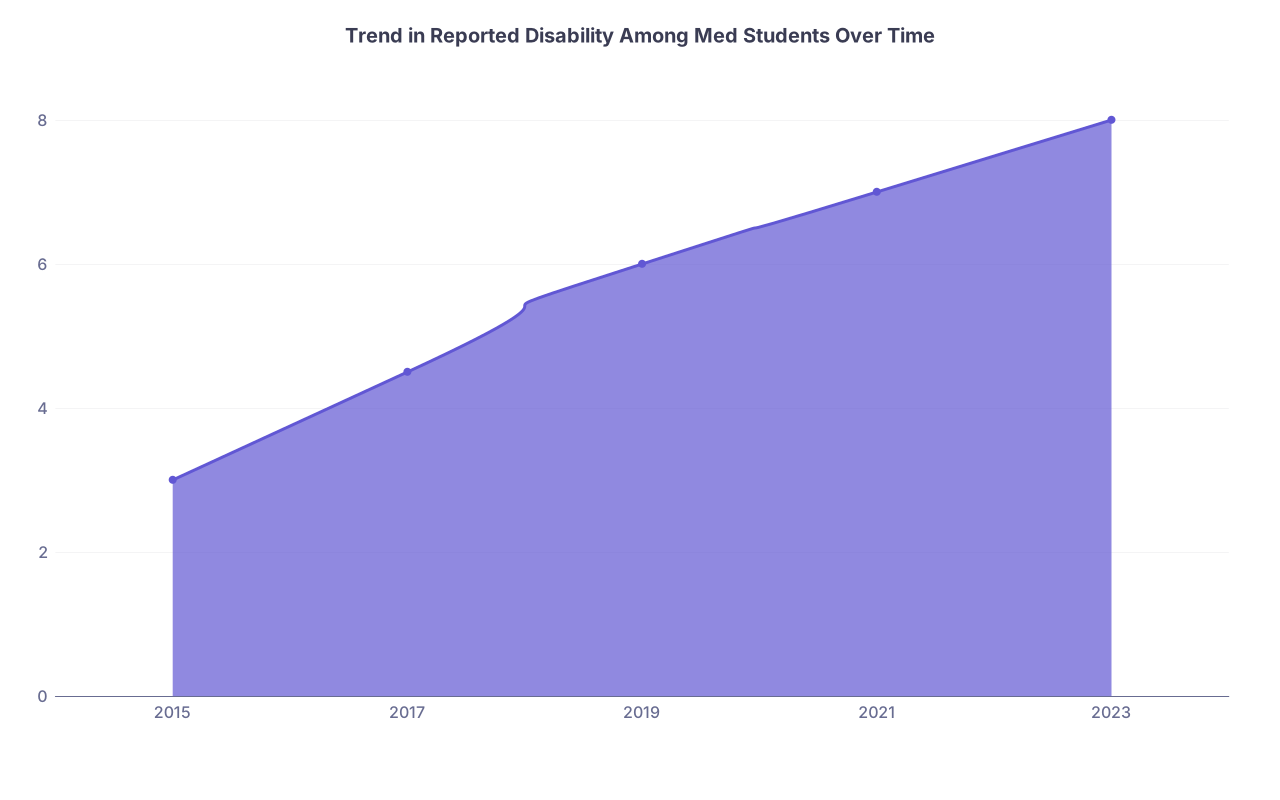
| Category | Value |
|---|---|
| 2015 | 3 |
| 2017 | 4.5 |
| 2019 | 6 |
| 2021 | 7 |
| 2023 | 8 |
That steady rise doesn’t mean med students suddenly got “sicker.” It means people are less afraid to report, and schools are being dragged—sometimes kicking and screaming—into modern disability practice.
Will there still be ugly cases? Yes. Will some students still be treated unfairly and pushed out under the guise of “performance”? Yes.
But the claim that disabled med students frequently lose their placements just for being disabled? That’s myth, not reality.
FAQs
1. Should I disclose my disability before starting clinical rotations, or wait?
If your disability will affect scheduling, stamina, or specific tasks (call, long standing, rapid note-writing), disclosing before rotations gives you leverage and legal clarity. Waiting until you’re already failing or in trouble massively weakens your position and makes it easier for the school to say the problem is “performance,” not lack of support.
2. Can a hospital site refuse to take me because of my disability?
They can push back, and some do. But if your school has determined you’re a qualified student with reasonable accommodations, the program is expected to work with sites or find alternative placements. Flat-out refusal purely based on disability risks both ADA and Section 504 problems. In practice, schools often negotiate modified duties, different units, or different sites rather than let a site simply blacklist you.
3. What if my preceptor ignores or undermines my accommodations?
Treat that as a structural problem, not a personal failing. Document dates, specific behaviors, and impacts. Then go straight to your clerkship director and/or disability office with concrete examples. “My attending ignores my note-taker accommodation and forces me to handwrite everything, causing pain and slower performance” is much harder to blow off than “they’re not being supportive.”
4. Do some specialties effectively shut out certain disabilities?
Some are absolutely more hostile or practically difficult—think surgical subspecialties with rigid physical expectations or heavy manual procedures. But even there, the question isn’t “Are you disabled?” It’s “Can you meet the essential functions with accommodations and safe delegation?” The assumption that disabled = automatically barred from procedural or acute specialties is lazy and often wrong. It’s case-by-case, and the barriers are as much cultural as they are physical.
Key points:
- Losing clinical placements solely because of disability is rare and legally risky for schools; most disabled students complete rotations successfully.
- When things go bad, it’s usually a combination of late disclosure, poor accommodations, biased professionalism judgments, and safety concerns—not just the label of disability.
- The trend in med education is toward more disclosure, better standards, and stronger legal pressure on schools, making it gradually safer—not more dangerous—for disabled students to claim the support they’re entitled to.