
The loudest opinions about ADHD and testing accommodations are wrong. And they’re usually coming from people who have never actually read an MCAT or USMLE technical manual.
Let me be blunt:
No, “everyone does not get extra time now.”
No, “ADHD kids aren’t just gaming the system.”
And no, testing accommodations do not magically turn a mediocre applicant into a 270 scorer.
You’re in the middle of a culture war where anecdotes beat data. Let’s flip that.
Myth 1: “ADHD accommodations are easy to get if you just say you’re anxious or distracted”
Reality: For high‑stakes exams like the MCAT, USMLE Step 1/2/3, and COMLEX, the bar for ADHD accommodations is deliberately high and getting higher.
I’ve seen students walk in saying, “My friend just said he has ADHD and got 50% extra time.” Then they see the actual requirements and their face drops.
Here’s what the major exam bodies typically want (yes, the details vary slightly, but the pattern is consistent):
- A formal diagnosis of ADHD by a qualified professional (not a five‑minute online quiz).
- A comprehensive evaluation report, often including:
- Developmental and educational history.
- Standardized cognitive testing.
- Standardized academic achievement testing.
- Self and observer rating scales.
- Documentation of functional impairment in testing or academic settings.
- History of accommodations in previous standardized testing or undergrad/med school (for many applicants, this is the killer).
A lot of bright, high‑achieving people with ADHD were never properly evaluated in childhood. They compensated. They overworked. They masked. So when they hit the MCAT or USMLE wall and finally seek accommodations, they meet a system that basically says:
“If you survived this long without formal documented accommodations, we’re skeptical you suddenly need them now.”
Is that scientifically sound? Not always. But it’s how the rules are written.
And when people talk about “everyone” getting extra time, they’re usually describing:
- College exams with disability offices that are much more flexible.
- Private tutoring or commercial tests where rules are looser.
- Their limited social circle, not actual population‑level data.
The real high‑stakes boards are closer to: “We will give you accommodations only after you prove beyond a doubt that we have no legal way out.”
Myth 2: “Accommodations give ADHD students an unfair advantage”
This is the favorite myth of the guy who scored a 250 and is very proud of how “raw” his numbers are.
The research on this is boringly consistent: accommodations like extra time tend to reduce the disadvantage, not create a massive advantage.
Let’s look at what data we actually have.
For ADHD and learning disorders, studies on college and graduate admissions tests (GRE, SAT, etc.) show:
- Students with documented disabilities who receive extra time still perform, on average, lower or similar to non‑disabled peers.
- The score gap between disabled and non‑disabled students may narrow with accommodations, but it typically does not reverse.
That’s the key point people miss: if extra time were a magic cheat code, you’d see students with ADHD suddenly outperforming everyone. You don’t.
On high‑stakes medical exams, the testing bodies are very careful. They know they’re under legal microscopes. They’ve run internal psychometric analyses on accommodated vs non‑accommodated groups. If accommodations were wildly inflating scores beyond ability, they’d be pulling those options back hard. Instead, what you mostly see is:
- Tighter rules.
- More documentation.
- Longer processing times.
Not “we regret ever allowing extra time because scores shot through the roof.”
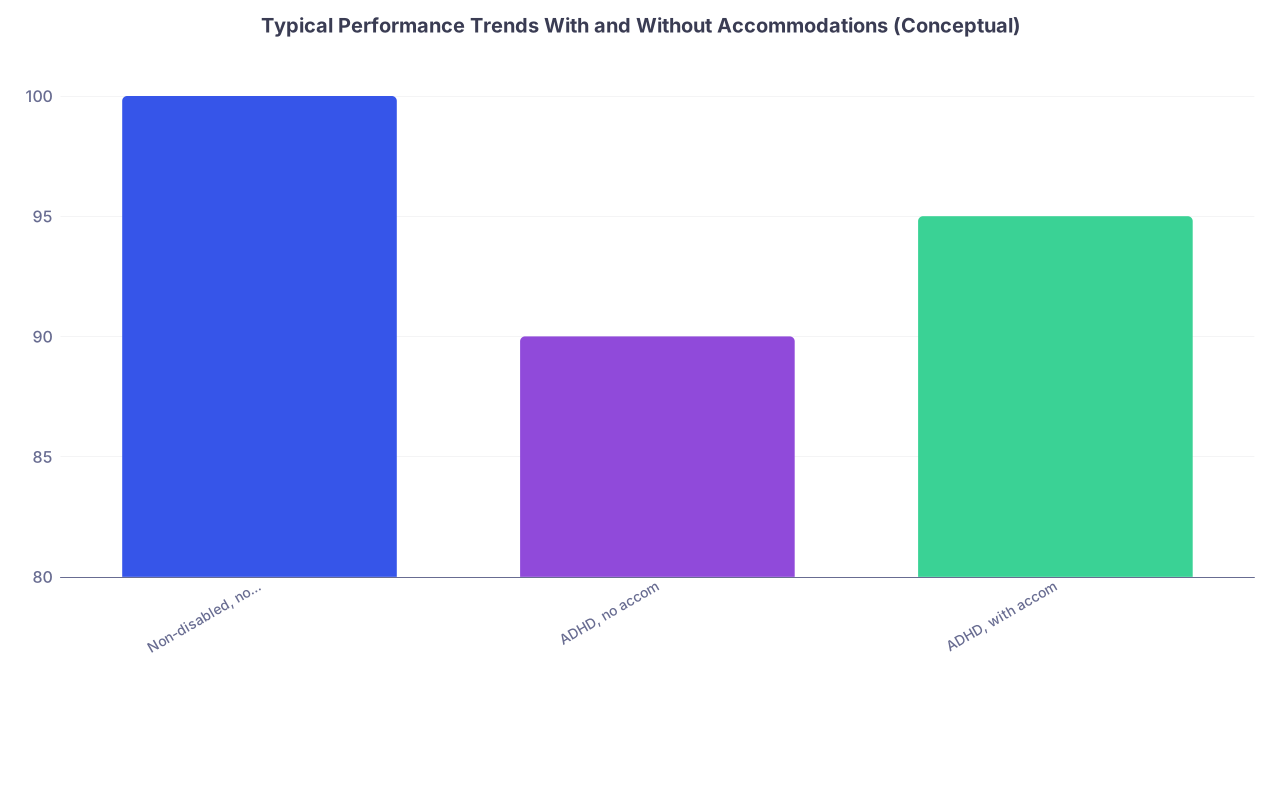
Let’s visualize what actually tends to happen conceptually:
| Category | Value |
|---|---|
| Non-disabled, no accom | 100 |
| ADHD, no accom | 90 |
| ADHD, with accom | 95 |
No, these are not specific USMLE or MCAT numbers. They’re the consistent pattern:
- ADHD without accommodations underperforms.
- ADHD with properly matched accommodations still doesn’t leapfrog the typical non‑disabled group.
Accommodations align the test format with someone’s neurological reality, so the test measures what it claims to measure: medical knowledge and reasoning, not how well you can white‑knuckle your way through attentional bottlenecks under punishing time pressure.
If your central belief is “a good doctor is the one who can read vignettes the fastest,” you’ve fundamentally misunderstood both medicine and psychometrics.
Myth 3: “If you really needed accommodations, you would’ve had them since grade school”
This one punishes exactly the people the system has failed the longest.
The reality of ADHD diagnosis in high‑achieving students:
- A lot of them are missed in childhood, especially:
- Women.
- People of color.
- Quiet, “daydreamy,” non‑disruptive kids.
- Many develop elaborate coping strategies:
- Hyper‑focusing last minute.
- Overstudying to compensate for reading inefficiency.
- Relying on parents for structure and planning.
Then they hit:
- MCAT: massive volume, complex passages, strict timing.
- USMLE: dense vignettes, full‑day testing, minimal breaks.
Suddenly, the wheels come off. Not because their ADHD “got worse,” but because the scaffolding they used to survive no longer works.
Testing agencies, however, live in a legal world, not a nuanced developmental-psychiatry world. They’re obsessed with “consistency of accommodations history.” If you never got extended time on the SAT, ACT, AP exams, or college finals, they treat late‑breaking requests as suspicious.
Is that sometimes protecting against fraud? Yes.
Does it also hurt a ton of legitimately disabled students who grew up in under‑resourced schools, immigrant families, cultures that dismiss mental health, or just had pediatricians who missed it? Also yes.
The testing agencies know this criticism. Their public stance is “we consider all evidence, including recent diagnoses.” Their actual behavior heavily favors long‑documented cases starting early in life.
So the myth “if you really needed it, you’d have had it” isn’t just wrong. It’s backwards. The people most in need are often exactly the ones least likely to have prior accommodations.
Myth 4: “MCAT/USMLE are modern; they must be ADHD‑friendly by design”
No. They’re mildly less brutal than they were 20 years ago. That’s a low bar.
The MCAT and USMLE are optimized for:
- Psychometric reliability.
- Predictive validity (do scores correlate with some measure of future performance).
- Standardization across massive populations.
They are not optimized for:
- How an ADHD brain processes written information.
- How working memory and sustained attention fluctuate over 7–8 hours.
- The cognitive cost of constant vigilance against distraction.
Look at what these tests demand:
- Rapid reading and integration of dense, decontextualized text.
- Constant set‑shifting between concepts and disciplines.
- Endurance across long, high‑pressure sessions with limited breaks.
That’s a near‑perfect stress test of the weakest domains in untreated ADHD.
Are there slight nods to accessibility? Sure:
- Better break structures than in the 1990s.
- Some interface improvements.
- Ear plugs, adjustable screens, etc.
But the default format is still heavily punitive to slower readers, people with variable attention, and those whose anxiety and ADHD interact.
This is why the most common accommodation request for ADHD is extended time. Not because people love being in the test center longer, but because that’s the only lever the test designers offer that partially offsets the timing‑based penalty baked into the format.
Myth 5: “If you get extra time, your score report is flagged and programs will judge you”
MCAT: AAMC does not currently flag accommodated scores to schools.
USMLE: The NBME/USMLE no longer routinely flags many categories of accommodations on score reports to licensing boards and residency programs (they used to be more aggressive about this historically).
The trend in high‑stakes testing over the last decade: move away from flagging accommodated scores, because it invites discrimination and runs straight into disability law problems.
Do some program directors privately sneer at the idea of accommodations? Sure. I’ve heard the comments:
- “If they needed extra time for Step 1, how will they handle the ICU?”
- “Real medicine doesn’t come with accommodations.”
That’s bias, not evidence.
Outcomes data from residency performance isn’t neatly stratified by “had accommodations vs didn’t.” But if accommodated test‑takers were systematically melting down in residency at high rates, you’d see far more open backlash and policy change. You don’t. What you see instead is a slow, grudging expansion of disability services within GME.
So no, your MCAT/USMLE score report is not a scarlet letter screaming “this person got extra time.” The bigger risk is actually not asking for accommodations, underperforming, and then trying to dig out of a 15–20 point score deficit on the MCAT or a barely‑passing Step 1.
Myth 6: “Testing accommodations will fix my ADHD performance problems”
Here’s the uncomfortable truth: accommodations are a partial solution, not a cure.
I’ve seen this pattern too many times:
- Student gets 50% extra time and a separate room.
- They expect a 20‑point MCAT jump or a 30‑40 point USMLE boost.
- Their score moves a little. Or barely.
Why? Because extended time helps exactly what it targets:
- Slower reading speed.
- Need for more re‑reads.
- Extra processing time for complex passages.
It does not automatically fix:
- Poor content knowledge.
- Weak question interpretation skills.
- Terrible test‑day routines and sleep.
- Inadequate spaced repetition or practice test strategy.
- Co‑occurring anxiety or depression that isn’t treated.
A lot of ADHD‑related impairments show up in the months before test day:
- Inconsistent studying.
- Difficulty with long‑term planning.
- Underestimating how much time it takes to finish resources.
- Burning out with last‑minute cramming.
Extra time on test day doesn’t undo bad prep. It just gives your brain a little more oxygen while it works with what you brought.
Here’s the healthy way to think about it:
Accommodations are infrastructure, not performance enhancers. They remove some artificial obstacles so that your true preparation level has a chance to show up.
Myth 7: “It’s unethical to pursue ADHD testing just to get accommodations for MCAT/USMLE”
What’s actually unethical is pretending the ADHD diagnosis rates in high‑achieving students are accurate when we know underdiagnosis is rampant.
Yes, there are people who exaggerate symptoms hoping for a performance edge. Psychologists know this. That’s why neuropsychological evaluations include:
- Validity scales.
- Inconsistency checks.
- Performance patterns that don’t match genuine ADHD profiles.
Diagnosticians are not idiots. They see patients all day. They can tell when someone’s “ADHD” story appeared out of nowhere two months before Step 1 with zero life‑span consistency.
But there’s another group:
Students who’ve quietly struggled their entire lives, finally hit a wall preparing for MCAT/USMLE, google “why is this so much harder for me,” and recognize themselves in ADHD literature for the first time.
Is it “convenient” that this happens near a big exam? Yes.
Is it also when stress and demands get high enough that hidden ADHD becomes undeniable? Also yes.
Getting a real evaluation:
- Clarifies whether you’re actually dealing with ADHD vs anxiety, depression, sleep disorders, or something else.
- Guides treatment (medication, coaching, CBT).
- Helps you understand lifelong patterns instead of just “I guess I’m lazy.”
If your primary goal is only a time‑and‑a‑half test, that’s a problem. If your goal is accurate diagnosis and management, and accommodations are one downstream implication, that’s not cheating. That’s accessing your rights.
Practical Reality: What ADHD and accommodations actually look like on MCAT/USMLE
Let’s ground this in what tends to happen, not what people rant about on Reddit.
| Exam | Common ADHD Accommodations | Reality of Approval |
|---|---|---|
| MCAT | Extra time, extra breaks, separate room | Strict documentation; long review times |
| Step 1 | Extra time, separate room, extra breaks | Often denied if no prior history |
| Step 2 CK | Similar to Step 1 | Slightly easier if already had Step 1 accom |
| COMLEX | Extra time, separate room | Highly variable; school support matters a lot |
Common patterns I’ve watched play out:
Students with longstanding documented ADHD and years of accommodations in school:
Good odds of getting some combination of extra time and/or separate room.Students with new diagnosis, no prior documented testing accommodations, but clear impairment on a solid evaluation:
Mixed. Some get partial accommodations. Some get denied and need to appeal (and appeals are slow).Students who scribble a one‑page letter from a PCP saying “patient has ADHD; recommend extra time”:
Almost guaranteed denial.
Timeline wise, accommodation processes are glacial. Six months lead time is not excessive. A year is safer. People who start the process 6–8 weeks before their planned exam date often end up delaying the exam or testing without accommodations.
The Future: Where this probably goes next
Despite the noise, the trend line is fairly clear:
- Legal pressure against discrimination is not going away.
- Awareness of adult ADHD, especially in high performers, is increasing.
- Med schools and residencies are slowly (painfully slowly) building disability infrastructure.
We’ll likely see:
- Slightly more standardized, transparent criteria for ADHD accommodations across major exams.
- Better recognition that late‑diagnosed ADHD is real and not automatically fraudulent.
- More focus on what matters for patient care: clinical reasoning, reliability, communication, not raw vignette reading speed.

| Step | Description |
|---|---|
| Step 1 | Struggling with test prep |
| Step 2 | Seek evaluation |
| Step 3 | Consider other causes |
| Step 4 | Comprehensive report |
| Step 5 | Submit accommodations request |
| Step 6 | Appeal or adjust plan |
| Step 7 | Test with accommodations |
| Step 8 | Formal ADHD diagnosis |
| Step 9 | Approved? |
Will we ever reach a point where the MCAT and USMLE are fully “neurodiversity‑informed” in design? Doubtful. Too much institutional inertia. Too many lawyers. But the direction of change is away from overt punishment and quiet blacklisting, and toward grudging accommodation.
Bottom line
Strip away the myths and what’s left is pretty simple:
- ADHD accommodations on the MCAT/USMLE are hard to get, tightly regulated, and designed to level the field, not hand out free points.
- Lack of childhood accommodations does not mean your ADHD is fake; it usually means the system missed you.
- Extra time and other supports correct a structural mismatch between the test and your brain—they do not replace solid content knowledge, good prep, or clinical ability.
Ignore the moral panic. Respect the data. And if your brain has been running uphill in mud for years, you’re not “cheating” by asking someone to finally fix the grade on the slope.